June 24

Who was the subject of an advertisement in a colonial American newspaper 250 years ago today?
Jun 24 - 6:24:1767 Georgia Gazette
Georgia Gazette (June 24, 1767).

“TO BE SOLD, A YOUNG, HEALTHY, and HANDY, NEGROE WENCH.”

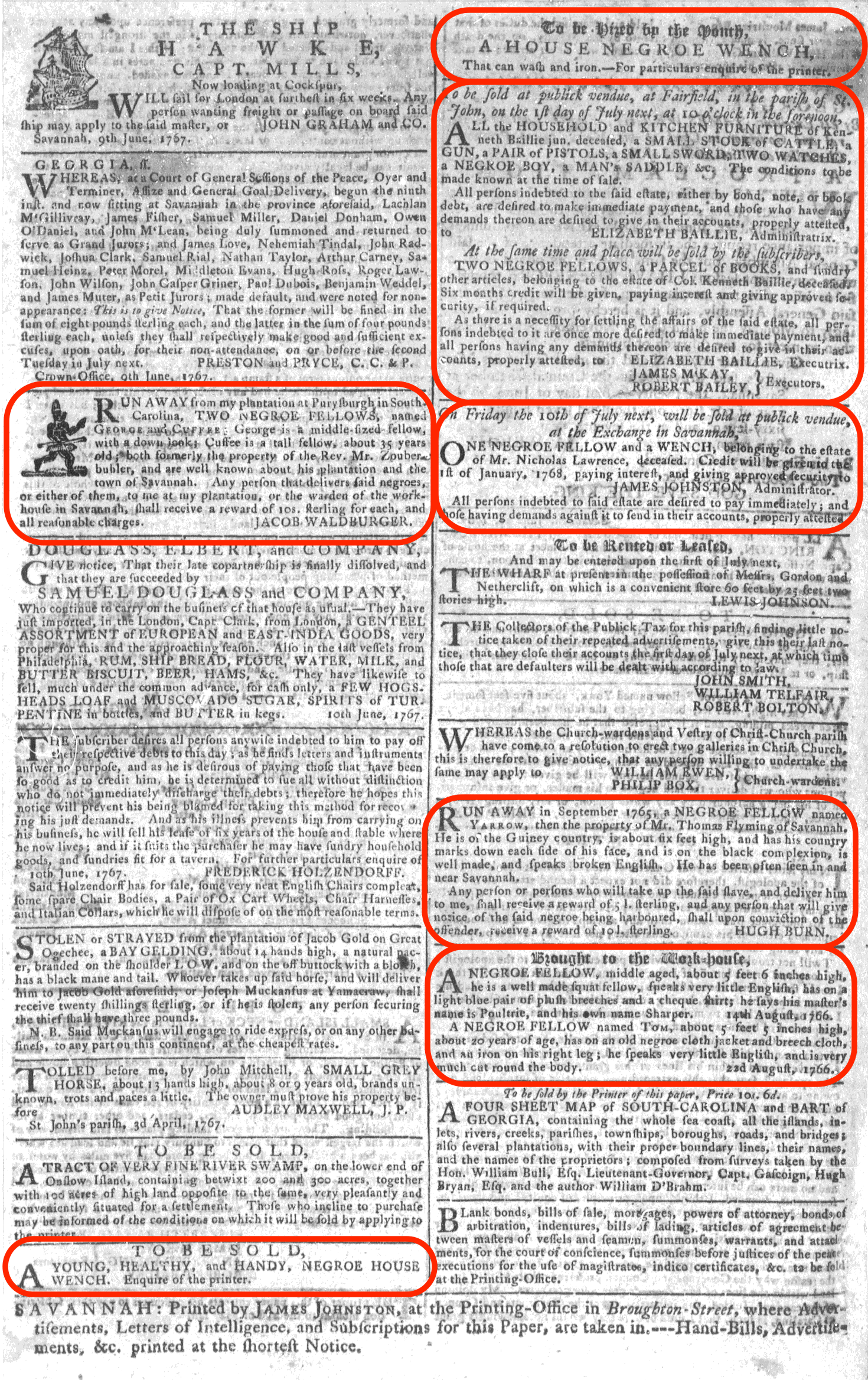
Nine advertisements about enslaved men and women appeared in the June 24, 1767, edition of the Georgia Gazette. Four of them offered slaves for sale. Another sought not to sell an enslaved woman outright but instead to hire her out by the month. Readers could rent her services – washing and ironing – for less than purchasing a slave. The slaveholder continued to generate a return on an investment in human property. Three other advertisements warned against runaways and offered rewards for their capture and return. The final advertisement identified two runaways that had been captured and “Brought to the Work-house, ” where they were being held until their masters collected them.

As the image above demonstrates, seven of those advertisements ran on the final page of the issue. They accounted for approximately half of the content printed on the page. The other two notices similarly accounted for half of the space allotted to advertising elsewhere in the issue. This underscores that advertisements concerning slaves provided a firm foundation for other sorts of advertising in the Georgia Gazette. Revenues from these advertisements contributed to the continuation of the newspaper.

Most of these advertisements focused exclusively on slaves, especially those for runaways and captured fugitives. On the other hand, some that advertised slaves for sale did so in the midst of attempting to make other sales as well. For instance, one notice for an estate sale listed “HOUSEHOLD and KITCHEN FURNITURE” and “a SMALL STOCK of CATTLE, a GUN, a PAIR of PISTOLS, a SMALLSWORD, TWO WATCHES, a NEGROE BOY, a MAN’s SADDLE, &c.” The same advertisement also listed “TWO NEGROE FELLOWS, a PARCEL of BOOKS, and sundry other articles.” Undifferentiated from other possessions, the presence of slaves among an estate inventory soon to be auctioned further demonstrates that eighteenth-century consumer culture (and the print culture that bolstered it) operated firmly within a system that relied on the productive labor of enslaved men, women, and children and the ability to buy and sell them as easily as any other commodities.

May 20

Who was the subject of an advertisement in a colonial American newspaper 250 years ago today?

May 20 - 5:20:1767 Georgia Gazette
Georgia Gazette (May 20, 1767).

“RUN AWAY … a MUSTEE WENCH.”

Jenny, an enslaved woman, made her escape, prompting Archibald Bulloch to place an advertisement in the Georgia Gazette. He offered a reward to “Whoever apprehends and delivers the said wench to me in Savannah.” To help readers identify Jenny, Bulloch described her as a “MUSTEE WENCH,” mobilizing one of the many categories for describing both the physical appearance and heritage of mixed race men, women, and children in the early modern Atlantic world.

Mustee, now chiefly an historical term according to the Oxford English Dictionary, specifically means “a person with one white-skinned parent and the other one-quarter black.” In other words, Jenny may have been one-eighth black, presumably fairly light-skinned, as the result of having one African great-grandparent. However, the OED also indicates that mustee sometimes also referred to “a person of mixed European and African descent” and, even more generally, “a person of mixed racial descent” (including indigenous Americans as well as Africans). Mustee was likely a shortened form of mestizo arising from non-standardized spellings. That being the case, Bulloch may not have intended to be any more descriptive than simply indicating that Jenny had a mixed racial heritage.

Whatever the case, Bulloch mobilized print culture to put black bodies on display. By advertising Jenny and describing her as a “MUSTEE WENCH,” he encouraged readers to engage in surveillance of all black women they encountered, to carefully examine their physical characteristics to assess whether they might be the runaway. This advertisement called attention not only to Jenny; it cast suspicion on all black women, the reward offering added incentive to take note of their bodies.

May 20 - 11:4:1732 South Carolina Gazette
South Carolina Gazette (November 4, 1732).

Research note: I consulted the Oxford English Dictionary for an authoritative definition and etymology of mustee. Among its historical sources, the OED included a runaway slave advertisement published in the South Carolina Gazette in 1732.

April 18

GUEST CURATOR: Jonathan Bisceglia

Who was the subject of an advertisement in a colonial American newspaper 250 years ago today?

Apr 18 - 4:18:1767 Providence Gazette
Providence Gazette (April 18, 1767).

“A Negro Woman who understands all Sorts of houshold Work.”

I chose this advertisement because slavery in northern colonies and states is often overlooked when discussing slavery in American history. For the most part, slavery and the slave trade in the southern colonies get more attention. However, slavery was not only used in the northern colonies (see the census from 1774) but Rhode Island was also a hub for the slave trade. According to historians at the John Carter Brown Library, “Not only did Rhode Islanders have slaves—they had more per capita than any other New England state—but also entered with gusto into the trade.” Rhode Islanders gained so many profits from slavery that “[b]y the close of the eighteenth century, Rhode Islanders had mounted at least a thousand voyages from Africa to the Americas.” Voyages like these not only kept the institution of slavery going but encouraged it. I found this advertisement quite surprising, learning that slavery was so important so close to home.

Apr 18 - Census
Rhode Island Census for 1774 (Newport: Solomon Southwick, 1774). Courtesy John Carter Brown Library.

**********

ADDITIONAL COMMENTARY: Carl Robert Keyes

Recovering the lives of enslaved men, women, and children can be an extremely difficult task. Historians consult many different kinds of sources in their efforts to reconstruct the experiences of slaves, including advertisements like the one Jonathan selected to feature today. That advertisement offers frustratingly few details, but it does reveal the presence of an enslaved woman in Rhode Island. It includes her approximate age and suggests the type of labor she performed for her master, “all Sorts of houshold Work.” The advertisement does not, however, include the enslaved woman’s name nor the name of the slaveholder who wished to sell her. The conditions of the sale were camouflaged by instructions to interested parties: “For further Particulars enquire at the Printing-Office.” This advertisement appeared immediately below another one that revealed the presence of slavery in Rhode Island but advanced few details: “TO BE SOLD, A Likely, healthy Negro Boy, about Fifteen Years old, fit for either Town or Country, having been used to Farming Business.” It also concluded with instructions to “enquire at the Printing-Office in Providence.” Such advertisements aid historians in making generalizations about the experiences of enslaved men, women, and children, even in the absence of enough evidence to sketch more complete biographies.

On the other hand, other sorts of advertisements for slaves tell much more complete stories about their subjects. Advertisements for runaways frequently incorporated extensive descriptions of enslaved men, women, and children, from their physical appearance to their clothing to any goods they carried off. They elaborated on their ethnicity and the languages they spoke. They specified any special skills runaways possessed or trades they practiced. They revealed relationships within slave communities and among others, black and white, that might attempt to aid runaways. In some cases, they even told stories of previous attempts to abscond. Although written by white masters attempting to regain their human property, some scholars consider advertisements for runaways to be the first slave narratives. It would be difficult to deny the agency exhibited by slaves who chose to flee from those who kept them in bondage.

March 31

GUEST CURATOR: Evan Sutherland

Who was the subject of an advertisement in a colonial American newspaper 250 years ago today?

Mar 31 - 3:31:1767 South-Carolina Gazette and Country Journal
South-Carolina Gazette and Country Journal (March 31, 1767).

“RUN-AWAY … a likely black fellow.”

Slavery was common in colonial and Revolutionary America. Slaves were first brought over in 1619 to aid in the production of crops like tobacco. Slaves were cheaper and more plentiful than indentured servants; many colonists took advantage of this. Slavery was harsh and cruel: slaves were beaten for misbehaving. This pushed many slaves to become runaways. Slave owners used newspapers to advertise their missing slaves, and offered rewards for finding them. Many of the advertisements were accurately descriptive of the runaways. Many slaves who ran away stole supplies, especially clothing and food, but sometimes even horses and boats. Today I am examining one example of a runaway slave advertisement that appeared in the South-Carolina Gazette and Country Journal. This particular advertisement said that the slave had a wife, and was “well known in town and country.” People were given rewards for returning slaves to their masters. Some slaves that were returned to their masters received harsh punishments, such as whippings and beatings.

**********

ADDITIONAL COMMENTARY: Carl Robert Keyes

Some scholars consider runaway advertisements the first slave narratives. Although written by masters attempting to regain their human property, runaway advertisements reveal aspects of the lives of their subjects that otherwise likely would remain hidden and forgotten through time. Still, they usually lack critical details and only provide outlines of much more complicated stories.

Today’s advertisement, for instance, sought the return of a “likely black fellow, formerly belonging to James St. John’s estate.” In naming the former master but not the enslaved man who ran away, Elizabeth Beatty deprived “the said Negro” of an important part of his identity even as she implicitly recognized the agency he exercised by absconding. Perhaps Beatty believed that she otherwise so adequately described the “likely black fellow” that according him a name was not necessary for readers to identify him. After all, he was “well known in town and country,” making it possible that local residents needed only a cursory description. If the unnamed slave had already demonstrated a propensity for running away that may have rendered additional details unnecessary for neighbors familiar with his misbehavior. If that was the case, Beatty may have placed this advertisement as an announcement for readers to be on the lookout for a repeat offender who was known for visiting “Mr. Lance’s plantation in Goose-creek.” Like so many other runaway advertisements, this one only hinted at the much more extensive narrative of the subject’s life.

That life apparently included a wife, a detail that humanized “the said Negro” despite the intention of the advertisement to treat him merely as a piece of property to be recovered. This detail revealed that enslaved men and women developed relationships and personal lives despite their captivity. They established bonds with others despite their bondage, no matter how diligently or aggressively their masters worked to regulate and surveil their lives. That the “likely black fellow … may be harboured” at Lance’s plantation suggested a conspiracy that included slaves other than just his wife, a community engaged in acts of resistance in support of the runaway’s initial act of resistance.

Elizabeth Beatty published this advertisement in hopes of having human property returned “to the Warden of the Workhouse.” An alternate reading, however, allows us to recover important elements of the experiences of enslaved people in the colonial and Revolutionary eras.

March 4

GUEST CURATOR: Samuel Birney

Who was the subject of an advertisement in a colonial American newspaper 250 years ago today?

mar-4-341767-georgia-gazette
Georgia Gazette (March 4, 1767).

“Five Pounds Sterling Reward. RUN AWAY … NEGROE MAN, named DAVID.”

This advertisement for a runaway slave named David provides a brief description of his appearance, including special features like the holes in his ears and the blanket, hat, and pair of “cheque trowsers, and an old cheque shirt” he took when he escaped. Slaves’ appearance was crucial to advertisements seeking their capture because clothing was one of the most important means of identifying people in the colonial and Revolutionary periods. Runaway slaves attempted to disguise themselves through altering or changing their clothes when possible.

Charmaine A. Nelson recently discussed the use of clothing in runaway slave advertisements. The amount of control slaves had over their appearance varied, and while David may not have had much choice in the clothes he possessed he still could have attempted to change his appearance after escaping his master. Nelson draws attention to David Waldstreicher’s arguments regarding the importance of describing slaves’ appearance and clothing in runaway advertisements, along with “trades or skills, linguistic ability or usage, and ethnic or racial identity.” Nelson also focuses on the case of a runaway woman named Cash, whose description included clothes she owned and that she presumably produced.

It’s depressing to realize that at a time when ideas of liberty and democracy were taking root in the American consciousness, people were also callously trampling on other humans’ attempts to gain freedom and prosperity.

For more information see “Cash’s Bundle: Fugitive Slave Advertisements, Clothing, and Self-Care” at The Junto.

**********

ADDITIONAL COMMENTARY: Carl Robert Keyes

Thomas Lee’s notice offering a reward for David included all four of the most common types of descriptions in runaway advertisements identified by David Waldstreicher.[1] Sam has already investigated the clothing David took with him. Lee also implicitly remarked on David’s trade or skills when he mentioned that the enslaved man fled “from the subscriber’s brick-yard.” He explicitly incorporated linguistic ability (“can speak no English”) and ethnic identity (“of the Gambia country”). This notice was one of nineteen runaway advertisements printed in newspapers throughout the colonies during the week of February 26 through March 4, 1767. Most deployed some or all of these common means of describing runaways.

From the clothes that David wore to his height to the “large hole in each year,” Lee provided means for identifying the fugitive slave according to his physical features, but doing so required surveillance by readers of the Georgia Gazette. In order for runaway advertisements to be effective, colonists needed to scrutinize black bodies – carefully, actively, and constantly. Using text rather than images, runaway advertisements put the bodies of Africans and African Americans on display in the pages of newspapers, but this effect was not limited to print. Such advertisements demanded that readers take special notice of any and all black people they encountered, especially any not previously familiar to them. Such advertisements required close inspection of black bodies as readers compared published descriptions to the flesh-and-blood people who stood before them. As a result, runaway advertisements targeted specific individuals, but they potentially affected all black people subject to being sized up by readers on the lookout for fugitives.

Readers of the Georgia Gazette grappled with only one runaway advertisement in the March 4, 1767, issue. However, other runaway advertisements had appeared recently in previous issues, including one for Maria that ran for six months. Such descriptions would have become very familiar to readers who encountered them week after week. Often multiple runaway advertisements appeared in any given issue of the Georgia Gazette. As a result, readers could mentally conjure up an assortment of mental images of various runaways whenever they encountered unfamiliar Africans and African Americans. Print furthered the display and examination of black bodies in colonial and Revolutionary America.

**********

[1] David Waldstreicher, “Reading the Runaways: Self-Fashioning, Print Culture, and Confidence in Slavery in the Eighteenth-Century Mid-Atlantic,” William and Mary Quarterly 56, no. 2 (April 1999): 248.

February 11

Who was the subject of an advertisement in a colonial American newspaper 250 years ago today?

feb-11-georgia-gazette-slavery-2
Georgia Gazette (February 11, 1767).

“RUN AWAY … NEGROE GIRL, named MARIA, about 15 years of age.”

This advertisement about a “TALL SLIM LIKELY YOUNG NEGROE GIRL, named MARIA” who ran away from her master would have been very familiar to readers of the Georgia Gazette. Dated August 5, 1766, it first appeared in the August 6, 1766, issue. It then appeared in almost every issue published for the next six months; the February 11, 1767, issue marked half a year that Donald Mackay inserted this runaway notice in the newspaper published in Savannah.

The longevity of this advertisement may be interpreted in more than one way. It might testify to the value that Mackay placed on Maria or how intensely he chafed for her return. As I noted when I first examined this advertisement last August, the physical description of Maria suggested that Mackay valued the “TALL SLIM LIKELY YOUNG NEGRO GIRL” for more than just her capacity to labor in the household or the fields. The expenses incurred by placing an advertisement for her return almost every week for six months (plus an award and reimbursement for “al reasonable charges” associated with Maria’s capture and transport) indicated that Mackay was willing to make a significant investment in reclaiming his human property. Maria’s potential resale value possibly more than justified such expenses.

That line of reasoning, however, assumes that Mackay instructed James Johnston, printer of the Georgia Gazette, to insert this advertisement each week and that he agreed to pay for each appearance. Like other newspapers published in smaller cities, such as the Providence Gazette, the [Portsmouth] New-Hampshire Gazette, and the [Hartford] Connecticut Courant, the Georgia Gazette featured significantly fewer advertisements than newspapers in the major urban ports. That the advertisement for the runaway Maria consistently appeared for six months may have been a function of the printer seeking to fill the pages with any sort of content, especially considering how many other advertisements in the Georgia Gazette ran for extended periods, often much longer than similar notices in newspapers published elsewhere.

Perhaps the real story combines elements of these two possibilities. Maybe Donald Mackay was so eager to have Maria returned and James Johnston was so eager to fill the columns in his newspaper that they worked out a payment schedule that included discounted rates. Whatever the circumstances, the frequency that this and other advertisements appeared in the Georgia Gazette raises suspicions that not all notices were indeed paid notices.

December 12

Who was the subject of an advertisement in a colonial American newspaper 250 years ago today?

dec-12-12121766-south-carolina-and-american-general-gazette
South-Carolina and American General Gazette (December 12, 1766).

“RAN AWAY … NERO … many scars about his head.”

Woodcuts frequently accompanied advertisements offering slaves for sale or warning about runaway slaves. As a result, images of Africans and African Americans appeared in newspapers regularly, in contrast to white colonists who were rarely illustrated with visual images. These woodcuts did not depict particular enslaved men, women, or children. Instead, they were stock devices used interchangeably, erasing the individuality of any of the slaves they purported to represent. Significantly, images of black bodies appeared in eighteenth-century newspapers at all because Africans and African Americans were marketed as commodities, just as the multitude of woodcuts depicting ships represented imported goods.

Last week I discovered that I have access to digitized copies of the South-Carolina and American General Gazette, a newspaper not previously incorporated into the Adverts 250 Project. As a result, today I chose to feature an advertisement from that newspaper rather than one either of the other two published 250 years ago today. Both the New-London Gazette and, especially, the New-Hampshire Gazette have contributed a good number of advertisements to this project over the past year. Featuring an advertisement from the South-Carolina and American General Gazette not only increases the number of newspaper included in this project, it also further augments the geographic scope of the project, bringing the number of newspapers printed in Charleston, South Carolina, in 1766 that have since been digitized to three. This rivals Boston with four, New York with three, and Philadelphia with two.

As I perused the December 12, 1766, edition of the South-Carolina and American General Gazette to make my selection for today, I was drawn to this runaway slave advertisement because of the woodcut. This is not the first time that I have examined a woodcut depicting a slave, but this one had an interesting aspect that was not part of similar woodcuts in other newspapers. The torso of the escaped slave was emblazoned with a capital “R,” presumably for “runaway.” The imaginary slave’s body was marked, almost as if it had been branded, while the actual slave – Nero, a sawyer and woodcutter – was also marked with “many scars about his head.” Advertisements for runaway slaves usually included some sort of physical description that allowed readers to scrutinize the black bodies they encountered beyond the pages of the newspaper. Those descriptions often included marks that had been inflicted upon them by masters and overseers. Nero’s scars may have derived from African cultural traditions or they may have been the result of his labors as a sawyer and woodcutter, but it was just as likely that they were indications of punishment and mistreatment. The real Nero was not marked with a capital “R,” but his body may have born other evidence of his enslavement.

August 29

Who was the subject of an advertisement in a colonial American newspaper 250 years ago today?

Aug 29 - 8:29:1766 Virginia Gazette
Virginia Gazette (August 29, 1766).

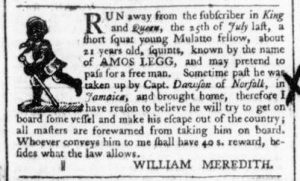
“RUN away … a short squat young Mulatto fellow.”

Amos Legg, an enslaved “young Mulatto fellow,” seemed determined to escape from bondage. In an advertisement alerting readers of the Virginia Gazette that Legg had made his escape, William Meredith also reported that “Sometime past he was taken up by Capt. Dawson of Norfolk, in Jamaica, and brought home.” Legg must have been a particularly recalcitrant slave, one who did not allow the setback of having been captured and returned to his master deter him from making a subsequent attempt to seize his own liberty in an age when Virginia’s gentry protested what they considered “enslavement” via infringements on their liberty by Parliament.

Like other genres of advertisements, those for runaways often followed a general formula and included stock language (just as they often included a stock image of an enslaved person). Advertisements for runaways frequently warned “masters of vessels” against giving passage to suspected runaways attempting to put as much distance between themselves and their masters as possible. That Legg had previously made it to Jamaica from Virginia indicates that masters had real cause to worry about such possibilities.

This advertisement tells a story of the resilience of one man who refused to accept his enslavement, but it also reveals the tenuous position of runaways. No matter how far away from their masters they managed to get, they were never completely free or safe. Their everyday experience included the possibility of capture and return, compounded by threats of punishment for the audacity of having made an escape at all. A sharp-eyed captain had taken up Amos Legg hundreds of miles from Virginia. How many other advertisements about runaway slaves resulted in men and women being returned to their masters after an all-too-brief respite from bondage?

August 6

Who was the subject of an advertisement in a colonial American newspaper 250 years ago today?

Aug 6 - 8:6:1766 Georgia Gazette
Georgia Gazette (August 6, 1766).

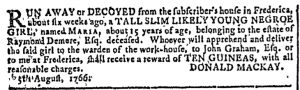
“TALL SLIM LIKELY YOUNG NEGROE GIRL.”

It would have been impossible to overlook Donald Mackay’s description of Maria, an enslaved young woman: “TALL SLIM LIKELY YOUNG NEGROE GIRL.” Each of the adjectives suggested that Maria was attractive, a young woman that most masters and others would have found desirable, a young woman who most likely would have become increasingly alluring as she continued to mature.

In the absence of any sort of visual image (not even a crude woodcut), Mackay put a black body on display by asking readers to imagine Maria’s appearance and inviting them to scrutinize every black woman they encountered to determine if they might be the runaway Maria.

This advertisement also hints at the treatment that Maria may have already experienced or that she was likely to experience at some point. White men had unfettered access to enslaved women throughout early American history, from the colonial period through the antebellum era and the Civil War. Writing under the pseudonym Linda Brent nearly a century after this advertisement was published, Harriet Jacobs published a slave narrative in which she documented the constant threat of sexual absue she faced as a slave in North Carolina in the early nineteenth century. Various other sources – slave narratives, letters, ledgers, and journals, written by both black and white authors – confirm the sexual violence perpetrated against black women under slavery. Some do so explicitly.

Others, like this advertisement, raise the possibility with more subtlety, asking observers to read between the lines.

A multitude of circumstances probably influenced Maria’s decision to run away, but her vulnerability to sexual abuse was likely one of them. Donald Mackay did not elaborate on all the reasons that he wanted this “TALL SLIM LIKELY YOUNG NEGROE GIRL” captured and returned, but eighteenth-century readers would have been aware of what was unwritten. This advertisement was about more than recovering a piece of human property who could work in the fields or do domestic labor in the household.

Advertisements for enslaved men, women, and children allow us to reconstruct portions of their lives when we read against the grain and interrogate the implications of what white authors have written.

July 2

Who was the subject of an advertisement in a colonial newspaper 250 years ago today?

Jul 2 - 7:2:1766 Georgia Gazette
Georgia Gazette (July 2, 1766).

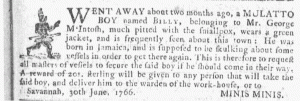
“WENT AWAY about two months ago, a MULATTO BOY named BILLY.”

This runaway advertisement does not fill in many of the details of the life led by “a MULATTO BOY named BILLY,” but it offers enough to imagine some of what his story might have been. The notice indicated that Billy “was born in Jamaica” and speculated that he was spending time on the Savannah waterfront “skulking about some vessels in order to get there again.” The advertiser did not question why Billy might have wanted to return to Jamaica, what would have drawn him there. In addition to being a familiar place, Jamaica may have been where Billy hoped to be reunited with a mother or siblings or other relatives or friends, a network of people that he cared about and who cared about him.

There’s no way to know that for certain. Billy may have had other reasons for wanting to return to Jamaica, but my first thought upon reading this advertisement was that it told the story of a boy who had been separated from his family and wanted to get back to them. I suspect that the advertiser may have had a similar hunch but refused to put it into words. Doing so would have recognized the humanity of Billy, the very real bonds of affection that he felt for his relatives and other significant people in his life. Doing so would have also acknowledged the extent that the slave trade separated families. This advertisement seems to carefully skirt Billy’s humanity in favor of depicting him as a commodity to be delivered back to “the warden of the work-house, or to MINIS MINIS” (presumably the name of the plantation estate of his master, George M’Intosh).