March 3

What was advertised in a colonial American newspaper 250 years ago today?
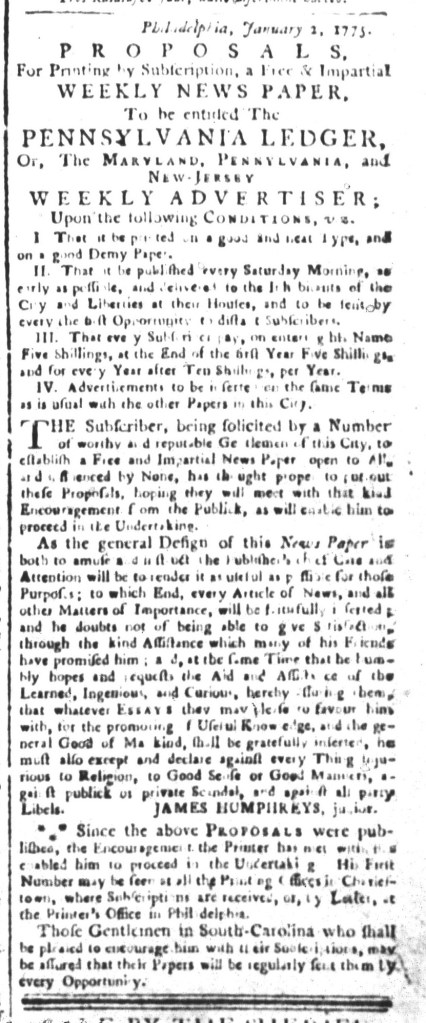
South-Carolina and American General Gazette (March 3, 1775).

“PENNSYLVANIA LEDGER … His First Number may be seen at all the Printing Offices in Charlestown.”

When James Humphreys, Jr., launched the Pennsylvania Ledger in 1775, he sought local subscribers by placing the proposals for his “Free & Impartial WEEKLY NEWSPAPER” in other newspapers published in Philadelphia.  Given the extended title – Pennsylvania Ledger, Or, the Maryland, Pennsylvania, and New-Jersey Weekly Advertiser (in the proposals) or Pennsylvania Ledger: Or the Virginia, Maryland, Pennsylvania, and New-Jersey Weekly Advertiser (on the masthead) – it made sense to promote the newspaper to prospective subscribers and advertisers in towns in Pennsylvania and neighboring colonies.  After all, colonial newspapers served vast regions.

Yet they circulated even more widely than the expansive title of the Pennsylvania Ledger suggested.  Realizing that was the case, Humphreys sent the proposals for the Pennsylvania Ledger to R. Wells and Son, the printers of the South-Carolina and American General Gazette, in Charleston.  Dated “Philadelphia, January 2, 1775,” the proposals ran in the February 24 and March 3 editions.  By that time, Humphreys had already commenced publication of his newspaper.  A note at the end of the advertisement acknowledged that was the case: “Since the above PROPOSALS were published, the Encouragement the Printer has met with has enabled him to proceed in the Undertaking.  His First Number,” published on January 28, “may be seen at all the Printing Offices in Charlestown, where Subscriptions are received.”  Wells and Son acted as local agents for Humphreys, a common practice among eighteenth-century printers who also participated in exchange networks for sharing newspapers and reprinting content.

Another note directed to readers of the South-Carolina and American General Gazette advised, “Those Gentlemen in South-Carolina who shall be pleased to encourage [Humphreys] with their Subscriptions, may be assured that their Papers will be regularly sent them by every Opportunity.”  That the January 28 edition was available for inspection at a local printing office by February 24 testified to Humphreys’s commitment to delivering newspapers to distant subscribers in a timely manner.  While he certainly welcomed individual subscribers, the printer likely hoped that his newspaper would attract the attention of the proprietors of establishments where merchants and others gathered to do business.  Coffeehouses, for instance, often supplied newspapers from near and far for patrons to peruse news about current events and consult the shipping news for updates about commerce in the British Atlantic world.  Humphreys had a reasonable expectation that publishing proposals for the Pennsylvania Ledger would yield subscribers in South Carolina.

December 4

What was advertised in a colonial American newspaper 250 years ago today?

Essex Journal (December 4, 1773).

“THOSE LADIES and GENTLEMEN who are desirous of seeing the curious ART of PRINTING, are hereby informed that on MONDAY next the Printing Office, will be opened for their reception.”

When Isaiah Thomas and Henry-Walter Tinges formed a partnership to publish the Essex Journal and Merrimack Packet: Or, the Massachusetts and New-Hampshire General Advertiser in the fall of 1773, they devised a savvy marketing campaign.  Thomas already published the Massachusetts Spy in Boston.  He continued overseeing that newspaper, while Tinges ran the printing office in Newburyport.  To generate interest in the new publication, the partners inserted a notice in the November 26 edition of the Massachusetts Spy, informing both prospective subscribers and prospective advertisers that they would distribute the inaugural issue of the Essex Journal “GRATIS” on December 4.  They envisioned “a very large Number will be printed off, and distributed throughout the Provinces of Massachusetts Bay and New-Hampshire.”

Thomas and Tinges used that first issue as a vehicle for further promoting the newspaper as well as several ventures Thomas already had underway.  An extensive address “To the PUBLIC” from the printers and “PROPOSALS For CONTINUING the ESSEX JOURNAL” filled most of the first page, appearing below a masthead that included woodcuts of the arms of the colony, an indigenous man holding an arrow in one hand and a bow in the other, on the left and a packet ship under sail, presumably carrying newspapers and letters, on the right.  The title of the newspaper ran between the images.  At short advertisement for a magazine that Thomas already marketed extensively completed the final column: “SUBSCRIPTIONS for the ROYAL AMERICAN MAGAZINE, which will speedily be published by I. THOMAS, in Boston, are taken in at the Printing-Office.”  A longer advertisement addressed to “the generous Patrons and Promoters of useful KNOWLEDGE, throughout AMERICA,” a notice that previously appeared in several newspapers published in Boston, appeared on the final page of the inaugural issue.  In it, Thomas solicited articles for the Royal American Magazine and warned prospective subscribers to submit their names soon or risk missing the first issue.  A shorter advertisement on the final page promoted “Thomas’s Boston Sheet ALMANACK for the year ensuing, proper for all Merchants, Shopkeepers, &c. to paste or hang up in their Stores or Shops.”

Essex Journal (December 4, 1773).

On the third page, the first advertisement immediately following the news invited “LADIES and GENTLEMEN who are desirous of seeing the curious ART of PRINTING” to visit the printing office on the following Monday.  The printers planned to open their shop to the public, prepared to “wait on all who will do them the honour of their company.”  Thomas and Tinges highlighted demonstrations scheduled for “eleven o’clock in the forenoon, and at three in the afternoon.”  They hoped that such exhibitions would help convince prospective subscribers and prospective advertisers to do business with them.  Opening the printing office to the public “for their reception” anticipated open houses that many businesses now host to draw attention to new endeavors.  Another advertisement, this one on the final page, asked “GENTLEMEN and LADIES in this and the neighbouring towns who will encourage the Publication of this Paper” to “send in their names with all convenient speed.”  Thomas and Tinges suggested that publishing subsequent issues of the Essex Journal was not a foregone conclusion.  Instead, they needed prospective subscribers to confirm their commitment before the next issue would go to press.  A second issue depended on “a sufficient number of Subscribers.”  As a final bonus, a supplement accompanied the inaugural issue.  It featured news about “the detestable TEA sent out by the East-India Company, part of which being just arrived in [Boston] harbour,” that made its way to Newburyport the previous day via “Friday’s Post.”  With the supplement, Thomas and Tinges made the point that subscribers to the Essex Journal could expect to receive the latest news as soon as it arrived in Newburyport rather than waiting for the Essex Gazette, published in Salem, the New-Hampshire Gazette, published in Portsmouth, or any of the newspapers published in Boston.

Despite these efforts, it took a few weeks for Thomas and Tinges to collect enough subscriptions to convince them of the viability of publishing the Essex Journal.  The various marketing strategies incorporated into the inaugural issue, from distributing free copies to the extensive subscription proposals to the open house at the printing office to the news supplement, likely helped generate interest, but the process took time.  Thomas and Tinges did not publish the second issue of the Essex Journal for more than three weeks.  It appeared on December 29, once again carrying the proposals and conditions to entice readers who had not yet subscribed.

November 26

What was advertised in a colonial American newspaper 250 years ago today?

Massachusetts Spy (November 26, 1773).

“THOSE who incline to ADVERTISE in said paper … may find it GREATLY to their ADVANTAGE.”

At the same time that Isaiah Thomas, printer of the Massachusetts Spy, set about launching the Royal American Magazine, he made plans to publish another newspaper, the Essex Journal, and Merrimack Packet: Or the Massachusetts and New-Hampshire General Advertiser.  For that endeavor, Thomas entered into partnership with Henry-Walter Tinges. Thomas planned to remain in Boston, overseeing his printing office there, while Tinges would manage the Essex Journal at the printing office in Newburyport.  The proposed publication would become only the second newspaper in Massachusetts printed outside of Boston, joining the Essex Gazette published in Salem since August 1768.

To incite interest in the Essex Journal, Thomas inserted an advertisement in the November 26, 1773, edition of the Massachusetts Spy, announcing that the first issue of a “New Weekly NEWS-PAPER” would be “distributed and given, GRATIS, to the Inhabitants of both Provinces,” Massachusetts and New Hampshire.  He hoped that the free issue would encourage those who received it to become subscribers.  Yet he did not focus solely on prospective subscribers.  The printer also advised merchants, shopkeepers, artisans, and others that they did not want to miss this opportunity to place their notices before the eyes of so many readers.  “THOSE who incline to ADVERTISE in said paper, in this or the neighbouring Towns,” Thomas proclaimed, “may find it GREATLY to their ADVANTAGE, especially the Merchants and Shopkeepers in BOSTON, as a very large Number will be printed off, and distributed throughout the Provinces of Massachusetts Bay and New-Hampshire.”  He reiterated that the inaugural issue would be “[Gratis],” underscoring that advertisers could expect many colonizers, even those who did not subscribe to other newspapers, to receive copies and peruse the contents.

Thomas accepted advertisements at his printing office in Boston.  Tinges also accepted them at his printing office in Newburyport.  The printer promoted “very reasonable prices” for placing notices in the new newspaper, but did not specify the rates.  When the first issue of the Essex Journal went to press, it included two dozen advertisements that accounted for slightly more than four of the twelve columns.  Thomas and Hinges placed a quarter of the notices, but they managed to attract several advertisers who sought the advantages interested in reaching readers who received free copies of the new newspaper.