June 6

What was advertised in a revolutionary American newspaper 250 years ago today?
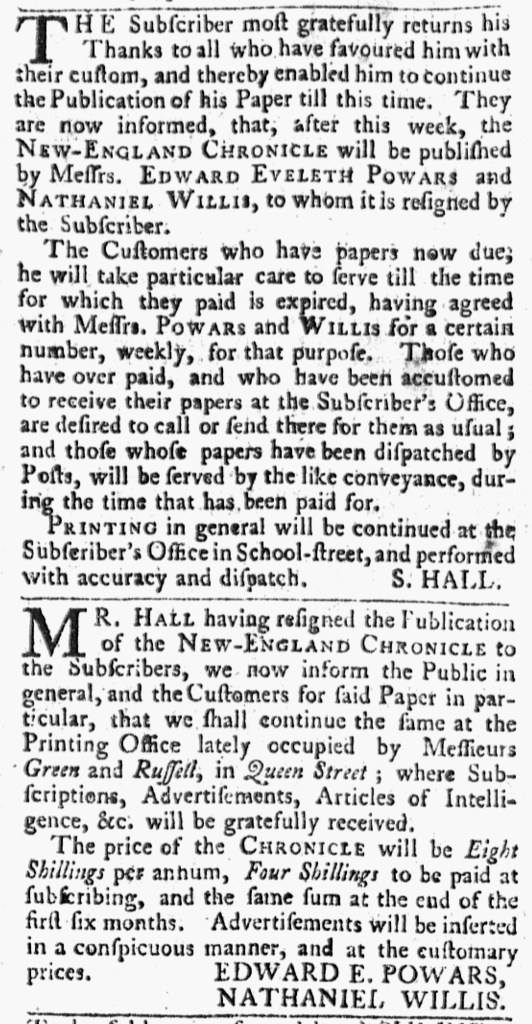
New-England Chronicle (June 6, 1776).

“After this week, the NEW-ENGLAND CHRONICLE will be published by Messrs. EDWARD EVELETH POWARS and NATHANIEL WILLIS.”

It was the last issue of the New-England Chronicle printed by Samuel Hall, but it would not be the last issue of that newspaper.  Instead, Hall “resigned the Publication of the NEW-ENGLAND CHRONICLE” to Edward E. Powars and Nathan Willis.  The former publisher and the new publishers informed subscribers and other readers what to expect in advertisements that appeared one after the other in the June 6, 1776, edition.

Hall went first, expressing his appreciation and “Thanks to all who have favoured him with their custom, and thereby enabled him to continue the Publication of his Paper till this time.”  Hall and his newspaper had undertaken an interesting journey over the past year and more.  In the spring of 1775, Hall and his brother, Ebenezer, were publishing the Essex Gazette in Salem.  After the battles at Lexington and Concord on April 19, all the newspapers in Boston folded, suspended publication, or moved to other towns.  The Halls published the last issue of the Essex Gazette in Salem on May 2, 1775, just a couple of weeks after the war began.  With the siege of Boston underway, the Halls moved to Cambridge, putting them and their newspaper in closer proximity to the army and the provincial congress.  The continued publishing their newspaper without a change in numbering but with a new name, the New-England Chronicle, on May 12.  Following Ebenezer’s death on February 14, 1776, Samuel continued as the sole printer.  The siege of Boston concluded when British forces departed on March 17.  Hall published the last issue of the New-England Chronicle in Cambridge on April 4.  He then moved into Boston and printed the first issue of the New-England Chronicle in that city on April 25.  Loyal customers had indeed “enabled him to continue the Publication of his Paper till this time” when he transferred it to Powars and Willis.

Although Hall no longer printed a newspaper, he continued running a printing office “next to the OLIVER CROMWELL Tavern, in SCHOOL-STREET,” in Boston.  In their advertisement, Powars and Willis announced that they would publish the New-England Chronicle “at the Printing Office lately occupied by Messieurs Green and Russell, in Queen Street.” They solicited subscriptions, advertisements, and “Articles of Intelligence” for publication.  The new proprietors of the newspaper listed the subscription price, eight shillings per year, but not the price for advertisements.  Instead, they promised that notices “will be inserted in a conspicuous manner,” making them worth the investment, “at the customary prices.”  Powars and Willis hoped that subscribers would continue with the New-England Chronicle now that they published it.

August 23

What was advertised in a revolutionary American newspaper 250 years ago today?

Constitutional Gazette (August 23, 1775).

The Public will easily perceive the advantage of advertising in the Constitutional Gazette.”

A new newspaper began circulating in New York at the beginning of August 1775.  John Anderson commenced publication of the Constitutional Gazette on August 2, judging from the date of the earliest known issue dated August 9.  Anderson published the broadsheet newspaper twice a week, on Wednesdays and Sundays.  It lasted a little more than a year.  Anderson distributed the last known issue on August 28, 1776.  As Clarence S. Brigham surmises, “the paper must have been soon discontinued, as the British entered New York in September, 1776.”[1]

On August 23, 1775, Anderson converted the seventh issue from a single leaf folio to a quarto of four pages.  At a glance, that would have been the most striking alteration to the format of the newspaper, but it was also the first issue to carry advertisements.  They ran on the final page.  One, placed by the printer himself, filled nearly an entire column.  In it, Anderson hawked pamphlets available at his printing office, including “Defensive War in a Just Cause Sinless,” a sermon by David Jones, “Self-Defensive War Lawful,” a sermon by John Carmichael, and a narrative of “Two Visits Made to some Nations of INDIANS, On the West Side of the River OHIO, In the Years 1772 and 1773,” drawn from Jones’s journal.  Another advertisement offered a reward for returning a lost pocketbook.  The anonymous advertisement instructed anyone who found the pocketbook to deliver it to the printer.  Beekman may have placed it himself or he may have manufactured it to suggest that others had sufficient confidence in the circulation of his newspaper to merit investing in advertising in it.

Another notice from the printer followed the advertisement about the lost pocketbook, this one soliciting more advertisements.  Anderson declared that he published advertisement “for half the price charged by others.”  In making his case, he insisted that the “Public will easily perceive the advantage of advertising in the Constitutional Gazette, when we positively assure them that near Two Thousand of this Gazette circulated twice a week through this City and its Environs.”  Furthermore, “a considerable number are sent to most of the country towns, in, and contiguous to this province.”  According to Anderson, the Constitutional Gazette quickly achieved an impressive circulation that rivaled other newspapers.  If prospective advertisers wanted to reach readers near and far, Anderson argued, then they should place their notices in his new newspaper.

**********

[1] Clarence S. Brigham, History and Bibliography of American Newspaper, 1690-1820 (Worcester, Massachusetts: American Antiquarian Society, 1947), 618.

November 26

What was advertised in a colonial American newspaper 250 years ago today?

Massachusetts Spy (November 26, 1773).

“THOSE who incline to ADVERTISE in said paper … may find it GREATLY to their ADVANTAGE.”

At the same time that Isaiah Thomas, printer of the Massachusetts Spy, set about launching the Royal American Magazine, he made plans to publish another newspaper, the Essex Journal, and Merrimack Packet: Or the Massachusetts and New-Hampshire General Advertiser.  For that endeavor, Thomas entered into partnership with Henry-Walter Tinges. Thomas planned to remain in Boston, overseeing his printing office there, while Tinges would manage the Essex Journal at the printing office in Newburyport.  The proposed publication would become only the second newspaper in Massachusetts printed outside of Boston, joining the Essex Gazette published in Salem since August 1768.

To incite interest in the Essex Journal, Thomas inserted an advertisement in the November 26, 1773, edition of the Massachusetts Spy, announcing that the first issue of a “New Weekly NEWS-PAPER” would be “distributed and given, GRATIS, to the Inhabitants of both Provinces,” Massachusetts and New Hampshire.  He hoped that the free issue would encourage those who received it to become subscribers.  Yet he did not focus solely on prospective subscribers.  The printer also advised merchants, shopkeepers, artisans, and others that they did not want to miss this opportunity to place their notices before the eyes of so many readers.  “THOSE who incline to ADVERTISE in said paper, in this or the neighbouring Towns,” Thomas proclaimed, “may find it GREATLY to their ADVANTAGE, especially the Merchants and Shopkeepers in BOSTON, as a very large Number will be printed off, and distributed throughout the Provinces of Massachusetts Bay and New-Hampshire.”  He reiterated that the inaugural issue would be “[Gratis],” underscoring that advertisers could expect many colonizers, even those who did not subscribe to other newspapers, to receive copies and peruse the contents.

Thomas accepted advertisements at his printing office in Boston.  Tinges also accepted them at his printing office in Newburyport.  The printer promoted “very reasonable prices” for placing notices in the new newspaper, but did not specify the rates.  When the first issue of the Essex Journal went to press, it included two dozen advertisements that accounted for slightly more than four of the twelve columns.  Thomas and Hinges placed a quarter of the notices, but they managed to attract several advertisers who sought the advantages interested in reaching readers who received free copies of the new newspaper.