What was advertised in a colonial American newspaper 250 years ago today?
South-Carolina Gazette and Country Journal (September 29, 1772).
“Sundry NEW ADVERTISEMENTS omitted this Week, in order to Place to the LONDON NEWS, &c. shall have particular Notice taken of them in our next.”
Advertising could appear anywhere in colonial American newspapers, even on the front page. In fact, some newspapers often devoted the entire front page to the masthead and advertising. Others placed both news and advertising on the front page. The distribution of items selected by the printer and paid notices submitted by advertisers varied from week to week in many newspapers.
Such was the case for the South-Carolina Gazette and Country Journal, printed by Charles Crouch. Consider the September 29, 1772, edition. Like other issues, it consisted of four pages crested by printing two pages on each side of a broadsheet and folding it in half. The first two pages contained news from London that arrived earlier in the week. The shipping news from the customs house indicated that the Mermaid from London entered port on September 24. The New Market, also from London, arrived a day later. That gave Crouch plenty of time to receive newspapers and letters from both ships, read through them, and choose which items to print before publishing a new weekly edition on September 29. He reserved advertising for the third and fourth pages, marking some notices with a header for “NEW ADVERTISEMENTS.”
Crouch also inserted a note to alert readers (and advertisers searching for their notices) that “Sundry NEW ADVERTISEMENTS omitted this Week, in order to Place to the LONDON NEWS, &c. shall have particular Notice taken of them in our next.” What constituted “particular notice” beyond making sure to publish them at all? No news appeared on the front page of the October 6 edition. Instead, “NEW ADVERTISEMENTS” filled all three columns on both the front page and the final page, two pages printed on the same side of a broadsheet. Printers often printed those pages first, reserving the second and third pages for news that arrived just before publication. In addition to the prominent placement of advertising on the front page, almost the entire issue consisted of paid notices. Only the second page carried anything other than advertising. News extended throughout the first and second columns. It overflowed into the third, but more “NEW ADVERTISEMENTS” accounted for half of that column.
The proportion and placement of news and advertising often varied from week to week in colonial newspapers as printers made decisions about providing news for subscribers who (sometimes) paid for their newspapers and disseminating paid notices for advertisers who accounted for an important revenue stream. As a result, some newspapers sometimes looked like vehicles for delivering advertising without much news content at all.
What was advertised in a colonial American newspaper 250 years ago today?
South-Carolina Gazette and Country Journal (September 15, 1772).
“Young Ladies and Gentlemen instructed in DANCING.”
An advertisement for “DANCING and FENCING” lessons in the September 15, 1772, edition of the South-Carolina Gazette and Country Journal alerted readers that “PIKE’s ACADEMY, for FENCING and DANCING” would soon offer a new “Season” of classes. Pike was probably already familiar to many prospective pupils, having offered instruction in Charleston for several years. He attempted to generate interest even among those who had already taken lessons with him by inviting students to his “NEW SUIT of ROOMS” on Church Street.
A significant portion of the advertisement consisted of the schedule. Pike devoted early mornings, “Five o’Clock to Nine,” to fencing lessons. He taught dancing to “Young Ladies and Gentlemen” in the afternoons on Thursdays and Saturdays in addition to his “EVENING SCHOOL, every Evening in the Week, from Six o’Clock to Nine.” That left “four Afternoons at Liberty every Week” for Pike to venture beyond his academy to provide private lessons to students “at their own Houses.” That may have been the preferred option for those who felt anxious about appearing anything other than graceful and genteel in front of observers.
Yet dancing was an activity meant to be undertaken in public, at least eventually. Colonizers asserted their status and took great pride in being skillful dancers. Smoothly completing complex steps testified to their refinement, while awkwardness or stumbling undermined impressions of politeness and sophistication they demonstrated in other aspects of their comportment and dress. Understanding the stakes, Pike scheduled an exhibition ball for early December and encouraged the “Parents and Guardians of his Scholars” to enroll them in lessons “as soon as possible.” The teacher and his pupils needed sufficient time “to complete his Figures in a proper Manner” during their lessons so the young ladies and gentlemen could showcase their skills in front of observers at the ball. Other dancing masters also raised the specter of public embarrassment in their advertisements, encouraging prospective students and their parents to enroll in lessons in order to withstand public scrutiny. By stoking anxiety, they aimed to motivate colonizers to engage their services.
What was advertised in a colonial American newspaper 250 years ago today?
South-Carolina Gazette and Country Journal (September 1, 1772).
“BOXES of MEDICINES fitted up as usual.”
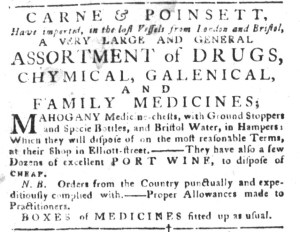
As fall approached in 1772, Carne and Poinsett alerted readers of the South-Carolina Gazette and Country Journal that they imported and sold a “VERY LARGE AND GENERAL ASSORTMENT of DRUGS, CHYMICAL, GALENICAL, AND FAMILY MEDICINES.” They competed with Thomas Stinson, who acquired his “FRESH SUPPLY of DRUGS, CHYMICAL and GALENICAL, With most Family Medicines now in Use” directly from “their ORIGINAL Warehouses,” and Edward Gunter, who stocked a “large and complete ASSORTMENT OF DRUGS and MEDICINES” imported via “the last Vessels from LONDON.”
In addition to carrying similar merchandise, each of these entrepreneurs offered an ancillary service for the convenience of their customers. Carne and Poinsett promoted “BOXES of MEDICINES fitted up as usual.” Their competitors gave more elaborate descriptions of this service. Gunter declared that he supplied “BOXES of MEDICINES, with Directions, for Plantations and Ships Use, prepared in the best Manner.” Similarly, Stinson explained that “BOXES of MEDICINES, with Directions for PLANTATIONS and SHIPS Use, are faithfully prepared” at his shop.
Providing these boxes kept Gunter, Stinson, and Carne and Poinsett competitive with each other, eliminating the possibility that prospective customers would turn to one who offered the convenience of such boxes medicines over one who did not. Yet marketing this service to customers did not constitute the sole reason for assembling these eighteenth-century versions of first aid kits. Doing so augmented sales beyond medicines that customers actually needed to medicines that they might need at some time in the future. Entrepreneurs who ran apothecary shops used the combination of uncertainty and distance to their advantage, realizing that many prospective customers did not have easy access to medicines and needed to plan for various possibilities rather than acquire remedies only when need became apparent. It mattered little to these entrepreneurs whether their customers ever used the medicines in the boxes they “fitted up as usual.” They traded in the security offered by the convenience of having various medicines on hand even if the buyers never needed to administer some of them.
What was advertised in a colonial American newspaper 250 years ago today?
Supplement to the South-Carolina Gazette (August 20, 1772).
“He makes American Punch in Perfection.”
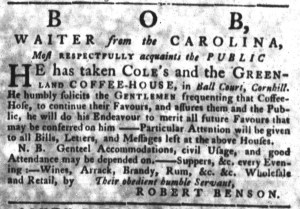
When Robert Benson became the new proprietor of “COLE’S and the GREENLAND COFFEE-HOUSE, in Ball Court, Cornhill,” in London, he placed advertisements in newspapers in South Carolina. Having formerly worked as a waiter at the Carolina Coffee House, he likely hoped that some merchants who had conducted business there would remember him fondly enough to visit his new establishment when they next traveled to London as well as entrust him to receive “Bills, Letters, and Messages” directed to local associates. He opened his first advertisement with a headline introducing himself as “BOB, WAITER from the CAROLINA,” but concluded it more formally as his prospective customers’ “obedient humble Servant, ROBERT BENSON.” In a subsequent advertisement, he dispensed with giving his full name, opting instead to solely use the more familiar “BOB, WAITER from the CAROLINA and PENNSYLVANIA COFFEE-HOUSE, in Birchin Lane.”
South-Carolina Gazette and Country Journal (August 18, 1772).
Benson made other changes when he published a second advertisement in newspapers in Charleston. In particular, he declared that “for the Accommodation of American Gentlemen, the South-Carolina, Georgia, and Pennsylvania News-Papers, will be regularly taken in.” Those newspapers featured a significant amount of news from Europe, especially London, that would have been more quickly and more readily available to visitors to the city, but they also carried digests of news from throughout the colonies, varying amounts of local news, prices current for a variety of commodities in Charleston, Savannah, and Philadelphia, and shipping news from the customs houses in those busy ports. In addition, readers could glean a fair amount of news (and gossip) from reading the advertisements, including legal notices and advertisements intended to promote commerce and consumption (and notices cutting off credit for disobedient wives who “ran away” from their husbands). Benson considered supplying American newspapers one of the services for his customers that demonstrated he “will exert his utmost Endeavours to merit their Favours.” He also declared that he “has fitted up” his establishment “very elegantly.” In addition to the newspapers, American merchants and other travelers would feel at home at Cole’s and the Greenland Coffee House because Benson “makes American Punch in Perfection.” Even as colonial merchants took part in London’s cosmopolitan culture, Benson suspected they would welcome a taste of home. He listed the “American Punch” last in his advertisement, one of several amenities that he hoped would make his coffeehouse an attractive destination. His competitors relied on reputation and word of mouth to attract customers from Charleston and other towns in the colonies. Benson, the affable “BOB,” on the other hand, believed that directly marketing his new venture in the colonies would contribute to its success. He attempted to leverage his reputation while also promoting the amenities that made his coffeehouse a rival to any others in London.
What was advertised in a colonial American newspaper 250 years ago today?
South-Carolina Gazette and Country Journal (August 11, 1772).
“White and coloured NEGRO CLOTH.”
The partnership of Ancrums and Chiffelle took to the pages of the South-Carolina Gazette and Country Journal to advise “their Friends” that they stocked “White and coloured NEGRO CLOTH, Together with a Variety of other GOODS, fromLONDON and BRISTOL” in the summer of 1772. They placed an advertisement in the August 11 edition, as did Atkins and Weston. They informed readers that they imported “NEGRO CLOTH, DUFFIL, BLANKETS, and SAIL CLOTH” from Bristol. Atkins and Weston assured “their Friends and Customers” that they set low prices. Elsewhere in the same issue, Thomas Eveleigh advertised “A FEW BALES of NEGRO CLOTH, and some good LONDON PORTER, just imported, and to be sold reasonably.”
Those advertisements accompanied seven others that offered enslaved men, women, and children for sale, one seeking “TWO or Three NEGRO BOYS, as Apprentices to the Wheel-Wright’s Business,” five announcing rewards for the capture and return of enslaved people who liberated themselves by running away from their enslavers, and a lengthy notice describing eighteen Black men and women “Brought to the WORK-HOUSE” and imprisoned there on suspicion of attempting to liberate themselves. The printer did not arrange advertisements according to purpose or category, so readers encountered notices about enslaved people interspersed with advertisements promoting consumer goods and services, real estate notices, legal notices, and other kinds of advertisements.
Ancrums and Chiffelle and their competitors who hawked “NEGRO CLOTH” may or may not have participated in the slave trade directly, yet they certainly aimed to profit from maintaining that institution. In their advertisements, those merchants made supplying enslavers with an inexpensive textile to clothe the men, women, and children held in bondage central to their operations at the stores and warehouses they operated in Charleston. Furthermore, they demonstrated that commerce enmeshed in the transatlantic slave trade extended beyond any sort of streamlined triangular trade that connected Africa, England, and colonies on the other side of the Atlantic. Even as ships departing from London, Bristol, and other English ports carried goods to Africa to purchase captives held in outposts along the coast, other ships from those ports delivered finished goods, including “NEGRO CLOTH,” directly to South Carolina and other colonies. Many merchants, including Ancrums and Chiffelle, sought opportunities to profit from selling supplies to enslavers, embracing the transatlantic slave trade in their business models even if they did not transport or sell Black men, women, and children themselves.
What was advertised in a colonial American newspaper 250 years ago this week?
Addition to the South-Carolina Gazette and Country Journal (August 7, 1772).
“Dr. KEYSER’S GENUINE PILLS.”
Like many colonial printers, Charles Crouch and Powell, Hughes, and Company advertised and sold patent medicines, including Dr. Keyser’s pills for venereal disease, at their printing offices in Charleston. In the summer of 1772, that prompted a feud between those printers. It began when Powell, Hughes, and Company ran a lengthy advertisement in their newspaper, the South-Carolina Gazette, providing a history of the medicine and its effectiveness. In the next issue of the South-Carolina Gazette and Country Journal, Crouch ran his own advertisement, but considered it “needless to trouble the public with more Encomiums on the Effects of this Remedy” in the public prints. Instead, he offered “A NARRATIVE of the Effects of Dr. KEYSER’s MEDICINE, with an Account of its ANALYSIS, by the Members of the Royal Academy of Sciences,” that colonizers could examine at his printing office. Powell, Hughes, and Company made clear in a new advertisement in the next issue of the South-Carolina Gazette that they took issue with Crouch seeming to critique their marketing efforts. That led to a series of advertisements that descended into the printers accusing each other of carrying counterfeit medicines and making attacks on each other’s character. Powell, Hughes, and Company even reprinted one of Crouch’s advertisements, for the purposes of insinuating that their rival suffered from venereal disease himself, in the July 30 edition of the South-Carolina Gazette.
Crouch chose not to escalate the war of words at that point. In his most recent advertisement, he proclaimed that “as to my good or bad Qualities, they are submitted to Candour and Impartiality of the respectable Public, whose Favours I shall always make my chief Study to merit.” That did not stop him from placing another advertisement for the patent medicine at the center of the controversy. In the August 4 edition of the South-Carolina Gazette and Country Journal, he inserted a short advertisement that alerted prospective customers that “A Fresh Parcel of Dr. KEYSER’s real famous PILLS, are to be had, with full Directions for their Use in all Cases, at CHARLES CROUCH’S Printing Office in Elliott-street.” He also reminded readers that they could peruse “a Narrative of the Effects of KEYSER’S Medicine, with an Account of its Analysis, by the Members of the Royal Academy of Sciences.” Crouch suggested the pills he sold were authentic when he described them as “real.” Edward Hughes died on July 30, so the newly-constituted Thomas Powell and Company may have been too occupied with other matters to take notice. Two days later, they ran a two-line advertisement that simply stated, “Keyser’s PILLS and Maredant’s DROPS, may be had at the Printing-Office near the exchange.” Crouch opted to advertise once again, inserting a variation of his most recent notice as one of only six that appeared in a supplement published on August 7. He revised the description from “A Fresh Parcel of Dr. KEYSER’s real famous PILLS” to “A Fresh Parcel of Dr. KEYSER’S GENUINE PILLS,” perhaps intending to defend his own merchandise and cast doubt on the pills stocked by a competitor without calling enough attention to his efforts to incite a response from Powell, Hughes, and Company. Of all the advertisements he could have chosen to include in the limited space in the midweek supplement to the South-Carolina Gazette, Crouch consciously chose to promote the patent medicines available at his printing office, likely hoping to build on any attention generated by the recent dispute.
Who was the subject of an advertisement in a colonial American newspaper 250 years ago today?
Addition to the South-Carolina Gazette and Country Journal (August 7, 1772).
“TWO HUNDRED CHOICE Gambia SLAVES.”
Charles Crouch usually distributed new issues of the South-Carolina Gazette and Country Journal on Tuesdays in 1772. Like many other printers, however, he sometimes issued a supplement, postscript, or addition on another day, disseminating news more quickly than waiting to print the next weekly edition of his newspaper. That was the case in early August. A standard four-page issue came out as scheduled on Tuesday, August 4, followed by a two-page Additionon Friday, August 7. Crouch either had too much news to fit in the standard issue at the time it went to press or he acquired news that he felt could not wait nearly a week shortly after the usual publication day. After all, his newspaper competed with two others in Charleston.
Most of the Addition consisted of news from London. The final column included a few items of local news as well as shipping news from the customs house. That left room for six short advertisements, three of them concerning ships seeking passengers and freight for trips to Philadelphia, Boston, and London. Another advertisement advised readers of an upcoming sale of “TWO HUNDRED CHOICE Gambia SLAVES, Mostly MEN and WOMEN,” scheduled for August 18. William Somarsall asserted that the captives “JUST arrived (after a short Passage) in the Sloop THOMAS & ANTHONY, SOLOMON GIBBS, Master.” The dateline read “Charles Town, August 7, 1772.” An entry for “Sloop Thomas & Anthony, Solomon Gibbs,” arriving from St. Kitts on August 6 appeared among the shipping news. The vessel apparently visited at least one port in the Caribbean before continuing to Charleston.
The publication of an Addition to the South-Carolina Gazette and Country Journal certainly served the interests of participants in the transatlantic slave trade. Of the six advertisements in the Addition, four previously ran in the standard issue on August 4. The midweek supplement provided an opportunity for Somarsall to promote an auction of enslaved men and women as soon as the Thomas and Anthony arrived in port. He wasted no time in submitting copy to Crouch’s printing office, rewarded with immediate publication. He ran the same advertisement three days later in the South-Carolina and American General Gazette … and a South-Carolina Gazette Extraordinary that circulated three days before the printers distributed the standard issue for that week on August 13. The appearance of a supplement once again facilitated the slave trade in addition to sharing news and other advertisements with colonizers.
What was advertised in a colonial American newspaper 250 years ago today?
South-Carolina Gazette (July 30, 1772).
“WHO … can doubt of the amazing Effects of that powerful and invaluable Medicine?”
A feud between Charles Crouch, printer of the South-Carolina Gazette, and Powell, Hughes, and Company, printers of the South-Carolina Gazette and Country Journal, played out in the pages of their newspapers in the summer of 1772. This feud did not concern their work as printers, nor did it appear in editorials. Instead, they sniped at each other in advertisements hawking a popular patent medicine, “Dr. KEYSER’S famous PILLS.”
According to advertisements that frequently appeared in newspapers from New England to South Carolina, colonial printers often supplemented their revenues from newspaper subscriptions, advertising, job printing, books, and stationery by selling patent medicines. Doing so required no specialized knowledge of the cures. The printers merely needed to supply the directions that often accompanied the nostrums they peddled. In addition, many consumers were already familiar with the most popular patent medicines, the eighteenth-century equivalent of over-the-counter medications.
Powell, Hughes, and Company ran a lengthy advertisement for “Dr. Keyser’s GENUINE Pills” in the July 9 edition of the South-Carolina Gazette. They opened by stating that “numerous Trials have proved [the pills] to be the safest, best, mildest, and most agreeable Medicine ever discovered, for the Cure of the VENEREAL DISEASE, from the slightest Infection to the most inveterate State of that dreadful and almost unconquerable Disorder.” They provided a long history of the medicine and its efficacy, concluding with a guarantee “to return the Money, if a complete Cure is not performed, provided the Patient adheres to the Manner of taking [the pills], as is given in the printed Directions.”
In the next issue of the South-Carolina Gazette and Country Journal, distributed on July 14, Crouch positioned his own extensive advertisement for “A CONSIGNMENT” of patent medicines on the front page. The list of medicines began with “A FRESH PARCEL of Dr. KEYSER’s FAMOUS PILLS, With FULL DIRECTIONS for their Use in all CASES.” Rather than publish the history of that medicine in his advertisement, Crouch alerted readers that they could read “A NARRATIVE of the Effects of Dr. KESYER’s MEDICINE, with an Account of its ANALYSIS, by the Members of the Royal Academy of Sciences.” He further elaborated, “It were needless to trouble the public with more Encomiums on the Effects of this Remedy.”
That statement, as well as competition for customers, raised the ire of Powell, Hughes, and Company. Two days later, they updated their previous advertisement, inserting an introductory paragraph that directly addressed Crouch’s advertisement. The partners, “far from thinking ‘it NEEDLESS to trouble the Public with more Encomiums of the Effects of this Remedy,’ look upon it as their Duty to insert the following Particulars of Keyser’s invaluable Medicine, in order that the Afflicted in this Province, may, in some Respects be made acquainted with the Virtues of the most efficacious Medicine ever discovered, and know where to apply for Relief, without the Danger of having other Pills imposed on them instead the GENUINE.” Powell, Hughes, and Company implied that Crouch carried counterfeit pills before inserting their original advertisement in its entirety.
Crouch objected to that insinuation. In the July 21 edition of the South-Carolina Gazette and Country Journal, he added a short note to his previous advertisement. Crouch now stated that he carried “A FRESH PARCEL of Dr. KEYSER’s FAMOUS PILLS, (perhaps the only REAL ONES that can be had in the Province at present) With FULL DIRECTIONS for their Use in all CASES.” He turned the accusation back to Powell, Hughes, and Company, suggesting that it was they, not he, who attempted to dupe the public with counterfeit and ineffective medicines.
That prompted Powell, Hughes, and Company to double down on their insistence that Crouch peddled counterfeits. On July 23, they expanded the new introduction of their advertisement, reiterating the “NEEDLESS to trouble the Public” quotation and adding a note about “the Danger of having a spurious Sort imposed on them, notwithstanding any forcible ‘PERHAPS’ to the Contrary.” Furthermore, they “assured” prospective customers that the pills they carried “were received from Mr. Keyser, therefore there can be no ‘Perhaps’ entertained of THEIR not being the GENUINE, unless it is by such who are naturally Obstinate and Conceited, without one good Quality to entitle them to be either.”
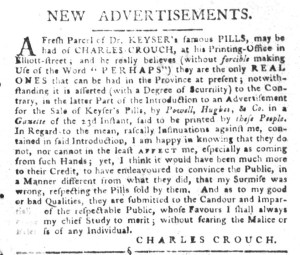
The back-and-forth continued in the next edition of the South-Carolina Gazette and Country Journal. Crouch and his competitors carefully monitored what each said about the other in their new advertisements. Crouch placed “NEW ADVERTISEMENTS” on the first page of the July 28 edition, leading with a new advertisement for “Dr. KEYSER’s famous PILLS” limited to a single paragraph that focused primarily on the controversy that had been brewing for the past few weeks. He once again stated that he sold the pills and declared that “he really believes (without forcible making Use of the Word “PERHAPS”) they are the only REAL ONES that can be had in the Province at present.” For the first time, he named his competitors, noting that “it is asserted (with a Degree of Scurrility) to the Contrary, in the latter Part of the Introduction to an Advertisement for the Sale of Keyser’s Pills, by Powell, Hughes, & Co. in a Gazette of the 23d Instant, said to be printed by these People.
Crouch devoted the remainder of his advertisement to upbraiding his competitors and defending his reputation. “In regard to the mean, rascally Insinuations against men, contained in said Introduction,” the printer stated, “I am happy in knowing that they do not, nor cannot in the least AFFECT me, especially as coming from such Hands.” He then suggested, “I think it would have been much more to their Credit, to have endeavoured to convince the Public, in a Manner different from what they did, that my Surmise was wrong, respecting the Pills sold by them.” He concluded with an assertion that “as to my good or bad Qualities, they are submitted to Candour and Impartiality of the respectable Public, whose Favours I shall always make my chief Study to merit; without fearing the Malice or Baseness of any Individual.”
South-Carolina Gazette and Country Journal (July 28, 1772).
Powell, Hughes, and Company did not interpret that as an overture to make peace or change their tone. On July 30, they began with the “New Advertisements” in the South-Carolina Gazette by reprinting Crouch’s advertisement “From the South-Carolina GAZETTE, AND Country Journal, of July 28, 1772. [No. 348.]” in its entirety. They made sure that readers could examine the original, though they also added “(t b c t f.)” to the final line, a notation that signaled to the compositor to continue inserting the advertisement until instructed to remove it. In so doing, they implied that Crouch intended to publicly shame them indefinitely. Yet they felt no remorse. Instead, they implied that Crouch suffered from the effects of venereal disease himself, especially cognitive deterioration, composing his latest advertisement only after taking a pill he acquired from Powell, Hughes, and Company. “WHO,” they asked, “after perusing the foregoing masterly Piece, produced by a SINGLE Dose of Dr. Keyser’s GENUINE Pills, sold by POWELL, HUSGHES, & Co. … can doubt of the amazing Effects of that powerful and invaluable Medicine?” They further intimated that Crouch suffered from venereal disease by asking, “After so copious a Discharge by ONE Dose, what may not be expected from a SECOND, or should THAT Patient take a WHOLE BOX?” Powell, Hughes, and Company snidely asserted that Crouch’s mental faculties were so far gone due to venereal disease that a single dose managed to give him only a few moments of clarity but he needed much more medicine to cease ranting and raving.
Powell, Hughes, and Company compounded the insult in a short paragraph that commented on Crouch’s grammar, further imputing that the effects of venereal disease made it difficult for him to string together coherent sentences. “In the mean Time,” they proclaimed, “the Reader is desired to correct TWO egregious Blunder, by inserting FORCIBLY for forcible, and THOSE PEOPLE instead of these People. The Word RASCALLY may stand, as ONE distinguishing Mark of the happy Talents and Abilities of the ingenious Author, as a —.” Pettiness descended into other insults unfit to print in the newspaper.
These exchanges demonstrate that Crouch and Powell, Hughes, and Company did not peruse each other’s publications solely in search of news items to reprint in their own. They also paid attention to advertisements, especially when their competitors marketed ancillary goods, like patent medicines, to supplement their revenues. These printers found themselves in competition to sell “Dr. KEYSER’S famous PILLS.” Rather than pursue their own marketing efforts, they chose to take umbrage at the strategies deployed by the other. Many purveyors of patent medicines stated in their advertisements that they did not need to offer additional information because the public was already so familiar with the product. Crouch may or may not have intended such an observation as a critique of Powell, Hughes, and Company’s advertisement. Whatever his intention, that was enough to garner a response that further escalated into a feud between rival printers hawking patent medicines.
What was advertised in a colonial American newspaper 250 years ago today?
South Carolina Gazette and Country Journal (July 14, 1772).
“Dr. KEYSER’s FAMOUS PILLS.”
Like other colonial printers, Charles Crouch cultivated multiple revenue streams simultaneously. Most printers produced and sold blanks or printed forms for common legal and commercial transactions. They also did job printing, completing orders for broadsides, handbills, circular letters, and a variety of other items according to the specifications of their customers. Many sold books, most of them imported from London, as well as stationery and writing supplies, and some printed newspapers. For Crouch, advertising revenues may have exceeded subscription fees for the South-Carolina Gazette and Country Journal, especially since he often distributed a supplement comprised solely of advertisements.
In addition to blanks, books, and stationery, printers frequently stocked and advertised patent medicines popular among consumers on both sides of the Atlantic. They did not need to possess any particular expertise to sell those patent medicines, especially since many came with “FULL DIRECTIONS for their Use in all CASES.” On July 14, 1772, Crouch advertised that he carried an array of patent medicines at his printing office, including “Dr. KEYSER’s FAMOUS PILLS,” “Dr. NELSON’s ANTISCORBUTIC DROPS,” “Dr. HILL’s genuine TINCTURE of VALERIAN,” “Dr. BOERHAAVE’s GRAND BALSAM of HEALTH,” JOYCE’s GREAT AMERICAN BALSAM,” “THE AGUE TINCTURE,” and “The GOLDEN TINCTURE.” Crouch gave these remedies a privileged place in his newspaper. His advertisement filled the first column on the first page and overflowed into the second. Only after promoting an array of elixirs and nostrums did he insert European news received via ships from London.
Crouch’s advertisement included blurbs of various lengths about each of the medicines, most likely reprinted from directions, advertisements, or other materials sent by his suppliers. The structure of the advertisement suggested that he received some of the most familiar items from London, but acquired Joyce’s Great American Balsam, the Ague Tincture, and the Golden Tincture separately. The blurbs for those three items included directions, suggesting that they may not have been as familiar to consumers as the patent medicines from London. Crouch may have hoped that putting less-familiar medicines in an advertisement with trusted remedies would enhance their appeal and convince prospective customers to trust in their efficacy.
In the colophon at the bottom of the final column on the last page, Crouch reminded readers that “all Manner of Printing Work is performed with Care and Expedition” at his printing office, yet he did not confine himself to the printing trade or even the book trade in creating revenue streams for his business. Like many other colonial printers, he also hawked patent medicines to supplement his other ventures.
Who was the subject of advertisements in a colonial American newspaper 250 years ago today?
South-Carolina Gazette and Country Journal (June 30, 1772).
“A CARGO OF TWO HUNDRED and EIGHTEEN WINDWARD COAST NEGROES.”
The images in the South-Carolina Gazette and Country Journal testified to the prevalence of advertisements about enslaved people in that publication. One column in the June 30, 1772, edition, for instance, featured five consecutive advertisements adorned with depictions of enslaved people for sale or fleeing for their freedom from their enslavers. Three of those announced upcoming sales of “WINDWARD COAST NEGROES,” “PRIME, HEALTHY, YOUNG NEGROES, Of the COROMANTEE and FANTEE Countries,” and “CHOICE and HEALTHY NEGROES, ARRIVED … directly from the GOLD COAST.” The other two encouraged colonizers to engage in surveillance of Black people to determine if anyone they encountered matched the description of James, “a likely, young Mulatto man,” Cato, “a stout negro man, well known in Charles-Town,” or “a negro boy named JAMEY, about eighteen years of age.” The advertisers offered rewards for the capture and return of James, Cato, and Jamey. In addition, they threatened to prosecute “with the utmost rigour of the law” anyone who aided those men.
Throughout the remainder of the four-page standard issue and the two-page supplement, six other advertisements incorporated woodcuts of enslaved people. None of them depicted any particular person; instead, they were stock images that Charles Crouch, the printer, provided for advertisers. In contrast, only five real estate notices included woodcuts of houses, also stock images. Only three advertisements for freight or passage had woodcuts of ships at sea. Although advertisements about enslaved people did not constitute the majority of advertisements in the South-Carolina Gazette and Country Journal, they did account for a sizeable minority of paid notices. Furthermore, the images that accompanied many advertisements about enslaved people made them the most visible content in a publication that almost never included images with news items and only occasionally included images with other advertisements. Those images demonstrated that a good portion of the business undertaken in the printing office related directly to perpetuating slavery. Crouch generated significant revenues from slave traders announcing auctions and enslavers offering rewards for the capture and return of fugitives who seized their own liberty.