October 10

Who was the subject of an advertisement in a colonial American newspaper 250 years ago today?
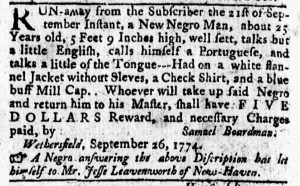
Connecticut Courant (October 10, 1774).

A Negro answering the above Discription has let himself to Mr. Jesse Leavensworth of New-Haven.”

In the fall of 1774, Samuel Boardman of Wethersfield took to the pages of the Connecticut Courant and Hartford Weekly Intelligencer to offer a reward for the capture and return of a “New Negro Man” who liberated himself by running away.  Boardman did not give a name for this man, but instead stated that he “talks but a little English, calls himself a Portuguese, and talks a little of the Tongue.”  He offered a reward to “Whoever will take up said Negro and return him to his Master.”  Dated September 26, the advertisement first appeared in the October 3 edition of the Connecticut Courant.  It included a notation indicating that a “Negro answering the above Discription has let himself to Mr. Jesse Leavensworth of New-Haven.”  Boardman most likely did not include that information in the copy he submitted to the printing office.

Instead, Ebenezer Watson, the printer, likely supplied it upon reading an advertisement that Leavenworth placed in the September 30 edition of the Connecticut Journal and New-Haven Post-Boy.  After all, printers regularly exchanged newspapers in hopes of acquiring content for their own publications.  Leavenworth devoted most of that notice to giving instructions for hiring his ferry, but added a note that recently a “lusty negro man, about 23 or 24 years old, speaks the Portuguese language, but little English” had “let himself to me.”  Leavenworth hired the young man, but was suspicious that he was a fugitive seeking freedom and his enslaver was looking for him.  Just in case, he supplemented his advertisement for the ferry with the description of the Black man who spoke Portuguese.  Given the timing of the advertisements in the two newspapers, Boardman would not have seen Leavenworth’s notice when he drafted his own advertisement.  If he had that information, he could have dispensed with advertising at all.

What role did Watson play in keeping Boardman informed about this development?  He might have dispatched a message to the advertiser in Wethersfield, though he could have considered the note at the end of the advertisement sufficient to update Boardman, figuring that his customer would check the pages of the Connecticut Courant to confirm that his notice appeared.  Watson could have also sent a message to Thomas Green and Samuel Green, the printers of the Connecticut Journal, along with his exchange copy of the Connecticut Courant, expecting they might pass along the information to Leavenworth.  In addition, Leavenworth might have eventually encountered Boardman’s advertisement, depending on his reading habits, or otherwise heard about it.  That alternative seems most likely.  No matter what other action Watson took, inserting the note that connected the unnamed Black man in Boardman’s advertisement in the Connecticut Courant to the unnamed Black man in Leavenworth’s advertisement in the Connecticut Journal alerted readers that they could collect the reward if they decided to pursue the matter.  The power of the press, including a printer whose assistance extended beyond merely setting type and disseminating the advertisement, worked to the advantage of Boardman, the enslaver, against the interests of the unnamed Black man who spoke Portuguese.
September 30

Who was the subject of an advertisement in a colonial American newspaper 250 years ago today?

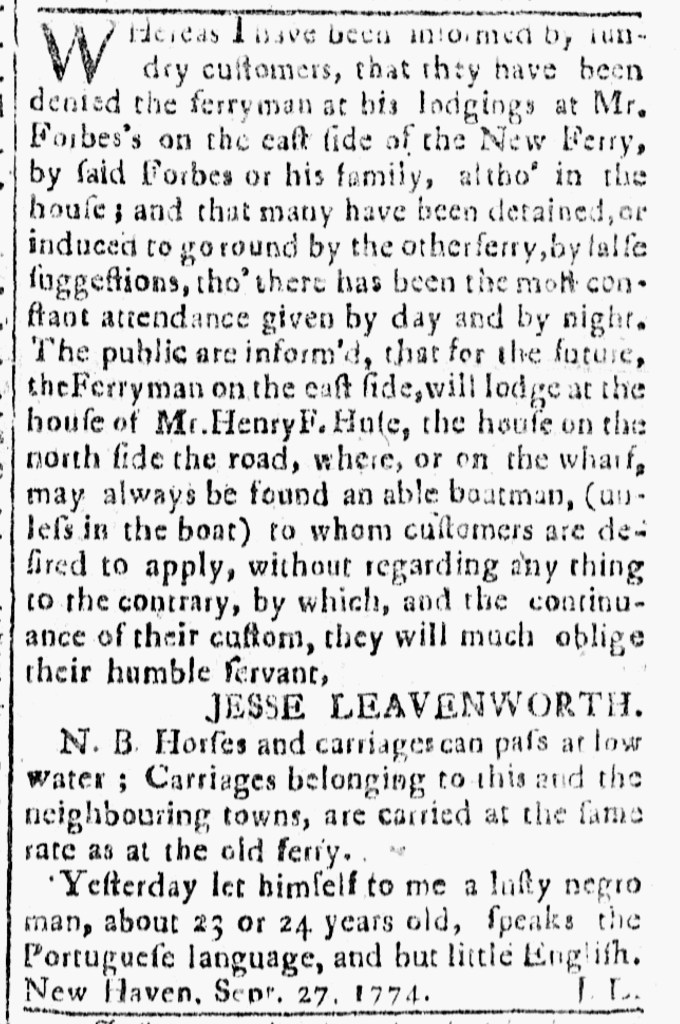
Connecticut Journal (September 30, 1774).

“Yesterday let himself to me a lusty negro man … speaks the Portuguese language.”

At the end of September 1774, Jesse Leavenworth placed an advertisement in the Connecticut Journal and New-Haven Post-Boy to give directions for finding and hiring “the ferryman … in the east side of the New Ferry” since there had recently been some confusion that caused frustration, inconvenience, and delays.  In addition, he briefly noted, “Yesterday let himself to me a lusty negro man, about 23 or 24 years old, speaks the Portuguese language, and but little English.”  In other words, Leavenworth had hired a Black man, yet he had concerns about whether that man was free to make contracts for his labor or had seized his liberty by running away from an enslaver.  In the absence of evidence that the Black man was indeed a fugitive seeking freedom, Leavenworth hired him, yet he also alerted the public in case anyone had more information or was looking for a young Black man who spoke Portuguese an not much English.

The public prints facilitated that sort of surveillance and oversight of Black people in early America, even in Connecticut and other colonies in New England.  Elsewhere in the same issue of the Connecticut Journal, William Smith ran an advertisement that described “a MOLATTO SLAVE, half Negro and half Indian, named DICK” who “RANAWAY from … the South Side of Long-Island” in late August.  Dick did not depart alone.  An “INDIAN FELLOW, named JOE,” accompanied him, fleeing from Nathaniel Woodhull, though Smith did not specify if Joe was indentured or enslaved.  Apparently, he was not free because Smith offered a reward to anyone who “secures him or them in any of his Majesty’s Gaols, or shall bring one or both of them to their Masters.”

Leavenworth could have taken similar action, delivering the unnamed Black man to the jail in New Haven and placing an advertisement for his enslaver to claim him.  Such advertisements appeared with regularity, most often in southern colonies and occasionally in New England.  They demonstrated the precariousness of living their everyday lives that Black people, including free Black men and women, faced since they could be imprisoned solely on the suspicion that they might be enslaved people who escaped from their enslavers.  Although Leavenworth chose to hire rather than imprison the young Black man who spoke Portuguese, his simultaneous decision to make an announcement in the newspaper also testified to the level of suspicion that Black people encountered as well as how colonizers used the power of the press to regulate them.

January 13

Who was the subject of an advertisement in a colonial American newspaper 250 years ago today?

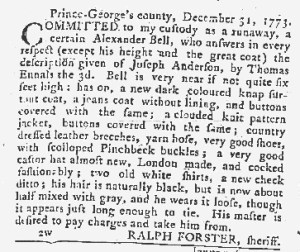
Maryland Gazette (January 13, 1774).

“Alexander Bell, who answers in every respect … the description given of Joseph Anderson.”

Thomas Ennalls offered a reward for the capture and return of “an Irish servant man” who ran away from him in Dorchester County, Maryland, at the end of November 1773.  In an advertisement that first ran in the December 16 edition of the Maryland Gazette, Ennalls described Joseph Anderson’s age, appearance, clothing.  The runaway, “about thirty years of age,” had “a thin visage” and “wears his own hair tied behind” his head.   His apparel included “an old surtout coat, … a knit pattern jacket …, old leather breaches, a pair of ribbed worsted stockings, [and an] English hat cut in the fashion.”  Anderson worked as a schoolmaster, but that position of trust did not prevent him from stealing “about eighteen or twenty pounds in cash” when he broke his indenture contract and ran away. Ennalls suspected that the unscrupulous schoolmaster “may change his name.”

Ralph Forster, the sheriff in Prince George’s County, carefully followed advertisements about runaway indentured servants, convict servants, and apprentices that appeared in the Maryland Gazette.  He also placed notices about suspected runaways that he detained.  In an advertisement that first appeared in the January 13, 1774, edition of the Maryland Gazette, he described “a certain Alexander Bell, who answers in every respect (except his height and the great coat) the description given of Joseph Anderson, by Thomas Ennals.”  Bell was “very near if not quite six feet high,” slightly taller than Anderson’s “five feet nine or ten inches high.”  If he was indeed Anderson, he had changed his name as Ennalls anticipated and may have sold, traded, or discarded the coat.  The rest of the clothing indeed matched, including “a clouded knit pattern jacket, … country dressed leather breeches, yarn hose, [and] a very good castor hat almost new, London made, and cocked fashionably.”  Forster’s requested that his prisoner’s “master … pay charges and take him.”

Among the many purposes served by advertisements in eighteenth-century newspapers, colonizers used them as an infrastructure for surveillance and enforcement in their efforts to maintain order when indentured servants, convict servants, and apprentices ran away from their masters.  They served a similar purpose for capturing enslaved people who liberated themselves and returning them to their enslavers.  Printers enhanced the power and authority already exercised by colonizers like Ennalls and Forster when they sold them space in their newspapers.

May 20

Who was the subject of an advertisement in a colonial American newspaper published 250 years ago this week?

Pennsylvania Packet (May 18, 1772).

“RUN AWAY … a Negro Man, named PETER.”

This advertisement testifies to both the mobility of enslaved people who liberated themselves by fleeing from their enslavers and the efforts of enslavers to capture and return to bondage fugitives seeking freedom.  Peter, “a Negro Man … of a yellow complexion,” escaped from Patrick Simpson’s plantation near Charleston, South Carolina, in the late spring or early summer of 1771.  Nearly a year later, an advertisement describing Peter ran in the Pennsylvania Packet.  The dateline in the advertisement indicated that it had originated in New York, not Charleston.  Hallett and Hazard, merchants who presumably operated on behalf of Simpson, informed readers that they would receive “TEN DOLLARS REWARD” for apprehending Peter and securing him “in any [jail] in Pennsylvania or New-Jersey” and notifying local agents in Philadelphia or Princeton.

What prompted Simpson to believe that Peter might have made it to Pennsylvania, New Jersey, or any of the neighboring colonies?  The advertisement described him as a “sensible, plausible fellow” and indicated that he spoke “very proper E[n]glish.”  Peter may have been able to pose as a free man as he made his way north, especially if it was obvious from his speech that he was “country born” rather than “new” from Africa.  When Simpson could not locate Peter in South Carolina, he might have suspected that he made his way to another colony.

In his attempt to capture and once again enslave Peter, Simpson enlisted the aid of both local agents and the general public.  Hallett and Hazard in New York, Peter Wikoff in Philadelphia, and Peter Gordon in Princeton all assisted Simpson, but the advertisement also called on others to engage in surveillance of Black men they encountered to assess if any of them matched the Peter’s description.  That meant observing their physical characteristics, their clothing, and their comportment as well as assessing their speech.  John Dunlap, the printer of the Pennsylvania Packet, also aided Simpson, earning revenues when he published the advertisement.  Capturing Peter was not simply a local matter, one confined to newspaper notices published in South Carolina and readers in that colony.  Instead, Simpson relied on an extensive apparatus as he sought to once again deny Peter his liberty.

November 9

What was advertised in a colonial American newspaper 250 years ago today?

New-London Gazette (November 9, 1770).

“Said Negro was seen on board Capt. John Rogers’s Sloop.”

When Pompey, an enslaved man, liberated himself by running away in the fall of 1770, Aaron Waitt enlisted the power of the press in his efforts to capture him.  Waitt initially placed advertisements in his local newspaper, the Essex Gazette, to alert residents of Salem, Massachusetts, and the surrounding area that Pompey had departed without his permission.  He provided a description, noting in particular that Pompey was about twenty-three years old, had a scar on his forehead, and wore a dark coat.

The advertisements in the Essex Gazette did not produce the results that Waitt desired, in large part because Pompey understood that mobility was one of the best strategies for freeing himself.  According to advertisements that Waitt subsequently placed in the New-London Gazette, the New-York Gazette and Weekly Mercury, and the Providence Gazette, Pompey boarded “John Roger’s Sloop,” the Free Mason, “at East-Greenwich, in the Colony of Rhode Island” on October 18 and then sailed to New York.  Pompey apparently tried to place himself out of reach of his enslaver, but that only prompted Waitt to broaden the scope of his advertising to newspapers in other colonies.  When he did so, he added details to aid readers in identifying Pompey.  Waitt noted the enslaved man’s height and reported that he was “a Leather-Dresser by Trade” who “speaks good English.

Waitt’s advertisements in several newspapers published in New England and New York contributed to a culture of surveillance of Black men already in place in the colonies.  Advertisements for enslaved people who liberated themselves amounted to an eighteenth-century version of racial profiling, encouraging readers far and wide to scrutinize Black people when they encountered them.  Waitt and others asked colonists to carefully observe the bodies, clothing, and comportment of Black men and women to determine whether they matched the descriptions published in newspapers.  In the case of Waitt and Pompey, such efforts were not confined to one locality or media market but instead extended across an entire region as the enslaver inserted advertisements in multiple newspapers.

November 3

What was advertised in a colonial American newspaper 250 years ago today?

Providence Gazette (November 3, 1770).

“RUN away … a Negro Man Servant, named Pomp.”

Like all newspapers published in colonial America, the Providence Gazette ran several sorts of “runaway” advertisements.  These included notices about indentured servants and apprentices who departed from their masters before their time of service concluded.  Other notices described enslaved people who seized their liberty, offering rewards to readers who captured them and returned them to bondage.  Husbands also turned to the public prints to place notices about disobedient wives who “eloped” from them.  Unlike the advertisements for indentured servants, apprentices, and enslaved people, these did not seek the return of wives to their husbands but instead warned that the aggrieved spouse would no longer pay debts accumulated by their absent wives.  The subjects of these notices were uniformly depicted as the transgressors, yet the advertisements implicitly testified to discord and exploitation perpetrated by the advertisers.  Runaways exercised one form of power available to them as they sought to improve their circumstances.

The various kinds of runaway advertisements promoted a culture of surveillance in early America, enlisting colonists to scrutinize the bodies, clothing, and comportment of people they encountered.  In particular, such notices focused attention on people who, at a glance, appeared to belong among the ranks of the lower sorts.  The November 3, 1770, edition of the Providence Gazette featured an advertisement concerning Pomp (or Pompey), “a Negro Man Servant,” who escaped from his enslaver.  Aaron Waitt described Pomp’s age, physical characteristics, including a scar on his forehead, clothing, and linguistic ability, noting that he “speaks good English.”  Waitt resided in Salem, Massachusetts, and also placed notices in the Essex Gazette, the newspaper published in that town.  Yet he apparently traced Pomp as far as Rhode Island, asserting that he received reports that the fugitive seeking freedom boarded the Free Mason when it sailed from East Greenwich to New York and Carolina.  Waitt used the public prints to encourage surveillance of Black men while targeting Pomp far beyond the towns in the vicinity of Salem. No matter the distance that Pomp put between himself and his enslaver, he had to be wary about encountering colonists who had seen the advertisements that described him and offered rewards for his capture and return.

April 7

What was advertised in a colonial American newspaper 250 years ago today?

Apr 7 - 4:7:1770 South-Carolina Gazette and Country Journal Supplement
Supplement to the South-Carolina Gazette and Country Journal (April 7, 1770).

“RUN-AWAY … a NEGRO FELLOW, named MONDAY.”

Newspaper coverage of the Boston Massacre in the weeks after it happened resulted in greater dissemination of advertisements entreating surveillance of Black men in South Carolina.  How did the one cause the other?  Following widespread custom, colonial printers did not write original articles about the Massacre but instead reprinted items from other newspapers.  Thus, the same story about the funeral procession for the victims appeared in both the South-Carolina Gazette and the South-Carolina Gazette and Country Journal within a couple of days of each other, copied either from its original source in the Boston-Gazette or another newspaper that reprinted the story from the Boston-Gazette.  Peter Timothy ran it in the April 5, 1770, edition of the South-Carolina Gazette, exactly one month after the Boston Massacre took place.  The story first appeared in the March 12 edition of the Boston-Gazette.  It took nearly four weeks for it to appear in a newspaper printed in South Carolina.

Charles Crouch, printer of the South-Carolina Gazette and Country Journal, did not allow Timothy, his competitor, to provide the colony’s only coverage of the shocking event.  He had just published his newspaper on April 3.  Given that most colonial newspapers distributed one issue per week, the South-Carolina Gazette and Country Journal was not scheduled for another edition until April 10 … but this news was too momentous to wait that long to take it to press.  Instead, Crouch published a two-page supplement on April 7.  The entire front and much of the back of that broadsheet featured news from Boston, including a woodcut of four coffins that closely replicated the one that accompanied the original article in the Boston-Gazette.  Although other newspapers that reprinted the story included woodcuts, none were as detailed as the one in the Boston-Gazette.  That being the case, Crouch most likely drew his coverage directly from that newspaper rather than another that reprinted it.

The space required for the news from Boston left a column and a half for other content.  Crouch filled that space with advertisements, including two advertisements for enslaved men who escaped from colonists who held them in bondage.  John Marley described “a neg[r]o fellow named GEORGE” who seized his own liberty five months earlier in November.  Humphry Sommers advertised “a NEGRO FELLOW, named MONDAY,” who escaped the day before the Boston Massacre took place hundreds of miles away in Massachusetts.  Both advertisements encouraged readers to engage in careful scrutiny of Black men to determine if they might be George or Monday.  Both Marley and Sommers offered rewards to colonists who helped capture the Black men they claimed as property.  Arguably, these notices received greater attention for having appeared in a supplement devoted to the Boston Massacre than when they ran in the standard issue of the South-Carolina Gazette and Country Journal.  Had it not been for Crouch issuing that supplement, these advertisements encouraging the surveillance of Black men would not have circulated as widely.

Apr 7 - Boston Massacre in South-Carolina Gazette and Country Journal Supplement
Supplement to the South-Carolina Gazette and Country Journal (April 7, 1770).

December 29

What was advertised in a colonial American newspaper 250 years ago today?

Dec 29 - 12:29:1769 New-London Gazette
New-London Gazette (December 29, 1769).

“A negro Man named TOM … has a scar on one of his wrists.”


The final issue of the New-London Gazette published in 1769 included several advertisements that encouraged surveillance of Black men, women, and children. The last column consisted almost entirely of advertisements concerning enslaved people who escaped from those who held them in bondage. Those enslaved people seized their own liberty at the same time that colonists complained about their supposed enslavement to Britain as a result of various measures enacted by Parliament, including duties levied on certain imported goods by the Townshend Acts.

The advertisements in the New-London Gazette encouraged readers to begin the new year by carefully observing Black people they encountered, assessing whether they matched the descriptions published in the newspaper. Each offered a reward as an incentive for participating in an eighteenth-century version of racial profiling, but only if that participation resulted in the capture and recovery of enslaved people who “Ran-away from their Master.”

Theophilus Hopkins advised colonists that Joseph Cuffe “speaks good English [and] very well understands playing on a violin.” Two other characteristics may have made him even easier to identify: he “has lost both his great toes” and he “went off in company with a small indian squaw.” Hopkins reported that Cuffe had been spotted with the Indian woman in the eastern part of Connecticut in the time since making his escape. In so doing, he encouraged colonists not only to observe individual Black people but also to take note of the company they kept.

Samuel Chapman similarly emphasized looking for specific configurations of people, in this instance a family that consisted of Newport, “a Negro Man Servant … of a light swarthy Complexion,” his wife, Sarah, and six children ranging in age from two to fifteen. The three eldest were boys – Rufus, Israel, and Gershon – followed by two girls – Rhena and Chloe – and then another boy – Amos. Like Cuffe, Newport could also be recognized by a unique physical attribute: he “has lost the Top of one or two of his Fingers on one Hand, by the firing of a Pistol.” Observers may have detected that more readily than Cuffe’s missing toes, but in each instance they were encouraged to engage in careful scrutiny of Black bodies.

Isaac Tanner of South Kingston, Rhode Island, was so eager to recapture “a negro Man named TOM” that he offered “SIX DOLLARS reward” in an advertisement in the New-London Gazette, apparently suspecting that Tom made his way to Connecticut. Tanner noted that the fugitive “often calls himself TOM CARD,” suggesting that he asserted agency in shaping his identity before making his escape. Tanner described the clothes that Card wore when he departed, but also stated that he “has a scar on one of his wrists.” Once again, an advertiser invited readers of the New-London Gazette to carefully examine Black bodies to identify or eliminate the Black people they encountered as suspected runaways.

This concentration of advertisements about enslaved men, women, and children who escaped on the final page of the New-London Gazette testifies to the widespread surveillance of Black bodies in the colonies on the eve of the American Revolution. This was not a feature of southern colonies alone. Instead, from Georgia to New England, enslavers mobilized the press for purposes of surveillance of Black people in service of recapturing those who escaped.

December 16

What was advertised in a colonial American newspaper 250 years ago today?

Dec 16 - 12:16:1769 Providence Gazette
Providence Gazette (December 16, 1769).

“RUN away … an Apprentice Lad.”

In December 1769, David Smith turned to the Providence Gazette when his apprentice, Eliazer Peck, “a Shoemaker by Trade,” departed without his permission. After Peck had been away for a week and Smith determined that he was unlikely to return of his own accord, he placed an advertisement that described the apprentice and offered a reward to anyone who “takes up and secures the said Apprentice, so as his Master may have him again.” Smith also advised that “All masters of Vessels are forbid to carry him off.” He did not want the delinquent apprentice further removing himself from his authority by sailing to another colony or elsewhere in the Atlantic world.

To aid in identifying the apprentice, Smith described both is physical features and the clothes he wore. He asked readers of the Providence Gazette to keep their eyes open for “a short thick-set Lad, round-shouldered, … full-faced.” Readers might also recognize his “brownish Coat, a short double-breasted Jacket, [and] blue knit Breeches.” If he did not acquire different garments, Peck could alter his appearance slightly by changing shirts; he took with him “two striped and one white Shirt.” To further aid in recognizing the apprentice, Smith gave his approximate age, “about 19 Years,” and hinted at his personality, noting he “has a Humour in his Eyes.”

Smith’s advertisement followed the same pattern as so many others that appeared in eighteenth-century newspapers throughout the colonies. That genre of notices described unfree laborers of various sorts: apprentices, indentured servants, convict servants, and enslaved men, women, and children. Such advertisements used the public prints as a mechanism of surveillance, encouraging colonists to closely examine people they encountered to determine if they matched the descriptions published in the most recent newspapers. These advertisements allowed those who already possessed greater authority and resources to exercise even more power by recruiting an entire community to aid them in capturing and returning runaway servants and apprentices and enslaved people who seized their own liberty by escaping from those who held them in bondage.

When they purchased advertising space in newspapers, colonists deployed the power of the press for various purposes. Some promoted the expansion of consumer culture by encouraging readers to acquire goods and services. Others posted legal notices for settling accounts with the estates of deceased colonists. Some offered employment opportunities. A good many utilized newspapers, the most widely circulated form of media of the period, to engage in surveillance of others, appealing to readers to carefully scrutinize their fellow colonists to detect and return runaways.