
What was advertised in a revolutionary American newspaper 250 years ago today?
“A distracted Man!”
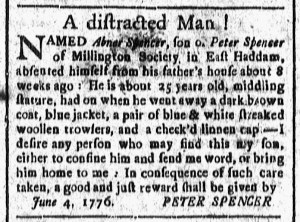
Peter Spencer sought the public’s assistance in locating his son Abner. He placed an advertisement in the June 7, 1776, edition of the Connecticut Gazette because Abner “absented himself from his father’s house” in East Haddam “about 8 weeks ago.” This does not seem to have been a case of any sort of discord that resulted in a rebellious son running away from the obedience demanded by his father. Instead, the headline described Abner as “A distracted Man,” suggesting that he had cognitive, intellectual, or developmental disabilities. Somehow, Abner had “absented himself” from the care of his father’s household.
Spencer published an alert, just as Elizabeth Fales of Walpole, Massachusetts, had done in the summer of 1774 when Jonathan Fales, a “Non Compos Mentis” man, “did … leave his House and Family … and has not been Home since.” Fales offered a reward to anyone “so kind to a distress’d Woman as to bring him home (without abusing him) or give Information that he may be found.” Similarly, Spencer promised a “good and just reward” to “any person who may find this my son, either to confine him and send me word, or bring him home to me.” To help identify Abner, his father described him as “about 25 years old, middling stature,” and wearing a “dark brown coat, blue jacket, a pair of blue & white streaked woollen trowsers, and a check’d linnen cap.”
Spencer’s advertisement about Abner happened to appear immediately below James Rogers’s notice offering a reward for the capture and return of a “Mustee Fellow named SY,” also “about 25 Years of Age,” who had liberated himself by running away from his enslaver in March. Rogers provided a lengthy description of Sy, even noting that he took a fiddle with him, and warned that “Masters of Vessels are forbid to carry off said Slave.” These notices that ran one after the other both concerned missing persons, yet the advertisers who placed them had very different purposes in doing so. Rogers aimed to use the power of the press to return a young man to slavery, while Spencer treated his advertisement as a means of disseminating news that was exceptionally important to a household responsible for providing care for a son who needed their support. One young man would benefit if the advertisement was successful, while the other certainly would not.