September 30

What was advertised in a revolutionary American newspaper 250 years ago today?
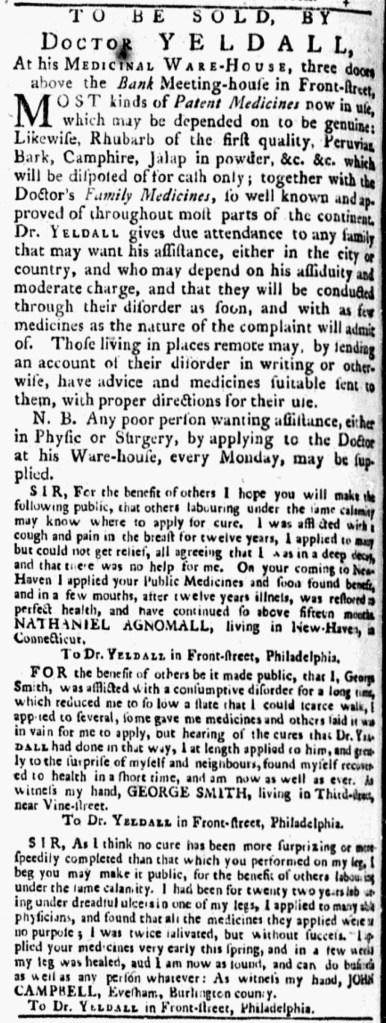
Pennsylvania Ledger (September 30, 1775).

“To the surprise of myself and neighbours, found myself recovered to health.”

Doctor Yeldall apparently believed that testimonials worked.  In June 1775, he published an advertisement that included several testimonials from his patients.  Three months later, he once again promoted his “MEDICINAL WARE-HOUSE’ in Philadelphia with an advertisement that featured three new testimonials.  The notice gave the impression that the doctor had not solicited them, but instead merely published letters addressed “To Dr. YELDALL in Front-Street, Philadelphia” at the request of those who sent them.  “For the benefit of others I hope you will make the following public,” Nathan Agnomall’s testimonial began.  Similarly, John Campbell, who had suffered “dreadful ulcers in one of my leges,” implored the doctor: “I beg you may make it public, for the benefit of others labouring under the same calamity” that Yeldall’s medicines healed leg.

In his preamble to the testimonials, Yeldall described his “Doctor’s Family Medicines” as “so well known and approved of throughout most parts of the continent.”  Two of the testimonials did indeed come from beyond Philadelphia.  Campell listed his address as “Eversham, Burlington county,” in New Jersey, while Agnomall stated that he was “living in New-Haven, in Connecticut.”  The third testimonial, however, came from a resident of Philadelphia, George Smith, “living in Third-street, near Vine-street.”  Skeptics in that city could question the veracity of letters that supposedly arrived from other colonies, but they might know Smith or could seek him out to confirm what they saw printed in the newspaper advertisement.  Smith’s letter even revealed that he had been cured of a “consumptive disorder” and “to the surprise of myself and neighbours, found myself recovered to health.”  Many residents of Philadelphia living in Smith’s neighborhood could also testify to the efficacy of the Yeldall’s medicines, at least that was the inference in Smith’s letter.  Unlikely to attempt to track down Smith or interview any of his neighbors, prospective patients who had not found relief through any other means may have found this testimonial convincing enough to give Yeldall’s medicines a chance.  Even if they had doubts, the details in Smith’s letter gave them hope by encouraging them to believe something that was likely too good to be true.

September 23

What was advertised in a revolutionary American newspaper 250 years ago today?

Virginia Gazette [Dixon and Hunter] (September 21, 1775).

“EVERY MAN HIS OWN DOCTOR.”

Like many other printers, John Dixon and William Hunter supplemented revenues from newspaper subscriptions, advertisements, and job printing by hawking patent medicines.  They ran an advertisement for “Dr. KEYS[E]R’s celebrated PILLS” in the September 23, 1775, edition of their newspaper, marketing a familiar remedy for “the Veneral Disorder.”  In addition to curing venereal diseases, the pills reportedly “restored Persons afflicted with dropsical Disorders, the Gravel [or kidney stones], Palsey, Apoplexy, White Swellings, Stiff Joints, and the Asthma.”

Yet, Dr. Keyser’s Pills were especially known for their efficacy in treating venereal disease, so much so that Dixon and Hunter offered a short history intended to assure prospective patients that they could depend on finding relief from their symptoms if they purchased the pills.  “His Majesty ordered the most rigid and nicest Examination, by twenty seven of the principal Physicians and Surgeons,” the printers reported.  They did so “not only immediately upon the Persons having been treated with the Medicine, but even for the Space of two Years afterwards, to see if the cures of all the numerous Patients were durable.”  This trail demonstrated that the pills were indeed effective: “to the eternal Honour of Dr. Keyser, there was not found a single Instance of Failure.”  Such an extraordinary outcome prompted the king to establish a hospital “where these Pills alone are administered.”  In addition, physicians on the continent had also “pronounced the Use of [Dr. Keyser’s Pills] superior in Efficacy, to all the Modes of Practice hitherto discovered.”

Beyond their effectiveness, the pills had another important advantage.  “EVERY MAN HIS OWN DOCTOR,” the headline proclaimed, echoing a similar headline, “Every One their own Physician,” that James Rivington, a printer in New York, previously used in promoting Dr. Keyser’s Pills.  Prospective customers, Dixon and Hunter suggested, could purchase the pills and use them without exposing themselves to the embarrassment of consulting a physician or, even worse, having their symptoms become visible to others.  “The Patient is most effectually cured,” the printers explained, “without any inconvenience to himself, or being exposed to the Shame or Confusion of his Disaster being known to the nicest Observer.”  Referring to “his Disaster” was a telling alternative to “his Disorder,” one intended to stoke anxiety in hopes of convincing readers afflicted with venereal disease to purchase Dr. Keyser’s Pills.  The printers conveniently acquired “a fresh Parcel lately from PARIS,” where the doctor’s widow continued making the pills.

June 25

What was advertised in a revolutionary American newspaper 250 years ago this week?

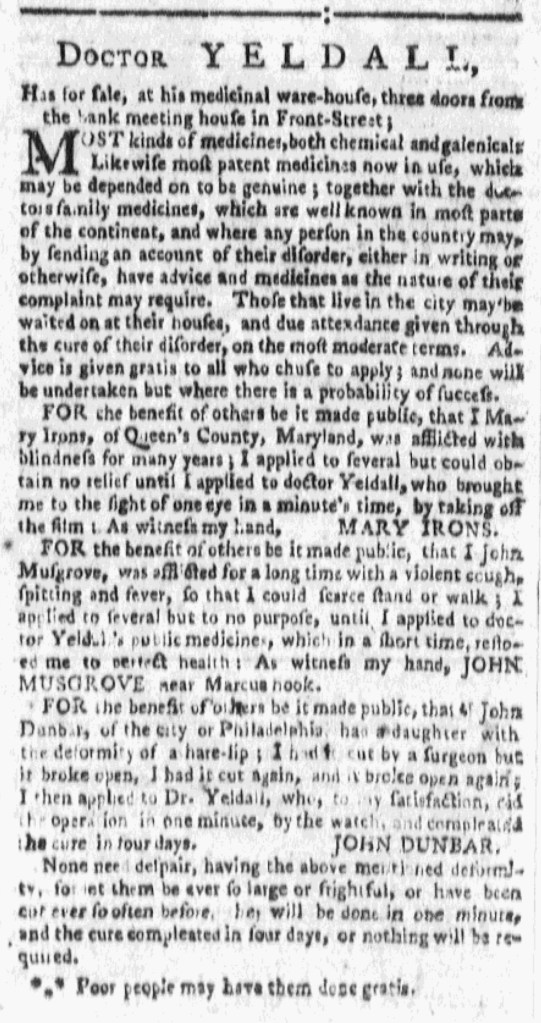
Rivington’s New-York Gazetteer (June 22, 1775).

“The doctors family medicines, which are well known in most parts of the continent.”

Doctor Yeldall ran his advertisement for remedies available “at his medicinal ware-house” on Front Street in Philadelphia in Rivington’s New-York Gazetteer at the same time that it appeared in the Pennsylvania Ledger.  He did, after all, claim that the “doctors family medicines” that he produced as an alternative to other patent medicines were “well known in most parts of the continent” and advised that “any person in the country may, be sending an account of their disorder … have advice and medicines as the nature of their complaint may require.”  Yeldall operated the eighteenth-century version of a mail order pharmacy.  Advertising in Rivington’s New-York Gazetteer: Or, the Connecticut, Hudson’s River, New-Jersey, and Quebec Weekly Advertiser placed his notice before the eyes of many more prospective patients.  In addition to selling medicines, Yeldall also performed medical procedures.  Two of the four testimonials in the original advertisement described restoring sight “by taking off the film” from a patient’s eye and repairing “the deformity of a Hare-Lip.”  New York was close enough to Philadelphia that Yeldall may have expected that some prospective patients who exhausted their options in one place would travel to Philadelphia in hopes that he would successfully treat them.

The advertisements in the two newspapers were nearly identical.  The use of capital letters and italics varied, likely the result the decisions made by compositors in the two printing offices.  That was usually the case when advertisers submitted the same copy to multiple newspapers.  The version in Rivington’s New-York Gazetteer lacked the longest of the four testimonials that ran in the Pennsylvania Ledger.  The compositor might have removed Alexander Martin’s description of how Yeldall “recovered me to my perfect health” after being “afflicted with a consumptive disorder for upwards of three years” in the interest of space.  Yeldall’s advertisement ran at the bottom of the final column on the third page of the June 22, 1775, edition of Rivington’s New-York Gazetteer, making it one of the last items inserted during the production of that issue.  The compositor, lacking space for the entire advertisement, may have simply removed one of the testimonials.  The notice still made the point that Yeldall supposedly cured several patients who “could obtain no relief” until they sought medical care from him.

June 17

What was advertised in a revolutionary American newspaper 250 years ago today?

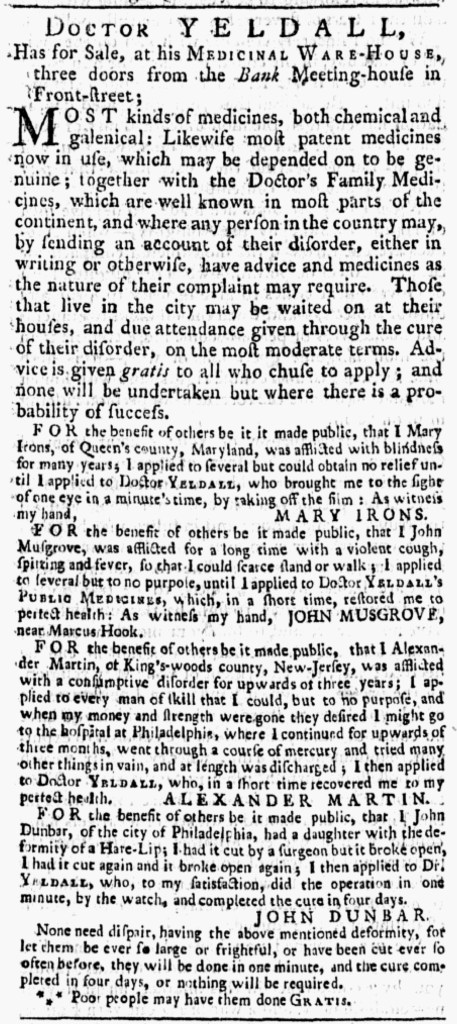
Pennsylvania Ledger (June 17, 1775).

“I applied to Doctor YELDALL’S PUBLIC MEDICINES, which, in a short time, restored me to perfect health.”

An advertisement placed by “DOCTOR YELDALL” in the June 17, 1775, edition of the Pennsylvania Ledger advised the public that he sold “MOST kinds of medicines” at his “MEDICINAL WARE-HOUSE” on Front Street in Philadelphia.  He carried “most patent medicines now in use” as well as his own line of “the Doctor’s Family Medicines,” which, he claimed, “are well known in most parts of the continent.”  Customers residing in the country could send orders for Yeldall to fill, while those in the city could arrange to “be waited on at their houses, and due attendance given through the cure of their disorder.”  The doctor did not charge for consultations, nor did he commence treatment except “where there is a probability of success.”  He attempted to build trust with prospective patients in his advertisement.

To that end, he also published a series of testimonials, hoping that former patients would prove even more convincing than his own description of his services.  Each started with the same phrase, “FOR the benefit of other be it made public,” suggesting that Yeldall solicited the testimonials and assisted in drafting them (or perhaps even wrote them himself).  In one, John Musgrove, who lived near Marcus Hook, Pennsylvania, reported that he “was afflicted for a long time with a violent cough, spitting and fever” to the point that he “could scarce stand or walk.”  He sought assistance “but to no purpose, until [he] applied to Doctor YELDALL’S PUBLIC MEDICINES.”  They quickly restored him to “perfect health.”  Alexander Martin “of Kings-woods county, New-Jersey” similarly declared that he “was afflicted with a consumptive disorder for upwards of three years,” during which time he “applied to every man of skill that [he] could, but to no purpose.”  He even entered the “hospital at Philadelphia” and stayed for three months, enduring “a course of mercury” and “tried many other things in vain.”  Only after his discharge from the hospital did Martin seek aid from Yeldall, who “in a short time recovered me to my perfect health.”  According to Martin and Musgrove, the doctor’s methods were both fast and effective.

In addition to prescribing the right medicines to treat his patients’ maladies, Yeldall also performed medical procedures.  In one testimonial, Mary Irons of Queen’s County, Maryland, declared that she “was afflicted with blindness for many years.”  She “applied to several, but could obtain no relief until I applied to Doctor YELDALL, who brought me to the sight of one eye in a minute’s time, by taking off the film.”  John Dunbar “of the city of Philadelphia” told of a surgeon who unsuccessfully treated his daughter.  She had “the deformity of a Hare-Lip” that “broke open” after the surgeon “cut” it.  Dunbar then took his daughter to Yeldall, “who, to my satisfaction, did the operation in one minute, by the watch, and completed the cure in four days.”  Yeldall added a note that others with “the above mentioned deformity” did not need to “dispair,” no matter how “large or frightful, or hav[ing] been cut so often before,” because his procedure “will be done in one minute, and the cure completed in four days” or else he did not charge for his services.  Perhaps the focus on how quickly the doctor performed these operations was meant to reassure prospective patients that they would not experience prolonged discomfort during a procedure.

Yeldall’s promises seemed too good to be true … and they almost certainly were.  Yet the “DOCTOR” realized that some prospective patients were likely desperate for any sort of treatment that they could hope for a different outcome.  As they searched for hope, he expected that his own promises and, especially, testimonials supposedly composed by his former patients would convince the afflicted to give him a chance to restore them to health.

February 28

What was advertised in a colonial American newspaper 250 years ago today?

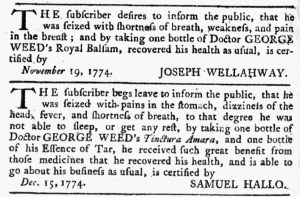
Pennsylvania Evening Post (February 28, 1775).

“By taking one bottle of Doctor GEORGE WEED’s Royal Balsam, recovered his health.”

A notice signed by Joseph Wellahway appeared in the February 28, 1774, edition of the Pennsylvania Ledger for the purpose of “inform[ing] the public, that he was seized with shortness of breath, weakness, and pain in the breast; and by taking one bottle of Doctor GEORGE WEED’s Royal Balsam, recovered his health as usual.”  Wellahway “certified” that testimonial on November 19, 1774.  Immediately below, Samuel Hallo offered a more elaborate endorsement, signed on December 15, 1774.  He recounted that he “was seized with pains in the stomach, dizziness of the head, fever, and shortness of breath, to that degree he was not able to sleep, or get any rest.”  He finally found relief “by taking one bottle of Doctor GEORGE WEED’s Tinctura Amara, and one bottle of his Essence of Tar.”  When he did that, “he received such great benefit from those medicines that,” like Wellahway, “he recovered his health, and is able to go about his business as usual.”

Weed, who regularly placed advertisements in Philadelphia’s newspapers, did not supplement these testimonials with a notice of his own, not even to direct prospective patients to his shop.  He likely believed that he had established such a reputation in the city that he did not need to do so.  It was not the first time he adopted that strategy.  An advertisement in the Pennsylvania Chronicle five years earlier featured testimonials from Jacob Burroughs, Margaret Lee, Tabitha Wayne, and Elizabeth Beach.  Each of those names may have seemed more plausible to skeptical readers than Joseph Wellahway and Samuel Hallo.  In December 1772, Weed concluded an advertisement with a note from a minister to certify that he “was under the Instructions and Directions of a judicious Practitioner of Physic, in New-England, from some Years,” though that missive was dated almost two decades earlier.  Some or all these endorsements may have been genuine, yet Weed might have manufactured some of them to market his remedies.  Prospective patients, then as now, likely embraced the veneer of authenticity in hopes that the medicines would indeed deliver the promised results.

October 24

What was advertised in a colonial American newspaper 250 years ago this week?

Rivington’s New-York Gazette (October 21, 1773).

“In a short time JAMES RIVINGTON will publish some other particulars of the efficacy of Dr. KEYSER’s PILLS.”

Like many other colonial printers, James Rivington supplemented revenues from the usual operations of his printing office by peddling patent medicines.  In particular, Rivington hawked Dr. Keyser’s Pills, one of the most popular treatments for venereal disease in eighteenth-century America.  This remedy was so popular that often name recognition alone marketed the pills to prospective customers.  For many weeks in the fall of 1773, Rivington ran a short advertisement that proclaimed, “EVERY ONE THEIR OWN PHYSICIAN, BY THE USE OF Dr, KEYSER’s PILLS.”  A border comprised of decorative type enclosed the bold headline and a promise that the medicine would “infallibly cure a DISEASE, not to be mentioned in a News-Paper, without the Knowledge of the most intimate Friends.”  For those still too embarrassed to purchase the pills, Rivington noted that they “are also wonderfully efficacious in curing the RHEUMATISM,” providing a cover story for prospective customers who wished to make use of it.

On occasion, Rivington enhanced that candid advertisement with descriptions of “CURES Performed by KEYSER’s PILLS,” giving examples to readers who still needed more convincing about whether they should invest in the medicine.  In the October 24 edition of Rivington’s New-York Gazetteer, for instance, the printer included three stories of patients who had been cured of “a fashionable disease.”  The most remarkable concerned a pregnant woman whose child “was born with the distemper.”  When the mother’s symptoms “grew very alarming,” she took the pills and recovered.  The infant’s wet nurse also took the pills and “the child, from the effect of the pills taken by the nurse, was perfectly restored to health.”  According to this story, Dr. Keyser’s Pills were so effective that they even cured a baby breastfeeding from a woman directed to take them!  The other two stories told of patients who had long suffered “with the same disease” and the “severest courses prescribed” by physicians, yet “restored” or “relieved” when they resorted to Dr. Keyser’s Pills.  Once again, Rivington avoided associating the pills exclusively with venereal disease.  To that end, he inserted other examples: “In the RHEUMATISM,” “In APOPLEXIES,” “In the ASTHMA,” and “A WHITE SWELLING.”  That swelling almost resulted in “the amputation of an arm,” but the patient experienced “a radical cure” upon taking Dr. Keyser’s Pills.”

That did not exhaust the stories of successful treatments, just the amount of space that Rivington devoted to advertising the pills in that issue of his newspaper.  He concluded his advertisement with a note that “In a short time [he] will publish some other particulars of the efficacy of Dr. KEYSER’s PILLS,” though he did not indicate if he intended to do so with newspaper advertisements, handbills, broadsides, or pamphlets.  The media mattered less than alerting prospective customers that the printer had access to similar stories.  They could wait to examine those or consider that sufficient enough justification to acquire the pills to start down their own road to recovery.

January 4

What was advertised in a colonial American newspaper 250 years ago today?

Massachusetts Gazette and Boston Post-Boy (January 4, 1773).

“More certificates may be seen, and any other particulars concerning them fully explained.”

Michael B. Goldthwait placed an advertisement for “Dr. KEYSER’S celebrated PILLS” in the January 4, 1773, edition of the Massachusetts Gazette and Boston Post-Boy, yet he had little to do with generating the copy.  Instead, he republished an advertisement that previously ran in the New-York Gazette and Weekly Mercury.  James Rivington, a printer and bookseller in New York, hawked the patent medicine to generate additional revenue.  He placed an advertisement that made a patient’s “certificate” or testimonial about the efficacy of Keyser’s pills its main focus.  Goldthwait may have worked with Rivington when he decided to reprint the advertisement in one of Boston’s newspapers.  Given the wide circulation of colonial newspapers, however, he Goldthwait may have seen Rivington’s advertisement in a copy of the New-York Gazette and Weekly Mercury that made its way to Boston and decided to appropriate it for his own use.

Goldthwait made only a few revisions to the notice before submitting it to a local printing office.  He altered the headline from “KEYSER’s PILLS” to “Dr. KEYSER’S celebrated PILLS” and streamlined the introductory paragraph that gave context for William Shipman’s testimonial, softening some of the language about the “purchase money” necessary to acquire the medicine.  The entire testimonial appeared, including Shipman’s assertion that it “is a faithful relation of my Case, and I can with an honest confidence recommend the Medicine to those who are afflicted with any Rheumatic complaints.”  Goldthwait did devise one significant embellishment.  Rivington concluded the original advertisement with an offer to provide “very satisfactory information” to anyone “desirous of enquiring further to the efficacy of this medicine,” but Goldthwait claimed that he had “more certificates” or testimonials at his shop near the Mill Bridge.  Those certificates likely included testimonials he published in an advertisement in August 1772.  Furthermore, Goldthwait could supply “other particulars” that “fully explained” those certificates.

When it came to advertisements appearing in multiple newspapers published in a town or city, merchants, shopkeepers, artisans, and other purveyors of goods and services often placed the same notice in more than one publication.  In terms of advertisements for consumer goods appearing in multiple newspapers published in different cities, that most often occurred with subscription notices for books, pamphlets, newspapers, and other printed materials as printers attempted to generate sufficient demand to make those ventures viable.  Apothecaries, shopkeepers, printers, and others throughout the colonies advertised Keyser’s pills, but they did not coordinate their marketing messages.  Shipman’s testimonial running in newspapers in Boston and New York was a rare instance of entrepreneurs in two towns exposing consumers to the same marketing campaign.

December 14

What was advertised in a colonial American newspaper 250 years ago today?

New-York Gazette and Weekly Mercury (December 14, 1772).

“The underwritten certificate, from one well known in New-York, and now in perfect health.”

James Rivington is best remembered today as a Loyalist printer who published a newspaper during the era of the American Revolution.  Before he launches his newspapers, he often placed advertisements for “KEYSER’s PILLS” in other newspapers published in New York in the early 1770s.  Whether or not they published newspapers, printers frequently stocked patent medicines, along with books, stationery, and writing supplies, to generate additional revenues.  That being the case, colonizers would not have considered it unusual to encounter advertisements in which Rivington hawked a medicine to those afflicted with venereal disease.

In an advertisement that ran in the New-York Gazette and Weekly Mercury for several weeks in late November and early December 1772, the printer advised that “Any Person desirous of being made more particularly acquainted” with the efficacy of Keyser’s Pills “than can be decently communicated in an Advertisement” could discuss the remedy with him and then “try a Method the easiest and safest, and so secret that the Patient may be cured” without anyone “harbouring the least Suspicion” of their “lamentable Circumstances.”  Yet Keyser’s Pills had an ameliorative effect on more than just venereal diseases.  Rivington devoted a section of his advertisement to how the pills had “Great Effects” on “THE RHEUMATISM” and concluded by noting that they would “cure a Negro in the worst Stage of the Yeaws.”

On December 14, Rivington placed a new version of his advertisement.  He asserted that Keyser’s Pills were so effective in alleviating “every appearance of the venereal distemper” that “persons tormented with other diseases” made “tryals” of the pills.  Those patients included William Shipman, “well known in New-York,” who “was a long time the verist of cripples” but now, as a result of taking Keyser’s Pills, was “in perfect health.”  Rivington referred readers to a “Copy of W. Shipman’s certificate” or testimonial that provided an overview of his suffering as a result of being “so violently afflicted with the rheumatism,” his disappointment with other medicines, his decision to “make trial of Dr. Keyser’s pills,” and the “suprizing relief” that he began experiencing after only two weeks.  Shipman continued taking the pills “without any other consequence but that happy one of being restored to perfect health and ease.”

Shipman’s testimonial comprised half of Rivington’s advertisement, indicating that the printer believed it would effectively market Keyser’s pills to prospective patients.  Rivington acknowledged that Shipman “took a great many of the pills, which made his cure expensive.”  Yet the effectiveness justified the expense.  The “health, strength and agility” that Shipman “now enjoys,” Rivington argued, “is an ample compensation for the purchase money.”  Consumers could acquire “boxes of Ten, Twenty, and Forty Shillings each” as they made their own “tryals” of the pills and determined how much they wished to invest.  Rivington likely intended that Shipman’s testimonial about taking the pills over a period of several months would convince customers to purchase in larger quantities in hopes of achieving the same results.

October 26

What was advertised in a colonial American newspaper 250 years ago today?

Supplement to the New-York Gazette and Weekly Mercury (October 26, 1772).

“JAMES RIVINGTON Takes Leave to exhibit a second Advertisement of Articles just imported in the Rose.”

Bookseller and shopkeeper James Rivington placed two advertisements in the New-York Gazette and Weekly Mercuryafter receiving new inventory via the Rose in the fall of 1772.  In the first, he listed dozens of titles, including “Grotius on War and Peace,” “a new Edition of Salmon’s Geographical Grammar,” and “the whole Works of the inimitable Painter Hogarth, in one Volume, with all the Plates he published.”  In addition, he stocked “a fine Assortment of venerable Law Books,” “a fine Assortment of Classicks,” and magazines published in London.  Like so many other newspaper notices placed by booksellers, Rivington’s advertisement served as a book catalog adapted to a different format.

Rivington devoted his second advertisement to other merchandise, stating that he “Takes Leave to exhibit” an additional entry in the public prints to advise prospective customers about “Articles just imported in the Rose, Capt. Miller, different from his literary Exhibition of this Day.”  That advertisement featured a variety of items and marketing strategies.  In a single paragraph, it had sections for musical instruments, patent medicines, clothing, and swords for “Those Gentlemen who propose to take the Field.”

Rather than merely list the patent medicines, Rivington inserted testimonials to assure consumers they were authentic: “Turlington’s Balsam: We certify that the Balsam advertised and sold by Mr. James Rivington, is the genuine sort purchased from us, made from the Receipt left by Mr. Turlington, to us, MARY WRAY, MARY TAPP.”  Similarly, prospective customers interested in “Anderson’s Scots Pills” did not need to worry about counterfeits.  Another testimonial stated, “I do certify that the Scot’s Pills sold by Mr. Rivington of New-York, are genuine, INGLIS.”  The layout of the advertisement did not call particular attention to these testimonials, but readers expecting a list of merchandise likely noted that Rivington departed from the usual format.

Rivington also devised a section about “elegant small Swords of all kinds.”  He listed several varieties, including “Cutteaus De Chase, Seymaters, Light Infantry, Cut and Thrust, &c.”  He concluded with the common abbreviation for et cetera to suggest that he carried even more swords.  To entice customers to examine the swords, he proclaimed that they were “the most beautiful … that ever were offered to Sale in this City.”  Rivington anticipated that customers interested in “superfine ribb’d Worsted Stockings for the wear of Gentlemen, of the best and newest Fashions” in another section of the advertisement would desire attractive swords that enhanced their attire.

A newspaper advertisement did not provide sufficient space for Rivington to tout all of his wares.  He concluded with a note that he “has many more Articles, of which a Catalogue is printing.”  Did that catalog provide commentary about any of those goods, whether blurbs about the clothing, swords, and musical instruments or additional testimonials about the patent medicines?  In a third advertisement in the supplement that accompanied the October 26, 1772, edition of the New-York Gazette and Weekly Mercury, Rivington included a testimonial about the “PATENT SHOT” he sold.  With more space available in a catalog, he may have elaborated on some of his merchandise in greater detail.

March 12

What was advertised in a colonial American newspaper 250 years ago today?

Pennsylvania Gazette (March 12, 1772).

The case and cure of Thomas Hewitt, sent to the Proprietor.”

An advertisement for Maredant’s Drops, a patent medicine, in the March 12, 1772, edition of the Pennsylvania Gazetteconsisted almost entirely of testimonials from patients who claimed that it cured impurities of the blood, scurvy, ulcers, “long continued inflammations of the eyes,” and a variety of other maladies.  Nicholas Brooks sold Maredant’s Drops at his shop on Market Street in Philadelphia.  In his advertisement, he directed prospective customers to visit in order to examine “the cases of the following persons, and many others, cured by Maredant’s drops.”  He listed several individuals, including “Joseph Feyrac, Esq; lately Lieutenant-Colonel in the 18th regiment of foot,” “Mr. Stoddard, brewer, Mr. Thomas Forrest, Attorney,” and “John Good, late surgeon to his Majesty’s sloop Ferrit.”  Brooks anticipated that the volume of testimonials would convince colonizers to take a chance on the patent medicines to see if they would benefit from similar results.

The shopkeeper noted that the patent medicine “may be taken in any season, without the least inconvenience or hindrance from business.”  In addition, this nostrum would “perfect digestion, and amazingly create an appetite.”  He did not say much else about Maredant’s Drops, but instead relied on two testimonials inserted in the advertisement.  In the first, dated “Kilkenny, June 25, 1771,” Thomas Hewitt explained that twenty years earlier he “was afflicted with a most violent scurvy” in his arms that eventually led to “large ulcers and blotches” on his face.  He consulted “several eminent physicians, and tried various medicines, prescribed by them, to little or no effect.”  Other residents of Kilkenny, where Hewitt lived for more than thirty years, could confirm that was the case.  Eventually, Hewitt saw Maredant’s Drops advertised by a printer in Kilkenny.  He purchased four bottles.  The medicine “quite restored” his appetite and the scurvy “gradually left [his] face, and all parts of [his] body.”  Hewitt declared himself “perfectly cured.”  The mayor of Kilkenny co-signed Hewitt’s testimonial to “certify the above case to be a fact.”

In another testimonial, Charles Ashley, an innkeeper, described the misfortunes of his son, afflicted with “the King’s evil” (scrofula, a form of tuberculosis) after surviving smallpox.  His son “was in so much misery, and without hopes of recovery” that Ashley “despaired of his life.”  When Ashley’s son recovered upon taking the “most excellent drops,” the innkeeper felt such “gratitude for so extraordinary a cure” that he “desired this to be made public.”  Furthermore, he invited readers to call at his house, “the Talbot inn, in the Strand,” to learn more and “see the child” for themselves.  Brooks apparently believed that he did not need to say more about Maredant’s Drops.  He depended on the testimonials to do all the necessary marketing.