April 24

What was advertised in a revolutionary American newspaper 250 years ago today?
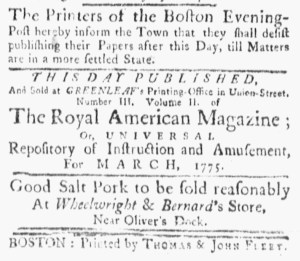
Boston Evening-Post (April 24, 1775).

“They shall desist publishing their Papers after this Day, till Matters are in a more settled State.”

The printers and the public did not know it yet, but the April 24, 1775, edition of the Boston Evening-Post would be the last issue of that newspaper.  Thomas Fleet established the newspaper in August 1735.  His sons, Thomas and John, continued publishing the Boston Evening-Post after their father’s death in 1758.  They even disseminated issues while the Stamp Act was in effect from November 1765 through May 1766, though they did not include their names in the colophon.  The events at Lexington and Concord, however, were too much of a disruption to continue.  The Fleets initially intended to suspend the newspaper and continue publication at some point in the future.  The April 24 issue included only three advertisements, the first one from the printers to “inform the Town that they shall desist publishing their Papers after this Day, till Matters are in a more settled State.”  A newspaper that had served Boston for just shy of forty years ended with “NUMB. 2065.”

By that time, Isaiah Thomas, the printer of the Massachusetts Spy, had already published the final issue of that newspaper in Boston on April 6 and headed to Worcester.  He revived it as the Massachusetts Spy: Or, American Oracle of Liberty in early May.  Nathaniel Mills and John Hicks distributed the last known issue of the Massachusetts Gazette and Boston Post-Boy on April 17.  The April 20 edition of the Massachusetts Gazette and Boston Weekly News-Letter was the last for a month.  Margaret Draper and John Boyle resumed publication of that newspaper on May 19, though they published issues sporadically for the next several months before turning the newspaper over to John Howe.  The February 29, 1776, edition may have been the last; it is the last known issue.  Benjamin Edes and John Gill suspended the Boston-Gazette with the April 17, 1775, edition.  Edes went to Watertown and resumed publication there on June 5.  He remained in Watertown until the end of October 1776.  At that time, he returned to Boston and continued publication in November. His sons became partners in 1779.  The Boston-Gazette did not close until September 1798.

At the beginning of April 1775, five newspapers served Boston, yet the beginning of the Revolutionary War in nearby Lexington and Concord on April 19 had a dramatic impact on those newspapers.  Two folded immediately, even though they hoped to resume when “Matters are in a more settled state.”  One suspended publication for a month and then limped along for less than a year.  Another relocated to Worcester and experienced success there.  Only the Boston-Gazette survived the war and resumed publication in that city.  Other newspapers eventually filled the void, commencing publication during the war, but for some time the town that long had more newspapers than any other in the colonies adapted to new circumstances that limited publication of news (and advertisements).
August 15

What was advertised in a colonial American newspaper 250 years ago today?

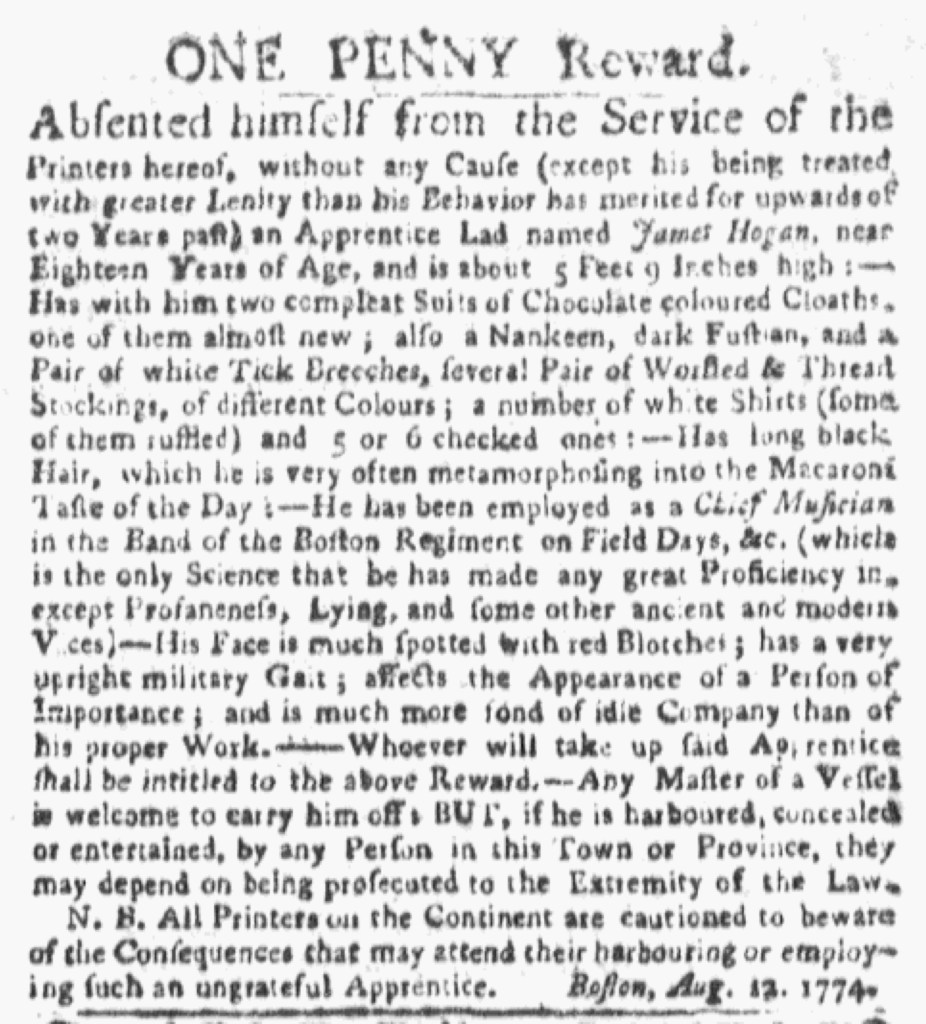
Boston Evening-Post (August 15, 1774).

“ONE PENNY Reward.”

Even though they offered a reward, Thomas Fleet and John Fleet, the printers of the Boston Evening-Post, did not really want anyone to return their runaway apprentice to them.  The reward, “ONE PENNY,” after all, was hardly an incentive but rather an insult to underscore how much contempt the printers had for James Hogan, their “ungrateful Apprentice.”  Contrary to standard language in runaway advertisements that advised ship captains against giving passage to runaway indentured servants and apprentices or enslaved people seeking freedom, the Fleets proclaimed that “Any Master of a Vessel is welcome to carry him off.”  They wished to be done with him, while also warning “All Printers on the Continent” against employing Hogan if he found his way to any of their printing offices.  Whatever skills he had gained, he was not worth the trouble.

Masters did not always treat apprentices well, yet the Fleets claimed that Hogan absconded “without any Cause (except his being treated with greater Lenity than his Behavior has merited for upwards of two years past).”  In addition to working in their shop, Hogan “has been employed as a Chief Musician in the Band of the Boston Regiment on Field Days.”  That was the only quality to his credit, “the only Science that he has made any great Proficiency in, except Profaneness, Lying, and some other ancient and modern Vices.”  Like too many young men seeking to express themselves and gain attention in a transatlantic consumer society, Hogan put too much emphasis on fashion, one of those vices.  According to the fleets, he had “long black Hair, which he is very often metamorphosing into the Macaroni Taste of the Day” and an extensive wardrobe.  In describing Hogan as a macaroni, the printers invoked eighteenth-century slang for a dandy or fop, referring in particular to elaborate hairstyles that rose far above the forehead.  A print produced in London in June 1774 depicted the dismayed reaction of an “honest FARMER” upon encountering his son, Tom, in all his macaroni trappings, including a wig with hair piled high above his head.

The Fleets suggested that Hogan focused more on this ridiculous fashion than his responsibilities in their printing office.  Even though he “has a very upright military Gait” and “affects the Appearance of a Person of Importance,” he was an apprentice who was “much more fond of Idle Company than of his proper Work.”  The Fleets did not seem disappointed by his departure.  Rather than seek his return, they used their advertisement to denigrate Hogan and warn others against trusting him.

May 24

What was advertised in a colonial American newspaper 250 years ago today?

Boston Evening-Post (May 24, 1773).

“A sprightly, active BOY … not much inclined to Macaronism, is wanted as an Apprentice.”

Thomas Fleet and John Fleet sought an apprentice to assist in their printing office at the Heart and Crown in Boston.  On May 24, 1773, the printers placed a notice in their own newspaper, the Boston Evening-Post, to advise readers that a “sprightly, active BOY, that can read and write, & not much inclined to Macaronism, is wanted as an Apprentice to the Printing Business.”

Most of those credentials make sense to modern readers.  The work undertaken in a printing office was physically demanding, so the Fleets needed a “sprightly, active” apprentice who was up to the challenge.  That apprentice would also assist in setting type and perhaps with some of the bookkeeping, making the ability to read and write almost essential (though some apprentices did learn to read in the process of setting type).  But what about a prospective apprentice “not much inclined to Macaronism”?

In that instance, the Fleets used a slang term recognized by eighteenth-century readers.  They did not seek a “Macaroni” or, as the Oxford English Dictionary explains, a “dandy or fop [who] extravagantly imitated Continental tastes and fashions.”  The OED also includes an example of “Macaroni” in use in 1770, revealing the derision bestowed on the young men who adopted the style: “There is indeed a kind of animal, neither male nor female, a thing of the neuter gender, lately started up amongst us.  It is called a Macaroni.  It talks without meaning, it smiles without pleasantry, it eats without appetite, it rides without exercise, it wenches without passion.”  In the colonies as in Britain, Macaronis participated in the consumer revolution to excess, wallowing in luxury and vice.

Such a character would not do in a printing office … and the Fleets did not want their business to become the venue for parents to attempt to correct such behaviors demonstrated by sons of an appropriate age to enter into apprenticeship agreements.  Many other employment advertisements of the era included “sober” (or, turning to the OED once again, “moderate in demeanour … indicating or implying a serious mind or purpose”) as one of the credentials.  The Fleets could have included “sober” in their notice, but perhaps they had recent encounters with Macaronis that made them particularly cautious about bringing an apprentice with such proclivities into their printing office.  They made it clear that Macaronis need not apply at the Heart and Crown.

April 13

What was advertised in a colonial American newspaper 250 years ago today?

Boston Evening-Post (April 13, 1772).

“A Select Collection of Letters Of the late Reverend GEORGE WHITEFIELD.”

It was one of the biggest news stories of the year.  George Whitefield died in Newburyport, Massachusetts, on September 30, 1770.  The next day, newspapers in Boston informed colonizers of the death of one of the most influential ministers associated with the eighteenth-century religious revivals now known as the Great Awakening.  Over the next several weeks, news spread throughout New England and to other colonies as printers exchanged newspapers and reprinted coverage from one to another.  Those printers also sensed an opportunity to generate revenues by producing and marketing broadsides, funeral sermons, and books that commemorated the minister’s death.  Throughout the colonies, but especially in New England, New York, and Pennsylvania, printers advertised commemorative items as they continued to publish updates about how colonizers near and far reacted to the news of Whitefield’s death.

Such advertising declined by the end of the year, but experienced a resurgence in the spring of 1771 when ships from England arrived in American ports with commemorative books and pamphlets published on the other side of the Atlantic.  Printers and booksellers encouraged colonizers to participate in another round of commodifying Whitefield.  That lasted for a couple of months before mentions of the minister faded from advertisements in the public print.  That did not mean, however, that entrepreneurs believed that the market for such commodities had disappeared, only that it was no longer so robust.  In the spring of 1772, Thomas Fleet and John Fleet, printers of the Boston Evening-Post, advertised “A Select Collection of Letters Of the late Reverend GEORGE WHITEFIELD … Written to his most intimate Friends, and Persons of Distinction, in England, Scotland, Ireland, and America.”  The minister wrote those letters between 1734 and 1770, “including the whole of his Ministry.”  In addition, the three-volume set contained “an Account of the Orphan House in Georgia” founded by Whitefield.  In an advertisement in the April 13, 1772, editions of the Boston Evening-Post and the Boston-Gazette, the Fleets indicated that they “Just received” the books “by the last Ship from London.”  Printers in England continued producing Whitefield memorabilia.  Apparently believing that demand existed or could be cultivated for such materials on both sides of the Atlantic, they presented consumers with another opportunity to acquire printed items associated with the minister.

November 26

What was advertised in a colonial American newspaper 250 years ago today?

Boston Evening-Post (November 26, 1770).

“Those Customers who live in the Country are more particularly desired to pay some Attention to the above reasonable Request.”

Extensive credit played an important role in fueling the consumer revolution of the eighteenth century.  Merchants, shopkeepers, and artisans all extended credit to their customers.  Printers did the same, often for periods of years rather than merely weeks or months.  Newspaper printers regularly inserted notices into their publications to call on subscribers, advertisers, and others to pay their debts.  In some instances, they stated that their ability to continue disseminating the news depended on customers paying their overdue bills.  More often, they threatened legal action against those who did not settle accounts by a specified date.

On November 26, 1770, Thomas Fleet and John Fleet, printers of the Boston Evening-Post, once again joined the chorus of printers who inserted such notices in their newspapers.  They requested that “All Persons indebted for this Paper, whose Accounts have been 12 Months standing … to make immediate Payment.”  Although they did not suggest taking anyone to court, they did express some exasperation with those who had not heeded previous notices.  “Those Customers who live in the Country,” the Fleets implored, “are more particularly desired to pay some Attention to the above reasonable Request.”

To increase the likelihood that those customers at least saw the notice, the Fleets deployed a couple of strategies.  First, they made it the first item in the first column on the first page.  It appeared immediately below the masthead and immediately above news items rather than interspersed among other advertisements.  Even if they only skimmed the contents to find items of interest, readers who perused that issue of the Boston Evening-Post were likely to spot the Fleets’ notice.  To help call attention to it and underscore its importance, the Fleets included several manicules.  A manicule on the first line directed attention to the notice.  A line composed of seventeen manicules beneath the advertisement seemed to insist that readers take note of what appeared above them.  Although the Fleets did not threaten to sue recalcitrant customers, they used other means to suggest they were serious about receiving overdue payments.

November 19

What was advertised in a colonial American newspaper 250 years ago today?

Boston Evening-Post (November 19, 1770).

“Ames’s ALMANACK is now in the Press, and will be published in a few Days.”

Was it news or advertising or both?  Thomas Fleet and John Fleet, printers of the Boston Evening-Post, noted that “Ames’s ALMANACK is now in the Press, and will be published in a few Days” in the November 19, 1770, edition.  This note was one of several items collected together as news from Boston.  The various items from the city amounted to more than a column, but a short section included brief reports about local deaths, ships in port, and Ames’s almanac.  The Fleets informed readers of the death of Elizabeth Langdon, widow of Deacon Josiah Langdon, and advised that the funeral and procession would take place the next day “if the Weather be fair.”  The printers also made note of the death of Mary Collson, the wife of leather dresser Adam Collson and daughter of Solomon Kneeland.  They reported that the “Glasgow Man of War arrived her from the same Place” and the “Mermaid Man of War was to Winter at Halifax.”  The Fleets concluded this list of brief updates with the note about Ames’s almanac, adorning it with a manicule to enhance its visibility.

That was the end of the news in that edition of the Boston Evening-Post.  Paid notices comprised the remainder of the contents.  The Fleets did not present the notice about the almanac as a freestanding advertisement, but they did treat is as a transition from news items they selected for publication and advertisements submitted by merchants, shopkeepers, artisans, auctioneers, and others.  The strategic placement may have allowed them to capture the attention of readers who perused the issue for news without intending to examine the advertisements, position it as a final news items before the advertisements commenced.  This served their own interests as entrepreneurs.  Several variations of the popular Ames’s Astronomical Diary or Almanack for the Year of Our Lord Christ 1771 hit the market in the fall of 1770, but this was probably the version with an imprint that stated it was “Printed and Sold by the Printers and Booksellers” of Boston.  Within the next several weeks, Richard Draper would advertise it in the Massachusetts Gazette and Boston Weekly News-Letter, Edes and Gill would advertise it in the Boston-Gazette, and the Fleets would advertise it in the Boston-Evening Post.  At that time, the Fleets devised a freestanding advertisement that ran among other advertisements rather than placing a notice within or adjacent to the news.

In advance of the almanac’s publication, the Fleets alerted prospective customers that an edition of Ames’s almanac would soon be available for sale at their printing office.  They used their access to the press to craft an announcement that appeared to be news even as it promoted a product that the printers had an interest in supplying to the public.  The placement of the notice as a transition between news and advertising was strategic.

May 22

What was advertised in a colonial American newspaper 250 years ago today?

“Enquire of the Printers.”

May 22 - 5:22:1769 Boston Evening-Post
Boston Evening-Post (May 22, 1769).

On May 22, 1769, readers of the Boston Evening-Post encountered an advertisement offering an enslaved youth for sale: “TO BE SOLD, A fine healthy Negro Boy, 17 Years old, brought up to Kitchen Work, and is fit for Town or Country. Enquire of the Printers.” On the same day, a nearly identical advertisement ran in the Supplement to the Boston-Gazette: “TO BE SOLD, A fine healthy Negro Boy, 17 Years old, bro’t up to Kitchen Work, and is fit for Town or Country. Enquire of Edes and Gill.” The Massachusetts Gazette, published the same day, also carried that advertisement: “TO BE SOLD, A fine likely Negro Boy, 17 Years old, bro’t up to Kitchen Work, and is fit for Town or Country. Inquire of Green & Russell.”

May 22 - 5:22:1769 Boston-Gazette Supplement
Supplement to the Boston-Gazette (May 22, 1769).

Except for variations in the spelling of “brought” (or “bro’t”), the copy in all three notices was identical until the final sentence that advised interested parties to “Enquire of the Printers” for more information. These advertisements and many others like them made T. and J. Fleet, Edes and Gill, and Green and Russell active participants in the slave trade. Printing advertisements for the purposes of buying and selling enslaved men, women and children or capturing those who escaped from bondage already made printers complicit in the perpetuation of slavery, but these “Enquire of the Printer” advertisements demonstrated even more active involvement as purveyors of people, not merely as conduits for disseminating information.

May 22 - 5:22:1769 Boston Post-Boy
Massachusetts Gazette [Green and Russell] (May 22, 1769).
Compared to newspapers published in the Chesapeake and Lower South, far fewer advertisements concerning enslaved men, women, and children ran in newspapers in New England and the Middle Atlantic, but they were not absent. Printers in Boston devoted less space in their newspapers to these advertisements, but the frequency of “Enquire of the Printer” advertisements suggests that the Fleets, Edes and Gill, and Green and Russell invested time in facilitating these transactions beyond what was required for receiving the copy and setting the type. In effect, they served as brokers, even if they never described or advertised their services in that manner.

January 8

What was advertised in a colonial American newspaper 250 years ago this week?

Massachusetts Gazette [Draper] (January 5, 1769).
“Most of these Papers will, probably, be irrevocably lost in a few Years, unless they be preserved by Printing.”

An advertisement concerning a proposed companion volume to a well-known publication appeared in the January 5, 1769, edition of Richard Draper’s Massachusetts Gazette. In 1764, Boston bookseller Jeremiah Condy published the first volume of The History of the Colony of Massachusetts-Bay by Thomas Hutchinson, lieutenant governor of the colony at the time. Thomas Fleet and John Fleet printed the book, which covered the period “from the first settlement thereof in 1628 until its incorporation with the colony of Plimoth, province of Main, &c. by the Charter of King William and Queen Mary, in 1691.” Three years later, Condy published the second volume, also printed by the Fleets. It extended the narrative “from the charter of King William and Queen Mary, in 1681, until the year 1750.” Both volumes were widely advertised in Boston’s newspapers and beyond.

Condy had been working on a related project when he died in 1768. As the Fleets explained, “THE late Mr. CONDY intended to have published a Volumne of curious Papers, to have served as an Appendix to the Lieutenant-Governor’s HISTORY of the MASSACHUSETTS-BAY, but Death prevented.” Not to be deterred, the Fleets issued a subscription notice “to encourage the Printing of the same Collection.” The proposed volume would be the same size and approximate length as the other two in the series, “about 600 Pages in Octavo.”

The Fleets deployed several strategies to convince readers to purchase the companion volume. They declared that they would publish it only “as soon as a sufficient Number of Subscribers appear to defrey the Expence.” If not enough buyers made a commitment in advance, the book would not go to press. Furthermore, the Fleets warned that “No Books will be printed for Sale.” This suggested a limited edition. They would print only enough copies to fulfill the orders placed by subscribers and no additional copies for subsequent retail sales. The printers attempted to maneuver prospective customers into reserving a copy for fear of missing out if they delayed. This may have been an especially effective strategy targeting those who acquired the first and second volumes as they contemplated completing the series with the companion volume.

In addition, the Fleets called on a sense of civic pride among prospective subscribers. They painted a stark portrait of what might happen if the proposed volume did not garner sufficient interest to go to press. “As most of these Papers will, probably, be irrecoverably lost in a few Years, unless they be preserved by Printing, it is hoped that a sufficient Number of Subscribers will soon appear.” According to the Fleets, the survival of the original documents mattered less than the proliferation of copies produced on the press. Any single document or copy could be lost or destroyed, but the proliferation of copies guaranteed that subsequent generations would continue to have access to the important documents that comprised the history of the colony. In that regard, subscribers practiced a significant public service. Those who subscribed to the companion volume did so not only “for the sake of their particular Entertainment” but also “from a regard to the Public.” The printers layered the act of purchasing this book with social meaning. Acquiring this volume, the Fleets argued, fulfilled a civic responsibility that would benefit the entire community, both now and in the future.

November 28

What was advertised in a colonial American newspaper 250 years ago today?

Nov 28 - 11:28:1768 Boston Chronicle
Boston Chronicle (November 28, 1768).

“Ames’s Almanack for 1769, SOLD by William M‘Alpine in MARLBOROUGH STREET, Boston.”

As November came to an end and a new year drew even closer, printers and booksellers in Boston and throughout the colonies placed advertisements for almanacs for the year 1769. Almanacs were big business for eighteenth-century printers. From the most humble to the most elite households, customers of assorted backgrounds purchased these slender and inexpensive volumes, creating a broad market. As a result, printers and booksellers considered almanacs an important revenue stream, one that justified extensive advertising.

Compared to many other advertisements for almanacs, William McAlpine’s notice in the November 28, 1768, edition of the Boston Chronicle was short and simple. In its entirety, it announced, “Ames’s Almanack for 1769, SOLD by William M‘Alpine in MARLBOROUGH STREET, Boston.” Other printers and booksellers sold other titles by other authors, but some also sold “Ames’s Almanack.” Indeed, more than one version of that popular almanac circulated in the fall of 1768.

The same day that McAlpine advertised in the Boston Chronicle, the Boston Evening-Post and the Boston-Gazette ran identical notices that warned readers that “a counterfeit Ames’s Almanack has been printed not agreeable to the original copy.” That notice implied that the counterfeit contained “above twenty Errors in the Sittings of the Courts,” making that important reference information included among the contents of many almanacs useless to anyone who purchased the counterfeit. The notice also advised prospective buyers how to recognize the counterfeit: “the Name of William MAlpine” appeared in the imprint at the bottom of the title page. Anyone wishing to acquire “the true genuine correct Ames’s ALMANACKS” needed to “take Notice” of the imprint and select only those “that at the Bottom of the Outside Title, is ‘BOSTON, Printed and sold by the Printers,’ &c. and no particular Name thereto.”

Rather than a public service, this notice was actually an act of sabotage. A cabal of printers issued a pirated copy of McAlpine’s legitimate edition of Nathaniel Ames’s Astronomical Diary, or, Almakack for the Year of our Lord Christ 1769 and, adding insult to injury, accused McAlpine of introducing multiple errors into a counterfeit that he printed and distributed. Charles Nichols estimates that printers annually sold 50,000 copies of Ames’s almanac by the time of the Revolution, making it quite tempting for printers to seek their own share of that market. Not coincidentally, the notice warning against McAlpine’s supposed counterfeit ran in newspapers published by printers responsible for the pirated edition. T. & J. Fleet printed the Boston Evening-Post and Edes and Gill printed the Boston-Gazette. Richard Draper, printer of the Boston Weekly News-Letter, operated the third printing office involved in the conspiracy. His newspaper ran the same notice that week, but it also included an advertisement for “AMES’s Almanack for 1769” that bore the imprint “Sold by the Printers and Booksellers in Town, and Traders in the Country.”

Quite simple in appearance, McAlpine’s advertisement for Ames’s almanac provides a window for a much more complicated story of competition, piracy, and sabotage committed by printers in eighteenth-century Boston. The notice about a counterfeit inserted in the Boston Evening-Post and the Boston-Gazette had the appearance of a news item. In each instance it appeared at the end of news content and the start of advertising, blurring the distinction. The marketing strategy deployed by the printers of the pirated edition went far beyond fair dealing.

October 6

GUEST CURATOR: Elizabeth Curley

What was advertised in a colonial American newspaper 250 years ago today?

oct-6-1061766-boston-evening-post
Boston Evening-Post (October 6, 1766).

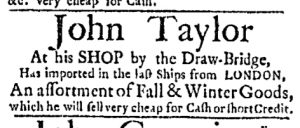
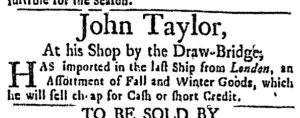
“John Taylor At his SHOP by the Draw-Bridge.”

I originally picked this advertisement from the Boston Evening-Post because John Taylor’s shop was in close proximity to a drawbridge that I researched for an entry last semester. Then this particular advertisement became more interesting when I found it in a second newspaper, the Boston-Gazette, printed on the same day by a rival publisher. As I did more research on the people and places in Boston, I learned about the printers of the Boston Evening-Post and the Boston-Gazette.

oct-6-1061766-boston-gazette
Boston-Gazette (October 6, 1766).

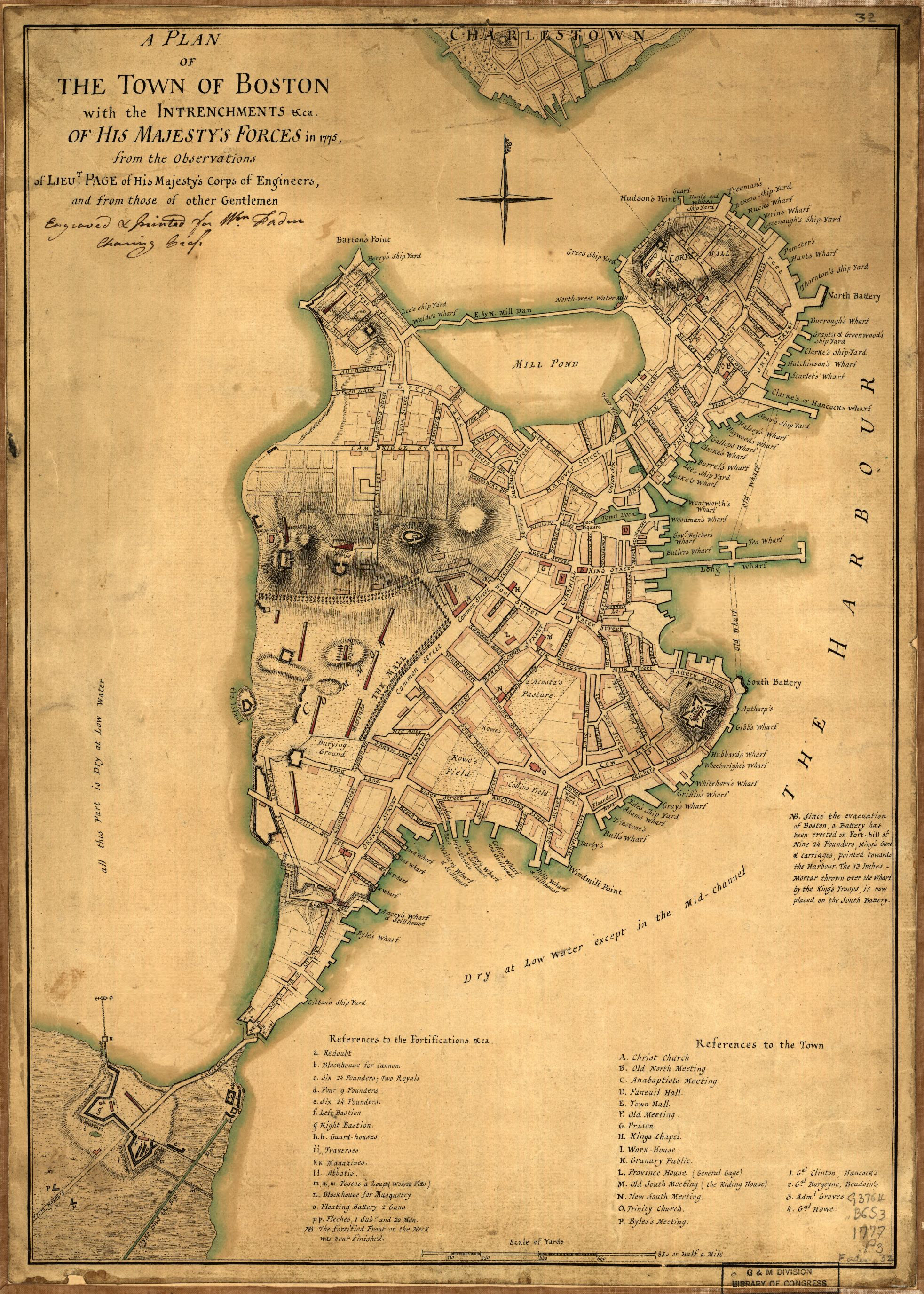
Printers have an interesting role in early American history, especially in colonial Boston. They were the ones who provided various types of entertainment and, more importantly, news and communication to the populace. Printers T. and J. Fleet at the Heart and Crown printed many items other than newspapers. They operated their shop on Cornhill Street, which was laid out in 1708 and ran from Water Street to Dock Square. (In 1789 it was renamed Washington Street.) Even from its earliest days Cornhill Street was full of intellectuals and publishers and printers. The Fleet family lived on Cornhill and ran their print shop beneath their residence.

oct-6-detail-of-map-of-boston
Detail of A Plan of the Town of Boston.
oct-6-map-of-boston
A Plan of the Town of Boston with the Intrenchments &ca. of His Majesty’s Forces in 1775, from the Observations of Lieut. Page of His Majesty’s Corps of Engineers, and from Those of Other Gentlemen (1777?). Library of Congress.

Thomas and John Fleet were prominent printers during the 1760s. In addition to newspapers, they sold broadsides and other important printed items that spread news and information. According to the Massachusetts Historical Society, their father started the newspaper that became the Boston Evening-Post, which they continued to print until 1776.

Benjamin Edes and John Gill printed the Boston-Gazette. These partners would over time get themselves in trouble with British authorities because of what they printed.  J. L. Bell has written about many examples of the printers of the Boston-Gazette closely walking the line of legal and illegal; for an example, see “Henry Bass Spills the Beans on a Political Protest.” Edes and Gill had a large circulation and may have been the Boston Evening-Post’s biggest competition. One reason that they may have had such a large circulation and got in to trouble often was Benjamin Edes was a member of the Loyal Nine, which was a secret group of patriots, nine “young business men” who planned a protest of the Stamp Act in 1765.

**********

ADDITIONAL COMMENTARY: Carl Robert Keyes

Elizabeth brings a sense of excitement to the research she does for the Adverts 250 Project. I’m continuously impressed with the primary and secondary sources she consults and incorporates into her analysis of the advertisements she has selected. As we work through revising and refining her first drafts, often we determine that some material should be eliminated in the interest of producing a concise entry that addresses one major theme. I know from experience how difficult and disappointing it can be to jettison portions of my own research and writing when certain parts of it just don’t work out. Unfortunately, that’s one of the hard lessons that Elizabeth and the other guest curators learn as we work collaboratively through the writing, revision, and publication process.

I appreciate the way that Elizabeth has used today’s advertisement as a jumping off point for examining the printers who produced newspapers and the advertisements they contained. However, she contemplated an alternate analysis of John Taylor’s advertisement that appeared in the October 6, 1766, issue of the Boston Evening-Post. Elizabeth located the same advertisement in the Boston-Gazette, prompting her to think about how “marketing and exposure were key to drawing in consumers, even in colonial America.” This is the third week that Elizabeth has been a guest curator for the Adverts 250 Project. With that statement from her first draft, she demonstrated that she really understands some of the questions that I find most interesting about the ongoing project.

Since this is a collaborative effort, I picked up Elizabeth’s research by consulting the other two newspapers printed in Boston in 1766. John Taylor’s advertisement also appeared later in the week in the October 9, 1766, issue of the Massachusetts Gazette, furthering strengthening Elizabeth’s suspicion that Taylor was being savvy by marketing his wares in multiple newspapers, increasing his shop’s exposure to as many readers as possible. The October 6, 1766, issue of the Boston Post-Boy did not carry Taylor’s advertisement. That does not mean that he did not attempt to place it in that publication. News items and other advertisements may have squeezed out Taylor’s advertisement in that particular issue.

oct-6-1091766-massachusetts-gazette
Massachusetts Gazette (October 9, 1766).

At the very least, Elizabeth and I have identified three newspapers that carried Taylor’s advertisement 250 years ago this week, demonstrating that the shopkeeper did calculate the benefits of increased exposure from multiple publications. As we saw in June, Jolley Allen pursued a similar strategy, placing the same advertisement in all four newspapers printed in Boston. Were these two advertisers outliers? Answering that question will require a lot more roll-up-the-sleeves research.