December 18

What was advertised in a revolutionary American newspaper 250 years ago today?
Connecticut Courant (December 18, 1775).

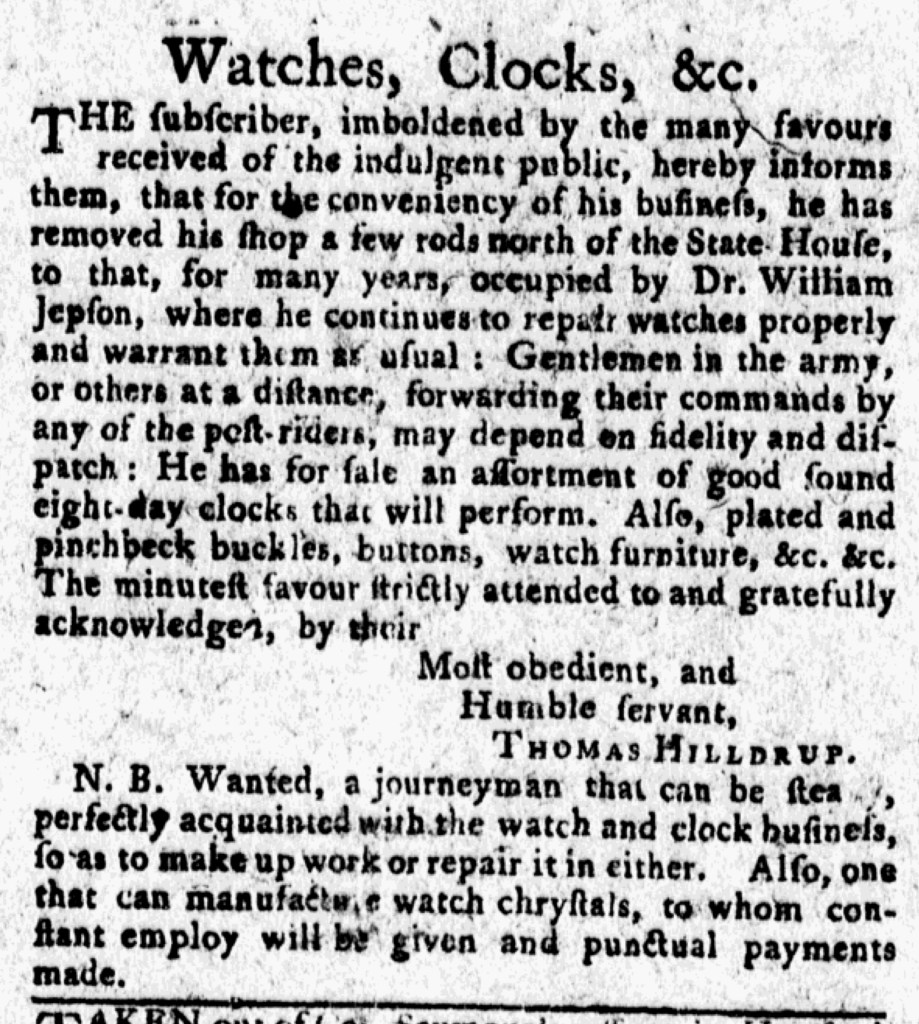
“Gentlemen in the army … forwarding their commands by any of the post-riders, may depend on fidelity and dispatch.”

Thomas Hilldrup, a watch- and clockmaker, had a history of running engaging advertisements in newspapers printed in Connecticut in the 1770s.  He once again took to the pages of the Connecticut Courant and Hartford Weekly Intelligenceron December 18, 1775, this time informing existing and prospective clients that he had moved to a new location.  In framing this announcement, he asserted that he had already built a reputation and earned the trust of many customers.  Having been “imboldened by the many favours received of the indulgent public,” Hilldrup declared, he “hereby informs them that for the conveniency of his business, he has removed his shop a few rods north of the State-House, to that, for many years, occupied by Dr. William Jepson.”  He supplemented this announcement with assurances about his skill and the quality of his work, stating that he “continues to repair watches properly and warrant them as usual.”

Realizing that the Connecticut Courant circulated far beyond Hartford, Hilldrup took the opportunity to address “Gentlemen in the army, or others at a distance.”  Like other watchmakers, he provided mail order services for cleaning and repairs.  He promised those clients that by “forwarding their commands by any of the post-riders” they “may depend on fidelity and dispatch.”  As the Continental Army continued the siege of Boston, Hilldrup may have known that some of the clients he served in recent years too part in that endeavor.  In an unfamiliar place that experienced some of the most significant disruptions during the first year of the Revolutionary War, they may have been at a loss to identify local artisans that they trusted to do repairs and perform routine maintenance.  That might have made Hilldrup’s mail order service look especially attractive.  The watchmaker likely also hoped that others enlisted in the army (as well as “others at a distance”) who had not previously availed themselves of his services would be influenced by his claim that he already established a robust clientele, those “many favours received of the indulgent public” that he invoked at the beginning of his advertisement.  Whether or not this strategy proved effective, Hilldrup envisioned “Gentlemen in the army” as a new category of customers to target in his marketing.  The Revolutionary War presented opportunities to savvy entrepreneurs as well as challenges and disruptions.
May 8

What was advertised in a revolutionary American newspaper 250 years ago today?

Connecticut Courant (May 8, 1775).

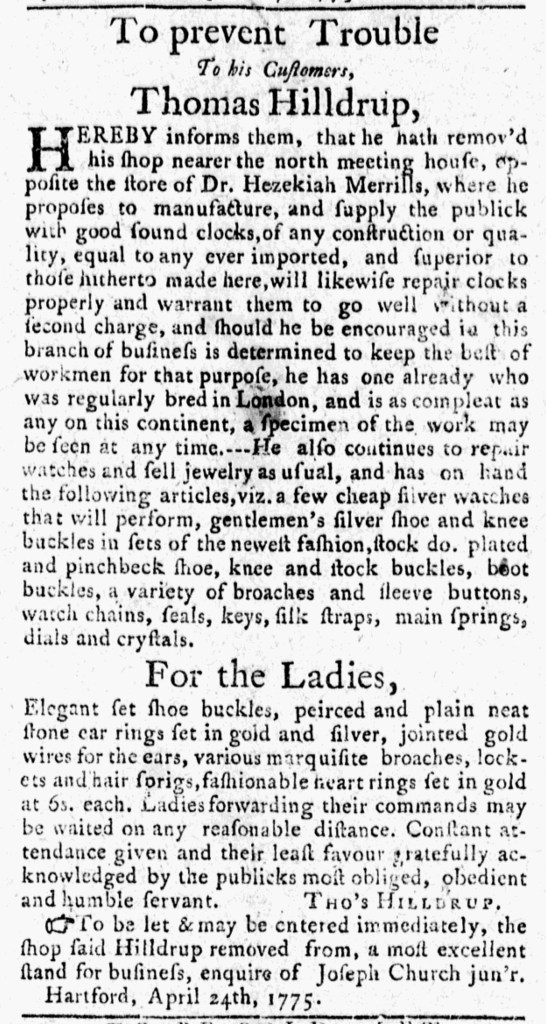
“To prevent Trouble …”

Thomas Hilldrup used a clever turn of phrase as a headline to draw attention to his advertisement in the May 8, 1775, edition of the Connecticut Courant and Hartford Weekly Intelligencer.  “To prevent Trouble,” it proclaimed, inviting readers to look more closely to see what kind of trouble might be afoot.  The headline stood out even more considering that most advertisements in that newspaper did not have headlines.  Among those that did, some used the names of the advertisers as the headlines, such as “PETER VERSTILE” and “CALEB BULL, jun.”  Hilldrup also used his name as a secondary headline on the third line of his advertisement.  A few headlines indicated the goods or services offered in the notices, including “LEATHER BREECHES” and “WILL COVER” (the phrase commonly applied to stud horses).

When they looked more closely, readers saw a second line, “To his Customers,” in a smaller font than the primary and secondary headlines on the first and third lines.  When they continued reading the body of Hilldrup’s advertisement they discovered his important message: “To prevent Trouble To his Customers, Thomas Hilldrup, HEREBY informs them, that he hath remov’d his shop nearer the north meeting house … where he proposes to manufacture, and supply the publick with good sound clocks.”  Hilldrup devised a dramatic means of announcing that he moved to a new location!  He ran the advertisement as a courtesy for those who might go looking for his former shop.  It turned out that it was nothing as dire as threatening to sue customers and associates who did not settle accounts, nor did it have any connection to current events.  Hilldrup first ran the advertisement on April 24, just days after the battles at Lexington and Concord.  He may or may not have been aware of those skirmishes when he composed the advertisement, though he almost certainly realized that the imperial crisis could boil over at any moment.  When his advertisement appeared in subsequent issues of the Connecticut Courant, readers no doubt searched the pages for new information about what was occurring in and near Boston and the responses in other places.  That meant that a notice placed “To prevent Trouble” likely garnered more attention than other advertisements as readers perused the newspaper.

December 10

What was advertised in a colonial American newspaper 250 years ago today?

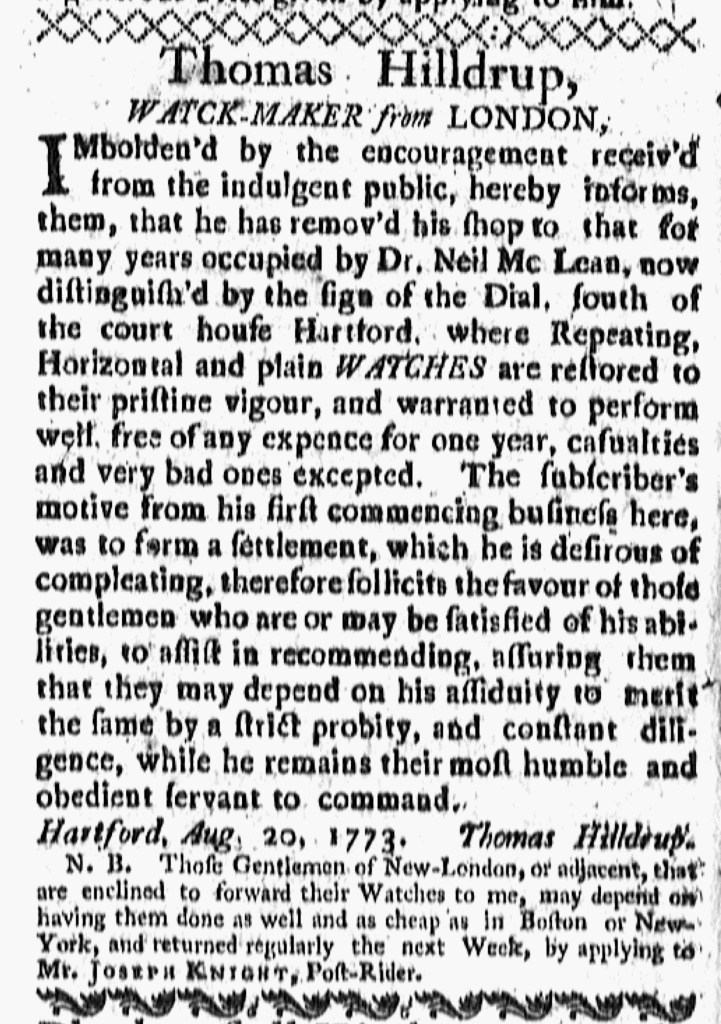
New-London Gazette (December 10, 1773).

“Forward their Watches to me … by applying to Mr. JOSEPH KNIGHT, Post-Rider.”

Thomas Hilldrup, “WATCK-MAKER from LONDON,” continued his advertising campaign in the fall of 1773.  Having settled in Hartford the previous year, he first set about cultivating a local clientele with advertisements in the Connecticut Courant, that town’s only newspaper.  Over time, he expanded his marketing efforts to include the Connecticut Journal and New-Haven Post-Boy and the New-London Gazette.  That meant that he advertised in every newspaper published in Connecticut at the time.  In an advertisement that ran for several months, Hilldrup declared that he had been “IMbolden’d by the encouragement receiv’d from the indulgent public” to move to a new location “now distinguish’d by the sign of the Dial.”  In other words, business had been good, customers had entrusted their watches to the enterprising newcomer for cleaning and repairs, and that demand for his services meant that others should engage him as well.

To that end, Hilldrup presented instructions for sending watches to his shop.  He appended a nota bene to his advertisement in the New-London Gazette, stating that the “Gentlemen of New-London, or adjacent, that are inclined to forward their Watches to me, may depend on having them done as well and as cheap as in Boston or New-York.”  In addition, Hilldrup offered speedy service, promising to return watches “the next Week.”  Clients could take advantage of these services, including a one-year warranty, “by applying to Mr. JOSEPH KNIGHT, Post-Rider.”  Knight did far more than deliver letters and newspapers from town to town.  He also contracted with various entrepreneurs to facilitate their businesses.  In addition to transporting watches for Hilldrup, Knight also sold “An ORATION, Upon the BEAUTIES of LIBERTY,” a popular political tract, in collaboration with Timothy Green, the printer of the New-London Gazette, and Nathan Bushnell, Jr., another post rider.  In forming a partnership with Knight, Hilldrup established an infrastructure for transporting watches to and from his shop, one that he could promote to prospective clients who might have otherwise been anxious about sending their watches over long distances.  Enlisting an associate already familiar in several towns in Connecticut, Hilldrup marketed an approved and secure method for sending watches to him to restore “to their pristine vigour.”

October 1

What was advertised in a colonial American newspaper 250 years ago today?

Connecticut Journal and New-Haven Post-Boy (October 1, 1773).

“WATCHES are restored to their pristine vigour, and warranted to perform well, free of expence for one year.”

Thomas Hilldrup, “WATCH MAKER from LONDON,” apparently considered his advertising campaign effective.  On October 1, 1773, his notice with the dateline, “Hartford, July 20, 1773,” once again appeared in the Connecticut Journal and New-Haven Post-Boy and the New-London Gazette.  Four days later, the same notice ran once again in the Connecticut Courant, the only newspaper printed in Hartford at the time.  When Hilldrup first arrived in Hartford in 1772 he commenced advertising in the Connecticut Courant, but it did not take long for him to surmise that he might benefit from advertising more widely.  He soon placed notices in the other two newspapers published in the colony.  Other watchmakers inserted their own advertisements in hopes of maintaining their share of local markets, but none of them advertised in multiple newspapers.  Hilldrup’s competitors also discontinued their advertisements after a few insertions, while the newcomer’s notices became a consistent feature in the three newspapers.

Hilldrup likely thought he made a wise investment by marketing his services in all three newspapers.  After all, those publications circulated widely throughout the colony.  Even if residents of New Haven or New London were unlikely to send their watches to Hilldrup at “the sign of the Dial” in Hartford, the watchmaker may have believed that prospective customers in other towns served by the Connecticut Journal and the New-London Gazette would find it as convenient to hire his services as those of his competitors … but only if Hilldrup made the effort to inform the public of his “constant diligence” in restoring watches “to their pristine vigour.”  In addition, his repeated advertisements in the three newspapers highlighted the guarantee he extended to clients, a promise that watches he fixed were “warranted to perform well, free of any expence for one year.”  In placing advertisements so widely and so often, Hilldrup reasoned that he could entice prospective clients beyond Hartford to give him a chance to serve them when they needed “Repeating, Horizontal and plain WATCHES” cleaned and repaired.

August 27

What was advertised in a colonial American newspaper 250 years ago today?

New-London Gazette (August 27, 1773).

“WATCHES are restored to their pristine vigour.”

A month had passed since Thomas Hilldrup, a “WATCH MAKER from LONDON” who recently relocated to Hartford, inserted an advertisement that originally ran for several weeks in the Connecticut Courant, published in Hartford, in the Connecticut Journal and New-Haven Post-Boy as well.  When he did so, he revised the dateline to “July 20, 1773,” but did not otherwise alter his advertising copy.  Near the end of August, he decided that he wished for the same notice to run in the New-London Gazette.  He once again altered the dateline, this time to “Aug. 20, 1773,” but did not make other changes.  Apparently, the watchmaker felt confident in his address to prospective customers as it appeared in the Connecticut Courant for the past two months.

By the time he placed that notice in the New-London Gazette, Hilldrup had been in Connecticut for the better part of a year.  He had been there long enough that it was not the first time that he attempted to extend his share of the market by saturating the newspapers published in the colony with his advertisements.  He initially published an advertisement in the September 15, 1772, edition of the Connecticut Courant and then revised it a month later.  Over time, he placed the revised advertisement in the Connecticut Journal on January 8, 1773, and in the New-London Gazette three weeks later.  The watchmaker established a pattern of starting with a single newspaper, the one printed in his own town, and then attempting to reach other prospective customers in the region though the same advertisement in other newspapers.

Such industriousness may have caught the attention of John Simnet, a watchmaker in New York, as newspapers published in Connecticut circulated beyond that colony.  Simnet learned his craft in London and had decades of experience working with clients there, a point of pride that he frequently highlighted in his advertisements.  Given his background, Simnet also promoted himself as the only truly skilled watchmaker in the area.  He had a long history of denigrating his competitors in his advertisements.  The cantankerous Simnet may have taken exception to Hilldrup’s arrival on the scene, considering Hartford too close for a competitor who listed similar credentials in his advertisements.  He had not previously placed notices in any of the newspapers printed in Connecticut, but decided to run an advertisement in the January 26, 1773, edition of the Connecticut Courant.  In choosing the newspaper published in Hartford, Hilldrup’s new location and a town more distant from New York than New Haven and New London, Simnet increased the chances that Hilldrup would see his advertisement.

For his part, Hilldrup did not respond directly to Simnet in the public prints, but he did follow the other watchmaker’s lead in making veiled references to competitors in an advertisement in the April 27 edition of the Connecticut Courant.  The headline for that advertisement, “WATCHES! only,” seemed to comment on a notice in which Enos Doolittle offered his services repairing clocks and watches in the previous issue.  In addition, Hilldrup included a nota bene that seemingly mocked Doolittle for hiring a journey who completed an apprenticeship in London, proclaiming that “I am capable of going through the business myself without any assistance.”  That nota bene also appeared in the original iteration of Hilldrup’s second advertisement that eventually found its way into multiple newspapers, though he removed it after several weeks in the Connecticut Courant.

As Hilldrup worked to cultivate a clientele that would secure his position in Hartford, he published advertisements in newspapers in several towns.  Achieving that kind of reach with his notices was only part of his marketing strategy.  In addition to engaging prospective customers, those advertisements put Hilldrup in conversation with competitors, directly and indirectly.  Rather than mere announcements that readers might easily dismiss, the watchmaker crafted messages that resonated beyond any single issue of a colonial newspaper.  In an advertisement that eventually appeared in all three newspapers published in Connecticut, he requested “the favour of those gentlemen who are or may be satisfied of his abilities, to assist in recommending” his services to others.

July 23

What was advertised in a colonial American newspaper 250 years ago today?

Connecticut Journal and New-Haven Post-Boy (July 23, 1773).

WATCHES are restored to their pristine vigour, and warranted to perform well, free of any expence for one year.”

Though dated “Hartford, July 20, 1773,” Thomas Hilldrup’s advertisement in the July 23 edition of the Connecticut Journal and New-Haven Post-Boy had been composed much earlier.  The same copy first ran in Connecticut Courant, published in Hartford, on May 25.  It appeared in each issue of that newspaper since then, though Hilldrup dropped a short nota bene carried over from his previous advertisement after two insertions.  In this latest advertisement, Hilldrup, a “WATCH MAKER from LONDON,” declared that he had already met with so much success during his brief time in Connecticut, that he had been so “IMbolden’d by the encouragement receiv’d from the indulgent public,” that he “remov’d his shop” to a new location.  Prospective customers could find him at “the sign of the Dial” in the shop formerly occupied by Dr. Neil McLean near the courthouse in Hartford, “where Repeating, Horizontal and plain WATCHES are restored to their pristine vigour, and warranted to perform well, free of any expence for one year.”

After publishing this promotion in the Connecticut Courant for two months, Hilldrup extended that guarantee to readers of the Connecticut Journal.  It was not the first time, however, that the watchmaker took to the pages of a newspaper printed in another town in his efforts to build a large enough clientele to allow him to settle permanently in Hartford.  His advertising campaign commenced in the Connecticut Courant in the fall of 1772, but eventually expanded to the Connecticut Journal and New-Haven Post-Boy and the New-London Gazette during the winter months.  The newcomer ran advertisements in every newspaper published in the colony at the time, making it clear that local watchmakers who already established their reputations among prospective customers faced some new competition.  Placing an advertisement in the Connecticut Journal and New-Haven Post-Boy the first time may have been an experiment for a watchmaker who recently arrived in Hartford.  Opting to place another advertisement in that newspaper six months later, however, indicated that he believed the first one had been effective in generating business beyond clients served primarily by Hartford’s Connecticut Courant.  Even then, he did not consider merely announcing his presence in Hartford sufficient to draw clients to his shop.  Instead, he offered a one-year guarantee on repairs to convince prospective customers to give him a chance over his competitors.

April 27

What was advertised in a colonial American newspaper 250 years ago today?

Connecticut Courant (April 27, 1773).

WATCHES! only.”

Having established himself in Hartford, watchmaker Thomas Hilldrup continued his advertising campaign with a new notice in the April 27, 1773, edition of the Connecticut Courant.  He stated that his “motive was to merit the approbation of the public from his first commencing business here” in the fall of 1772, while also providing an update that he had been successful in that endeavor as measured by “the many repeated favours already confer’d” by customers in the area.  Hilldrup also reminded prospective clients of the services and incentives he offered, including repairing watches “in a perfect and durable manner,” giving a warrantee that they would “perform well, free of any expence for one year,” and providing “advice gratis.”

Connecticut Courant (April 27, 1773).

Those appeals echoed Hilldrup’s earlier advertisements, but other aspects of his notice seemed to comment on a notice that a competitor, Enos Doolittle, placed in the previous issue of the Connecticut Courant.  Doolittle used a headline that read, “Clocks & Watches,” and informed the public that he had been trained in “the business of Clock Making and repairing all kinds of Watches.”  In turn, Hilldrup emphasized that he specialized in watches with a headline that proclaimed, “WATCHES! only.”  Doolittle also noted that he “employed a journeyman who has serv’d a regular Apprenticeship to the Watchmaking business in London.”  Hilldrup implied that this indicated some sort of shortcoming in the way that Doolittle managed his business.  In a nota bene, marked with a manicule to draw attention, Hilldrup declared, “The public are desired to take notice that I am capable of going through the business myself without any assistance.”  Hilldrup suggested that hiring a journeyman to handle some of the business that came into the shop meant that Doolittle lacked the skill necessary to do the work on his own.  Doolittle, like other artisans who mentioned employees, presented the journeyman’s presence as evidence of a thriving business.

Artisans rarely made direct comparisons between themselves and their competitors when they placed newspaper advertisements during the era of the American Revolution.  Hilldrup was an exception, though he did not explicitly name Doolittle in his notice.  Still, readers of the Connecticut Courant likely noticed that Hilldrup’s advertisement commented on the one placed by his competitor.

January 29

What was advertised in a colonial American newspaper 250 years ago today?

New-London Gazette (January 29, 1773).

Difficult jobbs performed for those who pretend to the business.”

At the end of January 1773, watchmaker Thomas Hilldrup continued expanding his advertising campaign.  When he arrived in Hartford in the fall of 1772, he inserted notices in the local newspaper, the Connecticut Courant, starting on September 15.  His advertisement ran almost every week throughout the remainder of the year and continued into the new year.  Early in 1773, he decided to increase the reach of his marketing by placing the same advertisement in the Connecticut Journal and New-Haven Post-Boy.  Not much time passed before he ran that notice in the New-London Gazette as well.  With that publication, Hilldrup advertised in all of the newspapers printed in the colony at the time, making his efforts a regional campaign.

Hilldrup made a variety of appeals intended to attract attention from prospective clients who may not have otherwise considered seeking the services of a watchmaker in Hartford rather than one in their own town.  When he asked “the candid public to make a tryal of his abilities” in repairing several different kinds of watches, he emphasized his training and experience in the cosmopolitan center of the empire.  The watchmaker declared that he “was regularly bread to the finishing business in London,” implying that, as a result, he possessed greater skill than watchmakers who learned the trade in the colonies.  To underscore that point, he proclaimed that he did “difficult jobbs … for those who pretend to the business.”  In other words, he informed fellow watchmakers who did not possess the same level of skill that they could bring repairs beyond their abilities to him to complete.  Such an offer planted a seed of doubt about his competitors and prompted readers to question their capabilities.  Hilldrup also attempted to cultivate a clientele by offering free services, pledging “any other jobbs that take up but little time [done] gratis.”  That allowed him to meet new clients while also creating a sense of obligation that they would eventually purchase accessories, like chains and keys, at his shop or hire him when their watches needed more extensive repairs.

The newcomer made his presence known in the colony, first by advertising repeatedly in the Connecticut Courant and then by advertising widely in the other newspapers published in the colony.  He promoted credentials that he believed eclipsed many of his competitors and offered services intended to incite interest among prospective clients near and far.

January 8

What was advertised in a colonial American newspaper 250 years ago today?

Connecticut Journal (January 8, 1773).

“Whose motive is to settle here if health permit[s], and the business answers.”

When Thomas Hilldrup arrived in Hartford in the fall of 1772, he commenced an advertising campaign to advise prospective customers that he repaired watches “in a perfect and durable manner, at an easy expence.”  Throughout late September and into October, November, and December, he consistently ran his advertisement in the Connecticut Courant, alerting readers that he planned “to settle here if health permit[s], and the business answers.”  That being the case, he invited the public “to make a trial of his abilities.”  In addition to repairing watches, Hilldrup also sold watches and accessories and provided ancillary services, including consultations with “those who are about to buy, sell or exchange.”

Hilldrup continued placing his advertisement in the Connecticut Courant in the new year.  He also decided to expand his advertising campaign to another newspaper, the Connecticut Journal and New-Haven Post-Boy.  Doing so extended the reach of his advertising and gave him access to a new market.  Why did the watchmaker decide to advertise in another publication?  Did he believe that the notice in the Connecticut Courant had been sufficiently successful to merit advertising in a newspaper in another town?  Among colonizers who perused multiple newspapers as they circulated far and wide in Connecticut and beyond, that certainly likely enhanced Hilldrup’s visibility and name recognition.  That he continued to invest in advertisements in the Connecticut Courant also suggests that he considered the outcomes so far worth the expense.

On the other hand, those advertisements may not have been as successful as Hilldrup hoped.  Perhaps placing the same notice in the Connecticut Journal and attempting to capture a portion of an adjacent market was an attempt to generate enough business to make remaining in Hartford a viable option.  Whatever his reasons for choosing to run his advertisement in an additional newspaper in January 1773, Hilldrup eventually determined that he cultivated a large enough clientele to remain in Hartford.  He continued advertising watches and repairs in newspapers published in that town for nearly two decades.  In the coming months, the Adverts 250 Project will examine some of his subsequent newspaper notices.

December 22

What was advertised in a colonial American newspaper 250 years ago today?

Connecticut Courant (December 22, 1772).

“WATCHES … Advice to those who are about to buy, sell or exchange.”

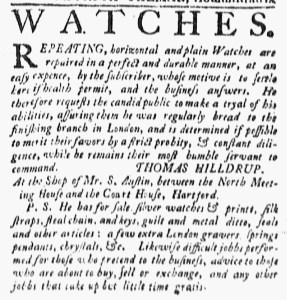
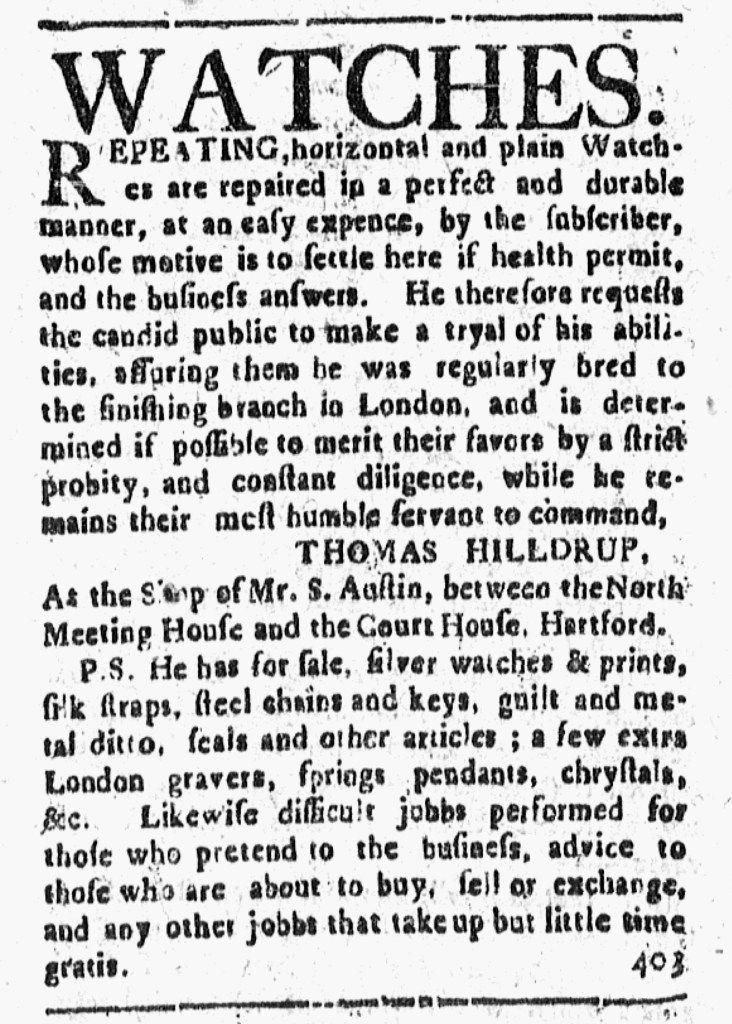
When Thomas Hilldrup arrived in Hartford in the fall of 1772, he commenced an advertising campaign in hopes to introduce himself to prospective customers who needed their watches repaired.  He first advertised in the September 15 edition of the Connecticut Courant.  That notice ran for three weeks.  On October 13, he published a slightly revised advertisement, one that appeared in every issue, except November 10, throughout the remainder of the year.  Although many advertisers ran notices for only three or four weeks, the standard minimum duration in the fee structures devised by printers, Hilldrup had good reason to repeat his advertisement for months.  He intended to remain in Hartford “if health permit[s], and the business answers.”  If he could not attract enough customers to make a living, then he would move on to another town.

Hoping to remain in Hartford, he asked prospective customers “to make a trial of his abilities” to see for themselves how well he repaired watches.  Satisfied customers would boost his reputation in the local market, but generating word-of-mouth recommendations would take some time.  For the moment, he relied on giving his credentials, a strategy often adopted by artisans, including watchmakers, who migrated from England.  Hilldrup asserted that he “was regularly bred” or trained “to the [watch] finishing branch in London.”  Accordingly, he had the skills “to merit [prospective customers’] favors” or business, aided by his “strict probity, and constant diligence.”  In addition, Hilldrup offered ancillary services in hopes of drawing customers into his shop.  He sold silver watches, steel chains, watch keys, and other merchandise.  He also provided “advice to those who are about to buy, sell or exchange” watches, giving expert guidance based on his professional experience.  Hilldrup concluded his advertisement with an offer that he likely hoped prospective customers would find too good to dismiss.  He stated that he did “any other jobbs that take up but little time gratis.”  Doing small jobs for free allowed the watchmaker to cultivate relationships with customers who might then feel inclined or even obligated to spend more money in his shop.

By running an advertisement with the headline “WATCHES” in a large font larger than the size of the title of the newspaper in the masthead, Hilldrup aimed to make his new enterprise visible to prospective customers in and near Hartford.  He included several standard appeals, such as promising low prices and noting his training in London, while also promoting ancillary services to convince readers to give him a chance.