November 8

What was advertised in a revolutionary American newspaper 250 years ago today?
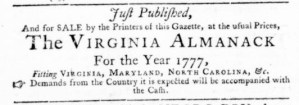
Virginia Gazette [Dixon and Hunter] (November 8, 1776).
“Demands from the Country it is expected will be accompanied with the Cash.”

When November arrived in 1776, John Dixon and William Hunter, the printers of the Virginia Gazette, began advertising “The VIRGINIA ALMANACK For the Year 1777.”  They ran their first advertisement on November 1, allowing prospective customers two months to purchase their almanacs before the new year began.  That also gave retailers in Williamsburg and other towns time to acquire almanacs to stock in their own shops and stores.  Dixon and Hunter printers advised that they sold the almanac “at the usual Prices,” though they did not specify the price in their advertisement.  The printers may have wished to assure readers that shortages of paper and other disruptions caused by the war had not resulted in significant increases in what they would pay for almanacs compared to previous years.

When Dixon and Hunter ran their advertisement a second time on November 8, they added a couple of lines that gave more information.  That included expanding the title to “The VIRGINIA ALMANACK For the Year 1777, Fitting VIRGINIA, MARYLAND, NORTH CAROLINA, &c.”  Readers in those states could depend on the astronomical calculations corresponding to their locations.  Dixon and Hunter did not mention in their advertisement that David Rittenhouse, a prominent mathematician and astronomer in Philadelphia, was credited as the author since he provided those calculations (and the printers, as editors, likely selected other contents).  Rittenhouse also supplied the calculations for Father Abraham’s Almanack, For the Year of Our Lord 1777, published by John Dunlap in Philadelphia.  In an advertisement in the November 12 edition of Dunlap’s Pennsylvania Packet, the printer boasted, “Our kind customers are requested to observe, that the ingenious David Rittenhouse, A.M. of this city, has favoured us with the Astronomical calculations of our Almanack for this year, therefore they may be most firmly relied on.”  Dixon and Hunter did not go into such detail, though Rittenhouse apparently undertook a separate set of calculations for states to the south of Pennsylvania.

Dixon and Hunter also added instructions for customers outside Williamsburg who sent orders rather than visiting the printing office to purchase their almanacs: “Demands from the Country it is expected will be accompanied with the Cash.”  That suggested that prospective customers were indeed familiar with “the usual Prices.”  It also revealed that the printers would not extend credit to either customers purchasing their own almanacs or retailers purchasing them to sell again.  Despite the upheavals of the war, they set a reasonable price, but in exchange they needed payment at the time of sale.  The printers declined to take on the risk of credit in such uncertain times.

October 13

What was advertised in a revolutionary American newspaper 250 years ago this week?

Virginia Gazette [Dixon and Hunter] (October 11, 1776).
“THE VIRGINIA ALMANACK For the Year 1777.”

Among the advertisements in the October 11, 1776, edition of the Virginia Gazette, John Dixon and William Hunter promoted “THE VIRGINIA ALMANACK For the Year 1777.”  The printers informed the public that the helpful reference manual was “NOW IN THE PRESS, And in a few Days will be published.”  If they wished, customers could place orders for the forthcoming almanac or watch for a subsequent announcement that it was available for sale.  The initial advertisement helped readers make plans while inciting demand.  In their advertisement, Dixon and Hunter merely announced the imminent publication of the almanac.  Sometimes printers devoted significant amounts of space to listing the contents of almanacs, another strategy for generating interest among readers.

It was not the first advertisement for an almanac for 1777 to appear in the public prints in 1776, but it was one of the few.  Francis Bailey advertised “THE LANCASTER ALMANACK, for the year 1777,” in the Pennsylvania Gazette a month earlier.  Usually, printers in several cities and towns began advertising almanacs for the coming year as fall arrived, giving customers plenty of time to acquire them.  Those customers included retailers who purchased in volume to sell again in their own shops.  In other years, a few advertisements for almanacs began appearing in newspapers in late summer.  More ran in September and October, with the most in November and December.  Printers continued advertising surplus copies in January, with newspaper notices tapering off in February and March.  In the fall of 1776, however, the number and frequency of advertisements about the production and dissemination of almanacs lagged compared to previous years.  Upheavals caused by the war, including paper shortages, likely contributed to the disruption and delay in the annual rhythm of marketing almanacs in early American newspapers.  Certainly not the greatest concern of readers and consumers, this was still one way that the war altered their everyday experiences and routines.

June 30

What was advertised in a colonial American newspaper 250 years ago today?

Jun 30 - 6:30:1768 Virginia Gazette Rind
Virginia Gazette [Rind] (June 30, 1768).
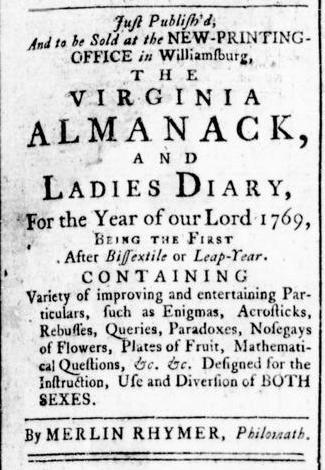
“THE VIRGINIA ALMANACK, AND LADIES DIARY, For the Year of our Lord 1769.”

William Rind got a jump on the market for almanacs for 1769, publishing The Virginia Almanack, and Ladies Diary, for the Year of Our Lord 1769 in June of 1768. He began advertising the almanac more than six months before the new year commenced, deviating significantly from the practices of most printers who published almanacs. Usually advertisements for almanacs began appearing in September and October, often announcing plans for publishing specific titles and promising that they would go to press soon. Such advertisements attempted to incite demand for products that were not yet available for purchase, seeking to predispose customers to specific titles long before they needed to acquire an almanac for the coming year. Advertisements announcing that almanacs had indeed been published and calling on customers to obtain their copies usually began appearing in November and December, increasing in number and frequency as January approached. Some of those advertisements continued after the first of the year as printers sought to relieve themselves of surplus copies, but they steadily tapered off. Most disappeared by the middle of February, though some advertisements continued to pop up at irregular intervals. The day before Rind promoted the Virginia Almanack in the Virginia Gazette, Charles Crouch inserted a brief advertisement in his South-Carolina Gazette and Country Journal that simply announced, “BALL’s ALMANACKS for the Year 1768, to be sold by the Printer.” Attempts to sell leftover almanacs for the current year continued even as the earliest of advertisements marketed almanacs for the coming year.

Rind realized that the end of June 1768 was indeed early for distributing an almanac for 1769. Accordingly, his advertisement did not include the usual information about the accuracy of the astronomical calculations or other aspects of the calendar specific to certain days or months. Instead, he focused on the “Variety of improving and entertaining Particulars” contained within the almanac, contents that could be consulted and enjoyed no matter the season or year. These included “Enigmas, Acrosticks, Rebusses, Queries, Paradoxes, … [and] Mathematical Questions” that were “Designed for the Instruction, Use and Diversion of BOTH SEXES.” Rind also listed “Nosegays of Flowers” and “Plates of Fruit.” Although these could have refered to illustrations, the American Antiquarian Society’s entry for the Virginia Almanack indicates that “[t]he Anatomy … is the only illustration.” Rind likely meant “Nosegays of Flowers” and “Plates of Fruit” figuratively, evoking the pleasures to be derived from perusing the many and varied contents of the almanac. Considering the schedule followed by most other printers, it was indeed early for publishing and advertising an almanac, but Rind adjusted his marketing to compensate and perhaps even generate greater demand than if he had waited until the fall.