February 3

Who was the subject of an advertisement in a revolutionary American newspaper 250 years ago today?

Virginia Gazette [Pinkney] (February 3, 1776).

“RUN away … a mulatto man, named GABRIEL.”

After taking out an advertisement in a competing newspaper on January 27, 1776, an apology for not publishing his Virginia Gazette because he had difficulty acquiring paper, John Pinkney managed to print the next issue on schedule on February 3.  He may or may not have published subsequent issues, but today the February 3 edition is the last known one from his press.  In his apology, Pinkney lamented, “It gives me the greatest Uneasiness that I cannot publish such Advertisements as ought to have appeared this Week.”  The next (and perhaps final) issue included more than two dozen advertisements of various lengths on the last two pages.

Among those advertisements, Julia Wheatley offered her services as a midwife, Carter Braxton and John Ware described real estate for sale, and Pinkney hawked “A TREATISE on the MILITARY DUTY, By adjutant DAVIS,” a pamphlet that “has met with the approbation of colonel BULLITT, and many other officers.”  Six of those notices, accounting for one-quarter of the advertisements by number and far more than that by length, concerned enslaved people.  David Meade advertised “ABOUT one hundred Virginia born NEGROES” for sale, including “some female house servants, a carpenter, and shoemaker.”  Four described enslaved men who liberated themselves by running away from their enslavers, offering rewards for their capture and return.  The advertisers enlisted the public in engaging in surveillance of Black men to determine if they matched the descriptions in the newspapers.  John Hudson, for instance, pledged “FIVE POUNDS reward” to “Whoever takes up … and secures” a “mulatto man, named GABRIEL, aged 52 or 53 years,” who had “a free woman for his wife, who goes by the name of Betty Baines.”  The other advertisement described “a negro man named Frank,” dressed like a sailor, “COMMITTED to the jaol of Surry county” two months earlier.  Thomas Wall, the jailer, called on Frank’s enslaver, Walter Gwin of Portsmouth, to claim the enslaved man and pay the expenses of holding him and running the advertisement.

Such advertisements stood in stark contrast to news about the Revolutionary War and “EXTRACTS from a most excellent pamphlet, lately published, and addressed to the Americans, entitled COMMON SENSE” that appeared elsewhere in that edition of Pinkney’s Virginia Gazette.  William Rind founded that newspaper nearly a decade earlier, distributing the first issue shortly after the repeal of the Stamp Act.  Eventually, Clementina Rind, his widow, published the newspaper and, following her death, Pinkney did so on behalf of her estate and her children.  During that decade, each of those printers published hundreds of advertisements about enslaved men, women, and children even as they circulated news about the imperial crisis and the first months of the Revolutionary War.  Revenues generated from advertisements about enslaved people underwrote newspaper coverage of current events and editorials about freedom and liberty.

August 31

What was advertised in a revolutionary American newspaper 250 years ago today?

Virginia Gazette [Pinkney] (August 31, 1775).

“She intends to open a DANCING SCHOOL … for young ladies.”

The new term had commenced, yet Sarah Hallam continued advertising her “DANCING SCHOOL” in Williamsburg in the August 31, 1775, edition of John Pinkney’s Virginia Gazette.  She first promoted the school in the public prints on August 17, announcing that she “intends to open a DANCING SCHOOL, on Friday the 25th instant, for young ladies.  That gave prospective pupils and their parents just over a week to enroll.  Hallam advertised a second time on the eve of opening her school and again a week later to give stragglers a chance to join.  She apparently considered advertising worth the investment.  The advertisement continued in four more issues, through the end of September.  According to the rates in the newspaper’s masthead, Pinkney charged three shillings for the first insertion (to cover setting type and space in the newspaper) and two shilling for each additional insertion (for the space once the type was set).  That meant that Hallam spent fifteen shillings on advertisements in Pinkney’s Virginia Gazette.  She charged twenty shillings as an entrance fee and then four pounds per year for each student.  That meant that the entrance fee for just one student covered her advertising expenses.

Hallam certainly made choices about her marketing campaign, choices not limited to how long it lasted.  Williamsburg had three newspapers at the time.  John Dixon and William Hunter published their own Virginia Gazette, as did Alexander Purdie.  Yet Hallam opted not to place notices in either of the other newspapers even though the printers charged the same rates.  She had a limit to how much she would spend on recruiting new students.  She apparently decided that a longer campaign in a single newspaper would be more effective than a shorter campaign in several newspapers.  She may have reasoned that each Virginia Gazette circulated so widely in Williamsburg that inserting an advertisement in Dixon and Hunter’s Virginia Gazette or Purdie’s Virginia Gazette would be superfluous after running it in Pinkney’s Virginia Gazette.  Why choose Pinkney’s newspaper over the others?  Perhaps she appreciated that Pinkney had printed the Virginia Gazette “FOR THE BENEFIT OF CLEMENTINA RIND’s CHILDREN” after the former printer’s death in September 1774.  For six months, the masthead made that proclamation immediately above the advertising rates.  As a female entrepreneur, Hallam may have found meaning in choosing the newspaper formerly printed by a woman and then printed to support her children following her death.

November 10

What was advertised in a colonial American newspaper 250 years ago today?

Virginia Gazette [Pinkney] (November 10, 1774).

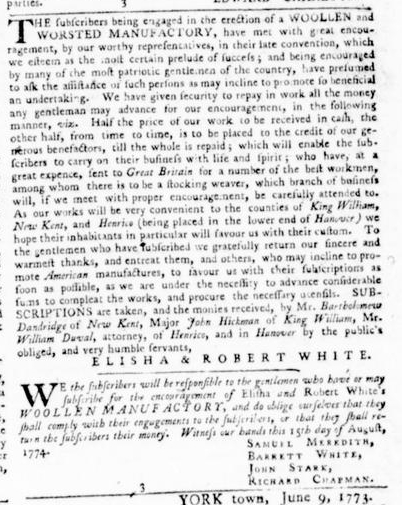
“A WOOLEN and WORSTED MANUFACTORY … American manufactures.”

As John Pinkney published updates from the First Continental Congress in the Virginia Gazette in November 1774, Elisha White and Robert White ran an advertisement to announce that they were “engaged in the erection of a WOOLLEN and WORSTED MANUFACTORY” that they anticipated would meet with great success.  They had already been “encouraged by many of the most patriotic gentlemen of the country,” yet sought even greater support for “so beneficial an undertaking” among the public.  In other words, they sought investors to defray the costs of this endeavor, addressing those “who may incline to promote American manufactures” as alternatives to goods imported from Britain.  The Whites had already gone to some expense, recruiting “a number of the best workmen,” though they still needed to “compleat the works, and procure the necessary utensils.”  Their enterprise would have even greater urgency as colonizers learned more about the Continental Association, a nonimportation pact, adopted by the First Continental Congress.

To raise the necessary funds to make their “MANUFACTORY” viable, the Whites established a subscription and designated local agents in several towns who collected the money on their behalf.  They also outlined their scheme for repaying these loans: “Half the price of our work to be received in cash, the other half, from time to time, is to be placed to the credit of our generous benefactors, till the whole is repaid.”  In case that seemed like too much of a gamble, the Whites appended a note from some of those “most patriotic gentlemen” to offer assurances.  Samuel Meredith, Barrett White, John Stark, and Richard Chapman pledged that they “will be responsible to the gentlemen who have or may subscribe for the encouragement of Elisha and Robert White’s WOOLLEN MANUFACTORY.”  If the project did not succeed, those four men “shall return the subscribers their money.”  That promise reflected their confidence in the Whites’ ability to “carry on their business with life and spirit” while simultaneously underscoring that civic duty called for supporting the “MANUFACTORY” through investing in it and, eventually, purchasing the goods produced there.  Political principles guided participation in both production and consumption of “American manufactures” as the imperial crisis intensified in 1774.

October 6

What was advertised in a colonial American newspaper 250 years ago today?

Virginia Gazette [Pinkney] (October 6, 1774).

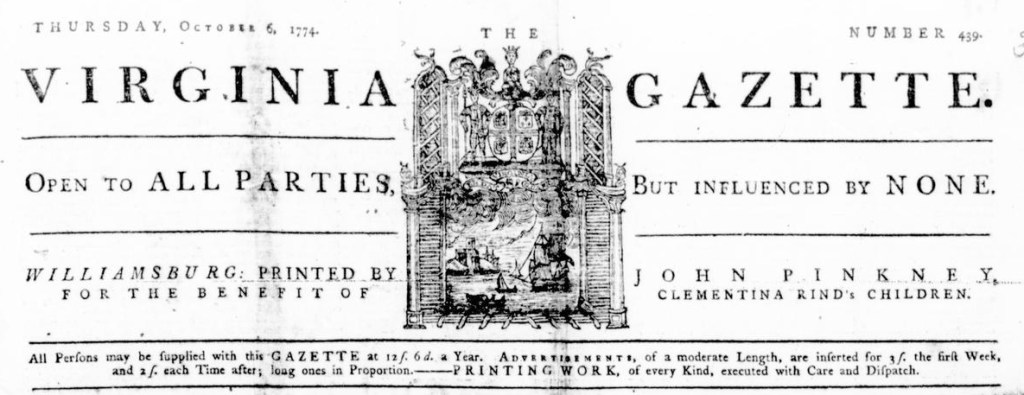
“ADVERTISEMENTS, of a moderate Length, are inserted for 3s. the first Week.”

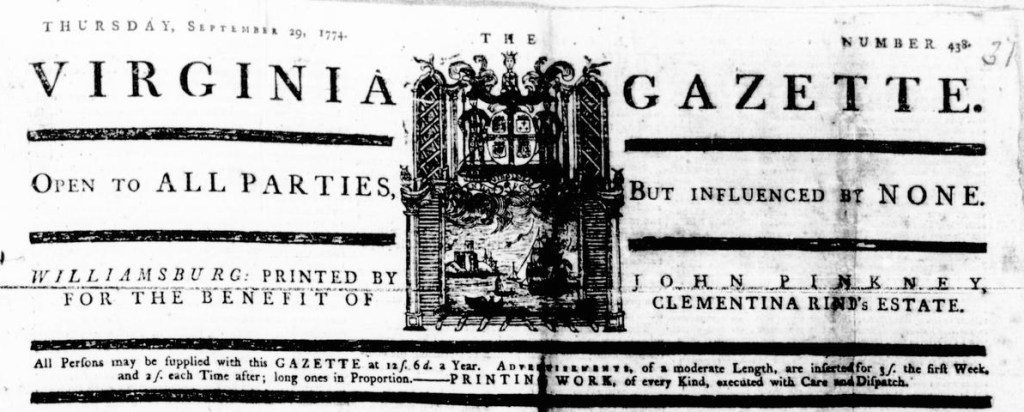
It was the third version of the masthead for the Virginia Gazette in three weeks.  Clementina Rind had been printing the newspaper for more than a year since her husband, William, died in August 1773.  During that time, the masthead included the title and the motto, “OPEN TO ALL PARTIES, BUT INFLUENCED BY NONE,” as well as the colophon.  It also incorporated an advertisement for subscribing, placing advertisements, and job printing undertaken in the printing office.  Placing the colophon with the masthead aided in distinguishing Rind’s Virginia Gazette from a newspaper of the same name printed by Alexander Purdie and John Dixon.  For their part, Rind’s competitors similarly presented their names in the masthead of their newspaper rather than placing the colophon at the bottom of the last page.  They did, however, reserve that space for an advertisement about subscriptions, advertisements, and job printing.

On September 22, 1774, the colophon for Rind’s Virginia Gazette stated, “PRINTED BY CLEMENTINA RIND,” for the last time.  The following week, it read, “PRINTED BY JOHN PINKNEY, FOR THE BENEFIT OF CLEMENTINA RIND’s ESTATE.”  At a glance, readers knew that a death had occurred: the thin lines that usually separated the title, motto, colophon, and advertisement had been replaced with much thicker lines that resembled the mourning borders that often appeared in early American newspapers.  Pinkney reverted to the thin lines for the October 6 edition, also updating the colophon once again.  Now it declared, “PRINTED BY JOHN PINKNEY, FOR THE BENEFIT OF CLEMENTINA RIND’s CHILDREN.”  The local news included a poem, “ON THE DEATH OF MRS. RIND,” submitted by a “CONSTANT READER.”

The conditions for subscribing remained the same.  Pinkney charged twelve shilling and six pence per year, the same price as Purdie and Dixon’s Virginia Gazette.  The fees for advertising also continued.  Customers could place notices “of a moderate Length” for three shillings for the first week and two shillings for each additional insertion.  The extra shilling in the first week covered the costs for setting the type.  As was the case in newspapers throughout the colonies, the rate changed for lengthier advertisements: “long ones in Proportion” to the base price.  Purdie and Dixon charged the same prices for advertising in their newspaper.  The advertisement in the masthead also advised, “PRINTING WORK, of every Kind, executed with Care and Dispatch.”  Publication of the Virginia Gazette continued with little disruption to subscribers and advertisers despite the death of the printer.  Pinkney had likely worked in the printing office with Rind during her tenure as printer, ready to assume responsibility for the business when she died.

Virginia Gazette [Pinkney] (September 20, 1774).