December 18

What was advertised in a revolutionary American newspaper 250 years ago today?
Connecticut Courant (December 18, 1775).

“Gentlemen in the army … forwarding their commands by any of the post-riders, may depend on fidelity and dispatch.”

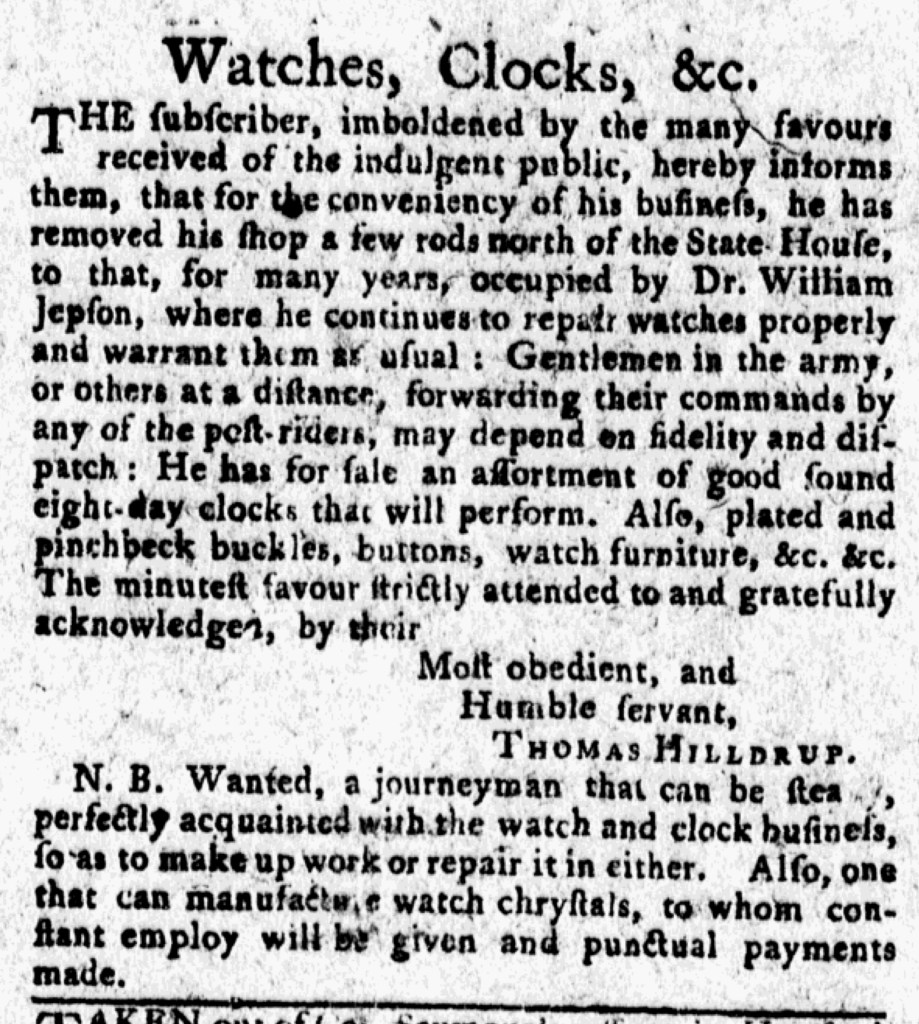
Thomas Hilldrup, a watch- and clockmaker, had a history of running engaging advertisements in newspapers printed in Connecticut in the 1770s.  He once again took to the pages of the Connecticut Courant and Hartford Weekly Intelligenceron December 18, 1775, this time informing existing and prospective clients that he had moved to a new location.  In framing this announcement, he asserted that he had already built a reputation and earned the trust of many customers.  Having been “imboldened by the many favours received of the indulgent public,” Hilldrup declared, he “hereby informs them that for the conveniency of his business, he has removed his shop a few rods north of the State-House, to that, for many years, occupied by Dr. William Jepson.”  He supplemented this announcement with assurances about his skill and the quality of his work, stating that he “continues to repair watches properly and warrant them as usual.”

Realizing that the Connecticut Courant circulated far beyond Hartford, Hilldrup took the opportunity to address “Gentlemen in the army, or others at a distance.”  Like other watchmakers, he provided mail order services for cleaning and repairs.  He promised those clients that by “forwarding their commands by any of the post-riders” they “may depend on fidelity and dispatch.”  As the Continental Army continued the siege of Boston, Hilldrup may have known that some of the clients he served in recent years too part in that endeavor.  In an unfamiliar place that experienced some of the most significant disruptions during the first year of the Revolutionary War, they may have been at a loss to identify local artisans that they trusted to do repairs and perform routine maintenance.  That might have made Hilldrup’s mail order service look especially attractive.  The watchmaker likely also hoped that others enlisted in the army (as well as “others at a distance”) who had not previously availed themselves of his services would be influenced by his claim that he already established a robust clientele, those “many favours received of the indulgent public” that he invoked at the beginning of his advertisement.  Whether or not this strategy proved effective, Hilldrup envisioned “Gentlemen in the army” as a new category of customers to target in his marketing.  The Revolutionary War presented opportunities to savvy entrepreneurs as well as challenges and disruptions.
November 9

What was advertised in a revolutionary American newspaper 250 years ago today?

Maryland Gazette (November 9, 1775).

“All work sent home as soon as done by the return of post.”

After his partnership with Abraham Claude ended, watchmaker Charles Jacob opened his own shop in Annapolis in the fall of 1775.  He placed an advertisement in the Maryland Gazette in hopes that “his former customers in town and country will favour him with their custom,” though he also intended for the notice to draw the attention of new customers.  Mentioning both his partnership with Claude and the clientele they had established demonstrated to prospective new customers that Jacob had the experience to serve them well.  In addition, he pledged “constant application to his business” or, in other words, an industriousness that customers would find more than satisfactory.

For the convenience of customers who lived outside Annapolis, Jacob provided an eighteenth-century version of mail order service.  In a nota bene, he stated that “orders from the country shall be strictly observed, and all work sent home as soon as done by the return of the post.”  In other words, he gave the same attention to watches sent to him to clean or repair as if the customer had visited his shop.  He did not give priority to customers who resided in Annapolis, nor did he delay returning watches to their owners when he finished working on them.  Prospective customers did not need to worry that their watches might end up sitting on a workbench or tucked away in a drawer and forgotten while Jacob attended to other projects.  Instead, he ran an orderly shop.

Jacob may have occupied the same location where he and Claude previously kept shop.  In their earlier advertisements, including one in the October 1, 1773, edition of the Maryland Gazette, they gave their address as “opposite Mr. Ghiselin’s, in West-Street.  In his new advertisement, Jacob declared that he “has just opened a shop next to John C. Lindsey’s tavern, and facing the late R. Ghiselin, in West-street.”  A familiar location may have helped him retain some of the customers that frequented the shop when he ran it in partnership with Claude.

July 6

What was advertised in a revolutionary American newspaper 250 years ago today?

New-York Journal (July 6, 1775).

“Removed next door to the white corner house … a dial plate over the window.”

John Simnet, a cantankerous watchmaker who frequently advertised in New York’s newspapers in the early 1770s, once again took to the pages of the New-York Journal in the summer of 1775.  In this notice, he announced that he “continues to repair and clean old watches … and sells new watches.”  He took a neutral tone in that notice compared to the derogatory declarations he sometimes made about his competitors in other advertisements.  Simnet did state that he cleaned and repaired watches “much cheaper and better than is usual,” comparing the price and quality of his services to those offered by other watchmakers, but he did not denounce any competitors by name or launch into a diatribe about the general incompetence of those who followed an occupation he often claimed as solely his own.  He also described himself as “one of the first who brought this curious and useful manufacture to perfection,” but limited that comment to promoting his own work rather than denigrating other watchmakers.

Perhaps Simnet was more interested in drawing attention to his new location.  He moved from a shop “at the Dial, next Beekman’s Slip, in Queen Street” to a shop “next door to the white corner house, New-York, opposite to the Coffee-House, and lower corner of the bridge.”  Detailed directions were necessary.  Neither New York nor any other town had standardized street numbers in the 1770s, though some of the largest port cities would begin assigning them by the end of the century.  Sinnet resorted to landmarks to direct customers to his shop.  Like many other entrepreneurs, he also marked his location with a device that represented his business, “a dial plate over the window.”  It may have been the same “Dial” that had adorned his previous location.  If Simnet did transfer the “dial plate” from one shop to another, he maintained a consistent visual image for customers and others to associate with his business.  Other entrepreneurs who placed advertisements in the July 6, 1775, edition of the New-York Journal also used images to mark their locations, including James Wallace, a lacemaker and tailor “At the SIGN of the HOOD,” and William Pearson, a clock- and watchmaker “At the Dial, in HANOVER-SQUARE.”  That a competitor displayed a dial made Simnet’s elaborate directions imperative.  He did not want prospective customers stopping by another shop by mistake.

May 7

What was advertised in a revolutionary American newspaper 250 years ago this week?

Rivington’s New-York Gazetteer (May 4, 1775).

“Repairing or cleaning WATCHES … entirely free from the old Fleecing Method.”

John Simnet’s notices became a fixture among the advertisements that appeared in New York’s newspapers in the first half of the 1770s.  The watchmaker migrated from England to Portsmouth, New Hampshire, in the late 1760s.  He spent about eighteen months there before moving to New York.  During his time in New England, he published a series of cranky notices that more often than not engaged in a feud with a competitor, Nathaniel Sheaff Griffith.  When Sinnet arrived in New York, he continued with the cantankerous advertisements, sometimes commenting on rival watchmakers in general and occasionally singling out a new competitor for the same sort of abuse he previously heaped on Griffith. Such behavior certainly made Simnet fun for the Adverts 250 Project to cover a couple of centuries later!

As the imperial crisis intensified in 1774, Simnet refrained from doing anything too outrageous in the public prints, but after fighting began at Lexington and Concord he demonstrated that he still had that spark.  Most advertisers, including his fellow watchmakers, usually promoted their own goods and services without mentioning their competitors.  Even when they proclaimed that they offered the best quality or the lowest prices, they did not intentionally denigrate their competitors.  Simnet, on the other hand, relished doing so.  In an advertisement in the May 4, 1775, edition of Rivington’s New-York Gazetteer, he mocked “what others think moderate or reasonable Terms,” suggesting that his peers who repaired and cleaned watches charged exorbitant rates for services poorly rendered.  Such work required yearly maintenance.  Simnet offered a superior alternative, cleaning and repairing watches such that they “perform much truer” and “retain their original Beauty much longer.”  Clients who availed themselves of his services liberated themselves from “the old Fleecing Method of paying by the Year.”  The watchmaker made clear that he believed his competitors cheated their customers, either by design or through a lack of competence.  When it came to having their watches repaired or cleaned, prospective customers did not “need be at an considerable Expence” if they entrusted the work to Simnet, watchmaker “From Clerkenwell, London,” rather than any of his inept competitors whose training and experience all took place in the colonies.

March 4

What was advertised in a colonial American newspaper 250 years ago today?

Pennsylvania Evening Post (March 4, 1775).

“WATCH MAIN SPRINGS MADE in Philadelphia.”

The headline proclaimed, “WATCH MAIN SPRINGS.”  Matthia Eyre, “SPRING MAKER from London,” hoped that would draw attention to his advertisement in the March 4, 1775, edition of the Pennsylvania Evening Post.  He informed readers, especially “Watchmakers in this and the neighbouring Provinces,” that he sold spring he produced in the colonies at the house on Third Street in Philadelphia.  In addition, watchmaker John Wood also stocked Eyre’s watch springs at his shop on Front Street.

Eyre asserted that “Watchmakers and others may be supplied with any Quantity of Springs much cheaper than can be afforded when imported from England.”  The price in combination with the “good Quality of the Springs” prompted the “Manufacturer” to suggest that he merited the “Encouragement” of watchmakers who needed parts.  Eyre likely composed his advertisement with confidence that both prospective customers and the public would consider his appeals in the context of current events, including the nonimportation agreement currently in place to protest the Coercive Acts.

The First Continental Congress devised the Continental Association in the fall of 1774.  The first article of that pact prohibited importing “any such Goods, Wares, or Merchandise, as shall have been exported from Great Britain.”  The eighth article, in turn, called for “encourag[ing] Frugality, Economy, and Industry; and promot[ing] Agriculture, Arts, and the Manufactures of this Country.”  Eyre offered an alternative to the watch springs that colonizers were no longer supposed to import, making it easier for them to abide by the Continental Association.  They could do so without sacrificing the quality of the parts they used in their work.  In addition, they had a duty to support a local “Manufacturer” in those troubling times.

Yet those “Watchmakers in this and the neighbouring Provinces” were not the only colonizers who read Eyre’s advertisement.  The spring maker enhanced his reputation in his community while simultaneously providing an example of American industriousness that answered the challenges of that tense political moment.  Readers could hardly peruse Eyre’s notice without having the Continental Association in mind.  He signaled to them that he answered the call, one of many artisans prepared to serve the American cause through his efforts in his workshop.

December 6

What was advertised in a colonial American newspaper 250 years ago today?

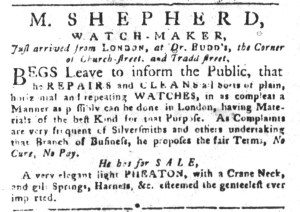
South-Carolina Gazette and Country Journal (December 6, 1774).

“WATCH-MAKER … proposes the fair Terms, No Cure, No Pay.”

When he moved to Charleston, one of the largest port cities in the colonies, M. Shepherd, a watchmaker, took to the pages of the South-Carolina Gazette and Country Journal to introduce himself to his prospective customers.  Like many artisans who crossed the Atlantic, he emphasized his connections to London, suggesting the level of skill he obtained while employed there.  In addition to stating that he “Just arrived from LONDON,” Shepherd also asserted that he “REPAIRS and CLEANS all Sorts of plain, horizontal and repeating WATCHES, in as compleat a Manner as possibly can be done in London.”  That was possible, in part, because he had “Materials of the best Kind for that Purpose.”  Shepherd’s competitors could make claims about doing work that rivaled that of their counterparts in London, but he was in a much better position to deliver on those promises.

The watchmaker also seized an opportunity to critique what he believed was a shortcoming in the services offered in the local market.  He suggested that “Silversmiths and other undertaking that Branch of Business,” rather than trained and experienced watchmakers, attempted to repair and clean watches, resulting in “very frequent” complaints about shoddy work.  In that regard, he echoed the critiques so often launched by John Simnet, another watchmaker from London who had migrated to the colonies.  Simnet regularly asserted that his competitors who attempted to fix watches did more damage, making it necessary for him to undertake even greater repairs.  Shepherd was so confident of his abilities that he offered a guarantee that he framed as “fair Terms.”  Invoking language more often deployed by physicians and apothecaries, the watchmaker promised, “No Cure, No Pay.”  In other words, if he could not fix a watch then he did not charge the customer for the time or materials that he invested in the effort.  As a newcomer in Charleston, he aimed to make his services attractive to prospective clients, highlighting both his skill and his no-risk guarantee.

June 12

What was advertised in a colonial American newspaper 250 years ago this week?

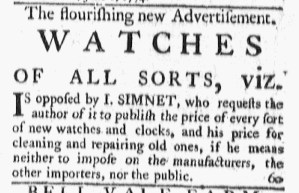
Rivington’s New-York Gazetteer (June 9, 1774).

“The flourishing new Advertisement … IS opposed by I. SIMNET.”

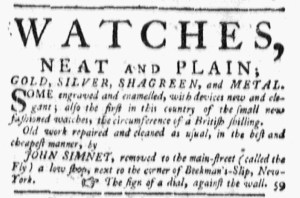
The cantankerous John Simnet once again picked a fight in the public prints in the summer of 1774, having previously engaged in similar behavior targeting competitors in Portsmouth in the late 1760s and New York in the early 1770s.  The watchmaker did not seem content simply promoting his own skill and merchandise, as he did in an advertisement for “WATCHES, NEAT AND PLAIN; GOLD, SILVER, SHAGREEN, and METAL” that first ran in the June 2, 1774, edition of Rivington’s New-York Gazetteer and appeared again a week later.  In that notice, Simnet emphasized a novelty available at his shop, “the first in this country of the small new fashioned watches, the circumference of a British shilling.”

Rivington’s New-York Gazetteer (May 26, 1774).

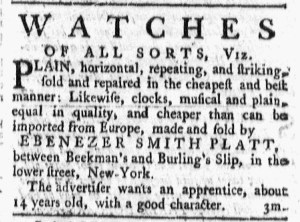
Yet Simnet did not believe that was not enough to distinguish him from his competitors. Instead, he placed a second advertisement in Rivington’s New-York Gazetteer on June 9, that one deriding “The flourishing new Advertisement” with a headline for “WATCHES OF ALL SORTS, viz.” that went on to list “PLAIN, horizontal, repeating, and striking.”  Ebenezer Smith Platt had been running that advertisement in Rivington’s New-York Gazetteer, though Sinmet’s comment about “The flourishing new Advertisement” suggests that his competitor may have distributed handbills or broadsides as well.  The part that really upset Simnet seems to have been Platt’s assertion that he made and sold watches and clocks “equal in quality, and cheaper than can be imported from Europe.”  Even though artisans throughout the colonies, including clock- and watchmakers, often made such appeals, Simnet acted as though they applied solely to him and his business.

Rivington’s New-York Gazetteer (June 9, 1774).

To that end, he quoted the headline of Platt’s advertisement and then trumpeted that he “IS opposed” to the claims made in it.  Simnet went on to demand, though he framed it as a request, that “the author of it” (he did not mention Platt by name) “publish the price of every sort of new watches and clocks, and his price for cleaning and repairing old ones, if he means neither to impose on the manufacturers, the other importers, nor the public.”  On occasion, Simnet had published the prices he charged for cleaning and repairs, though in his current advertisement he merely stated, “Old work repaired and cleaned as usual, in the best and cheapest manner.”  He sought to hold Platt to a higher standard than he met, suggesting that he did so in service to “the public” that might have otherwise been duped by Platt.  In an era when most advertisers promoted their own goods and services without engaging directly with their competitors, Simnet regularly took to the newspapers to demean others who followed his trade, especially those who ran their own advertisements.  He apparently considered such means effective … or at least derived some form of satisfaction from such conduct.

June 11

What was advertised in a colonial American newspaper 250 years ago today?

Maryland Journal (June 11, 1774).

“No money be expected until the test of proof shall confirm their intrinsic value.”

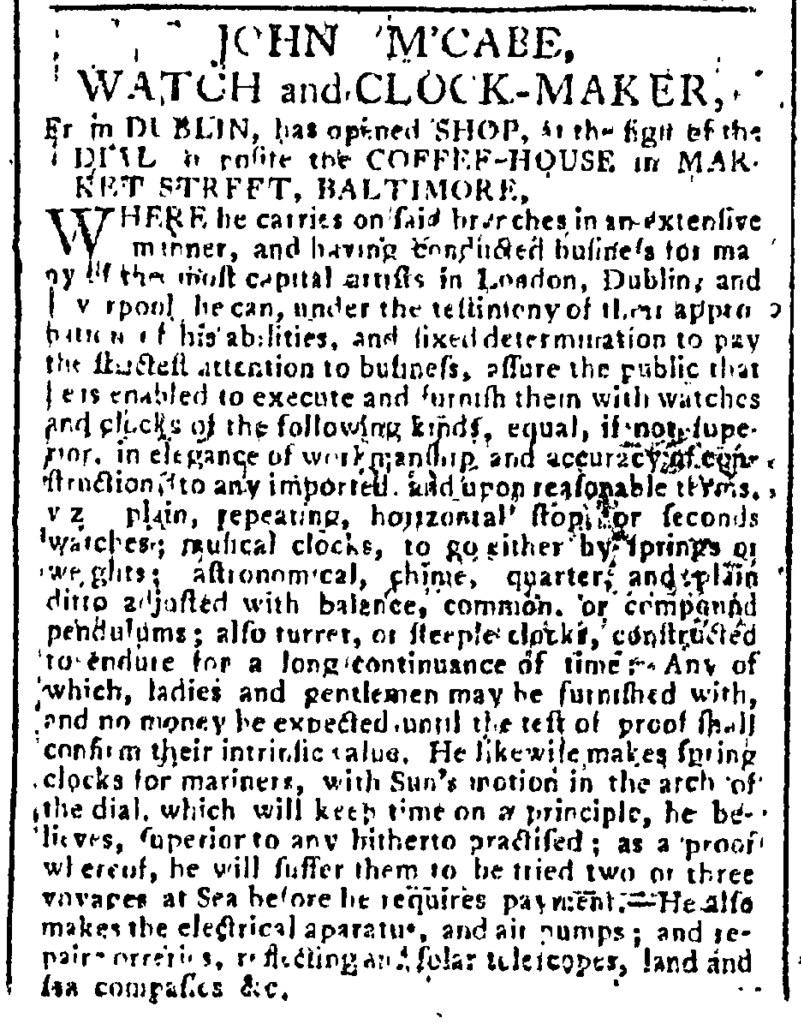
When he set up shop “at the sign of the DIAL” in Baltimore, John McCabe, a “WATCH and CLOCK-MAKER, From DUBLIN,” deployed a marketing strategy commonly undertaken by artisans who migrated across the Atlantic to the colonies.  In an advertisement in the June 11, 1774, edition of the Maryland Journal, he sought to establish his reputation in a town that did not have firsthand knowledge of his skill.  Instead, he relied on an overview of his experience, asserting that he had “conducted business for many of the most capital artists in London, Dublin, and Liverpool.”  Having worked in the most exclusive shops in urban centers, especially the cosmopolitan center of the empire, gave the newcomer a certain cachet, enhanced even more by the “testimony of their approbation of his abilities” that he claimed he could produce.

Yet McCabe did not rest on such laurels that were not immediately apparent to readers.  Instead, he simultaneously declared that his “fixed determination to pay the strictest attention to business.”  Underscoring his industriousness also came from the playbook developed by other artisans, a familiar refrain in their advertisements.  Prospective customers who might have been skeptical of McCabe’s credentials could judge for themselves whether he made clocks and watches “equal, if not superior, in elegance of workmanship and accuracy of construction to any imported.”  They could acquire such timepieces “upon reasonable terms,” getting the same style and quality as watches and clocks from London without paying exorbitant prices.

Even though the initial portions of his advertisement resembled notices placed by other artisans, McCabe, he did include an offer not made nearly as often: allowing a trial period for customers to decide if they wished to purchase or return watches and clocks from his shop.  The enterprising artisan declared that “ladies and gentlemen may be furnished” with any of the variety of clocks and watches listed in his advertisement and “no money be expected until the test of proof shall confirm their intrinsic value.”  McCabe did not explicitly state that customers could return items they found lacking, so confident was he that they would indeed be satisfied with his wares during the trial.  He extended a similar offer for “spring clocks for mariners … which keep time on a principle, he believes, superior to any hitherto practised.”  Customers could make that determination for themselves: “he will suffer them to be tried two or three voyages at Sea before he requires payment.”  Such arrangements would have required some negotiation about the amount of time and the length of those voyages, but allowing for such trials before collecting money from customers did not put McCabe at a disadvantage in the eighteenth-century commercial culture of extending extensive credit to consumers.  Prospective customers likely expected credit, so McCabe gained by transforming the time that would elapse between purchase and payment into a trial, giving those customers the impression that they received an additional benefit from doing business with him.  For some, that may have been the more effective marketing strategy than any claims about his experience working in the best shops in London, Dublin, and Liverpool.

April 29

What was advertised in a colonial American newspaper 250 years ago today?

New-Hampshire Gazette (April 29, 1774).

WATCHES sent … by Post Riders, will be mended, cleaned and sent back with great Care.”

In the spring of 1774, Nathaniel Sheaff Griffith once again advertised that he “Cleaned and Repaired” clocks and watches “in the cheapest and best Manner,” making appeals to both price and skill.  He regularly ran notices in the New-Hampshire Gazette, but this one included an update about an employee who worked in his shop in Portsmouth.  Griffith advised prospective customers that he “has a Workman from London, which Work shall be done with Fidelity and Dispatch.”  In other words, Griffith vouched for his employee.  Other artisans in New England sometimes promoted the work undertaken by their employees.  For instance, Charles Stevens, a goldsmith and silversmith in Providence, informed the public that he “employs an excellent Workman from London” who did “all Kinds of Jewellers Work.”  Similarly, Enos Doolittle advised readers of the Connecticut Courant that he “employed a journeyman who has serv’d a regular Apprenticeship to the Watchmaking business in London.”  Griffith, Stevens, and Doolittle all signaled that they could effectively serve an even more extensive clientele thanks to the workmen from London who labored in their shops.

That may have been a factor in another marketing strategy that Griffith deployed for the first time.  He concluded his advertisement with a note that “WATCHES sent from East, West, North or South by Post Riders, will be mended, cleaned and sent back with great Care.”  While he may have done business that way in the past, he had not previously mentioned this option in his newspaper advertisements.  Perhaps now that he had an assistant Griffith felt more secure in advertising this service widely.  Once again, other artisans in New England also marketed similar arrangements.  Thomas Hilldrup, a watchmaker from London who settled in New London, declared that clients could “forward their Watches to me … by applying to Mr. JOSEPH KNIGHT, Post-Rider.”  He promised the same sort of “Dispatch” or quick service that Griffith did, stating that any watches he received would be “returned regularly the next Week.”  Post riders provided an infrastructure for watchmakers like Griffith and Hilldrup to serve clients who lived at a distance, expanding their business to rural towns rather than working solely for local customers in port cities.

March 27

What was advertised in a colonial American newspaper 250 years ago this week?

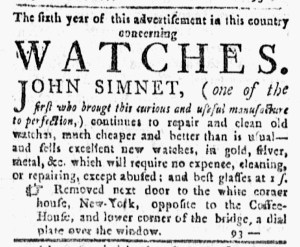
New-York Journal (March 24, 1774).

“WATCHES … no Expence for cleaning them.”

John Simnet, a watchmaker, was a prolific advertiser in New York’s newspapers in the early 1770s.  In late March 1774, he placed a new advertisement in the New-York Journal, with a headline that proclaimed, “The Sixth Year of this Advertisement in this Country.”  Simnet referred to the fact that he migrated to the colonies from London, though he first set up shop in New Hampshire.  He advertised there for about a year and a half, frequently engaging in feuds with a competitor, before relocating to New York.  Perhaps prospective customers in and near Portsmouth had not appreciated his abrasive style, though the curmudgeon did not seem to learn his lesson if that was the case.  After settling in New York, he frequently picked fights with local watchmakers, their arguments witnessed by newspaper readers as they perused the advertisements.  Over the years, the colorful Simnet has become a favorite for the Adverts 250 Project, one of the colonial advertisers most often featured thanks to his lively notices.  In March 1774, Simnet had indeed commenced his “Sixth Year” of running advertisements in the colonies.

When he did so, he advanced a marketing strategy he frequently deployed.  Simnet offered an ancillary service for free to his clients who paid for other services: “those Gentlemen, &c. who have employed the Advertiser to Repair their WATCHES, ARE now at no Expence for cleaning them.”  In other words, he did not charge customers for routine cleaning of watches that he previously repaired.  That kept the watches in good running order, which further testified to Simnet’s skills and justified hiring him for other work.  The watchmaker declared that “it will be his endeavour to prove, Watches which are tolerably good, will perform 20 Years without Expence.”  Prospective clients could take their watches to his competitors who did not invest the same care in their work, causing them to have to pay for additional repairs over time, or they could entrust their watches to Simnet with confidence that he would assist them in averting further expense.  His clients could avoid paying for “mending Work” on their watches (and simultaneously safeguard Simnet’s reputation) if they presented their watches for cleaning “at least once a Year.”  Putting a little effort into such routine maintenance, offered for free, made the clients and the watchmakers partners in the enterprise, encouraging customer loyalty.