August 2

What was advertised in a colonial American newspaper 250 years ago today?

New-York Gazette and Weekly Mercury (August 2, 1773).

“He makes all sorts of coaches … equal to any imported from England.”

William Deane made appeals to price and quality in an advertisement for the coaches he constructed at his shop “in Broad-street” in the August 2, 1773, edition of the New-York Gazette and Weekly Mercury.  Compared to most other advertisers, however, he devised much more elaborate marketing strategies to convince prospective customers of the price and quality he offered.

Deane started by describing the various services in his shop.  He made several different kinds of carriages as well as “all sorts of harness and saddlers work.”  In addition, he also did “painting, gilding and Japanning, in the neatest and most elegant manner.”  Deane emphasized that he achieved a high level of quality while offering the lowest possible prices because he did not outsource any of those jobs to artisans.  Instead, he “finishes all carriages whatever in his own shop, without applying to any other.”  Accordingly, he was “determined to make them as good, sell them as cheap, and be as expeditious as there is a possibility.”

The carriagemaker realized that he needed “to convince the public of the truth of what he asserts.”  To that end, he vowed that he “will make any piece of work that is required, equal to any imported from England, and will sell it at the prime cost of that imported.”  His customers did not have to sacrifice either price or quality, one for the other, when they supported domestic manufacture by purchasing carriages made in his shop in New York.  Furthermore, they benefitted from additional bargains since they “will save the freight, insurance, and the expences naturally attending to putting the carriages to rights after they arrive.”  In so many ways, purchasing a carriage from Deane was so much easier than importing one made in England.  In addition, he “has now a considerable stock of the best of all materials fit for making carriages,” so he was ready to serve customers who placed orders.

Deane offered a “further inducement,” a one-year guarantee on the carriages made in his shop.  He had been providing guarantees in newspaper advertisements for at least six years (including in an advertisement with nearly identical copy in the New-York Journal more than a year earlier).  The carriagemaker declared that he “will engage his work for a year after it is delivered, that is, if any part gives way, or fails by fair usage, he will make it good at his own expence.”   To make the choice even more clear, he underscored that prospective customers would not have access to that kind of customer service in maintaining their carriages if they opted for ones made in England.  “Those advantages,” Deane intoned, “cannot be obtained on carriages imported.”

The carriagemaker’s advertisement revolved around price and quality.  He did more than make casual reference to them, developing a sophisticated marketing strategy that touted the advantages of purchasing carriages made in his shop.  He used only the best materials and oversaw every aspect of the construction to produce carriages that rivaled in craftsmanship those imported from England.  He also offered competitive prices, especially since his customers saved on shipping and insurance, and a one-year guarantee on any parts that might require repairs.  Deane sought to convince prospective customers that all of this made his carriages the best choice.

June 21

What was advertised in a colonial American newspaper 250 years ago this week?

New-York Journal (June 18, 1772).

Those advantages cannot be obtained on carriages imported.”

Advertisers began encouraging consumers to “Buy American” before the American Revolution.  Such was the case in an advertisement that coachmaker William Deane placed in the New-York Journal for several weeks in May and June 1772.  He advised “the public in general and his customers in particular” that he made all sorts of carriages and did all of the painting, gilding, and japanning.  With an attention to detail, Deane “finishes all carriages whatever in his own shop without applying to any other,” utilizing his “considerable stock of the best of all materials fit for making carriages.”  Furthermore, the coachmaker declared his determination “to make them as good, sell them as cheap, and be as expeditious as there is a possibility.”

Deane competed with coachmakers in England.  Many colonizers preferred to purchase carriages from artisans on the other side of the Atlantic, but Deane asserted that imported carriages were merely more expensive but not superior in quality or craftsmanship to those he constructed in New York.  He proclaimed that he could “make any piece of work that is required equal to any imported from England, and will sell it at the prime cost of that imported.”  That accrued various benefits to his customers.  Deane explained that they “will save the freight, insurance, and the expences naturally attending in putting the carriages to right after they arrive.”  Why incur those addition expenses and risk purchasing carriages that needed repairs after shipping when Deane made and sold carriages of the same quality in New York?

In addition, Deane offered a guarantee, stating he “will engage his work for a year after it is delivered.”  That meant that “if any part gives way or fails by fair usage, he will make it good at his own expence.”  What did prospective customers have to lose by purchasing one of Deane’s carriages?  They paid less for the same quality, plus they had easy access to the maker for repairs, including repairs undertaken for free if the result of some defect.  “Those advantages cannot be obtained on carriages imported,” Deane trumpeted as he concluded making his case that consumers in the market for carriages should “Buy American” by choosing his carriages over any that they would import from England.  Two centuries later, car manufacturers deployed “Buy American” marketing campaigns as they competed in an increasingly globalized economy, but that strategy did not emerge from developments in the twentieth and twenty-first century.  Coachmakers like William Deane encouraged consumers to “Buy American” long before the creation of the modern automotive industry.

September 17

What was advertised in a colonial American newspaper 250 years ago today?

Sep 17 - 9:17:1767 New-York Journal
New-York Journal (September 17, 1767).

“The Coach-making Trade is carried on in all its different Branches.”

Elkanah and William Deane incorporated multiple marketing appeals into their advertisement for carriages slated for sale at auction the following week. Just as modern car dealerships do today, the coachmakers stocked several models so potential customers could choose the one that best fit their needs, tastes, and budgets. They may have also offered choices between new and used carriages. Other coachmakers, including Adino Paddock in Boston, advertised used carriages in the 1760s. The Deanes explicitly described both their “Post-Chariot, and Harness” and “one Horse-Chaise, with Steel-Springs and Iron Axeltree neatly finished with Harness complete” as “new,” but not their “Curricle and Harness.” That they instead described as “good.” If the curricle did indeed have a previous owner, it made sense to focus on its condition to reassure skeptical customers.

The Deanes also proclaimed that they pursued their trade “in all its different Branches” to the same standards as in London and Dublin. They had previously advertised that they “made and finished” coaches, harnesses, saddles and accessories “in the genteelest taste” and that employees in their workshop had been “regularly brought up to the different Branches of Trade.” Establishing connections to London and Dublin elaborated on that appeal. Consumers did not need to import carriages from workshops across the Atlantic. Instead, local artisans possessed the same skills and expertise and followed the same styles as in the most cosmopolitan cities in Britain and Ireland. Their coaches rivaled any built elsewhere in the empire.

Finally, the Deanes inserted a nota bene that informed prospective customers that they “warrant their Work for Twelve Months.” The coachmakers regularly included this guarantee in their advertisements, having previously stated in an earlier notice that the items they sold were “warranted for Twelve Months. They did not offer false promises about the craftsmanship of their carriages; instead, they were so confident that they backed up their appeals to quality with guarantees valid for an entire year after purchase.

Buying a carriage was a major purchase for any customer, even the most affluent. Some colonists spared no expense when they imported carriages from workshops in London, yet local coachmakers sought their own place in the market. Elkanah and William Deane underscored the virtues associated with the carriages they made and sold, promising customers the same cachet as well as services, including repair work during the first year, that faraway competitors could not provide.

May 28

What was advertised in a colonial American newspaper 250 years ago today?

May 28 - 5:28:1767 New-York Journal
New-York Journal (May 28, 1767).

“Have their Work done by Men who have been regularly brought up to the different Branches of Trade.”

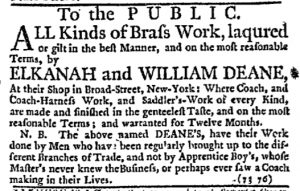
Elkanah and William Deane made coaches “At their Shop in Broad-Street, New-York.” At the same location they also did “Coach-Harness Work, and Saddler’s-Work of every Kind.” The Deanes apparently were not impressed with many of their competitors, issuing sharp words about the quality of work customers could expect from other shops. In a nota bene they asserted, “The above named DEANE’S, have their Work done by Men who have been regularly brought up to different Branches of Trade, and not be Apprentice Boy’s, whose Master’s never knew the Business, or perhaps ever saw a Coach making in their Lives.”

The quality promised by the Deanes resulted from specialized training by qualified artisans. They accused competitors of hiring workers who had supposedly been through apprenticeships, but they cast doubt on the caliber of expertise and experience possessed by some of the supposed masters who trained the next generation of coachmakers and artisans in related occupations, such as harnessmakers and saddlers. The Deanes warned that prospective customers needed to heed not only the credentials of the coachmaker who ran a shop but also those of anyone employed in that shop. After all, the owner of a shop did not undertake all the work but instead distributed it and oversaw the labor of others. The Deanes took responsibility for the work done by every employee in their shop, pledging that they only hired experienced “Men who have been regularly brought up to the different Branches of Trade.”

Assuring potential customers of the quality of the work produced in their shop was so important to the Deanes that they offered a one-year guarantee. Whether repairs to coaches or new harnesses or saddles, everything that came out of their shop was “warranted for Twelve Months.” By providing a guarantee, the Deanes underscored that their scathing comments about training and expertise were not merely idle boasts. They could afford to guarantee their work because they were so confident in their own skills and experience as well as those of everyone who worked in their shop.