April 1

What was advertised in a colonial American newspaper 250 years ago today?
Pennsylvania Evening Post (April 1, 1775).

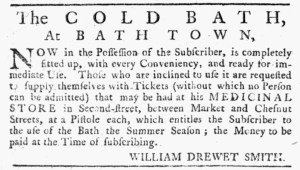
“The COLD BATH, At BATH TOWN.”

William Drewet Smith, a “Chemist and Druggist,” diversified his business interests in the spring of 1775.  He operated a shop “At HIPPOCRATES’s HEAD” on Second Street Philadelphia, selling a “general Assortment of Druggs and patent medicines, surgeons instruments, [and] shop furniture.”  In an advertisement in the March 25 edition of the Pennsylvania Ledger, he promoted one of those patent medicines, “Baron SCHOMBERG’s Grand Prophylactic LIMIMENT” to prevent venereal diseases and treat the symptoms of those who did not practice prevention soon enough.  In that same issue, he inserted a second advertisement, that one hawking “Baron Van Haake’s royal letters pattent composition, for manuring land” to farmers and gardeners.

A week later, Smith ran yet another notice to announce that he was now the proprietor of the “COLD BATH, At BATH TOWN.”  The facility, he reported, “is completely fitted up, with every Conveniency, and ready for immediate Use.”  Those seeking entry needed to buy tickets (“without which no Person can be admitted”).  The apothecary sold them for “a Pistole each” at his “MEDICINAL STORE.”  Those who intended to travel to Bath, about sixty-five miles north of Philadelphia, could obtain their tickets before making the trip.  Rather than a single admission, each ticket entitled the bearer “to the use of the Bath [throughout] the Summer Season,” but they had to pay the entire balance “at the Time of subscribing.”  Smith did not allow guests to avail themselves of the amenities at his spa on credit.

Advertising in both the Pennsylvania Evening Post and the Pennsylvania Ledger, Smith joined the ranks of eighteenth-century entrepreneurs who marketed health tourism in America.  The apothecary probably figured that it made sense to branch out in that direction.  When clients visited his shop in Philadelphia, especially clients of means who had the leisure to travel, he could recommend the rejuvenating waters at the “COLD BATH” and the benefits of being away from the bustling urban port to supplement the medicines that he supplied.  He likely believed that his reputation and experience as a “Chemist and Druggist” made him a trustworthy provider of other health services in the eyes of the public.
March 25

What was advertised in a colonial American newspaper 250 years ago today?

Pennsylvania Ledger (March 25, 1775).

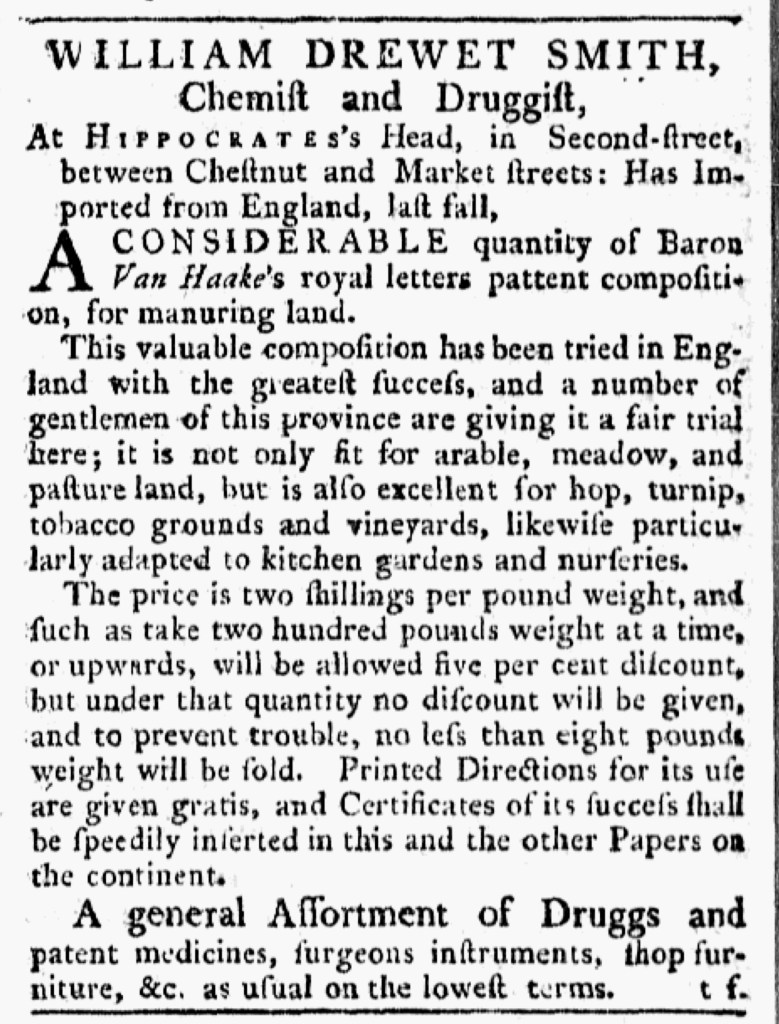
“Certificates of its success shall be speedily inserted in this and the other Papers on the continent.”

William Drewet Smith, “Chemist and Druggist,” ran an apothecary shop “At HIPPOCRATES’s Head, in Second-street” in Philadelphia in the 1770s.  He expected that prospective customers would associate Hippocrates, the ancient Greek physician known as the “Father of Medicine,” with the “general Assortment of Drugs and patent medicines, surgeons instruments, [and] shop furniture” that he sold.  Yet those were not the only items that Smith peddled.

The apothecary ran an advertisement for “Baron Van Haake’s royal letter pattent composition, for manuring land” in the March 25, 1775, edition of the Pennsylvania Ledger.  In addition to medicines for treating the body, the Smith sold this compound for nurturing soil and raising crops.  For those not familiar with its use, the chemist explained that the “valuable composition has been tried in England with the greatest success.”  In addition, “a number of gentlemen of this province are giving it a fair trial here.”  Trials demonstrated that the treatment “is not only fit for arable, meadow, and pasture land, but is also excellent for hop, turnip, tobacco grounds and vineyards” as well as “kitchen gardens and nurseries.”  In other words, any farmer, any gardener, or anybody else who raised crops or plants of any kind needed to try Varon Van Haake’s composition to see for themselves its positive impact on their endeavors.

Smith stated that he included “printed Directions for its use” free with every sale.  He also planned to insert “Certificates of its success” (or testimonials from satisfied customers) “in this and the other Papers on the continent,” suggesting that he was already in possession of such endorsements.  To further entice prospective customers, he offered a “five per cent discount” to customers who “take two hundred pounds weight at a time, or upwards.”  He also mentioned that he imported this product from England “last fall,” signaling to readers that he acquired it before the Continental Association went into effect so they could purchase it with a clear conscience.

Elsewhere in the same issue of the Pennsylvania Ledger, Smith published a lengthy advertisement for “Baron SCHOMBERG’s Grand Prophylactic LINIMENT” that supposedly prevented and cured “most venerial complaints.”  He included a statement from the “ingenious” chemist responsible for the liniment and noted that he provided printed directions “for its particular use.”  When it came to advertising Baron Van Haake’s composition for treating soil, Smith applied marketing strategies already familiar from the patent medicines that he sold.