January 9

What was advertised in a colonial American newspaper 250 years ago today?
Maryland Journal (January 9, 1775).

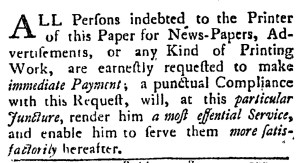
“ALL Persons indebted to the Printer … are earnestly requested to make immediate Payment.”

Among the advertisements that filled the first page of the January 9, 1775, edition of the Maryland Gazette, William Goddard inserted his own notice that requested “ALL Persons indebted to the Printer of this Paper for News-Papers, Advertisements, or any Kind of Printing Work … make immediate Payment.”  Printers often placed such notices calling on subscribers to settle accounts and, sometimes, incorporating overdue payments for other services.

The inclusion of “Advertisements” in Goddard’s notice raises questions about the business model usually associated with colonial printers.  Historians of the early American press have long asserted that printers extended credit for subscriptions while demanding payment in advance for advertisements.  Accordingly, advertising represented the real revenue in publishing newspapers.  Yet several printers periodically called on customers to pay for “Advertisements.”  Those notices, however, do not make clear what they meant by “Advertisements.”  They may have referred to paid notices that appeared in their newspapers, in which case some printers deviated from the (standard?) practice of requiring payment in advance, but they might have instead meant handbills, broadsides, and other advertising media that many printers stated that they could prepare on short notice.

In the colophon at the bottom of the final page, Goddard gave the location of his printing office in Baltimore, “where ADVERTISEMENTS, for ready Money only, and SUBSCRIPTIONS for this PAPER … are taken in.”  That suggests that Goddard did indeed have a policy of insisting on payment for advertisements before printing them in the Maryland Journal.  Does that definitively mean that “Advertisements” in his call for customers to pay their bills meant handbills and broadsides and not newspaper notices?  Not necessarily.  Goddard may have invoked a relatively new policy.  The colophon that asserted that he inserted advertisements “for ready Money only” had been in use for about three months, since October 1774, but prior to that he had used a streamlined version that did not mention any of the services he provided.  In its entirety, it read: “BALTIMORE: Printed by W. GODDARD, at his Printing-Office near the FOUNTAIN-INN, MARKET-STREET.”  Perhaps Goddard previously extended credit to advertisers but changed his policy when too many took advantage.  His notice and his colophons do not give a straightforward answer but instead suggest that the business practices of some printers may have been more complex than often assumed.

Maryland Journal (January 9, 1775).

July 1

What was advertised in a colonial American newspaper 250 years ago today?

Connecticut Gazette (July 1, 1774).

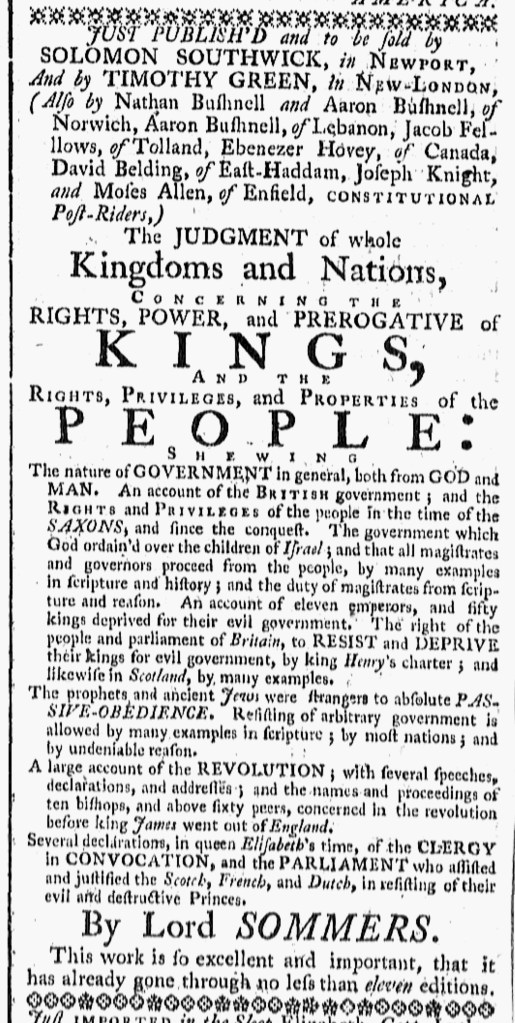
To be sold by … CONSTITUTIONAL Post-Riders.”

The front page of the July 1, 1774, edition of the Connecticut Gazette featured an open letter “TO THE KING” from “AMERICA” followed immediately by an advertisement for a book, The Judgment of Whole Kingdoms and Nations, Concerning the Rights, Power, and Prerogative of Kings, and the Rights, Privileges, and Properties of the People.  The petition requested a redress of grievances that took into account the “rights and privileges … solemnly given, granted, confirmed, ratified and recognized … by your royal predecessors and their parliaments.”  The book, a constitutional history of Great Britain, echoed that theme in much greater detail, making it hardly a coincidence that advertisement just happened to follow the letter.

American printers in three cities had recently produced American editions of The Judgment of Whole Kingdoms and Nations.  In 1773, John Dunlap printed it in Philadelphia and Isaiah Thomas printed it for John Langdon, a bookseller, in Boston.  The advertisement promoted a 1774 edition “JUST PUBLISH’D and to be sold by SOLOMON SOUTHWICH, in NEWPORT.”  Timothy Green, the printer of the Connecticut Gazette, also sold the book in New London.  In addition, readers could acquire it from “CONSTITUTIONAL Post-Riders” who operated out of Norwich, Lebanon, Tolland, East Haddam, and Enfield.  The National Postal Museum explains that the Constitutional Post was “an alternative to the British run Parliamentary Post.”  William Goddard originally established a “new constitutional Post … between [Philadelphia] and Baltimore” and quickly expanded it.  According to the National Postal Museum, Goddard considered the Parliamentary Post “unacceptable because it was not private – postmasters were allowed to intercept and open letters – and because he saw it as another form of taxation without the colonists’ consent.”  Many shared this view; the number of riders in Connecticut affiliated with the Constitutional Post just a few months after its founding demonstrates that was the case.  In July 1775, the Second Continental Congress assumed responsibility for the Constitutional Post, appointing Benjamin Franklin as postmaster.  Goddard desired the position, but he settled for Riding Surveyor of the Post.  By then, the Constitutional Post had demonstrated its capacity for delivering letters, newspapers, and books.  In the summer of 1774, for instance, the Constitutional Post served as a distribution network for The Judgment of Whole Kingdoms and Nations, consistent with Goddard’s vision for maintaining English rights and liberties in the colonies.

February 8

What was advertised in a colonial American newspaper 250 years ago today?

Pennsylvania Chronicle (February 8, 1774).

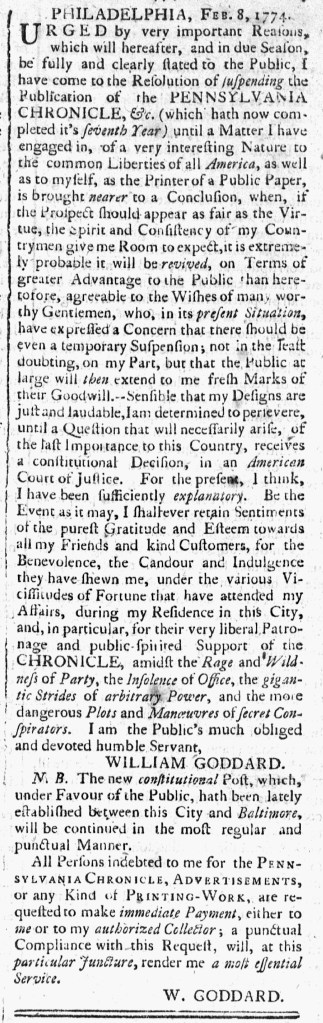
“I have come to the Resolution of suspending the Publication of the PENNSYLVANIA CHRONICLE.”

William Goddard published the final issue of the Pennsylvania Chronicle on February 8, 1774.  That newspaper commenced publication seven years earlier, on January 26, 1767.  The Adverts 250 Project tracked Goddard’s efforts to launch the Pennsylvania Chronicle, advertisements that ran in the first issues, and many more advertisements throughout its run.  Aside from news items, the final issue featured only three paid notices along with a letter from Goddard.

The printer explained that “very important Reasons” led him to “the Resolution of suspending the Publication of the PENNSYLVANIA CHRONICLE.”  He suggested that those reasons “will hereafter, and in due Season, be fully and clearly stated to the Public.”  He further hinted that he planned to revive the newspaper when “a Matter I have been engaged in, of a very interesting Nature to the common Liberties of all America, as well as to myself, as the Printer of a Public Paper, is brought nearer to a Conclusion.”  Goddard made other cryptic references, pronouncing that he had been “sufficiently explanatory.”  Still, he could not resist thanking his patrons for their support “amidst the Rage and Wildness of Party, the Insolence of Office, the gigantic Strides of arbitrary Power, and the more dangerous Plots and Manoeuvres of secret Conspirators.”

Many readers, especially those who had resided in Philadelphia for any amount of time, may have remembered that Goddard initially published the Pennsylvania Chronicle in partnership with Joseph Galloway and Thomas Wharton.  In his History of Printing in America (1810), Isaiah Thomas notes that the newspaper “was established under their influence and subject to their control, until 1770.”  At that time, Galloway and Wharton sold their share to Benjamin Towne, but Goddard soon “separated from his partners.”  After that, a “portion of [the newspaper] was … for a long time, devoted by Goddard to the management of a literary warfare which took place between him and his late partners.”[1]  In 1770, Goddard had also published a pamphlet, The Partnership, that put the enmity between himself and his former partners on full view for the public.  The lengthy subtitle testified to how much the relationship had deteriorated:  “The history of the rise and progress of the Pennsylvania Chronicle, &c.: Wherein the conduct of Joseph Galloway, Esq; speaker of the Honourable House of Representatives of the province of Pennsylvania; Mr. Thomas Wharton, Sen. and their man Benjamin Towne, my late partners, with my own, is properly delineated, and their calumnies against me fully refuted.”  In turn, Galloway and Wharton had Goddard imprisoned for debt for the following year.

As the Pennsylvania Chronicle declined, Goddard founded the Maryland Journal, the first newspaper published in Baltimore, in August 1773.  Goddard relocated to Baltimore after “suspending” the Pennsylvania Chronicle.  In a nota bene at the end of his letter in the final issue, he declared that the “new constitutional Post, which … hath been lately established between this City and Baltimore, will be continued in the most regular and punctual Manner.”  That was the first route in what became a much more expansive network of post offices operated independently of the British postal system, allowing colonizers to send letters and disseminate newspapers without interference from British officials.

As a last matter of housekeeping, Goddard called on “All Persons indebted to me for the PENNSYLVANIA CHRONICLE, ADVERTISEMENTS, or any Kind of PRINTING-WORK … to make immediate Payment.”  Printers and other entrepreneurs regularly placed notices with the intention of settling accounts.  Goddard’s notice merits special attention because he indicates that some customers owed for advertisements.  Many historians of the early American press assert that printers extended generous credit to subscribers while generating revenue by demanding that advertisers paid in advance.  Some printers, however, periodically ran notices calling on advertisers to make payment.  Goddard and some of his fellow printers apparently did not enforce a hard-and-fast policy when it came to paying for advertisement before publication.

Although the Pennsylvania Chronicle ceased publication in 1774, Goddard continued publishing the Maryland Journal and became involved in other projects, including the Constitutional Post, that became the subjects of news articles, editorials, and advertisements.  Undoubtedly, William Goddard will make additional appearances as the Adverts 250 Project continues examining advertising, print culture, and politics during the era of the American Revolution.

**********

[1] Isaiah Thomas, The History of Printing in America: With a Biography of Printers and an Account of Newspapers (1810; New York: Weathervane Books, 1970), 438.

January 8

What was advertised in a colonial American newspaper 250 years ago today?

Maryland Journal (January 8, 1774).

“My Entreaty to a great Majority of the Subscribers … to pay the Entrance Money, (a small Sum!)”

Less than five months after William Goddard commenced publication of the Maryland Journal on August 20, 1773, he found the enterprise in a dire financial position, at least according to the notice that he placed in the January 8, 1774, edition.  It appeared under a heading for “New Advertisements,” the first item following news, letters, and editorials.  With a manicule to help draw attention to his message, the printer lamented, “IT gives me real Pain to find myself under the Necessity of repeating my Entreaty to a great Majority of the Subscribers for the Encouragement of this paper, to pay the Entrance Money, (a small Sum!) agreeable to Contract.”  Indeed, Goddard had specified in his subscription proposals that Baltimore’s first newspaper would cost “the moderate Price of TEN SHILLINGS, … per Annum, one Half to be paid at the Time of subscribing, and the Remainder at the Expiration of the Year.”  He also pledged to begin publication “as soon … as I shall obtain a sufficient Number of Subscribers barely to defray the Expence of this Work.”

Enough subscribers may have submitted payment “barely to defray” the cost of printing those first issues, but Goddard apparently did not insist that more subscribers actually pay the entrance fee before he launched the venture.  Publishing a newspaper was a complex endeavor.  With a large enough subscription base, printers could convince others to subscribe.  The size of that subscription base also testified to the circulation of the newspaper, important for bringing in advertisements.  Many printers considered advertising more lucrative than subscriptions, allowing credit for subscriptions but not advertisements.  Still, that was not the deal that Goddard outlined in the subscription proposals for the Maryland Journal.  He may have figured that subscribers would pay once he distributed the first issue, so he gambled on taking the newspaper to press before most subscribers paid.  Goddard may have also been concerned about the prospects of competition.  The growing port had reached the point that it might support its own newspaper instead of relying on newspapers published in Annapolis and Philadelphia … but could it support two newspapers?  At the same time that Goddard circulated proposals for the Maryland Journal, Robert Hodge and Frederick Shober announced that they “intend shortly to exhibit Proposals for publishing a NEWS-PAPER, which shall be justly entitled to the Attention and Encouragement of this FLOURISHING TOWN.”  In the end, Goddard printed a newspaper in Baltimore, while Hodge and Shober did not.  Perhaps Goddard overextended himself when he faced competition.

If the Maryland Journal failed and Goddard shuttered his printing shop in Baltimore, it would not be his fault.  At least that was what he claimed in his notice, asserting that “[t]hose who neglect complying with this reasonable Request” to pay the entrance fee “may consider themselves individually accessary to the Fall of the Maryland Journal.”   Goddard did not acknowledge that he may have been overzealous in publishing the newspaper before he secured sufficient funding, nor did he acknowledge reasons that some subscribers may have been dissatisfied.  For instance, publication had been sporadic at times in those first months.  From Goddard’s perspective, however, that did not absolve subscribers of their obligation to pay.  After all, publishing a newspaper was an “arduous and very expensive Undertaking” that would not endure without “that Assistance which was expected, according to the Terms of the Proposals.”  Even if Goddard got a little ahead of himself by publishing the newspaper before collecting the entrance fees, subscribers now had a duty to catch up with their payments.  Otherwise, the public would lose a newspaper that disseminated all sorts of advertisements and news, including coverage of the crisis over tea that resulted in colonizers in Boston dumping tea shipped by the East India Company into the harbor.

October 4

What was advertised in a colonial American newspaper 250 years ago today?

Pennsylvania Chronicle (October 4, 1773).

“The Printer of this Paper begs the Favour of ALL who are indebted to him for the Pennsylvania Chronicle, Advertisements, &c. to make IMMEDIATE PAYMENT.”

William Goddard exercised his prerogative as printer to place his notice first among the advertisements that appeared in the October 4, 1773, edition of the Pennsylvania Chronicle.  He placed it immediately below the shipping news from the customs house in Philadelphia, a strategy frequently deployed by colonial printers.  Even if readers only skimmed the remainder of the contents of that issue, the advertisements, once they determined that the portion devoted to news came to an end then they might give more attention to the first of the notices they encountered than any of the others.

Goddard participated in a familiar refrain among printers: “The Printer of this Paper begs the Favour of ALL who are indebted to him … to make IMMEDIATE PAYMENT.”  He made a special appeal to “his Customers who live in the Country,” whether in Pennsylvania or other colonies served by the Pennsylvania Chronicle, to “order Payment to be made in this City,” Philadelphia, “or remit the same by the first good Opportunity.”  Goddard pleaded for cooperation because “the Accounts are small and lie so wide of each other, that they cannot be collected without great Trouble and Expence.”  He implied that most overdue accounts were so small that customers would not experience any hardship in settling them, while also encouraging their cooperation in not making the process more onerous than necessary.  Stating that the accounts “lie so wide of each other” also suggested an extensive circulation for the Pennsylvania Chronicle, a factor for prospective advertisers to take into consideration when choosing which of the several newspapers published in Philadelphia should carry their notices.

Notably, Goddard addressed customers “indebted to him for the Pennsylvania Chronicle, Advertisements,” and anything else, such as books or job printing.  Historians have traditionally asserted that colonial printers struck a balance between extending credit to subscribers and requiring advertisers to pay before printing their notices, making advertising the more consistent and more significant source of revenue for printers who published newspapers.  Apparently, not all printers, however, adopted that business model.  Goddard was one of several printers who ran notices that called on both subscribers and advertisers to pay their bills.  Those printers may have been more selective in allowing credit for advertising than for subscriptions, yet their own notices indicated that they did allow credit for advertising for at least some customers. Advertising certainly had the potential to be lucrative, but only if printers required payment in advance or successfully collected payments after extending credit to advertisers.

August 30

What was advertised in a colonial American newspaper 250 years ago today?

Pennsylvania Chronicle (August 30, 1773).

“THE Butchers who have no stalls in the market of this city … will sell their meat a Half-penny cheaper than those that have.”

By the end of August 1773, it was a notice familiar to readers of the Pennsylvania Chronicle.  Starting on August 9, the “Butchers who have no stalls in the market of this city” placed an advertisement to inform prospective customers of a considerable bargain available “at their stands in the street above the meal-market.”  Collectively, those butchers pledged that they “will sell their meat a Half-penny cheaper” than the butchers fortunate enough to have stalls in the city market.  They underscored that they did business on the site “where the new market was intended to have been built.”  Undercutting the competition was not merely a marketing strategy.  It was a political protest.

Candice L. Harrison provides an overview of the failed attempt to construct a new market in Philadelphia in the early 1770s.  “As both the rural and urban population thickened,” she explains, “Philadelphia’s public markets drew in increasing numbers of vendors and consumers.  With only a small space of about twenty stalls reserved for the use of ‘country people’ – the Jersey Market – and the rest of the shambles rented to town butchers, residents from the surrounding counties petitioned the colonial legislature for the erection of new market stalls in October 1772.”  Soon after, the colony’s General Assembly and the city’s Common Council collaborated on choosing a site to build new market stalls.  They planned to start the project in January 1773.

Not everyone, however, was happy about this development.  Colonizers who owned property near the proposed site objected.  Many expressed concerned that the location of the new market would reduce their property value as well as alter the character of the wide streets in the neighborhood.  According to Harrison, Owen Jones, the provincial treasurer, led the opposition, assisted by William Goddard, “the printer of the Pennsylvania Chronicle [who] lent his editorial and printing skills to muster broader public support” against the market.  Harrison, Goddard, and their allies wrote newspaper editorials and distributed handbills and pamphlets.  While most of the opposition remained peaceful and worked through legal channels, Goddard “issued a call for physical action in a handbill” in June 1773.  Building commenced, met with vandalism and theft by some of the opponents.  The project came to an end on June 29.  The opposition prevailed after “destroying the erection of the market and privileging their own private interests over the ‘public good.’”  In the process, they asserted that “their rights of property ownerships stretched out into the public streets” and “articulated a definition of public space that was neither common nor fully public.”

Given the situation, it was no accident that the butchers without stalls in the city market set up shop “where the new market was intended to have been built” as a rejoinder to the coalition of middling artisans and merchants who had successfully obstructed the project.  They likely intended that discounted prices would not only mean more customers and revenue for themselves but also greater annoyance for local residents.  In addition, it hardly seems a coincidence that they chose to advertise in Goddard’s newspaper.  Although they likely did not relish paying their adversary to publish the advertisements, they almost certainly took some satisfaction in using the printer’s own newspaper against him.  While Goddard could have refused to run the advertisement, he might not have noticed it if someone else who worked in the printing office accepted it and handled the details, especially considering that Goddard was in the process of opening a printing office in Baltimore and launching the Maryland Journal.  That might have been just the distraction the butchers needed to stick it to the printer by advertising their protest in the Pennsylvania Chronicle.

**********

For more on this incident, see Candice L. Harrison, “A Jack of All Spaces: The Public Market in Revolutionary Philadelphia,” paper presented to a joint seminar of the Program for Early American Economy and Society and the McNeil Center for Early American Studies, February 16, 2006.

August 20

Who were the subjects of advertisements in a colonial American newspaper 250 years ago today?

Maryland Journal (August 20, 1773).

“A NEGRO GIRL, about 12 years old.”

“RAN away … Negro PRINCE.”

After many months of disseminating subscription proposals and promoting the Maryland Journal, the first newspaper published in Baltimore, William Goddard printed and distributed the first issue on August 20, 1773.  In addition to subscribers, he sought advertisers to generate revenues that would make the enterprise viable.  In an update that appeared in the May 20 edition of the Maryland Gazette, for instance, Goddard pledged that “seasonable notice will be given in this gazette, to give gentlemen an opportunity to advertise in the first number.”  Just as John Dunlap managed to do when he launched the Pennsylvania Packet, Goddard attracted a significant number of advertisers for the first issue of the Maryland Journal.  Advertising accounted for a little more than four of the twelve columns in the inaugural issue.

Those advertisements included some that previously appeared in other newspapers, including Daniel Grant’s notice that he opened an inn and tavern “at the Sign of the Fountain” in Baltimore and a lengthy notice concerning land in the Ohio River valley placed by Virginia planter and land speculator George Washington.  Other advertisers included Christopher Hughes and Company, “GOLDSMITHS and JEWELLERS,” David Evans, “CLOCK and WATCH-MAKER,” Francis Sanderson, “COPPERSMITH,” Grant and Garrison, “TAYLORS,” and Mr. Rathell, “Teacher of the ENGLISH Language, Writing-master and Accomptant.”

Maryland Journal (August 20, 1773).

In addition, Thomas Brereton, “COMMISSION and INSURANCE BROKER,” placed a short notice in which he “GRATEFULLY acknowledges the favours of his friends, and hopes for a continuance of their correspondence.”  He also reported that he “has now for sale, a Pocket of good HOPS, a 10-inch new CABLE – and wants to buy a NEGRO GIRL about 12 years old.”  In another advertisement, Richard Bennet Hall described a Black man, Prince, who had liberated himself the previously December.  Prince was captured once “at Susquehanna Lower Ferry, but made his escape, and is often seen in the neighbourhood.”  The formerly enslaved man managed to elude capture, but Hall hoped his advertisement would help put an end to that. He offered five dollars who anyone who detained Prince in a local jail “so that that the owner may get him again” or ten pounds and “reasonable charges” to anyone who delivered Prince to Hall in Prince George’s County.  In its very first issue, the Maryland Journal became an instrument for perpetuating slavery with both a brokerage notice related to the slave trade and an advertisement encouraging readers to engage in surveillance of Black men in order to identify an enslaved man who liberated himself and assist in returning him to captivity.  Goddard had prior experience publishing such advertisements in the Providence Gazette and the Pennsylvania Chronicle.  From New England to Georgia, no newspaper printer in the colonies rejected advertisements about enslaved people.  Instead, they solicited and accepted them as an integral part of generating revenues that underwrote publishing news and editorials.

May 20

What was advertised in a colonial American newspaper 250 years ago today?

Maryland Gazette (May 20, 1773).

“Seasonable notice will be given in this gazette, to give gentlemen an opportunity to advertise in the first number.”

William Goddard, the printer of the Pennsylvania Chronicle in Philadelphia, continued his efforts to establish a new operation in Baltimore.  In the early 1770s, Maryland had only one newspaper, the Maryland Gazette, published by Anne Catherine Green and Son in Annapolis.  In late October 1772, Goddard placed an advertisement in that newspaper to announce his intention to publish the Maryland Journal and Baltimore Advertiser “as soon … as I shall obtain a sufficient Number of Subscribers barely to defray the Expence of the Work.”  He also solicited advertisements, stating that they “shall likewise be accurately published, in a conspicuous Manner, with great Punctuality, at the customary Prices.”

Nearly seven months later, Goddard inserted an update in the May 20, 1773, edition of the Maryland Gazette.   He had opened a printing office “in Baltimore-town,” where “PRINTING in all it’s various branches, [was] performed in a neat,correct, and expeditious manner, on the most reasonable terms.”  The printer also informed readers that he would begin publishing the Maryland Journal “As soon as proper posts or carriers are established.”  They could expect at least one more update in the Maryland Gazette before that happened because Goddard wished “to give gentlemen an opportunity to advertise in the first number.”  While advertising could aid merchants, shopkeepers, artisans, and others in capturing the markets served by Baltimore’s first newspaper, Goddard also knew from experience that advertisements accounted for an important revenue stream.

In his notice, Goddard attended to both advertisers and subscribers.  He requested that the “gentlemen” who served as local agents “who have been so obliging as to take in subscriptions … transmit the subscription lists (or the subscribers names and places of abode) as speedily as possible” so he “may be enable to ascertain the number necessary to be printed” as well as make arrangements for delivering the newspapers “to every subscriber.”  Goddard was still three months away from publishing “the first number” of the Maryland Journal and Baltimore Advertiser, but his notice in the Maryland Gazette kept the public, including prospective subscribers and advertisers, apprised of his progress.  In the coming months, the Adverts 250 Project will examine Goddard’s success in attracting advertisers for “the first number” and subsequent editions of Baltimore’s first newspaper.

January 3

What was advertised in a colonial American newspaper 250 years ago this week?

Pennsylvania Chronicle (January 3, 1772).

“Blanks and Hand-Bills, in particular, are done on the shortest Notice, in a neat and correct Manner.”

Some colonial printers used the colophon at the bottom of the final page of their newspapers merely to give publication information.  Such was the case in several newspapers during the first week of 1773.  The colophon for the New-Hampshire Gazette succinctly stated, “PORTSMOUTH, Printed by Daniel and Robert Fowle.”  Similarly, the colophon for the Boston-Gazette simply read, “Boston: Printed by EDES & GILL, in Queen-Street, 1773.”  Beyond New England, the colophon for the Pennsylvania Gazette gave similar information: “PHILADELPHIA: Printed by HALL and SELLERS, at the NEW PRINTING-OFFICE, near the Market.”

In contrast, many printers treated their colophons as perpetual advertisements for the goods and services they provided at their printing offices.  In many instances, those colophons included the most readily accessible information about subscription prices, advertising fees, or both.  Consider the colophon for the Pennsylvania Chronicle.  It opened with the same information that appeared in concise versions in other newspapers: “PHILADELPHIA: Printed by WILLIAM GODDARD, at the NEW PRINTING-OFFICE in Front-Street, near Market-Street, on the Bank Side, and almost opposite to the London Coffee-House.”  In a bustling city where printers published four other newspapers, Goddard wanted to make sure that subscribers, advertisers, and other customers could find his printing office.

From there, the printer noted that “Subscriptions, (at TEN SHILLINGS per Annum) Advertisements, Articles and Letters of Intelligence are gratefully received for this paper.”  In addition to generating revenue through subscriptions and advertising, Goddard encouraged an eighteenth-century version of crowdsourcing for content that he might choose to include in his publication.  In addition to publishing the Pennsylvania Chronicle, Goddard also accepted orders for job printing.  In the final lines of the colophon, he asserted that “all Manner of Printing Work is performed with Care, Fidelity and Expedition,” adding that “Blanks [or printed forms] and Hand-Bills, in particular, are done on the shortest Notice, in a neat and correct Manner.”  That Goddard and other printers so often mentioned handbills in their colophons suggests that many more of those ephemeral advertisements came off of colonial presses than the relatively few that survived might suggest.

Eighteenth-century printers introduced a variety of variations into their colophons.  Some included only brief publication information, while others consistently used their colophons as advertisements to promote their businesses.  Those who took that approach were the most consistent advertisers of the period, disseminating at least one advertisement in each issue they printed.  Even the most prolific advertisers among the merchants, shopkeepers, and artisans who placed paid notices did not advertise at that rate.

October 29

What was advertised in a colonial American newspaper 250 years ago today?

Maryland Gazette (October 29, 1772).

“I now propose to publish, by Subscription, … a Weekly News-Paper.”

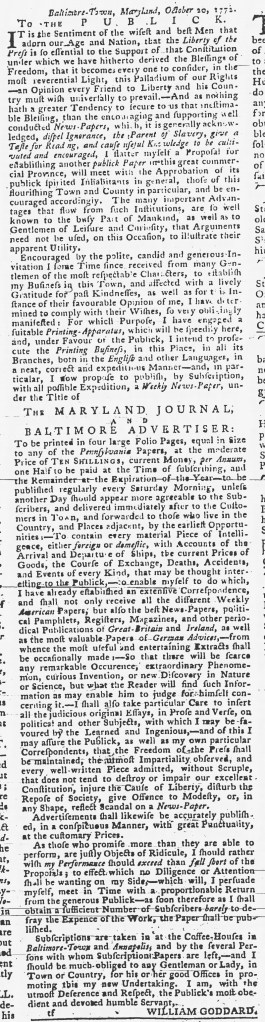
Maryland had only one newspaper in 1772.  William Goddard aimed to change that.  To aid his efforts, he inserted a proposal in the October 29 edition of the Maryland Gazette, the publication that would be his competitor if he managed to launch “THE MARYLAND JOURNAL, AND BALTIMORE ADVERTISER.”  Printed in Annapolis, the Maryland Gazette served the entire colony, but Goddard believed that a market existed, or would exist after some savvy advertising, to support two newspapers in the colony.  In addition, he underscored the political utility of newspapers to prospective subscribers.  “IT is the Sentiment of the wisest and best Men that adorn our Age and Nation,” Goddard declared in the first sentence of his proposal, “that the Liberty of the Press is so essential to the Support of that Constitution under which we have hitherto derived the Blessings of Freedom, that it becomes every one to consider, in the most reverential Light, this Palladium of our Rights.”  The printer further explained that “well conducted News-Papersdispel Ignorance, the Parent of Slavery, give a Taste for Reading, and cause useful Knowledge to be cultivated and encouraged.”  Accordingly, he called on “every Friend to Liberty and his Country” to support his proposed project.

Goddard’s proposal filled nearly an entire column in the Maryland Gazette.  In addition to expounding on the philosophy that prompted him to consider publishing a newspaper in Baltimore, he advised potential subscribers that he was indeed prepared to launch the venture “as soon … as I shall obtain a sufficient Number of Subscribers barely to defray the Expence of the Work.”  Already in correspondence with “many Gentlemen of the most respectable Characters” in Baltimore, Goddard had “engaged a suitable Printing-Apparatus, which will be speedily here.”  In addition, as printer of the Pennsylvania Chronicle he had already “established an extensive Correspondence, and shall not only receive all the different Weekly American Papers, but also the best News-Papers, political Pamphlets, Registers, Magazines, and other periodical Publications of Great-Britain and Ireland.”  In addition to printer and publisher, Goddard assumed the responsibilities of editor, drawing the news from the letters, newspapers, and periodicals sent to him.  Every American newspaper printer-editor reprinted extensively from other publications. Goddard even acquired “the most valuable Papers of German Advices” in order to provide news of interest to the growing German population in the backcountry.

The proposal also outlined the particulars of the publication and how to subscribe.  The newspaper would be “printed in four large Folio Pages, equal in Size to any of the Pennsylvania Papers” that, along with the Maryland Gazette, operated as local newspapers for Baltimore and the region.  Goddard intended to print and distribute the newspaper “regularly every Saturday Morning, unless another Day should appear more agreeable to the Subscribers.” Subscriptions cost ten shillings per year, with half to be paid immediately and the other half at the end of the year. Goddard briefly mentioned advertisements, noting they would be “accurately published, in a conspicuous Manner, with great Punctuality, at the customary Prices.”  He did not list those prices.  Colonizers interested in subscribing could leave their names “at the Coffee-Houses in Baltimore-Town and Annapolis” or with “several Persons with whom Subscription Papers are left.”  Like other printers attempting to launch new projects, Goddard relied on a network of local agents who assisted in recruiting subscribers.

Beyond the particulars, Goddard emphasized that he pursued a higher purpose than merely generating revenues or turning a profit on the publication.  He promised to publish news about every “remarkable Occurence, extraordinary Phenomemon, curious Invention, or New Discovery in Nature or Science” as well as “judicious original Essays … on political and other Subjects.”  In selecting material to include in the Maryland Journal, Goddard pledged that “the Freedom of the Press shall be maintained, the utmost Impartiality observed, and every well written Piece admitted, without Scruple, that does not tend to destroy or impair our excellent Constitution, injure the Cause of Liberty, disturb the Repose of Society, give Offence to Modesty, or, in any Shape, reflect Scandal on a News-Paper.”  In an era of upheaval as Parliament turned unwanted attention to the colonies, Goddard framed publishing a newspaper as a civic duty that served the commercial and political interests of the community.

Did the subscription proposal help Goddard to obtain that “sufficient Number of Subscribers barely to defray the Expence” and commence publication?  Perhaps, but it took some time.  The first issue appeared on August 20, 1773, ten months after Goddard initially proposed publishing the Maryland Journal and Baltimore Advertiser.  The newspaper continued publication, under the guidance of various printers and proprietors, throughout the American Revolution and into the 1790s, transitioning from weekly to semi-weekly to tri-weekly to daily as newspaper publishing expanded throughout the new nation.