December 12

What was advertised in a colonial American newspaper 250 years ago today?

Pennsylvania Journal (December 12, 1771).

“Newest fashionable muffs, tippets and ermine.”

In the fall of 1771, furrier Fromberger and Siemon placed newspaper advertisement in their efforts to entice customers to visit their new shop on Market Street in Philadelphia.  They adopted several strategies that may have served them well, though their effectiveness may have been mitigated by an uneven rollout of the furriers’ advertising campaign.

Fromberger and Siemon commenced advertising in the Pennsylvania Journal in late September.  They incorporated a variety of appeals into their notice.  They informed customers that they catered to the latest tastes, stating that they carried “the newest fashionable muffs, tippets, and ermine, now worn by the ladies at the courts of Great Britain and France.”  They also called on consumers “to encourage their American manufacture” rather than purchase imported items.  In addition, the furriers sought to establish ongoing relationships with their customers by providing ancillary services.  Their customers could send their furs to Fromberger and Siemon to have them “taken care of gratis for the summer season.”  To draw attention to these various marketing strategies, the furriers adorned their advertisements with a woodcut depicting a muff and tippet.

That advertisement did not last long in the Pennsylvania Journal before it appeared in the Pennsylvania Chronicle.  Fromberger and Siemon commissioned only one woodcut, so they arranged to have it transferred from one printing office to another.  Once again, their advertisement quickly lapsed.  They revived it in the Pennsylvania Journal on December 5, though without the woodcut.  The following week, it ran once again, this time with the image of the muff and tippet.  The woodcut made its way back to William Bradford and Thomas Bradford’s printing office.  On December 19, however, Fromberger and Siemon’s advertisement appeared once more without the image that made it so distinctive.  Why, after investing in the woodcut, did the furriers deploy it so haphazardly?  Was it a tradeoff against the expense of purchasing the additional space?  Did the printers play any role in deciding that they needed the space for other content?  What other factors played a role in how Fromberger and Siemon executed their advertising campaign?

November 3

What was advertised in a colonial American newspaper 250 years ago this week?

Pennsylvania Gazette (October 31, 1771).

“THOMAS SHIELDS … at the Golden Cup and Crown.”

When Thomas Shields, a goldsmith, advertised his services in the October 31, 1771, edition of the Pennsylvania Gazette, he adorned his notice with a depiction of a crown suspended above a cup.  That image corresponded to the sign that marked his location on Front Street in Philadelphia.  It also helped to distinguish his advertisement from others in the same issue.  Ten other notices incorporated images, but all of them featured woodcuts of vessels at sea.  Each of those advertisements sought passengers and freight for ships preparing to leave the busy port.

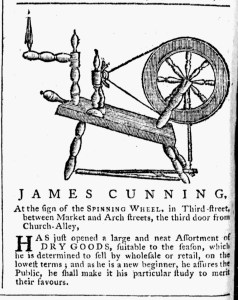
The images of the ships belonged to David Hall and William Sellers, the printers of the Pennsylvania Gazette.  Along with stock images of houses, horses, enslaved people, and indentured servants, colonial printers provided images of ships to advertisers.  Those who desired more specialized images, on the other hand, commissioned them and retained ownership.  That being the case, some advertisers used their woodcuts in one newspaper for a while before transferring them to another newspaper.  At about the same time that Shields ran his advertisement in the Pennsylvania Gazette, James Cunning, a shopkeeper “At the sign of the SPINNING WHEEL,” supplied his woodcut of a spinning wheel to two other newspapers, first the Pennsylvania Journal and then the Pennsylvania Packet.  The notation at the end of Shields’s advertisement, “5 W,” indicated that he arranged for it to run for five weeks.  After that, he could collect his woodcut from Hall and Sellers and transfer it to another printing office.

I regularly choose these unique images that adorned newspaper advertisements when I select notices to feature on the Adverts 250 Project.  Relative to their numbers and frequency in the early American press, such images are overrepresented on this project, meriting a disclaimer that Shields’s advertisement and others with such images were not typical.  They do, however, testify to what was possible in eighteenth-century advertising and the choices that advertisers made when it came to format, incurring additional expenses, and placing notices in multiple newspapers.  In addition, the Adverts 250 Project has compiled an informal census of woodcuts that advertisers commissioned in the late 1760s and early 1770s.  After nearly six years producing the Adverts 250 Project, I get the impression (though this needs to be tested against a more systematic accounting) that the frequency of such images accelerated in the early 1770s, a sign that greater numbers of advertisers embraced the additional expense if those woodcuts garnered greater attention for their newspaper notices.

October 30

What was advertised in a colonial American newspaper 250 years ago this week?

Pennsylvania Packet (October 28, 1771).

“JAMES CUNNING, At the sign of the SPINNING-WHEEL.”

When John Dunlap launched the Pennsylvania Packet on October 28, 1771, the first edition featured an astounding number of advertisements, enough that he distributed a supplement containing some of the news and advertising that did not fit in the standard issue.  Still, he did not print all of the advertisements submitted to his printing office.  Dunlap included a note that “Some Advertisements … are deferred till next week, when they shall be carefully regarded.”  Most colonial newspapers did not benefit from such an abundance of advertising in their inaugural issues.  Advertisers tended to wait to assess the success and circulation of new newspapers before investing in advertising that might not be seen by many readers.  Dunlap may have attracted so many advertisers because he announced in the subscription proposals that “The first Number shall be given gratis.”  Many advertisers may have assumed that free newspapers would result in high demand, at least for that first issue, making their own advertisements sound investments.

James Cunning, a merchant who did business “At the sign of the SPINNING WHEEL, in Third-street,” was among the advertisers who placed notices in the first issue of the Pennsylvania Packet.  He adorned his advertisement with an image of a spinning wheel, replicating the sign that marked his location.  That image, however, was not unique to the Pennsylvania Packet.  It previously appeared in advertisements Cunning placed in the Pennsylvania Journal on October 10 and October 17.  Colonial printers tended to supply stock images of ships, houses, horses, enslaved people, and indentured servants to advertisers, but advertisers who wished to publish other kinds of images had to commission woodcuts that then belonged to them, not the printers.  Three advertisements in the inaugural issue of the Pennsylvania Packet included images of ships at sea, but Cunning’s was the only advertisement with a specialized image keyed to his particular business.  To make that happen, he had to retrieve his woodcut of the spinning wheel from the printing office operated by William Bradford and Thomas Bradford at the corner of Front and Market Streets and deliver it, along with copy for his advertisement, to Dunlap’s “NEWEST PRINTING-OFFICE” on Market Street.  Already in the first issue of the Pennsylvania Packet, Dunlap participated in a longstanding practice of providing stock images for advertisers while also incorporating more specialized woodcuts that advertisers submitted with their copy.

October 21

What was advertised in a colonial American newspaper 250 years ago today?

Pennsylvania Chronicle (October 21, 1771).

“The newest fashionable muffs [and] tippets.”

A woodcut depicting a muff and tippet adorned the advertisements that the partnership of Fromberger and Siemon placed in the Pennsylvania Chronicle and the Pennsylvania Journal in the fall of 1771.  The advertisers did not rely on the image alone to market their “large assortment of Russia and Siberia fur skins” and garments made from those furs, but it almost certainly helped draw attention to their advertisements.  That woodcut also represented an additional expense.  Unlike the type used to print the copy in their notices, the woodcut belonged to the advertisers rather than the printers.  That being the case, Fromberger and Siemon collected their woodcut from one printing office and delivered it to another when they expanded their advertising campaign.

The furriers first inserted an advertisement in the September 26 edition of the Pennsylvania Journal.  It ran again the following week.  Nearly three weeks elapsed before the same advertisement appeared in the October 21 edition of the Pennsylvania Chronicle.  It featured identical copy, though the compositor made different decisions about line breaks, as well as the familiar woodcut that occupied nearly half the space allotted to the advertisement.  Careful examination of the image reveals that it was indeed the same woodcut, not a similar image.  Fromberger and Siemon commissioned only one woodcut, but they aimed to garner a greater return on their investment by disseminating it in more than one newspaper. For many readers of the Pennsylvania Chronicle, the image would have been new and novel when they encountered it.  Those who also happened to peruse the Pennsylvania Journal, however, would have recognized the woodcut.  The repetition of the image likely helped Fromberger and Siemon achieve greater visibility for their enterprise.  Had they published it more regularly, they might have encouraged readers to consider the image a trademark of sorts, but their notices appeared too sporadically.  Although Fromberger and Siemon did not seize the opportunity to further enhance their marketing efforts through consistent repetition of the image of the muff and tippet in the fall of 1771, they did devise advertisements that stood out from others because of the woodcut that accompanied them.

September 26

What was advertised in a colonial American newspaper 250 years ago today?

Pennsylvania Journal (September 26, 1771).

“The newest fashionable muffs.”

In the fall of 1771, the partnership of Fromberger and Siemon took to the pages of the Pennsylvania Journal to promote a “Very large assortment of Russia and Siberia fur skins” which they intended to make into muffs, tippets, and linings for cloaks.  They deployed a variety of marketing strategies to capture the attention of consumers in Philadelphia and its environs.

For instance, the partners informed readers that they sold “the newest fashionable muffs, tippets, and ermine, now worn by the ladies at the courts of Great Britain and France.”  Fromeberger and Siemon attempted to incite demand by educating their prospective clients.  Ladies who feared they were unfamiliar with the latest trends on the other side of the Atlantic as well as those who merely wanted to confirm that they had indeed kept up with the latest styles could visit Fromberger and Siemon’s shop to outfit themselves.

Even as the partners emphasized European tastes, they also promoted “American manufacture.”  In the process, they suggested to “the ladies” that they could play an important role in supporting the commercial and politic interests of the colonies in the wake of recent meddling by Parliament that had resulted in nonimportation agreements in response to the Stamp Act and the duties imposed on certain goods in the Townshend Acts.  All but the duty on tea had been repealed and merchants returned to importing vast arrays of goods, but some American entrepreneurs continued to advocate for “American manufacture.”  Consumers did not have to sacrifice quality when supporting those entrepreneurs, at least according to advertisers like Fromberger and Siemon who promised they made muffs and tippets “superior to that which is manufactured in England.”

In addition to those appeals, the partners also offered a free ancillary service to their customers.  “Ladies who purchase any manufactured furs of great value” could wear them in the fall, winter, and spring and then “send them to our manufactory” where they would “be taken care of gratis for the summer season.”  Fromberger and Siemon cultivated relationships with customers that did not end when making a sale but could instead continue for years as they assisted in the care and maintenance of expensive garments.

A woodcut depicting a muff and tippet may have drawn the attention to Fromberger and Siemon’s advertisement, but they did not rely on the visual image alone to market their wares.  Instead, they incorporated several appeals to “the ladies” they hoped would visit their shop, order garments, and make purchases.  They invoked current fashions in England and France, the importance of supporting “American manufacture,” and free services to convince readers to become customers.

September 19

What was advertised in a colonial American newspaper 250 years ago today?

Massachusetts Gazette and Boston Weekly News-Letter (September 19, 1771).

“To be Sold by OLIVER SMITH, at the Golden Mortar.”

Oliver Smith, an apothecary, promoted a variety of remedies in an advertisement in the September 19, 1771, edition of the Massachusetts Gazette and Boston Weekly News-Letter.  The headline proclaimed “Best double-distilled Lavender Water,” introducing the merchandise before naming the seller.  Several other advertisements featured the same structure, including one for “Choice Cheshire CHEESE” placed by Ellis Gray and another for “THE very best of fresh Orange JUICE” from John Crosby.  Most purveyors of goods and services, on the other hand, used their names as headlines for their advertisements, including Caleb Blanchard, William Jackson, John Langdon, Henry Lloyd, and Jonathan Trott.  Thomas Walley adopted both methods.  “Teneriff Wine” appeared as the first headline and then his name as a second one.

Smith’s headline helped to distinguish his notice from others, but another element of the advertisement did so even more effectively.  A woodcut depicting a mortar and pestle appeared in the upper left corner, drawing the eye of readers.  Except for the lion and unicorn in the masthead at the top of the first page, Smith’s woodcut was the only image in that issue and the supplement that accompanied it.  Further enhancing the apothecary’s marketing efforts, the woodcut corresponded to the sign that marked the location of his shop.  He advised prospective customers that they could purchase a variety of nostrums “at the Golden Mortar” on Cornhill.  Other advertisers mentioned shop signs, but did not commission woodcuts to adorn their notices.  Crosby, for instance, regularly advertised citrus fruit “at the Sign of the Basket of Lemmons” in the South End, but he did not include an illustration.

Advertisers typically paid for the amount of space their notice occupied, not the number of words.  In that regard, Smith and Crosby made similar investments in marketing their wares in the September 19 edition.  Smith, however, incurred additional expense for the woodcut, an investment that he presumably believed would pay for itself by resulting in more attention and more customers.

August 29

What was advertised in a colonial American newspaper 250 years ago today?

New-York Journal (August 29, 1771).

“HATS MANUFACTURED by … NESBITT DEANE.”

For many weeks in the summer of 1771, Nesbitt Deane took to the pages of the New-York Journal to advertise hats he made and sold “Aside the Coffee-House Bridge.”  His hats had several qualities he expected consumers would appreciate, including exceptional “Fineness, Cut, Colour and Cock.”  These were not ordinary hats that prospective customers could acquire in just any shop, Deane confided, but instead “MANUFACTURED … by a Method peculiar to himself, to turn rain, and prevent the Sweat of the Head damaging the crown.”  Such promises may have enticed some readers to visit his shop to examine his hats for themselves to see what distinguished them from others available in the bustling port city.  Deane also called on “Such Gentry and others, who have experienced his Ability” by purchasing and donning his hats to recommend them to others.

Eventually, the hatter determined that he might attract more attention and incite greater demand if an image accompanied his advertisement.  Without revising the copy, he doubled the length of his notice, beginning on August 29, with a woodcut depicting a tricorne hat.  A banner bearing Deane’s name, adorned with rococo flourishes completed the image.  Such finery likely prompted the “Gentry and others” among readers of the New-York Journal of the engraved images on trade cards and billheads that circulated in London and, to a lesser extent, the largest cities in the colonies.  Another advertiser, Gerardus Duyckinck, had been enclosing the copy of his advertisements within a baroque cartouche for several years.  His most recent advertisement, perhaps an inspiration for Deane, appeared once again in the August 29 edition.

The sophistication inherent in Deane’s image testified to the “Fineness” of his hats, but it also meant that he invested more in his marketing efforts.  In addition to commissioning a woodcut unique to his business, he also paid for twice as much space in the New-York Journal each time his advertisement appeared.  The compositor’s notation at the end, “95 –,” indicated that the notice with the woodcut first appeared in issue 1495 but Deane had not selected an end date.  Neither had he done so for his first advertisement composed entirely of text.  In both instances, the hatter committed to more than the standard four weeks that the printer set as a minimum.  Between the indefinite duration of his notices and enhancing them with a striking image, Deane demonstrated his belief that more and better advertising would produce results.

August 1

What was advertised in a colonial American newspaper 250 years ago today?

Pennsylvania Gazette (August 1, 1771).

At the GOLDEN LION.”

In the early 1770s, John Carnan, a goldsmith and jeweler, ran a shop at the corner of Second and Chestnut Streets in Philadelphia.  He promoted his “GOLD, SILVER and JEWELLERY WORK” in advertisements in the Pennsylvania Gazette, assuring prospective customers that he made his wares “in the best and newest taste.”  Like many other purveyors of goods, he provided an overview of his inventory in a dense paragraph of text.  Carnan listed everything from “TANKARDS, cans, tea, coffee and cream pots” to “gold, silver, gilt, enamelled, Scotch pebble, moco, chrystal, paste and glass sleeve buttons” to “silver and enamelled snuff-boxes [and] silver mounted decanter corks.”  In addition, he offered customers the opportunity to select among “sundry other articles, too tedious to mention.”  In terms of advertising copy, Carnan’s notice very much resembled others placed by purveyors of goods and services in Philadelphia and other American towns and cities.

The woodcut that adorned Carnan’s advertisement, however, distinguished it from others.  Carnan marked his location with a sign depicting a golden lion.  A woodcut that also depicted a lion appeared in the upper left corner of his advertisement.  (Regular visitors to the Adverts 250 Project will likely recognize this lion as the image that has appeared on its home page since its inception.)  The woodcut in the advertisement may have replicated Carnan’s shop sign, serving as a logo or brand that identified his business.  Even if the woodcut did not resemble the sign, incorporating an image of a lion likely helped consumers associate the regal animal with the goldsmith and jeweler, making his shop all the more memorable.  Unlike the woodcuts depicting ships at sea, the only other images in the August 1, 1771, edition of the Pennsylvania Gazette beyond the masthead, the woodcut of the lion belonged to the advertiser rather than the printer.  Carnan invested in an image reserved for his sole use.  Over time, he included the image in other advertisements, providing consistency via the image even as he generated new copy for his notices.  Inserting the same woodcut in multiple advertisements also allowed him a greater return on his investment.  Not every advertiser who commissioned unique woodcuts used them more than once.  Carnan, however, recognized the potential for enhancing his marketing efforts with an image that represented his business and attracted attention among prospective customers.

July 22

What was advertised in a colonial American newspaper 250 years ago today?

Pennsylvania Chronicle (July 22, 1771).

“DUTCH FANS, upon different constructions.”

Yesterday’s entry featured an advertisement for “ROLLING SCREENS for Cleaning Wheat or Flax-seed” placed in the July 18, 1771, edition of the Pennsylvania Journal by Christian Fiss.  That advertisement was notable for the image that accompanied it, a woodcut depicting a winnowing fan (better known as a “DUTCH FAN” in the eighteenth century) for separating the wheat from the chaff.  Printers provided several stock images of ships, horses, houses, indentured servants, and enslaved people for advertisers to incorporate into their notices, but not other images with more limited usage.  Instead, advertisers like Fiss commissioned woodcuts specific to their businesses when they wanted to draw greater attention to their newspaper notices.

At the same time that Fiss included an image of a winnowing fan in an advertisement in the Pennsylvania Journal, one of his competitors, Robert Parrish, pursued the same strategy in the Pennsylvania Chronicle.  Fiss divided the space in his advertisement more or less evenly between image and text, but Parrish devoted more space to images than to his description of the “various kinds of wire work” he made.  In addition to a woodcut depicting a winnowing fan, he included a second woodcut of a rolling screen.  That represented even greater expense for his marketing efforts, but Parrish presumably believed that investing in such images would result in more sales and the woodcuts would pay for themselves in the end.

Parrish previously included his woodcut depicting a winnowing fan in an advertisement in the October 29, 1770, edition of the Pennsylvania Chronicle.  He may have chosen to resume running advertisements that included that image upon seeing Fiss publish advertisements with a similar image.  Having made the initial investment, he did not want to lose any advantage once a competitor commissioned a woodcut of his own.  Not long after that, he collected his woodcuts from the Pennsylvania Chronicle and delivered them to the Pennsylvania Gazette to include in an advertisement with identical copy on October 15.  Unlike the stock images that printers provided, such specialized images belonged to the advertisers, who could choose to insert them in more than one newspaper.  Parrish sought to increase the exposure, achieve a greater return on his investment, and ward off a rival by inserting the images in more than one newspaper.

July 21

What was advertised in a colonial American newspaper 250 years ago this week?

Pennsylvania Journal (July 18, 1771).

“ROLLING SCREENS for Cleaning Wheat or Flax-seed.”

Christian Fiss devoted half of the space in his advertisement in the July 18, 1771, edition of the Pennsylvania Journal to a depiction of a rolling screen for cleaning wheat and flaxseed.  That woodcut almost certainly garnered attention from readers since it was one of the few images in that issue.  Woodcuts adorned only three other advertisements, each of them showing nearly identical vessels at sea.  The printers provided those stock images to advertisers seeking freight and passengers.  On the other hand, Fiss commissioned an image specific to the “ROLLING SCREENS,” “DUTCH FANS,” and “various kinds of WIRE-WORK” he made at his shop.  That woodcut appeared exclusively in his advertisements; other artisans who made similar items did not have access to it when they placed notices of their own.

Although the vast majority of eighteenth-century newspaper advertisements did not feature any sort of image, woodcuts commissioned by individual entrepreneurs did appear with some regularity.  Did the frequency change over time?  Did advertisers become more likely to use combinations of words and unique images to promote their products?  Did they become more likely to use images as brands or logos to make their advertisements more distinctive and their businesses more memorable?  I believe that the answer to each of those questions is “yes,” but I also caution that this is merely an impression at this point rather than based on tabulating the number of specialized images incorporated into advertisements.  When I compiled an archive of American newspapers published in 1771 that have since been digitized, I noticed what seemed to be a greater frequency of images commissioned by advertisers compared to the late 1760s.  This merits further investigation to chart the evolution of graphic design in early American advertising.  Throughout the eighteenth century, advertisers resorted primarily to text to deliver messages to prospective customers, but it also appears that over time greater numbers of advertisers experimented with visual images and invested in iconography associated with their businesses.  As advertisers continued to encourage colonists to participate in a transatlantic consumer revolution, the early 1770s may have been a turning point in the development of advertisements that utilized unique images.