July 27

What was advertised in a colonial American newspaper 250 years ago today?

New-York Gazette and Weekly Mercury (July 27, 1772).

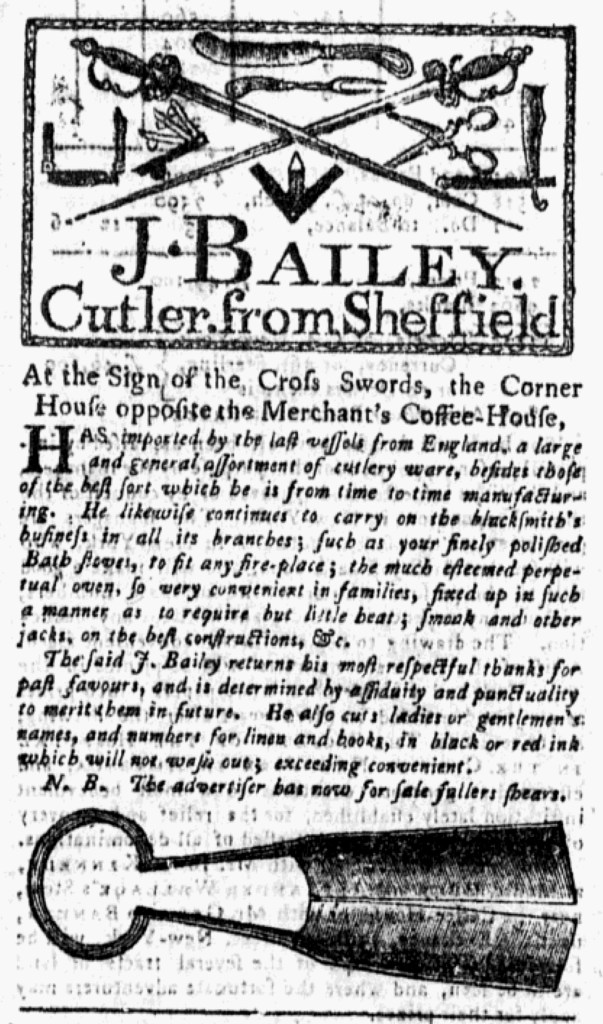
“J. BAILEY. Cutler. from Sheffield.”

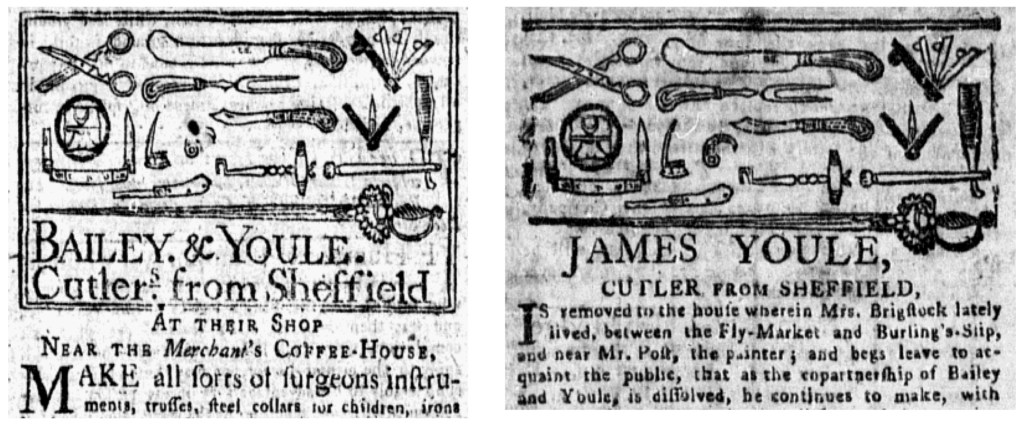
In the early 1770s, cutlers in New York competed with each other not only for customers but also in producing elaborate images to accompany their advertisements in the city’s newspapers.  It began in the spring of 1771 with Bailey and Youle, “Cutlers for Sheffield,” running an advertisement with a woodcut depicting more than a dozen items made and sold at their shop, enhancing their list of “surgeons instruments, … knives, razors, shears, and scissors.”  Not long after, Richard Sause followed their lead with an advertisement featuring a woodcut depicting more than a dozen items available at his shop.  Two items, a knife and a sword, had his name on them, suggesting that he marked his wares so consumers would recall who produced them and, if satisfied with the quality and durability, buy from him again.  In that regard, Sause improved on the image distributed by Bailey and Youle, although his competitors may have also marked their cutlery even if the woodcut in the newspaper did not indicate that was the case.

When Bailey and Youle dissolved their partnership a year later, Youle retained the woodcut and modified it to remove any reference to his former associate.  Not long after Youle disseminated that image in the public prints, Lucas and Shephard, WHITESMITHS and CUTLERS, From BIRMINGHAM and SHEFFIELD,” published their own advertisement with a woodcut showcasing many of the items they made and sold.  Bailey apparently considered that strategy effective for attracting customers (or at least not losing them to his competitors) because he devised his own woodcut that enclosed “J. BAILEY.  Cutler.  from Sheffield” and several cutlery items within a decorative border.  The copy of his advertisement gave his location as “the Sign of the Cross Swords, the Corner House opposite the Merchant’s Coffee-House.”  A pair of crossed swords appeared at the center of the woodcut.  A second woodcut appeared at the end of the advertisement, under a nota bene that advised that Bailey “has now for sale fullers shears.”  The cutler used the additional image to distinguish his notice from those of his competitors.  All three advertisements ran in the July 27, 1772, edition of the New-York Gazette and Weekly Mercury (Bailey’s on the third page, Youle’s on the first page of the supplement, and Lucas and Shephard’s on the second page of the supplement).  Given the prevalence of images in advertisements placed by his competitors, Bailey may have considered it imperative to get his own woodcut depicting his wares into circulation among consumers in New York.

Left: New-York Gazette and Weekly Mercury (March 4, 1771); Right: Supplement to the New-York Gazette and Weekly Mercury (July 27, 1772).

July 13

What was advertised in a colonial American newspaper 250 years ago today?

New-York Gazette and Weekly Mercury (July 13, 1772).

“All sorts of knives and forks, pocket and penknives.”

Lucas and Shephard, “WHITESMITHS and CUTLERS, From BIRMINGHAM and SHEFFIELD,” enhanced their advertisement in the July 13, 1772, edition of the New-York Gazette and Weekly Mercury with a woodcut that depicted many of the items they made and sold at their new location in “the shop lately occupied by Messrs. Bailey and Youle.” Lucas and Shephard provided an extensive list of their wares, making the combination of words and image an eighteenth-century precursor to the illustrated catalogs that so significantly shaped consumer culture in the second half of the nineteenth century.

Lucas and Shephard followed the lead of other cutlers in New York.  Previously, Bailey and Youle adorned their own advertisements with a woodcut that depicted more than a dozen items they produced in the shop.  When the partnership dissolved, James Youle retained the woodcut, modified it to remove his former partner’s name, and inserted it in advertisements in the New-York Gazette and Weekly Mercury in June and July 1772.  Lucas and Shepard began running their advertisement two weeks after Youle’s notice ran on June 29.  It was not the first time that the woodcut that accompanied one of Youle’s advertisements may have inspired imitation.  In April 1771, Richard Sause ran advertisements with a woodcut that showed all sorts of cutlery items that he made at his shop just a few weeks after Bailey and Youle’s notice appeared in the public prints.  A sword and a table knife even bore his name, suggesting that he marked his work in some manner.

Like those cutlers who placed advertisements before them, Lucas and Shephard deployed a variety of appeals to entice prospective customers.  They emphasized their skill, promising “great accuracy” in their work, and a “reasonable price.”  They also made a nod to customer services, pledging to “carry on their business with dispatch” in order “to give satisfaction to all who may please to employ them.  The image increased the likelihood that readers would take note of their advertisement, especially considering Youle continued running his own advertisements with depictions of his cutlery ware.  Lucas and Shephard may have considered their own woodcut imperative for competing with Youle, a necessary investment when they chose to advertise in a newspaper in which he already established visibility for his shop.

July 6

What was advertised in a colonial American newspaper 250 years ago today?

Boston Evening-Post (July 6, 1772).

“THE STAGE-COACH Between NEW-YORK and BOSTON.”

In the early 1770s, Jonathan Brown and Nicholas Brown placed advertisements seeking “encouragement” for stagecoach service they wished to establish between Boston and New York.  In addition to calling on the public to support them by traveling on their stagecoaches, the Browns sought investors “willing to become adventurers … in said undertaking.”  They outlined the various benefits of this service, including increasing commerce in the Connecticut as colonizers traveled through the province instead of bypassing it by sailing from New York to Providence and then continuing overland to Boston.

When summer arrived, the Browns launched the service on a trial basis.  They initially placed an advertisement in the June 25 edition of the New-York Journal to announce that the “STAGE COACH BETWEEN NEW-YORK AND BOSTON … for the first Time sets out this Day.”  In the following days, they placed additional advertisements in the Connecticut Courant, published in Hartford, and the Connecticut Journal, published in New Haven.  On July 6, their advertisement from the New-York Journal appeared in the Boston Evening-Post, alerting the public at that end of the line that the stagecoach paused in Hartford for a week and would arrive in Boston on July 11.  The Browns planned for the next trip to depart on July 11, so prospective passengers had nearly a week to make plans if they wished to travel at that time.  If demand warranted, the operators intended to “perform the Stage once a Week.”

The advertisement in the Boston Evening-Post included one element not included in the New-York Journal.  A woodcut depicting horses, a driver, and a stagecoach with a passenger visible inside appeared at the top of the advertisement.  That helped to draw attention to their notice by distinguishing it from others, especially since it was the only advertisement in that issue that incorporated an image (though Jolley Allen’s notice on the following page did feature his trademark border).

In hopes that their “Trial” would find sufficient “Encouragement” to establish a permanent route that ran once a week, the Browns placed advertisements in several newspapers along their route.  They did not, however, advertise as extensively as possible, perhaps due to budgetary constraints.  They could have flooded the market with advertising, placing notices in both newspapers printed in New York, all five in Boston, and even any in Philadelphia for prospective passengers who planned to travel north.  Perhaps they wished to assess the return on their investment for their initial round of advertising before expanding to additional publications.

June 18

What was advertised in a colonial American newspaper 250 years ago today?

Massachusetts Spy (June 18, 1772).

“HATS manufactured and sold by the advertiser.”

Of the five newspapers published in Boston in the summer of 1772, the Massachusetts Spy had the most elaborate masthead, but it also had featured the fewest innovations in design for the rest of the contents, including advertisements.  For instance, a decorative border enclosed Jolley Allen’s advertisement when it appeared in each of the other newspapers, but that distinctive format was not incorporated into Allen’s notice when he submitted identical copy to the Massachusetts Spy.

That did not prevent Martin Bicker from attempting to draw more attention to his advertisement with an image of his merchandise in the upper left corner.  Bicker advertised that he “manufactured and sold” hats.  A woodcut depicting a tricorne hat, a popular style at the time, alerted readers to the contents of the advertisement before they read it.  Bicker did not provide many details about his hats, but he did declare that he “hopes he has given such satisfaction to his customers as will induce them to continue their favours.”  In other words, he invited repeat business and recommendations via word of mouth.

New-York Journal (June 18, 1772).

The same day that Bicker’s advertisement ran in the Massachusetts Spy, Nesbitt Deane once again inserted his advertisement for hats in the New-York Journal.  Both the appeals he made to customers and the image that accompanied the notice were more sophisticated.  Deane trumpeted that he made hats “to exceed in Fineness, Cut, Colour and Cock.”  In addition, he devised a means “to turn rain, and prevent the Sweat of the Head damaging the crown.”  Prospective customers would not find that feature in other hats, Deane asserted, because he invented “a Method peculiar to himself. He also gave a discount to retailers who bought in volume, offering “Encouragement to those who buy to sell again.”  Like Bicker, Deane acknowledged his existing customers and asked them to promote his hats.  “Such Gentry and others, who have experienced his Ability, ’tis hoped will recommend.”  The image at the top of Deane’s advertisement included both a tricorne hat and a banner with his name.  Rococo flourishes further enhanced that image.

Bicker did not deploy as many appeals as Deane in his effort to entice consumers to purchase his hats, but including an image in his advertisement distinguished it from most others in the Massachusetts Spy.  Relatively few advertisements published in the eighteenth-century newspapers featured images of any sort.  Did including images give advertisers an advantage?  Deane apparently thought so.  By the time Bicker placed his notice, Deane had been running his advertisement for nearly a year.  He likely would not have inserted it in the New-York Journal so many times if he did not believe he received a return on his investment.

June 17

What was advertised in a colonial American newspaper 250 years ago this week?

Supplement to the Pennsylvania Packet (June 15, 1772).

“Sweeping brushes as 19 s. per dozen, and lower by the half or whole gross.”

John Hannah described himself as a “WHOLESALE AND RETAIL BRUSHMAKER” in an advertisement that appeared in the supplement that accompanied the June 15, 1772, edition of the Pennsylvania Packet.  Although he stocked “a good assortment of painting brushes” and “a general assortment of bone brushes” that he “imported in the last vessels from England and Holland,” he focused on the items that he produced in his own shop “AT THE HOG, … At the north-east corner of Second and Chestnut Streets” in Philadelphia.  A woodcut depicting a boar, the bristles on the crest of its back evident, adorned his advertisement.

Hannah declared that he “made and manufactured” all kinds of brushes “in the best manner” at his shop, assisted by “the best hands in the city.”  The quality of his brushes derived from both the materials, “a large and general assortment of Bristles” imported from Europe, and the skills of those who worked in his shop.  In addition to quality, Hannah promoted low prices, especially for wholesale transactions.  He proclaimed that he “can sell on as reasonable terms as any manufacturer in the province,” challenging prospective customers to compare his prices to those set by his competitors. To demonstrate that he did indeed offer good bargains, he listed some of his prices.  Hannah sold a dozen sweeping brushes for nineteen shillings.  He offered discounts to buyers who purchased in greater volume.  Similarly, he charged four shilling for a dozen “weavers brushes” and “lower by the half or whole gross.”  That he did not specify how deeply he discounted such purchases suggested that customers could negotiate the prices.

Hannah incorporated several appeals into his advertisement.  He emphasized the quality of his finished product as well as the skills of the workers who labored in his shop.  He promoted the range of choices available to customers.  He also promised the lowest prices in the colony, listing his prices and offering discounts to retailers and others who purchased large quantities of brushes.  To draw attention to his advertisement, he included a woodcut that resembled the sign that marked the location of his shop, a rudimentary form of branding his business.

May 27

What was advertised in a colonial American newspaper 250 years ago this week?

Pennsylvania Chronicle (May 25, 1772).

“Shoemakers may be supplied with tools of every kind used in their business.”

A silhouette of a shoe adorned Robert Loosely’s advertisement in the May 25, 1772, edition of the Pennsylvania Chronicle, but it was not footwear that the “Shoe Maker” aimed to sell.  Instead, he hawked “Shoemakers Tools, A general assortment lately imported from London.”  His inventory included “BEST London made cast steel knives,” “Pincers of all sizes, Shoe rasps and files of the best kind, Hammers of all sizes,” “An assortment of awl blades and tacks,” “Bend soles,” and much more.  The “&c. &c. &c” (or “etc. etc. etc.”) at the end of his list indicated that he named only a portion of his merchandise.

Loosely leveraged his training and experience as a shoemaker to convince others who followed the occupation that he was indeed qualified to assert that he provided them with “the best goods, on the most reasonable terms.”  He explained that he “served his apprenticeship in England, and for some years carried on a considerable trade there.”  That made him familiar with the equipment and supplies required to make shoes and boots.  He drew on experience in selecting which “Shoemakers Tools” to import and sell, unlike merchants and shopkeepers who treated those tools as general merchandise alongside so many other items they stocked.  Loosely underscored that during his time working in England he “became acquainted with the most reputed manufacturers of tools and leather.”  As a result, he “flatters himself he has it in his power to serve those that please to apply to him.”

Artisans with training or experience in England frequently gave those credentials in their newspaper advertisements when they migrated to the colonies, but they usually did so to convince prospective customers to purchase their wares or prospective clients to engage their services.  Loosely adapted that strategy to his own purposes, signaling to fellow artisans that they could depend on him to supply them with the best tools and materials to use in their own workshops.

May 3

What was advertised in a colonial American newspaper 250 years ago this week?

Providence Gazette (May 2, 1772).

“At the Sign of the GREYHOUND.”

In the spring of 1772, Nathaniel Wheaton advertised a “fine Assortment of Spring and Summer GOODS” that he recently imported to Providence “by the last Vessels from England.”  He pledged to sell these items “cheaper than he has yet done,” promising bargains for prospective customers.  To attract attention to his appeals to consumer choice, that “fine assortment,” and low prices, those low prices, he adorned his advertisement in the Providence Gazette with an image of a dog.  He gave his location as “the Sign of the GREYHOUND, between the Baptist Meeting-House and the Church,” suggesting that the woodcut was intended to depict a greyhound.  Readers may not have recognized the breed at a glance.

Despite the image’s shortcomings, it enhanced Wheaton’s marketing efforts.  It was the only woodcut incorporated into an advertisement in the May 2, 1772, edition of the Providence Gazette.  Elsewhere in the issue, only the masthead featured an image.  That almost certainly made readers take note of Wheaton’s advertisement, especially considering that most others consisted of dense paragraphs of text.  In addition, the image contributed to creating a brand for Wheaton, giving his business a visual identity that colonizers encountered in more than one place.  They saw his sign when they traversed the streets of Providence and they glimpsed his advertisements in the Providence Gazette.  Wheaton may have also distributed broadsides, handbills, trade cards, or billheads that also bore an image purported to be a greyhound.

Other advertisers mentioned their shop signs.  Thurber and Cahoon, for instance, announced that they did business at “the Sign of the BUNCH of GRAPES, in CONSTITUTION-STREET.”  Tillinghast and Holroyd ran a store “at the Sign of the ELEPHANT.”  Their advertisements hint at the rich visual culture associated with commerce in urban ports in eighteenth-century America.  For his part, Wheaton expanded that visual culture into the most common media of the era, newspapers, increasing the chances that prospective customers would peruse the copy of his advertisement.  Even if they did not, he gained greater visibility for his shop and name recognition than competitors who did not insert images with into their notices.

April 6

What was advertised in a colonial American newspaper 250 years ago today?

Boston Evening-Post (April 6, 1772).

“At the GOLDEN MORTAR … A compleat and fresh Assortment of Drugs & Medicines.”

Very few images appeared in the April 6, 1772, edition of the Boston Evening-Post.  The masthead ran on the first page, as usual, featuring a cartouche with an ornate border enclosing an image of a crown suspended over a heart.  Immediately below, the colophon stated that the newspaper was “Printed by THOMAS and JOHN FLEET, at the HEART and CROWN in Cornhill.”  Readers encountered only two other images in that issue, both of them adorning advertisements on the second page.  A woodcut depicting a ship at sea embellished a notice that announced the London would soon sail for London.  It helped draw attention to instructions for anyone interested in “Freight or Passage [to] apply to the Captain on board, or to Nath. Wheatley’s Store in King-Street.”

That woodcut belonged to the printers, Thomas Fleet and John Fleet.  The woodcut that accompanied Oliver Smith’s advertisement, however, did not.  It depicted a mortar and pestle, replicating Smith’s shop sign, “the GOLDEN MORTAR,” in the same way the image in the masthead represented the sign that marked the Fleets’ printing office.  The Fleets and other printers supplied a small number of woodcuts – ships at sea, houses, horses, enslaved people – for eighteenth-century advertisers to include in their newspaper notices.  If advertisers wished for specialized images associated exclusively with their businesses, they commissioned the woodcuts and provided them to the printers.  That also meant they could retrieve their woodcuts from one printing office and submit them to another.

Smith did so in the early 1770s.  His woodcut depicting a mortar and pestle enhanced an advertisement in the Massachusetts Gazette and Boston Weekly News-Letter in the fall of 1771.  More than half a year later, the same woodcut appeared in an advertisement in the Boston Evening-Post.  Not only did Smith attempt to widen his share of the market for “Drugs & Medicines” in Boston by advertising in multiple newspapers, he also sought to increase the visibility of the device associated with his shop.  The “GOLDEN MORTAR” served as a rudimentary trademark or brand that made his advertisements and his shop easy for consumers to identify.

February 10

What was advertised in a colonial American newspaper 250 years ago today?

Pennsylvania Chronicle (February 10, 1772).

“ENGINES of all sorts for extinguishing of fire.”

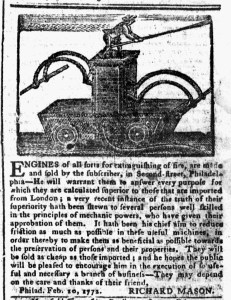
Richard Mason constructed and sold “ENGINES of all sorts for extinguishing of fire” at his workshop in Philadelphia in the early 1770s.  In an advertisement in the Pennsylvania Chronicle, he advised the public that he designed and built his engines “to answer every purpose for which they are calculated superior to those that are imported from London.”  Yet he did not expect readers simply to take his word for it.  Instead, he confided that “a very recent instance of the truth of their superiority hath been shewn to several persons well skilled in the principles of mechanic powers, who have given their approbation of them.”

To that end, Mason declared, “It hath been his chief aim to reduce friction as much as possible in these useful machines, in order thereby to make them as beneficial as possible towards the preservation of the persons and their properties.”  Reducing friction mattered because colonizers pumped these engines by hand after rolling them to the location of a fire.  An image that accompanied Mason’s advertisement depicted an engine shooting a stream of water at an unseen fire, but did not fully capture the number of people and the amount of labor required to operate it.  The wooden engine consisted of a pump enclosed within a tower mounted on a chassis.  Handles on either side of the tower worked the pump.  A leather hose fed the pump with water via a connection on the chassis.  Pumping the engine forced a stream of water to spray from an inflexible metal tube attached to the top of the tower.  As others worked the pump, an operator standing atop the tower manipulated the position of that tube, pointing it in the right direction and adjusting its position, in an effort to douse the fire.

Fire constituted a significant hazard in cities like Philadelphia with so many buildings made of wood crowded closely together.  Just a few years after Mason published his advertisement, a fire destroyed a large portion of New York.  Municipal fire departments did not yet exist.  Instead, colonizers formed their own companies.  Mason sought customers for his “ENGINES of all sorts for extinguishing of fire” among his fellow residents of Philadelphia rather than the local government.

Watch a brigade operate a replica of an eighteenth-century fire engine at Colonial Williamsburg.

January 27

What was advertised in a colonial American newspaper 250 years ago today?

Pennsylvania Packet (January 27, 1772).

“GEORGE BARTRAM’s WOOLLEN DRAPERY AND HOSIERY WAREHOUSE, At the Sign of the GOLDEN FLEECE’s HEAD.”

Much of the content of George Bartram’s advertisement in the January 27, 1772, edition of the Pennsylvania Packet resembled what appeared in notices placed by other merchants and shopkeepers.  Bartram informed prospective customers that he “Just imported … A very large Assortment” of textiles “from BRITAIN and IRELAND.”  He then listed a variety of fabrics to demonstrate the choices available to consumers.

In addition to providing an overview of his merchandise, Bartram deployed other means of making his business memorable.  For instance, he marked it with a sign that featured a distinctive device, advising prospective customers to visit “the Sign of the GOLDEN FLEECE’S HEAD” on Second Street.  Some colonial entrepreneurs used similar signs, but many did not.  Among the other advertisers in the January 27 edition of the Pennsylvania Packet, John Carnan, a jeweler, ran a shop “AT THE GOLDEN LION,” but Joseph Carson, Francis Hopkinson, William Miller, Alexander Power, John Sparhawk, Mary Symonds, and James Wallace did not mention signs that marked their locations.  Bartram further enhanced his advertisement with an image of a golden fleece’s head that may have replicated his shop sign.  Most advertisers who called attention to their signs did not make the additional investment in woodcuts.  Bartram apparently made the investment only once.  He ran an advertisement with the same copy, but no image, in the Pennsylvania Chronicle on the same day.

Bartram also gave his business a name, another marketing strategy adopted by relatively few advertisers in the eighteenth century.  Some merchants, shopkeepers, and artisans used their shop signs as the names for their businesses, but most advertisers did not give their businesses any sort of name.  Printers and booksellers were the most likely to name their businesses.  Although he did not have a sign with a distinctive device, Sparhawk called his shop the “LONDON BOOK-STORE” in his advertisement.  John Dunlap, printer of the Pennsylvania Packet, advertised books available at the “NEWEST PRINTING-OFFICE.”  Among advertisers from other occupations, Bartram distinguished his shop from others by calling it “GEORGE BARTRAM’s WOOLLEN DRAPERY AND HOSIERY WAREHOUSE, At the Sign of the GOLDEN FLEECE’s HEAD.”  He incorporated his own name, a sign, an image depicting that sign, and a name for his business into his advertisement, distinguishing it from others and making his endeavor more memorable.