February 22

GUEST CURATOR:  Mary Aldrich

What was advertised in a colonial newspaper 250 years ago this week?
Feb 22 - 2:17:1766 Connecticut Courant
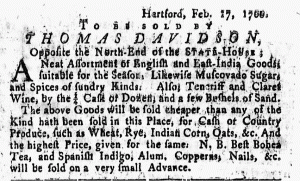
Connecticut Courant (February 17, 1766).

“The above Goods will be sold … for Cash or Country Produce.”

It is interesting that Davidson starts his advertisement assuring his potential customers that the “neat assortment of English and East-India Goods [were] suitable for the season.” He is letting them know that the products he was currently carrying could be used immediately and did not need to be stored until their use was required.

Davidson also mentioned that if people did not have cash on hand he would be more than happy to barter. He even went beyond mentioning his openness to bartering; he listed specific items that he would accept in lieu of cash. He would have accepted country produce and a list of other products that costumers from the town would likely have gotten from another source or grown themselves.

By accepting items other than cash in exchange for goods, he interested a larger audience because hard currency was not as common at this time. Davidson appealed to a larger constituency than if he had advertised cash only.

**********

ADDITIONAL COMMENTARY:  Carl Robert Keyes

Mary notes that Davidson described his stock of “A Neat Assortment of English and East-India Goods” as “suitable for the Season.” This was one of many appeals the shopkeeper incorporated into his advertisement, along with mentioning price, quality, and the possibility of bartering. This advertisement also includes several stock phrases, including “Neat Assortment” and “suitable for the Season,” among its attempts to woo potential customers.

Davidson inserted one element that did not always appear in eighteenth-century advertisements: the date. While it was not exceptional for an advertiser to include a date, it was not the standard practice either. In this case, the date of the advertisement matched the date of the issue in which it appeared. (The type would have been set and the newspaper printed before February 17, so most likely Davidson intentionally specified that the date of his commercial notice would bear the same date as the issue in which it appeared.) Davidson, like other newspaper readers of the period, would have realized that sometimes an advertisement might be repeated for weeks or even months. Including the date in his advertisement buttressed his claim that his “Assortment of English and East-India Goods” was indeed “suitable for the Season,” or at least allowed readers and potential customers to better assess that claim.

February 21

GUEST CURATOR:  Mary Aldrich

What was advertised in a colonial newspaper 250 years ago today?

Feb 21 - 2:21:1766 New-Hampshire Gazette
New-Hampshire Gazette (February 21, 1766).

“Assortment of the best of Medicine, among which are the following, viz. Burlington’s Balsom of Life.”

Robert Turlington’s Balsam of Life was an English nostrum that claimed to contain twenty-seven ingredients. It was patented in England in 1744 with the claim that it could cure kidney and bladder stones, colic, and inward weakness. Turlington’s pamphlet contained testimony from users that a multitude of other ailments would be cured because they took this medicine. In order to appeal to people, Burlington stressed in his pamphlet  the natural ingredients he used, specifically balsam, which is “a perfect Friend to Nature, which it strengthens and corroborates when weak and declining, vivifies and enlivens the Spirits, mixes with the Juices and Fluids of the Body and gently infuses its kindly Influence into those Parts that are most in Disorder.”

Patent medicines began in Europe and quickly became a hit, so much so that rivals were almost instantly a problem. Many people were too busy or too poor to go call the doctor; these “cure alls” were perfectly marketed to these people. And the multitude of products all advertising as being the best kept the price of them down to some extent.

For more, see George B. Griffenhagen and James Harvey Young’s Old English Patent Medicines in America.

**********

ADDITIONAL COMMENTARY:  Carl Robert Keyes

Some histories of advertising in America suggest that little was advertised – with the exception of patent medicines – in the eighteenth and early nineteenth centuries. The Adverts 250 Project, on the other hand, regularly demonstrates the diversity of goods and services marketed in colonial America, including, on occasion, the patent medicines that have given early American advertising such a bad reputation.

Mary discusses a 46-page pamphlet that Turlington published in England in hopes of convincing potential customers to choose his Balsam of Life over the medicines offered by a host of competitors. Colonial merchandisers sometimes distributed similar pamphlets, but did not engage in newspaper advertising for patent medicines to the same extent as in England because the American market did not have the same surplus of such products. Newspaper advertisements in colonial period tended to mention patent medicines only by name, without expounding on their contents or promised effects (as seen in today’s featured advertisement). This shifted a bit after the Revolution. In the wake of a greater number of newspapers being published, as well as many expanding to multiple issues each week, more space for advertising became available. Newspaper advertising for patent medicines became more extensive after the Revolution, sometimes including the same sorts of testimonials that Turlington used to promote his Balsam of Life in his original pamphlet from the 1740s.

In Old English Patent Medicines in America, Griffenhagen and Young describe advertisements in the colonies as “drab” compared to those in London and the English provinces. Note, however, that Josiah Gilman offered one innovative marketing method: “Customers may depend on being served as well by sending as if present themselves.” In other words, Gilman offered an early form of mail order shopping. Customers did not need to visit his shop in person. Instead, they could select which items listed in the advertisement that they wished to purchase and send for them.

Welcome, Guest Curator Mary Aldrich

Mary Aldrich is a senior at Assumption College, majoring in History. She finds all areas of history interesting because every period has contributed to the human consciousness in some way. She has enjoyed immensely working on the Isaiah Thomas Broadside Ballads Project, a collaborative effort with the American Antiquarian Society.  She will be guest curating from Sunday, February 21 through Saturday, February 27.

Welcome, Mary Aldrich!

Reflections from Guest Curator Elizabeth Curley

GUEST CURATOR:  Elizabeth Curley

The Adverts 250 Project has immensely changed my view of Colonial American history. Before it had been a one-dimensional thing I had learned about in a textbook, and then later in my hometown, Lexington, Massachusetts, from walking around. But that was just it: it was history. I never thought about beyond my tests or projects. Delving into the world of early American newspaper advertisements, however, changed this view. I was able to see and connect every day events from the 1760s to the things I see and do in the twenty-first century. They obviously did not have cell phones or tweet as much as I do (@WomenOfAC ) but their day-to-day lives were not much different. They went to work, they went shopping for wares, and had lives beyond the Redcoats and Patriots. That thought is what made me so interested in this project and made colonial America history seem three-dimensional.

I will say though in the beginning this project was difficult because there are so many small steps in finding each advertisement.  For each advertisement you must first do general research on the Early American Newspapers database.  Then you must map out the days that have newspapers, and which ones have advertisements.  This takes a while and you need to be very organized.  Then they must be approved by Professor Keyes.  After they are all approved then you must write the commentary which has even more research involved.  Once you get the process down it can be much quicker.

The most difficult part of this project for me was actually finding the advertisements and getting them approved. It was hard, because many of the advertisements were published in multiple weeks, so previous guest curators Maia Campbell and Kathryn Severance beat me to them. When you pick your adverts you have to go through and line them up based on the date and also find ones that connect to you somehow. I choose to use ones that connected with me because I feel that it made my commentary easier to write and more genuine for the audience that would be reading them. I wanted the audience to know that: “No, I’m not just some bored college kid doing this because my professor told me to. I genuinely enjoyed the project and the process that was involved.”

Beyond finding the advertisements was the next little step: writing the commentary. This required research, lots and lots of research. However, because I was able to choose advertisements that interested me doing the research and writing the commentary about it was actually enjoyable, because I was interested in what I was learning and writing about.   That did make my commentary a little bit longer than was required, but I felt it was appropriate based on the content of the advertisement and the knowledge that I had gained from the research I had done.

By doing this project I was able to actually be involved in making history relevant and that is what I believe “doing” history is. It is taking history and making it relatable and three-dimensional for as much of the audience as possible. Now that I have done Week 1 of the Adverts 250 project I can say with confidence that Week 2 will be much easier for me. I can not wait to be the guest curator for March 20-26.

**********

ADDITIONAL THOUGHTS:  Carl Robert Keyes

Thank you, Elizabeth, for an engaging selection of advertisements this week.  I appreciate the way that you found a personal connection to each advertisement and your enthusiasm for how these everyday advertisements helped to make colonial America come alive for you.  As she mentioned above, Elizabeth will be returning for a second week as guest curator later in the semester.

February 20

GUEST CURATOR:  Elizabeth Curley

What was advertised in a colonial newspaper 250 years ago today?

Feb 20 - 2:20:1766 Pennsylvania Gazette
Pennsylvania Gazette (February 20, 1766).

“INTENDS to open a School in the Country.”

Joseph Garner, “Master of the Church School,” and John Todd, “Master of the Friends Public School, in Philadelphia,” were looking for a fellow teacher to go into the Pennsylvania countryside to teach at a new school.   Many people think of teaching as a women’s profession but in 1766 it could be considered a man’s profession because they were the ones who had schooling in some subjects.

Garner and Todd go on to list different skills they would like this gentleman teacher to have, such as the ability to teach Navigation, “Mensuration of Superficies and Solids,” Surveying, and “Extraction of the Square and Cube Roots.” These arithmetic skills would have been applicable to the banker, the merchant, and the insurance officer.

The final application requirement was that the applier have an “Unexceptional Recommendation, respecting Morals.”

The key reason I chose this advertisement was because I am studying to become an elementary educator with a concentration in history. I believe that being an educator to the next generation of leaders, CEOs, union workers, pro athletes, service employees, and mothers and fathers is the biggest honor that can be bestowed upon me. I think all teachers believe this at their core, although there are many other benefits. Taking Professor Keyes’s Public History class has shown me all the ways history can be brought inside and beyond a classroom, and, as a future educator, it will be my job to show children that history is not just in their textbooks but all around them.

**********

ADDITIONAL COMMENTARY:  Carl Robert Keyes

As with yesterday’s featured advertisement, Elizabeth has chosen a notice that does not explicitly mention women yet allows us to explore how gender shaped women’s (and men’s) experiences in the late colonial period.

By and large, men and women received different kinds and levels of education in eighteenth-century America. In addition, schoolmasters operated “Latin” schools modeled on classical curricula in European schools for a small number of pupils, usually male, and “English” schools that provided instruction in basic reading, writing, and arithmetic for a greater number of students, both male and female. Men served as instructors at Latin schools, but both schoolmasters and schoolmistresses operated English schools.

This advertisement makes it clear that Garner and Todd envisioned a school for boys and young men who would eventually go on to careers as merchants or bankers or secure jobs in customs houses and insurance offices. It is possible that the school would have admitted girls and young women for instruction in basic skills. It is also possible that they would have pursued some of those lessons in mixed-sex classrooms (though other advertisements from the period make it clear that in such cases students would be closely monitored to make sure everyone behaved appropriately, as concerns about “Unexceptionable Recommendations, respecting Morals” make clear). When it came time for the more advanced and supposedly masculine subjects, male students would have met separately in sex-segregated classrooms with male instructors.

February 19

GUEST CURATOR:  Elizabeth Curley

What was advertised in a colonial newspaper 250 years ago this week?

Feb 19 - 2:17:1766 Boston-Gazette
Boston-Gazette (February 17, 1766).

“A large Assortment of Kilmarnock Carpets.”

Lewis and Bant posted this advertisement to advertise their carpeting and flooring company. They also say they have a good assortment of other English goods which would be sold to the consumer for “very low for cash.” Their shop was located in Cornhill Street, which is now part of Washington Street in Boston.

The advertisement describes their carpets as Kilmarnock and being imported from Glasgow. Glasgow is a major river port city, whereas Kilmarnock is in west central Scotland. Many goods were made in the country and they would be brought into populated port cities to be sold or exported.

Screen Shot 2016-02-18 at 9.32.04 AM
Location of Kilmarnock in Scotland.

The carpet is being sold in ½ , ¾, and yard measurements, which is not much different than today. Unless you are buying a standardized size (usually 8×12 ft or 6×9 ft) today, carpets are custom measured in either yards or feet. Also parts of the advertising style haven’t changed much for carpet companies in the Boston area. Lechmere Rug Co. of Cambridge, Massachusetts, is a local family-owned carpet company that has been in the area since 1975.

This advertisement grabbed my attention because I have worked at Lechmere Rug since I was little, alongside my father, who owns the business, and my brother. I have measured homes and dropped off rugs, so naturally I chose this advertisement because it reaches close to home for me.

**********

ADDITIONAL COMMENTARY:  Carl Robert Keyes

One of the things that I enjoy most about working on the Adverts 250 Project is discovering the ways that eighteenth-century advertisements resonate with others. For some readers, specific advertisements speak to their own scholarly interests. Others draw connections between certain advertisements and their everyday lives, their occupations, their hobbies, their interests, their choices as consumers in the early twenty-first century.

I would not have predicted that Elizabeth would select this particular advertisement. It appeared right above shopkeeper Jane Eustis’s much lengthier advertisement. Knowing that Elizabeth is especially interested in women’s history and sought to include as many advertisements from women as possible during her time as guest curator, I would have guessed Jane Eustis’s advertisement would have been at the top of her list.

But that was before I knew that Elizabeth had worked in the family business at Lechmere Rug Co. Her father’s name is listed on the web site, but not the names of their expert installers or other staff. Patrick Curley speaks with pride on behalf of the craftsmen he employs. Lewis and Bant’s advertisement does not indicate the names of others who worked in their shop either, but many historians of women in early America have demonstrated that wives and other female relations often assisted in operating family businesses in the colonial era. Laurel Thatcher Ulrich has described them as “deputy husbands” because these women temporarily assumed traditionally masculine responsibilities in the marketplace when their husbands were not available.

Today’s advertisement may not explicitly feature a woman, unlike others Elizabeth has chosen, but it does allow us to explore women’s history as we question who else might have been working in Lewis and Bant’s shop. Then and now, many members make valuable contributions to family businesses. Elizabeth has assisted her father and brother at Lechmere Rug Co. It is possible that wives and daughters worked in Lewis and Bant’s shop as well.

In Which One Digital Archive Nearly Replicates One Existing Archive

In recent weeks I’ve spilled a fair amount of ink considering how both methodology and access shape the Adverts 250 Project. I’ve demonstrated three different levels of access to newspapers printed in 1766 included in Early American Newspapers: 14 via my college’s library, 15 via the Boston Public Library’s electronic resources (including the extremely significant addition of the Pennsylvania Gazette) and 21 via the digital resources available in the reading room at the American Antiquarian Society (which has access to all the titles in Early American Newspapers because the AAS and Readex are partners in the endeavor).

I’ve also demonstrated how my methodology for selecting advertisements (each must come from that date or a newspaper published most immediately before that date in cases of no newspapers printed on a particular date) has caused certain newspapers to receive disproportionate coverage due to most newspapers being published at the beginning of the week and relatively few at the end.

Feb 19 - Masthead for New-York Gazette 2:18:1766
Masthead for an Extraordinary (“Extra”) to the New-York Gazette (February 18, 1766).

I’ve made promises that when my Public History students’ tenure as guest curators comes to an end that I will resort to the resources available in the AAS’s reading room as a means of featuring a greater number of publications and achieving more extended geographic reach.


However unintentionally, I may have implied that accessing Early American Newspapers at the American Antiquarian Society means that I am working from a complete archive of publications from 1766. There are several reasons why this assumption is not completely accurate. The project will be migrating toward the best possible digital access, but that is not the same as complete access to every newspaper in an archive. Today I’d like to examine how closely the most extensive access to Early American Newspapers mirrors what is available in the stacks at the AAS.

Recall that I previously identified these newspapers printed at some point in 1766 (from Edward Connery Lathem’s Chronological Tables of American Newspapers, 1690-1820) that are not available via even the AAS’s most extensive access to Early American Newspapers.

New Hampshire

  • Portsmouth Mercury (last known September 29)

New York

  • New-York Gazette or Weekly Post-Boy

Pennsylvania

  • [Germantown] Wahre und Wahrscheinliche Begebenheiten (only known February 24)

North Carolina

  • [Wilmington] North-Carolina Gazette (last known February 26)

South Carolina

  • [Charleston] South-Carolina and American General Gazette
  • [Charleston] South-Carolina Gazette (suspended starting October 31, 1765; resumed June 2, 1766)
  • [Charleston] South-Carolina Gazette and Country Journal
Feb 19 - Masthead for Connecticut Courant 2:17:1766
Masthead for the Connecticut Courant (February 17, 1766).

I consulted the AAS’s online catalog and, especially, Clarence to find out if the AAS collections included these newspapers. (Clarence – named for Clarence Brigham, librarian (1908-1930) and director (1930-1959) of the AAS and author of the two-volume History and Bibliography of American Newspapers, 1690-1820 – is a database that indicates which specific issues of early American newspapers are in the AAS collections, replicating and updating portions of Brigham’s monumental bibliography.) Here’s what I discovered:


  • Portsmouth Mercury: scattered issues from 1766.
  • New-York Gazette or Weekly Post-Boy: weekly issues and occasional supplements through October 9.
  • Wahre und Wahrscheinliche Begebenheiten: photostat copy of only known issue (as indicated in the catalog record; Clarence does not specify this detail).
  • North-Carolina Gazette: AAS does not possess any issues.
  • South-Carolina and American General Gazette: scattered issues from 1768 through 1778, but none from 1766.
  • South-Carolina Gazette: one damaged issue from 1766 along with scattered issues from 1737, 1740, 1760, 1763, 1767, 1768, 1770, 1772, and 1774.
  • South-Carolina Gazette and Country Journal: scattered issues from 1766 as well as scattered issues from 1768 through 1775.

Based on these findings, it appears that digital access to newspapers printed in 1766 via Early American Newspapers very nearly replicates the holdings of the American Antiquarian Society. For the most part, the AAS possesses only scattered issues of the titles not included in Early American Newspapers. This is a major achievement that allows researchers to view the contents of these publications while also preserving the originals.

For the purposes of this project, a digital archive that nearly completely replicates the newspaper holdings of the AAS (at least, those printed in 1766) also streamlines the research process. Having compiled a calendar of which newspapers were printed on which dates in 1766, I can quickly scan the relevant issues when selecting an advertisement to feature on any given date. I imagine that the reading room staff at the AAS also appreciates that I am not repeatedly requesting large bound volumes of eighteenth-century newspapers that they then have to page, process, deliver to me, and later return to their designated places in the closed stacks.

On the other hand, for other sorts of projects, the research process goes much more smoothly and efficiently when I can quickly – but carefully – flip through the pages of a bound volume of newspapers, scanning for particular content. To preserve the originals, scrolling through microfilm copies serves the same purpose. When it’s necessary to examine a large number of issues published sequentially, digital access via Early American Newspapers can be slow and cumbersome by comparison. That’s not a criticism but rather recognition that digital surrogates are not always the best format for conducting research. (On the flip side, the ability to do keyword searches in Early American Newspapers can streamline the research process significantly. I’ll write more about the virtues and imperfections of keyword searching digitized newspapers some other time.)

Feb 19 - Masthead for Boston Evening-Post 2:17:1766
Masthead for the Boston Evening-Post (February 17, 1766).

I noted above that in the coming months this project will migrate to the best possible digital access, but that is not the same as complete access to every newspaper in an archive (although in this case it is really close). Next week I will consider the difference between access to every newspaper in an archive and access to every newspaper printed. Once again, these distinctions may seem merely academic at first glance, but I continue to maintain that researchers must be aware of the scope and limitations of their resources and we have an obligation to others who read our work to share that information.


As I consider these issues, I keep returning to two of the main arguments presented by Kenneth Carpenter (Harvard Libraries, retired) and Michael Winship (English, University of Texas – Austin) in their keynote address at the Digital Antiquarian Conference last May: (1) digital sources should be consulted as complements to, rather than replacements for, original sources and (2) be conscious of the metadata that provides the foundation for digitized sources so you know how closely digital surrogates replicate original documents.

February 18

GUEST CURATOR:  Elizabeth Curley

What was advertised in a colonial newspaper 250 years ago this week?

Feb 18 - 2:18:1766 New-York Gazette
New-York Gazette (February 21, 1766).

“Wants a Place, A Young Woman that is capable to attend Children.”

A woman looking for placement was not an uncommon thing in early American newspapers. Young women usually would look to be a housekeeper or cook, to care for children, or assist the women of the house. This young woman described her skills as “capable to attend Children, make up small Clothes,” and be all around helpful to the family. Our generation would describe her as a nanny.

In the American colonies, the number of servants a family had often depended on their economic status. Like the size and grandeur of a family’s house, the number of servants could be a status symbol. Not much has changed today.

Feb 18 - Masthead New-York Gazette 2:17:1766
Masthead for New-York Gazette (February 17, 1766).

For me, this advertisement was also an interesting find because normally the New-York Gazette published on Mondays. This week they published both a Monday (February 17) and a Tuesday (February 18) edition, which is were I found this advertisement. Normally for the Adverts 250 Project I would have had to go back to a Monday edition, but for this week I did not have to.

Feb 18 - Masthead New-York Gazette 2:18:1766
Masthead for New-York Gazette Extraordinary (February 18, 1766).

**********

ADDITIONAL COMMENTARY:  Carl Robert Keyes

“Not much has changed today.” Indeed, conspicuous consumption was not an invention of the twentieth or twenty-first centuries. It existed before the consumer revolution of the eighteenth century and genteel colonists engaged in it as a means of further differentiating themselves from each other as the middling and lower sorts gained greater access to consumer goods throughout the 1700s.

I believe that Elizabeth is the first guest curator to comment explicitly on the methodology used in selecting the featured advertisement for each day. She notes the same methods that I have described elsewhere in extended commentary about the project’s methodology and how it shapes the scope of the project.

As an instructor, this is an important behind-the-scenes element of students’ work. Each guest curator has compiled a census of newspapers published during his or her week based on the calendars generated by Early American Newspapers. As a result of supplements and extraordinary (“extra”) issues as well as publications starting or stopping in response to the Stamp Act or other reasons, the list of newspapers published in one week often differs from the list for the next week.

As Elizabeth indicates, many colonial American newspapers were published at the beginning of the week, on Mondays, but in most weeks no newspapers were printed on Tuesdays. As we examined this more closely, we discovered that William Weyman actually published the New-York Gazette three times during this week in 1766: the regular issue on Monday, February 17; a broadside (one-page) “Extraordinary” issue on Tuesday, February 18; and a two-page “2d Extra” on Friday, February 21.

Feb 18 - Masthead New-York Gazette 2:21:1766
Masthead for New-York Gazette 2d Extra (February 21, 1766).

This was not immediately apparent, however, due to a coding error in the metadata. The two extraordinary issues were treated as one in Early American Newspapers. As I have noted elsewhere, researchers need to be aware of faulty metadata (background information or “data that provides information about other data”) that may lead them to incorrect conclusions about digitized sources.

Feb 18 - Readex Calendar
Note that the calendar of issues generated by Early American Newspapers does not indicate that the New-York Gazette was published on February 21, 1766.  That “2d Extraordinary” has been conflated with the Extraordinary issue of February 18, 1766.

Elizabeth’s advertisement was actually published in the “2d Extra” on February 21. The February 18 Extraordinary did not include any advertisements. That means that today’s featured advertisement technically departs from the established methodology for this project.

I asked Elizabeth not to edit her original submission when we discovered this. Together we have fast forwarded three days to February 21, but this allows us to make a valuable point about the shortcomings that sometimes emerge when relying on digitized sources.

(Besides, February 18 is my birthday. I’m glad that we found a way to incorporate at least a masthead from a newspaper published 250 years ago on February 18, 1766, into the project.)

February 17

GUEST CURATOR:  Elizabeth Curley

What was advertised in a colonial newspaper 250 years ago today?

Feb 17 - 2:17:1766 Boston Gazette
Supplement to the Boston-Gazette (February 17, 1766).

“A fresh Assortment of Garden Seeds … warranted to be good.”

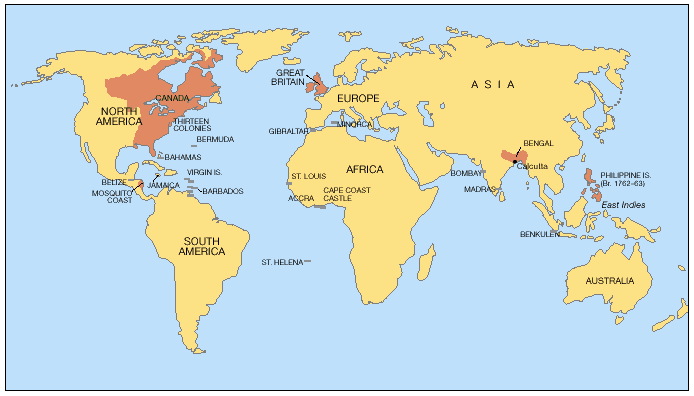
As a female millennial who is interested in women’s rights and equality, seeing a woman merchant who posted in a newspaper made me very excited! Lydia Dyar sold “A fresh assortment ” of seeds of all types, from spices and herbs to vegetables. She listed quite a collection of different types of seeds and goes on to say that she has even more. The seeds came from London and had been recently brought in on “the lasts Ships, and Captain Freeman.” Even though the seeds came from London, they had probably been collected from all over England’s other colonies, from the Caribbean to India to trading posts in Africa.

Feb 17 - British Empire 1763
Britain’s global empire in 1763, a result of commercial enterprise and military conquest.

With it being February and winter being somewhat close to over, the early American colonists would be starting to think and prepare for spring. Spring meant that the growing season was going to start and seeds would be a necessity.   Many early American colonists grew much of what they ate rather than always trading or purchasing food. They had no 24-hour CVS or Super Walmart. Lydia Dyar also “warranted to be good” which would be a sort of warrantee that the seeds would yield the appropriate amount of fruit.

**********

ADDITIONAL COMMENTARY:  Carl Robert Keyes

When she first selected this advertisement, Elizabeth asked if it was out of the ordinary for women to participate in the eighteenth-century marketplace as retailers, wholesalers, suppliers, or producers rather than as consumers. I explained that women filled those roles more often than everyday assumptions about early America might suggest. In urban ports like Boston, New York, and Philadelphia as many as one-fifth to one-third of shopkeepers were women.

On the other hand, women did not tend to place advertisements in proportion to their numbers. It would not quite be correct to state that advertisements placed by women were uncommon, but on the whole women tended to be less likely to promote their businesses in the public prints than men.

Given her desire to feature advertisements by women, Elizabeth had three choices in the four-page Boston-Gazette and its two-page Supplement, both issued on February 17, 1766. Lydia Dyar’s advertisement appeared on the second page of the supplement. Shopkeeper Jane Eustis advertised an extensive assortment of textiles on the third page of the regular issue.

Feb 17 - 2:17:1766 Boston-Gazette - Renkin
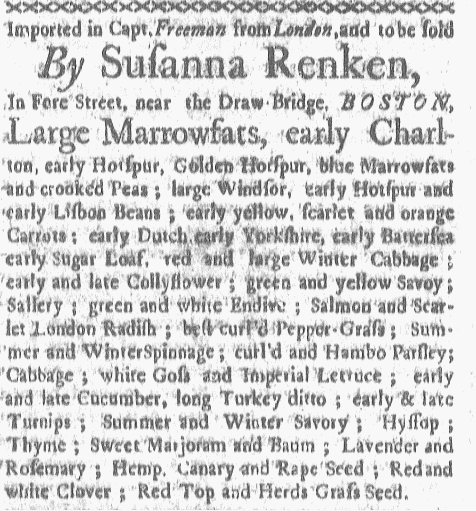
Boston-Gazette (February 17, 1766).

And Susanna Renken, a competitor to Lydia Dyar, inserted this advertisement on the final page of the regular issue. Notice that both women sell many of the same seeds. Both indicate that they had been supplied by Captain Freeman. In the absence of an existing personal or commercial relationship with one seed seller or the other, how might a colonial consumer have decided which to visit?

Convenience based on location might have been a deciding factor. However, Dyar made appeals to potential customers that Renken did not: “warranted to be good, and of last Year’s Growth, sold at the lowest Terms.” Renken announced that she had seeds for sale, but Dyar put extra effort into marketing her wares. Perhaps Renken ended up regretting that the Boston-Gazette published a supplement – including Dyar’s advertisement – that week instead of holding her competitor’s advertisement until publishing a new full issue the following week.

February 16

GUEST CURATOR:  Elizabeth Curley

Who was the subject of an advertisement in a colonial newspaper 250 years ago this week?

Feb 16 - 2:14:1766 New-Hampshire Gazette
New-Hampshire Gazette (February 14, 1766).

“TO BE SOLD … A NEGRO LAD, about Seventeen Years of Age.”

As we know from the previous week’s advertisements, even the northern colonies embraced the slave trade. This advertisement has no information about the owner, only that if interested readers should inquire of the printer for more information. We do know that the boy is being sold for lumber or on “short credit.”

At about seventeen the boy had been owned by the advertiser for four years. He could “speak good English.” However, the advertisement goes on that he was not being bought for his “BEAUTY or GOOD QUALITIES.” He would have made a good worker or “labouring Servant.” This means that he would have probably worked outside, perhaps on docks or a farm or assisting with carpentry or masonry. If he had been pretty he could have been placed as a house servant, which might have included duties such as footman, general house staff, and, if the family was wealthy enough, a coach or stable man.

The comment about his looks and beauty go beyond what type of work he would be doing though. Those comments point to the view that his owner and many others had.   They believed that African Americans were inferior and had only bad intentions. However much this makes me upset as a human being, this is an advertisement that needs to be brought up for the discussion that will follow. Many people believe that racism is not as relevant or present today, and, though African Americans thankfully are not property any more, as a nation we have a long way to go until we as a people are united in equality.

**********

ADDITIONAL COMMENTARY:  Carl Robert Keyes

As historians have worked since the era of the modern civil rights movement to better incorporate race, class, and gender into our narratives and interpretations of the American past, some critics (both within and, especially, beyond the academy) have accused us of so-called revisionism. Most historians agree that acknowledging our complicated past tells a richer and fuller story. Furthermore, it is a patriotic endeavor in that it challenges us as a nation to recognize when we have fallen short of the rhetoric of the Revolution so we can strive to do better. But in order to do better, we must be fully aware of both current events and the actions, attitudes, and ideas that have produced and shaped those current events over decades and centuries.

Yet there are other reasons to tell a story of the past that includes as many perspectives as possible. Earlier this semester, Elizabeth and her peers in our Public History course read this passage:

“Students’ lack of historical knowledge about the past results in an inability to see themselves, their families, and their communities as part of the larger process of American history. If students fail to see their own histories as important, they do not believe that they can have an impact on their environments. One of the ways in which people ‘learn to be members of society’ is to feel engaged in it. History is central to identifying, analyzing, and interpreting the values upon which civil society depends. All historians should remember that they are citizens as well as scholars and that they possess some responsibility to the larger civic community.”[1]

Many critics of so-called revisionism yearn for historical narratives they consider patriotic. They envision history as a means of inculcating civics in students. Although I disagree with the shape of the narrative many critics wish to impose, I wholeheartedly agree that civic participation is one of the most important purposes of studying the past. As the passage above argues, we need history with as much breadth and depth as possible in order to empower ALL Americans to engage in thoughtful citizenship and compassionate service to their communities.

The advertisement Elizabeth selected for today is important in its own right for what it tells us about the history of slavery in America and the depictions of Africans and African Americans in colonial New England. There is so much more to say about an advertisement that denigrates a seventeen-year-old boy for a supposed lack of both “BEAUTY or GOOD QUALITIES,” but I appreciate that Elizabeth has challenged us also to think about why it is important that we analyze this kind of advertisement and include it in our historical narrative.

**********

[1] Patricia Mooney-Melvin, “Professional Historians and the Challenge of Redefinition,” in Public History: Essays from the Field, rev. ed., ed. James B. Gardner and Peter S. LaPaglia, (Malabar, FL: Krieger Publishing Company, 2006), 17.