February 15

GUEST CURATOR:  Elizabeth Curley

What was advertised in a colonial newspaper 250 years ago today?

Feb 15 - 2:14:1766 New-London Gazette
New-London Gazette (February 14, 1766).

“Ames’s Almanacks for the Present Year, to be Sold by T. Green.”

An almanac is “an annual publication containing a calendar for the coming year, the times of such events and phenomena as anniversaries, sunrises and sunsets, phases of the moon, tides, etc., and other statistical information and related topics.” In today’s society we do not see an almanac in everyone’s back pocket and purse; however back in the 1700s they were a lot more popular.

Here in the New-London Gazette, T. Green is advertising Ames’s Almanack for the “present year” which was 1766. Nathaniel Ames is considered to be the first person to publish an almanac in colonial America. The first annual publishing was done in 1725 and was published in Bridgewater, Massachusetts, until he moved to the South Shore later in his life. Ames’s Almanack was for many yeas considered the greatest with it publishing more then 60,000 copies. That’s quite a large number of copies for a colonial work. He started an industry that would spawn the likes of Poor Richard’s Almanack (Ben Franklin, 1733, Pennsylvania) and Rhode-Island Almanack (James Franklin, 1727, Rhode Island)

Almanacs were a major part of day-to-day life for people during the colonial time. They helped “everyday” people such as farmers, shopkeepers, and black/silversmiths know a little about each day. They would include astrological information, some details of the previous years weather, tide flow charts, copies of poems and stories, and historical essays. They also promoted reading throughout the countryside, and commerce for people such as T. Green. One family could purchase an almanac annually and it would give them access to literary works and a variety of useful information.

**********

ADDITIONAL COMMENTARY:  Carl Robert Keyes

Elizabeth is correct when she notes the ubiquity of almanacs in colonial America. They were cheap print. These small, inexpensive pocket references could be found in households from the grandest to the most humble and were published locally in large numbers from an early date.
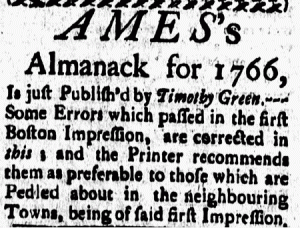
Oct 25 - 10:25:1765 New-London Gazette
New-London Gazette (October 25, 1765).

This is not the first time that an advertisement for Ames’s Almanack in the New-London Gazette has been featured by the Adverts 250 Project. In fact, it was the second advertisement I selected when this project was still confined to #Adverts250 on Twitter. This earlier advertisement demonstrates how far in advance almanacs were printed. By the end of October, Timothy Green advertised that his imprint of the almanac did not include “Some Errors which passed in the first Boston Impression” and marketed the version of Ames’s Almanack he printed as “preferable to those which are Pedled about in the neighbouring Towns.”

Not unlike purchasing calendars in the modern era, it is reasonable to expect that colonial consumers bought almanacs before the first of the year or as shortly thereafter as possible. To gain the full value of a calendar or an almanac requires using it throughout the entire period it covers. I previously featured an advertisement for almanacs placed three weeks into the new year. Elizabeth selected an advertisement for almanacs placed nearly seven weeks into the new year!
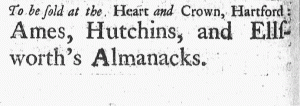
Jan 21 - 1:20:1766 Connecticut Courant
New-London Gazette (February 14, 1766).

What is happening here? It could be that the advertisement is filler, especially given its brevity, but it is also possible that Green ended up with a surplus and sought to continue to sell as many almanacs as possible to those who had not yet purchased them or desired additional copies. This advertisement could have been both padding that filled the page and the issue and an attempt to recoup his investment in printing Ames’s Almanack. This was the very first advertisement to appear in this issue of the New-London Gazette. Subscribers who read the news would have had to also read this advertisement to register that the advertising section had begun. Even if they did not continue with the other advertisements, at least they would have seen this one. It was the printer’s prerogative to place advertisements for his own goods and services wherever he wished in the issue.
February 14

GUEST CURATOR:  Elizabeth Curley

What was advertised in a colonial newspaper 250 years ago today?

Feb 14 - 2:14:1766 New-Hampshire gazette
New- Hampshire Gazette (February 14, 1766).

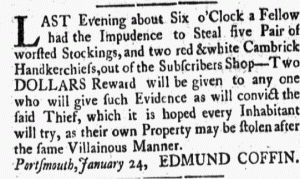
“A Fellow had the Impudence to Steal five Pair of worsted Stockings.”

I could not imagine having my stockings and handkerchiefs stolen from within my own home or shop. Clearly this person from New Hampshire could not either until it happened to him, and he was upset enough to place a whole two dollar reward for information on thief. That would have been a lot of money for five pairs of stockings and two red and white handkerchiefs. This makes me wonder if it was more about revenge on the thief.

This advertisement was placed in Portsmouth, which was one of the biggest cities in New Hampshire, and had different types of people living in the area: robbers and other questionable characters, shopkeepers, merchants, and the genteel class. Edmund Coffin went on to say that “every inhabitant” should watch out and report such behavior or it could happen to them.

This advertisement really grabbed my attention. It was a little different from some of the other advertisements that I had seen, because it was not a service or goods begin sold or bought. Especially in today’s society socks and handkerchiefs are so easily attainable that I would never even think twice if two of my socks disappeared.

**********

ADDITIONAL COMMENTARY:  Carl Robert Keyes

The Adverts 250 Project focuses primarily on marketing consumer goods and services in eighteenth-century America, but then (as now) not all advertisements were placed for that purpose. The guest curators from my Public History class and I have reached an agreement: each may select one advertisement not intended to sell goods or services during his or her week.

Elizabeth is beginning her week as guest curator with her “exception(al)” advertisement, but it is an extremely good choice because it tells us a lot about consumption in eighteenth-century America. Purchasing goods was not the only way to participate in the consumer revolution taking place in the colonies and Britain. Sometimes people came into possession of goods in more nefarious ways via an underground economy that included stolen items. Serena Zabin devotes an entire chapter to this “Informal Economy” in Dangerous Economies: Status and Commerce in Imperial New York. In addition to stolen items, secondhand goods were often exchanged via the informal economy. As Elizabeth notes, people of various backgrounds – from the lower sorts to the elite – resided in colonial cities and towns. Not all of them purchased new goods, but a great many found alternate ways to participate in the marketplace. This advertisement demonstrates one way they did so, much to the chagrin of poor Edmund Coffin who was the victim of an eighteenth-century shoplifter.

Welcome, Guest Curator Elizabeth Curley

Elizabeth Curley is a sophomore at Assumption College. She is an Elementary Education and History double major, with the goal of becoming a 6th grade social studies teacher. When it comes to history her favorite topics are the American Revolution, the Antebellum South, and the Industrial Revolution.   When she’s not being a dedicated student she enjoys learning about different world cultures and cooking. You can follow her public history twitter account: @WomenOfAC .

Welcome, Elizabeth Curley!

Reflections from Guest Curator Kathryn J. Severance

In the process of guest curating the Adverts 250 Project for my Public History class this week, I learned a great deal about conducting historical research. In doing so, I gained knowledge about the processes associated with “doing” history and about how historians take their research and compile it into something that the public can enjoy. In my time spent researching eighteenth-century newspaper advertisements, I came to understand the intricate research process associated with public history projects. I learned that in presenting my work to the public, I need to find ways to engage an audience that may consist of individuals with varying historical backgrounds. I experienced some challenges in the process of doing this project, though I also found it a very rewarding project to take part in. This project initially seemed like it was more of a challenge than it turned out to be for me.

I aimed my posts towards a broad audience and hoped that my posts would interest both historians and the general public, rather than exclusively the historical crowd. Instead, my hope was that people from all backgrounds could be engaged by my work. I think that history is something that should never be exclusive, but instead, always something that is created in a way that the general public can access without issue. I like this project because I was able to find materials and then share them with a broader audience who may not have otherwise been able to access or view the materials. I also like to make connections to the present day whenever possible, as I feel as though this helps historical material feel real and relevant in today’s world.

I encountered some challenges in my journey to accomplish the project. One of these challenges was time. I tend to overbook my time, from having two jobs, including a paid part-time job and an internship as a reporter, to being a full-time student and social media director for Assumption’s Odyssey group. This means that sometimes I skim over details. The first set of advertisements I chose were from the incorrect week and I had to conduct research again in order to correct my error. However, I did not allow this to make me dislike the project, or to make me feel as though I could not handle the project. I allowed the challenges of the project to fuel my work.

The most rewarding part of the Adverts 250 Project for me, personally, was finding different aspects of the advertisements to research. As a journalist, I thoroughly enjoy the processes associated with researching in general, but in this case it was even more interesting due to the fact that the topics I was researching were based in the eighteenth century, whereas in journalism, the topics I research are often something that occurred during the current century. I had to be innovative with my research methods because in some cases materials on a certain topic would not be readily available, due to their age. This meant I needed to think differently and find a way to break down the advertisement’s text into smaller parts. I was careful to only check out sources that were legitimate and historically accurate to prevent blogging about anything that might include questionable facts. I think that enjoying doing this project helped make it simpler and faster than I had originally expected that it might be.

When I first heard about this project, it seemed interesting, but also like a lot of work. This concerned me because I have a fairly busy schedule this semester and I’m already doing lots of research and writing for my internship at the newspaper. I love to learn as much about history as I can and this project served as a cause for me to do some research on topics within Colonial America that I might not have otherwise ever explored. This project is a wonderful experience for college students to take part in and I wish the other guest curators the very best of luck in their week.

**********

ADDITIONAL THOUGHTS:  Carl Robert Keyes

Thank you, Kathryn, for selecting wonderful advertisements this week.  Your choices often challenged me to think about certain types of advertisements and the appeals they made in new ways.  Kathryn will be returning for another week later in the semester.

February 13

GUEST CURATOR:  Kathryn J. Severance

What was advertised in a colonial newspaper 250 years ago today?

Feb 13 - Massachusetts Gazette 2:13:1766
Massachusetts Gazette (February 13, 1766).

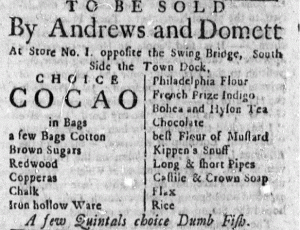
“TO BE SOLD By Andrews and Domett At Store No. 1. opposite the Swing Bridge, South Side the Town Dock.”

Andrews and Domett marketed bags of cocao, cotton, brown sugar, redwood, copper, chalk, iron hollow ware, flour, indigo, Bohea tea (an item advertised often during Colonial times, previously featured on Adverts 250), chocolate,  mustard, snuff, pipes, soap, flax, and rice. Each of these items are interesting on their own, so I chose a few of the items to focus on which some might not recognize, as they are not commonplace items during the twenty-first century, though they were in eighteenth-century America.

I did not recognize “Iron hollow Ware.” I hypothesized that this item was a type of Colonial dishware. Of course, this lack of knowledge led to an investigation. Iron hollow ware was a type of cooking pot that was made from cast iron. Today there are many individuals who collect this and other Colonial cookware for their personal home collections as a hobby. To learn more about “Iron hollow Ware” consult this book.

Feb 13 - Indigo in Bucket
Indigo.

Another item on the list of goods in the advertisement that I find intriguing, is the “French Prize Indigo.” Indigo is a powder derived from plants that was utilized during Colonial times as a dye to create blue clothing. Its importance was high, as blue was a highly desirable color for clothing, despite the fact that it could only be derived from indigo plants at this time. In appearance, it was a blue powder which is derived from the leguminous plant of the Indigofera genus, a plant that has over 300 identifiable known species in the world. Only two varieties of this plant are used to make indigo, including the indigofera tinctoria, which is native to both India and Asia, and the indigofera suffructiosa, which is native to South and Central America. Due to the fact that indigo was an import, it would likely be one of the more pricey items on the list in the advertisement. The University of Minnesota has an excellent historical account of “Indigo in the Early Modern World.”

During the late nineteenth century, German chemist Adolf von Baeyer created synthetic indigo and production of the synthetic dye began during the early twentieth century. Research about formulating a chemical composition for synthetic indigo was furthered due to the fact that dyes derived from natural indigo were not a significant enough source due to the rise of its use within the nineteenth-century clothing industry. The color of indigo is always a blue hue, but use of different amounts of indigo can result in a variety of shades that the substance produces when using it for dying.

**********

ADDITIONAL COMMENTARY:  Carl Robert Keyes

Kathryn focuses on some of the goods marketed to colonial consumers. Each item stocked by Andrews and Domett merits its own investigation. What, for instance, distinguished “Castile & Crown Soap” from each other? Colonial consumers certainly would have known, but as Kathryn points out many of the goods commonly advertised and purchased in the eighteenth century are no longer as familiar to twenty-first century consumers. Advertisements are often classified or catalogued as ephemera (especially advertising media other than newspapers, such as handbills, trade cards, or billheads), but consumer goods had their own ephemeral qualities as well.

In addition to the items for sale, I am interested in the format of this advertisement. Rather than listing their wares in a single, dense paragraph, Andrews and Domett utilized two columns with only one item per line, making it easier for potential customers to identify items of interest. The advertisement also strategically includes fonts of different sizes as well as capitals and italics. Why did “CHOICE COCAO” and “A few Quintals choice Dumb Fish” receive special treatment in this advertisement? Did Andrews and Domett imagine that these would be especially popular with customers once they knew these items were available? Or perhaps these items had been overstocked and tied up too many of the shopkeepers’ resources. Did they merit special attention in the advertisement because the shopkeepers needed to sell them most quickly?

I also wonder who made some of the decisions about the format of the advertisement. To what extent did Andrews and Domett describe to the printer how they wished their advertisement to appear in the newspaper? Did they give detailed instructions about columns, font size, and type? Vague or general instructions? No instructions at all? Advertisements like this one may testify to the creativity of the printer as much as the marketing savvy of the advertisers.

February 12

GUEST CURATOR:  Kathryn J. Severance

Who was the subject of an advertisement in a colonial newspaper 250 years ago this week?

Feb 12 - 2:10:1766 New-York Gazette
New-York Gazette (February 10, 1766).

“TO BE SOLD, For Want of Employ.”

This advertisement was put forth by a master looking to sell a slave due to the fact that they no longer could use their work.  Advertisements for slaves were common since slaves were commodities during the Colonial period.  In the eyes of many at the time, selling slaves was not much different than selling oxen or horses.

Feb 12 - Abolition Map
Map of Slave States and Free States in 1800.

The slave featured within this particular advertisement seems to be nineteen years old.  At twenty myself, I took a look at this advertisement and, for a second, imagine my own life.

I imagine that many members of the public would be interested to know that a newspaper in what came to be known as the North, advertised slavery in the 1760s.  These types of advertisements also continued in New England’s newspapers for at least 10 years until Vermont, inspired by the Declaration of Independence, was the first to ban slavery in its 1777 state constitution.  Other New England states followed suit.  By 1800 all the states within New England’s borders abolished slavery.

**********

ADDITIONAL COMMENTARY:  Carl Robert Keyes

Today Kathryn has selected a type of advertisement that surprises many students who enroll in my courses on early America, whether the introductory survey or advanced electives on colonial and Revolutionary America or the capstone research seminar on slavery in America. As Kathryn points out, many are shocked when looking through the pages of eighteenth-century newspapers to discover just how often enslaved men, women, and children were advertised, either to be bought and sold or because they ran away from their masters.

Many students (and I would venture to guess many New Englanders as well as other Americans) imagine a strict North-South divide. Slavery as an institution was something that existed in the South, they assume, but not in the North. Such assumptions conflate nineteenth-century America and earlier periods by grafting the antebellum era over the realities of seventeenth- and eighteenth-century America.

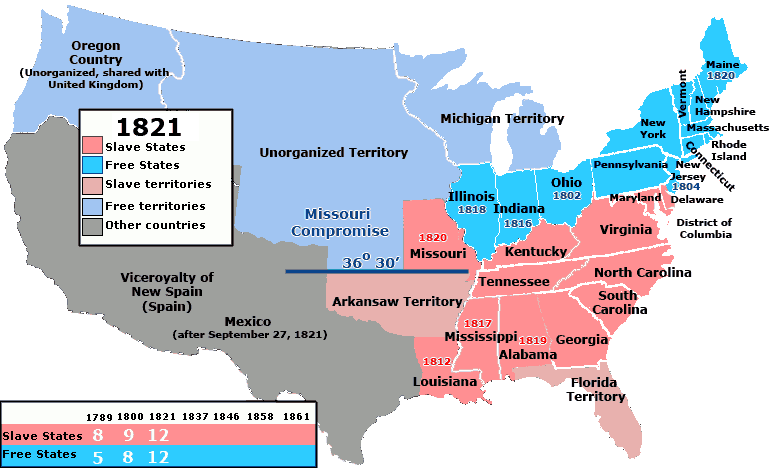
Feb 12 - Abolition Map 1821
Map of Slave States and Free State in 1821.  Note that New Jersey and New York merit additional explanation and clarification due to gradual emancipation.

Even the history of abolition is messier than simply stating that after a certain year slavery had been abolished in Northern states. Not every state adopted immediate abolition. New York (1799) and New Jersey (1804) each enacted gradual emancipation intended to phase out slavery over time. As a result, slaves resided in New York as late as 1824 and in New Jersey until the Civil War ended in 1865.

This advertisement reminds us of a history of slavery that is all too often hidden: its widespread practice throughout all the colonies in the seventeenth and eighteenth centuries and its continuation in some Northern states well into the nineteenth century.

In Which Methodology, as well as Access, Significantly Shapes the Project

Last week I demonstrated that different institutions have varying levels of access to the titles included in Early American Newspapers, arguing that this shaped the scope of the project. The access from the reading room at the American Antiquarian Society includes 21 newspapers published in 1766 with broad geographic reach, while accessing Early American Newspapers via my college’s library allows me to examine only 14 newspapers. Those titles are confined mostly, but not exclusively, to New England and New York.

In some ways the effects might be minimized, especially if we take into account T.H. Breen’s argument about the standardization of consumer culture throughout the colonies in the eighteenth century. Colonial consumers, he maintains, purchased imported goods that were increasingly uniform from port city to port city, region to region, in the decades leading up to the American Revolution. Indeed, Breen claims that having similar experiences in the marketplace and speaking a common language of consumption facilitated Americans’ ability to speak to each other about political matters, especially as they imbued consumption with political valences in the wake of the Stamp Act and other measures enacted by Parliament.

That being said, I would still prefer to demonstrate that advertisements from the Chesapeake and the Lower South marketed the same or similar goods and deployed the same or similar appeals as the commercial notices printed in newspapers from New England and the Middle Atlantic. I would like to be able to show – visually and through commentary – rather than merely tell. In addition, even if colonists did have access to increasingly standardized goods and services throughout the colonies that does not necessarily mean that regional differences did not also emerge, especially in terms of marketing. Did advertisers throughout the colonies make similar appeals as they marketed the same assortment of goods?

These are some questions I wanted to raise last week, but the bibliographic details were already so extensive that I held them in reserve. This week I would like to raise some other questions about the contours of this project, but these are based on my methodology rather than access to Early American Newspapers.

Recall that whenever possible I select an advertisement published on that date 250 years ago. When no newspapers were published on that date (or, at least, none that I can access!) I resort to a newspaper printed as close to that date as possible (but always previously printed: it must have been in the hands of colonists somewhere). In addition, I consult newspapers from as many different cities, colonies, and regions as possible. On some days I have multiple options. To help illustrate this, guest curator Kathryn J. Severance and I worked out this census of newspapers that we can access via the Boston Public Library’s electronic resources for the current week, Sunday, February 7 through Saturday, February 13.

February 6, 1766

  • Boston News-Letter
  • Pennsylvania Gazette
  • These newspapers fall outside of this week. Consult them only if there were no acceptable adverts in the newspapers published on February 7.

February 7, 1766

  • Connecticut Gazette
  • New-Hampshire Gazette

February 8, 1766

  • No newspapers were published on February 8. Use any newspaper published on February 7 or, if necessary, February 6.

February 9, 1766

  • No newspapers were published on February 9. Use any newspaper published on February 7 or, if necessary, February 6.

February 10, 1766

  • Connecticut Courant
  • Boston Evening-Post
  • Boston Gazette
  • Boston Post-Boy
  • New-York Gazette
  • New-York Mercury
  • Newport Mercury
  • Wochentliche Philadelphische Staatsbote

February 11, 1766

  • No newspapers were published on February 11. Use any newspaper published on February 10.

February 12, 1766

  • No newspapers were published on February 12. Use any newspaper published on February 10.

February 13, 1766

  • Boston News-Letter
  • Pennsylvania Gazette

Notice that no newspapers were published on February 8 and 9, 1766. For those dates the methodology dictates selecting advertisements from either the Connecticut Gazette or the New-Hampshire Gazette. I know from experience that both of those can be rather slim pickings when it comes to advertisements for consumer goods and services. The Connecticut Gazette often did not feature any, while the New-Hampshire Gazette tended to reprint the same advertisements for multiple weeks.

This census helps to illustrate the somewhat surprising origins of the first 30 advertisements featured in 2016 (before my Public History students assumed their guest curator responsibilities). I included this list last week, but did not have sufficient space to evaluate it.

  • 7 advertisements: Massachusetts Gazette (Boston)
  • 7 advertisements: New-Hampshire Gazette (Portsmouth)
  • 4 advertisements: Newport Mercury
  • 3 advertisements: New-York Gazette
  • 3 advertisements: New-London Gazette
  • 2 advertisements: Connecticut Courant (Hartford)
  • 1 advertisement: Boston Evening-Post
  • 1 advertisement: Boston Gazette
  • 1 advertisement: Boston Post-Boy
  • 1 advertisement: New-York Mercury

In seeking to be current, to provide “the freshest advices foreign and domestick,” my methodology gives disproportionate attention to the New-Hampshire Gazette, a relatively minor newspaper from a relatively small town. (I know, I know: harsh words for what now bills itself as “The Nation’s Oldest Newspaper,” having been in continuous publication in one form or another since 1756.) The New-Hampshire Gazette did not publish nearly as many advertisements for consumer goods and services as its counterparts in Boston, New York, and Philadelphia. That the New-Hampshire Gazette has been featured so prominently is a consequence of selecting advertisements from the most recently published newspaper on any given date.

The New-Hampshire Gazette and the New-London Gazette, which included even fewer advertisements, were printed on Fridays in 1766. No newspapers were printed on Saturdays or Sundays. As a result, my methodology prescribes that I select advertisements from these two publications three days of the week. Sometimes neither featured enough advertisements to make this possible, forcing me to go back to the Massachusetts Gazette, which also helps to explain why so many advertisements featured here derive from its pages. (Keep in mind that I used accessed Early American Newspapers via my college throughout January, which meant that the Pennsylvania Gazette was not an option. Since my students are using the Boston Public Library’s electronic resources to access Early American Newspapers they have incorporated the Pennsylvania Gazette into this project. When I am once again responsible for selecting the featured advertisement each day I will incorporate an even greater number of publications by accessing Early American Newspapers in the reading room at the American Antiquarian Society.)

I’ll close today’s extended commentary by reiterating that the New-Hampshire Gazette has received disproportionate attention due to the methodology I have developed for pursuing this public history and digital humanities project, not solely due to variations in access to Early American Newspapers. Quite simply, newspapers were printed on the day they were printed. On the other hand, I have developed a much different sampling method for my book project. The methodology I use here would not be appropriate in a manuscript seeking to analyze the development of advertising in eighteenth-century America.

February 11

GUEST CURATOR:  Kathryn J. Severance

What was advertised in a colonial newspaper 250 years ago this week?

Feb 11 - 2:10:1766 Boston Evening-Post
Boston Evening-Post (February 10, 1766).

“WANTED to purchase, A burthensome SLOOP of about 55 Tons.”

The average colonial consumer would not be seeking to purchase an entire ship, such as the individual in this advertisement.

One thing especially interesting about historical newspapers in general is their usage of language or terminology that is sometimes extremely unfamiliar to the average modern reader.  I particularly enjoy looking up the terminology and discovering what it means.  In the case of this advertisement, the term “burthensome” was entirely unfamiliar to me before I took some time to research it.  I found that it is the original version of the modern term “burdensome.”  In this advertisement, the word indicated the durability of a ship.

The item being sought out is a sloop.  This is a type of ship that came to have multiple meanings that vary, depending upon the historical period being discussed.

**********

ADDITIONAL COMMENTARY:  Carl Robert Keyes

Once again, I appreciate Kathryn’s attention to language. “Porringers” and “salvers” yesterday and now “burthensome” and “sloop.” Certainly “sloop” has not fallen out of usage to the same extent as the other three, but it is a term most familiar to those with specialized knowledge of maritime history and culture. I’ll admit that while I could identify a sloop as a sailing vessel, I did not know which aspects distinguished a sloop from other vessels prior to Kathryn selecting this advertisement and writing about it. Even having conducted a bit more research, I still find the varieties of sloops perplexing. I imagine that this advertisement provides enough information (a sloop, 55 tons, constructed in the 1760s, sailing in and out of colonial American ports) to figure out much more detail after an afternoon in a library or archive.

Yet here again eighteenth-century advertisements help to demonstrate how common knowledge has changed over the centuries. A great many residents in a seafaring town like Boston would not have thought twice about a “SLOOP of about 55 tons.” They would have been able to instantly envision such a vessel and its size and configuration relative to other ships in the harbor. (Other advertisements in the same issue mention brigantines and snows.) Many would have had family, friends, or acquaintances who earned their livings sailing on such ships. Most would have connected many of the goods offered for sale in other advertisements with the sloops and other vessels that transported raw materials and finished items via networks of commerce and exchange that crisscrossed the Atlantic.

Feb 10 - Sloop Mediator
Model of the sloop Mediator.

Update:  Liz Loveland alerted us to a model of the Chaleur, a sloop converted into a two-masted schooner in 1768.  The On the Water exhibit at the Smithsonian Institution’s National Museum of American History also includes this model of the eighteenth-century sloop Mediator.

February 10

GUEST CURATOR:  Kathryn J. Severance

Feb 10 - 2:10:1766 Boston Post-Boy
Boston Post-Boy (February 10, 1766).

What was advertised in a colonial newspaper 250 years ago today?

“Will be Sold by PUBLIC VENDUE … A variety of genteel House Furniture, belonging to a Gentleman going out of the Province, viz. Mohogony Desk and Book-Case.”

This advertisement features a series of household goods for sale, listing both the type of items and how many of the items are available.  This particular advertisement was placed by an individual who was leaving the ‘province,’ which, for all intents and purposes, meant the same thing as the colony.  Today, we might look at this ad as an eighteenth-century version of an advertisement for a yard sale of a homeowner who was leaving the state. It is always interesting to look at something from history and see it through a modern lens. When a person moves, they sometimes sell their possessions to make some funds for the move and get rid of possessions that will not be needed or wanted for their journey elsewhere.

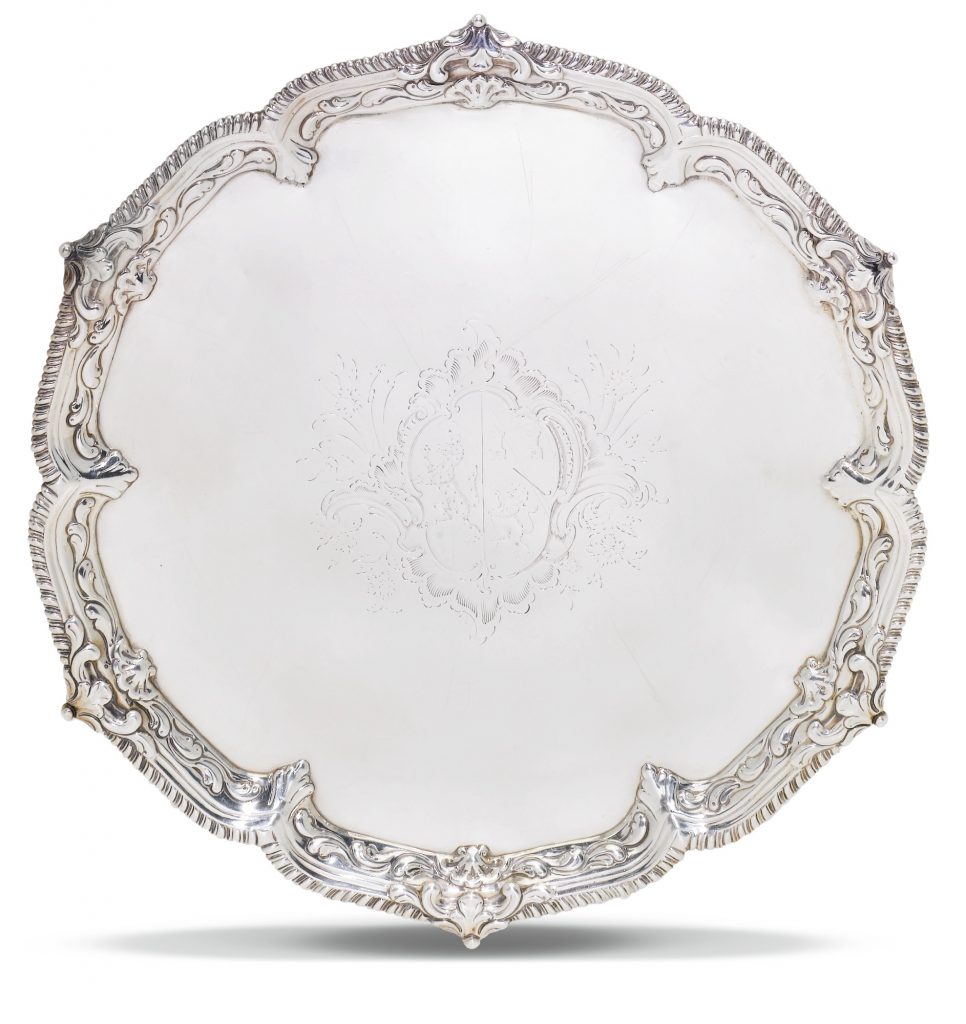
Feb 10 - Silver Salver
Silver Salver (Ebenezer Coker, London, 1766).

One item featured in the advertisement that I find intriguing is the mahogany desk.  Desks of the Colonial period were sometimes ornate, featuring far more details and far more lavish woods than what is utilized in today’s desks.  To a large extent, furniture helped to designate a family or individual’s social class.  Wealthier families would have the most ornate woods and intricately-carved pieces in their homes, while middling individuals would have pieces that were far more basic.

Other items also caught my attention: the “porringers” and “salver.”  A porringer was a special type of bowl that featured one or two decorated handles and were often made out of silver or pewter.  They were often used for serving soup or porridge. (Check out this modern recipe for perfect porridge from BBC Good Food magazine.) Once again, the more ornate the dishes were, the more wealth that a family had. Silver was a sign of elite status, while pewter was a sign of the middling and lower sorts.  A salver, on the other hand, was an eighteenth-century tray.  These also could be made of silver or pewter, with the same connotations for their worth. Check out this silver salver crafted by Ebenezer Coker of London.

**********

ADDITIONAL COMMENTARY:  Carl Robert Keyes

One of the reasons I founded the Adverts 250 Project was to use advertisements to open up the daily lives of colonists. I anticipated that some advertisements would be featured because they were simply mundane, what colonists expected to see, rather than exceptional or extraordinary in some way.

Kathryn has chosen an advertisement and offered commentary that illuminates the daily lives of colonists in several ways, some of them demonstrating a continuity with our modern lives and others demonstrating how much has changed. I confess that I never thought of this kind of “Public Vendue” notice as an eighteenth-century “garage sale” advertisement, but Kathryn makes a valid comparison that I will incorporate into my own classroom explanations in the future.

I also appreciate the way she worked through some of the language in the advertisement. Porringers? Salvers? Those would have been housewares encountered by many early Americans on a daily basis. The words they used to describe them would have been part of their everyday lexicon. Yet the words sound strange to most of us today. The uses, to some extent, seem archaic. Who needs a porringer to serve soup or porridge when there’s a bowl in the cupboard?!

The household goods this gentleman sought to sell included one more item much less common today. His “Case containing 12 Knives and Forks, [and] 12 Spoons” also included a spoon “for Marrow.” That’s not a standard piece of many silverware sets sold today, reflecting a change in dining habits since the colonial era.

February 9

GUEST CURATOR:  Kathryn J. Severance

What was advertised in a colonial newspaper 250 years ago this week?

Feb 8 - 2:7:1766 New-London Gazette
New-London Gazette (February 7, 1766)

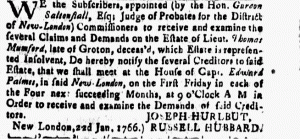
“We the subscribers, appointed … Commissioners to receive and examine the several Claims and Demands on the Estate of Lieut. Thomas Mumford, late of Groton, deceased.”

This advertisement is of a different nature than many others featured within the Adverts 250 Project. This is due to the fact that it is not advertising goods or services. Instead, this advertisement is a probate notice, a type of memorandum about managing the estate of the deceased. In this particular case, the deceased individual was Thomas Mumford. Joseph Hurlbut and Russell Hubbard were appointed by a judge as executors of his estate.

From this example, we can conclude that probate notices were constructed very differently than advertisements for goods and services were. The text within the notice seems as if it is printed in small type, unlike many of the advertisements for goods that I came across in my time examining Colonial newspaper advertisements for this project. This may be because the text is lengthier and formed in complete sentences, rather than in list format, as some of the advertisements for goods were.

**********

ADDITIONAL COMMENTARY:  Carl Robert Keyes

This advertisement reminds us of one of the many different purposes that colonists turned to the public prints to publish notices of various sorts. As I explained when I inaugurated the Adverts 250 Project, I am primarily interested in advertisements for goods and services, their methods of marketing wares to potential customers, and their role in the consumer revolution of the eighteenth century. This eliminates a fair number of advertisements from consideration for inclusion here. However, I have instructed my students that during their time as guest curators they are permitted to choose one of these other kinds of advertisements per week. If it caught their attention and helped them to learn more about early American society and print culture, then it was fair game.

Kathryn makes some important observations about this probate notice. Even though it includes some italics and capitals (exclusively for people and place names), it does not vary the font size or experiment with white space at all. It appears very dense, even more dense than many of the advertisements for goods and services. As Kathryn points out, advertisements listing assorted goods also included a lot of text, but often the format provided more variation. Probate notices, on the other hand, followed a rather standard formula (both for the wording of the text and its format). The responsibility for drawing readers to advertisements promoting goods and services fell on the advertisers. On the other hand, the “Commissioners” appointed “to receive and examine the several Claims and Demands on [an] Estate” may very well have felt that it was the responsibility of the “several Creditors” to stay informed of any legal notices appearing in the local newspaper. In publishing a probate notice the commissioners had fulfilled their responsibility. They were not required to devise flashy advertisements.