In Which Book Catalogues Encouraged a Revolution in Reading

Last week I examined a bookseller’s newspaper advertisement that could have doubled as a broadside book catalogue. This week I would like to continue an exploration of eighteenth-century book catalogues, focusing primarily on the evolution of this method of advertising among Philadelphia’s booksellers. The earliest catalogues were broadsides that could be posted in a public place or folded and sent through the post. Later catalogues became pamphlets and were often bound at the front or back of a book, inserted in magazines, or available free of charge as stand-alone items at booksellers’ shops. Printers and booksellers sometimes concluded their newspaper advertisements by noting that customers could get a more complete sense of their stock if they visited their shop to peruse the catalogue.

The first book catalogues were typically undifferentiated lists of goods, but booksellers steadily made innovations in format to make their catalogues a distinctive medium. In 1754, David Hall issued Philadelphia’s first broadside catalogue.[1] It included 425 short author entries in two columns, the items grouped by size with octavos and duodecimos far outnumbering folios and quartos. This method privileged some of the most expensive books by listing them first, and it also allowed potential customers to visualize the physical appearance of a book. Those who valued books as a symbol of consumption could choose a folio edition of Swan’s British Architecture and Designs that would definitely draw attention when placed on a desk or table. Another customer might prefer to continue purchasing octavo-sized volumes that would have an orderly appearance on the bookshelf. Within each size category, the books were listed in continuous paragraphs. In contrast, William Bradford distributed a broadside catalogue five years later that featured only one title per line in each of its three columns. Bradford’s style of organizing his advertisement may have made for easier skimming or reading but at the expense of limiting the number of titles he could list – only half as many as featured on Hall’s catalogue.[2] Running competing bookshops in a city of less than 30,000 inhabitants, Hall and Bradford most likely examined each other’s catalogues. The two booksellers apparently believed that potential customers preferred the format of their catalogue to that of their competition as both booksellers continued publishing their catalogues in their original format for quite some time. Fifteen years after his first catalogue appeared, Hall issued a broadsheet catalogue that closely resembled his initial catalogue: two columns with the books categorized by size and set in continuous paragraphs. That same year, William and Thomas Bradford distributed a broadsheet catalogue that listed one title per line, this time divided into four columns rather than three.[3] These early catalogues sought to attract customers solely by providing a list of books in stock, a strategy repeatedly employed in the years before the Revolution. Until the 1770s, most booksellers’ catalogues followed Hall’s or Bradford’s method for listing their stock. New innovations began to appear in the last decades of the century as booksellers increasingly targeted specialized reading audiences.

As inventories increased and booksellers experimented with different styles and formats, their catalogues became more elaborate. Generally, the earliest booksellers’ catalogues were broadsides or broadsheets listing a couple of hundred authors or titles. Although some booksellers continued to issues broadsides even into the 1790s, most switched to octavo- and duodecimo-sized volumes featuring one thousand or more books listed on dozens of pages. One extraordinary volume, a 215-page duodecimo catalogue that contained nearly 2,700 titles described by Clarence Brigham as “the most extensive and elaborate catalogue published in the eighteenth century,” was issued by H. Caritat of New York in 1799.[4] Such catalogues sometimes gave the impression that a bookseller’s stock had great depth, but often he only carried one or two copies of most of the volumes listed.

In the final three decades of the eighteenth century, book catalogues became more innovative, partially as the result of attempts to appeal to readers with special interests. Broadsides and broadsheets became slender volumes consisting of dozens of pages, and printers, booksellers, and publishers began to market particular products to specific readers. Rather than grouping books according to size, booksellers began to categorize them by topic so potential customers could more easily find books that might be of interest. Alternately, some began to alphabetize the titles to assist readers looking for a particular book. Some catalogues even alphabetized titles within topics or provided excerpts or puffs that were intended to hook the reader and create desire for a book that he or she might not have previously considered purchasing. Mathew Carey emphasized that these innovations probably led to better sales. In a letter to his colleague Timothy Brundige, he offered the following advice: “If you were to take the trouble to draw out your lists in alphab. Order classing each Kind of Books together, such as law, medical, historical, religion &c it would be very complete & be much more serviceable than in the present confused mode.”[5]

Carey spoke from experience. He had inserted his “Catalogue of Books” in his own magazine, the American Museum, during its final years of publication, if not sooner. Carey’s catalogues offered a more systematic and sophisticated method of advertising than many earlier booksellers’ catalogues and newspaper notices, and his method of distribution allowed him to court customers who had already expressed an interest in the historical, political, and belle lettres essays that appeared in his magazine. Starting at twelve pages and eventually expanding to twenty-four, Carey’s catalogues further subdivided his merchandise into categories such as Law; Medical, Surgical, and Chemical Books; Religious Books; History, Voyages, and Travels; Poetry and Drama; and Books of Navigation.[6] His approach increased the chances that readers who discovered various advertisements stuffed in the magazine might take notice of the catalogue and helped potential customers to quickly find items matching their own interests. Carey de-emphasized his stationery wares and other items more than most other booksellers. His first catalogues inserted in the American Museum included short lists of printed blanks and stationery items, but mentioned no other goods. Carey eventually discontinued listing anything except books as his business endeavors became increasingly specialized.

By the end of the century, booksellers became increasingly specialized in their use of several advertising media, developing advertisements meant to target potential customers with particular interests, whether they were professionals, like doctors and lawyers, members of polite society interested in belles lettres, or merchants and sea captains. For instance, in the 1790s George Davis posted at least three broadside catalogues that featured law books exclusively.[7] Although others might find some volumes of interest, Davis directly addressed “Gentlemen of the Bar and their Students.” Curiously, broadside catalogues did not achieve the level of sophistication evident in contemporary octavo-sized multi-page catalogues by the end of the century. Rather than list his books by topic, Davis continued to divide them according to size. Other booksellers, such as Rice and Company, loosely grouped books together by topic but did not include any headings to aid potential customers in finding books or pamphlets they might find most interesting.[8]

The evolution of book catalogues in early America offers a glimpse of the intersection of the reading revolution and consumer revolution that simultaneously occurred in the eighteenth century. Advertisers sought to hasten the transformation of reading habits from intensive consideration of bibles and devotional works to extensive reading of a different kinds of books, including reading novels for pleasure. Book catalogues from the period demonstrate how booksellers, printers, and publishers classified their stock as well as suggest how their potential customers – readers – imagined and assessed their wares in new ways.

**********

[1] David Hall, Imported in the Last Ships from London, and To Be Sold by David Hall, at the New-Printing Office, In Market-Street, Philadelphia, the Following Books (Philadelphia: B. Franklin and D. Hall, 1754).

[2] William Bradford, A Catalogue of Books. Just Imported from London, and To Be Sold by W. Bradford, at the London-Coffee-House, Philadelphia, Wholseale and Retail. With Good Allowance for Those That Take a Quantity (Philadelphia: William Bradford, 1759).

[3] William and Thomas Bradford, Imported in the Last Vessels from London, and To Be Sold by William and Thomas Bradford, Printers, Booksellers, and Stationers, At Their Book-Store in Market-Street, Adjoining the London Coffee-House; Or By Thomas Bradford, At His House in Second-Street, One Door from Arch-Street, and Nearly Opposite the Sign of St. George, A Large and Neat Assortment of Books and Stationary (Philadelphia: [William and Thomas Bradford,] 1769); and David Hall, David Hall, At the New Printing-Office, in Market-Street, Philadelphia, Has to Dispose Of, Wholesale and Retail, the Following Books, &c. (Philadelphia: D. Hall and W. Sellers, 1769).

[4] Clarence S. Brigham, “American Booksellers’ Catalogues, 1734-1800,” in Essays Honoring Lawrence C. Wroth, ed. Frederick R. Goff (Portland, ME: Anthoensen Press, 1951), 62.

[5] Mathew Carey to T. Brundige, 20 March 1795, Mathew Carey Letterbook, Lea & Febiger Collection, Historical Society of Pennsylvania.

[6] Mathew Carey, Mathew Carey’s Catalogue of Books, for August, 1792 (Philadelphia: [Mathew Carey,] 1792), inserted in American Museum, July 1792, Library Company of Philadelphia; ibid., Mathew Carey’s Catalogue of Books, for September, 1792 (Philadelphia: [Mathew Carey,] 1792), inserted in American Museum, August 1792, Library Company of Philadelphia; ibid., Mathew Carey, No. 118 Market-Street, Philadelphia, Has Imported from London, Dublin, and Glasgow, an Extensive Assortment of Books [October 1792] (Philadelphia: [Mathew Carey,] 1792), inserted in American Museum, September 1792, Library Company of Philadelphia; ibid., Mathew Carey, No. 118 Market-Street, Philadelphia, Has Imported from London, Dublin, and Glasgow, an Extensive Assortment of Books [November 1792] (Philadelphia: [Mathew Carey,] 1792), inserted in American Museum, October 1792, Library Company of Philadelphia; and ibid., Mathew Carey, No. 118 Market-Street, Philadelphia, Has Imported from London, Dublin, and Glasgow, an Extensive Assortment of Books [January 1793] (Philadelphia: [Mathew Carey,] 1792), inserted in American Museum, December 1792, Michael Zinman Collection, Library Company of Philadelphia.

[7] George Davis, Law Books (Philadelphia: 1792); ibid., Law Books — Latest Editions (Philadelphia: 1794); and ibid., Law Books — Latest Irish Editions (Philadelphia: 1795). Also see his four-page catalogue devoted solely to law books: Davis’s Law Catalogue, for 1799. Latest London and Irish Editions (Philadelphia: Zachariah Poulson, Jr., 1799).

[8] Rice and Company, Rice and Co. Booksellers and Stationers, South Side of Market-Street, Next Door But One to Second-Street, Philadelphia; Have Imported in the Last Vessels from London, Dublin, and Glasgow, a Large and General Assortment of Books, and Stationary Ware, Which They Will Dispose Of By Wholesale and Retail on Very Moderate Terms (Philadelphia: 1789).

April 14

GUEST CURATOR:  Kathryn J. Severance

What was advertised in a colonial newspaper 250 years ago today?

Apr 14 - 4:14:1766 New-York Gazette
New-York Gazette (April 14, 1766).

This advertisement is not for goods or services, but instead a runaway advertisement. William Darlington hoped that someone would find his twenty-six-year-old “Irish Servant Man, Named CONNOR O“ROURK”. He went on to describe the servant’s physical features, which brings up the fact that missing person advertisements from the eighteenth century could not actually feature a photo of the missing person. You can probably understand the limitations that this posed. Today’s society is often very visual, but in the eighteenth century it was common for advertisements to not have any visuals to accompany them.

The Irish man in the advertisement was an indentured servant, whose labor was owned by the man who put out the advertisement. The concept of indentured servitude is that an individual or an individual’s family member agrees, through the signing of a contract, to give a person’s labor (and personal freedoms) over to a “master” for a certain period of time, in which the servant was to provide service, which would help pay off a debt. During the seventeenth century, the Virginia Company was responsible for founding indentured servitude as a means of payment for transportation of those who could not afford to pay for their own way to North America. Colonial indentured servitude and the slave trade were both forms of labor in which individuals could not choose to stop working for their master. This means that they were also not allowed to leave their master’s location, meaning that many indentured servants and slaves who went missing had attempted to escape the limitations of their conditions by running away.

For a lesson designed to introduce middle school students to indentured servitude and slavery, check out this link from Teaching American History in South Carolina.

**********

ADDITIONAL COMMENTARY:  Carl Robert Keyes

Indentured servants are part of my world. Not literally, of course, but to me they are a familiar part of the American colonial experience and the past that has unfolded into the present. I sometimes forget just how foreign the past can be to others who do not spend as much time in the eighteenth century as I do. The differences between then and now manifest themselves in so many different ways, from something as mundane as the long S in eighteenth-century texts (which I no longer notice, but the guest curators brought to my attention earlier this week as a challenge they encountered in just reading advertisements and other parts of the newspaper for this project) to entire systems of economic and social organization that structured everyday life and interaction in the colonies.

Systems of unfree labor – slavery, indentured servitude, apprenticeships – fall into that latter category. They offer potent evidence of change over time. We live and work in a much different world today than our eighteenth-century ancestors. Our memories of that world have faded unevenly. From our readings (from the excellent Slavery and Public History) and discussions about slavery in our Public History course throughout the semester, we have reached the conclusion that most Americans are aware that slavery existed at some point in the American past, but, for the most part, they do not know much about slavery and its impact on slaves and slaveholders or the major political, social, and economic contours of American history.

Anecdotally (based on both everyday conversations and nearly a decade of teaching), it seems that the average person on the street knows even less about other forms of unfree labor, including indentured servitude. (Even the program I am using to compose this passage does not recognize “unfree” as a real word. Scholars of early America use it regularly, once again demonstrating that we sometimes live in a very different world.) As other scholars have noted, all too often people imagine a stark divide between European settlers and enslaved Africans in colonial America, not realizing that many of the “lower sorts” among European colonists were exploited for their labor and (temporarily) belonged to masters. We may not know all of the details of Connor O’Rourk’s story – why he became an indentured servant and why he chose to run away from his master – but, as Kathryn notes, both slaves and indentured servants sought freedom by running away. Many students are surprised to learn that indentured servants existed at all. Their presence certainly complicates the story of the colonial experience.

April 13

GUEST CURATOR:  Kathryn J. Severance

What was advertised in a colonial newspaper 250 years ago this week?

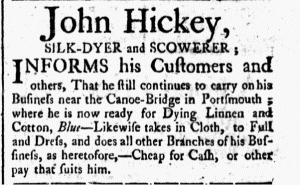
Apr 13 - 4:11:1766 New-Hampshire Gazette
New-Hampshire Gazette (April 11, 1766).

“John Hickey, SILK-DYER and SCOWERER … continues to carry on his Business.”

In this advertisement John Hickey advertised his silk-dying business to the public. It seems that his shop has been set up for some time “near the Canoe-Bridge in Portsmouth.” This advertisement focuses on the color blue as one of the silk-dyer’s colors that he could dye. As I mentioned in February when I guest curated, the use of indigo allowed for textiles to be dyed blue.

For a period of time, fabrics used to make clothing and other items were imported from Europe. In 1750 however, Americans moved toward becoming more independent and self-sufficient by starting to produce their own fabric on a larger scale. Silk-dying in colonial America was part of the vast textile field that existed at the time. Unlike wool fabric, which was made of thread spun from the wool of sheep, silk was a fabric that had to be imported. For this reason, it was more of a luxury textile. Silk was produced much differently from wool, as it was spun by silk worms. In the eighteenth century, silk was imported mostly from China, where the silk worms are naturally found, but it was also imported from the English, who had ventured into the silk-production trade during the thirteenth century. England’s climate was not as ideal as China’s for the worms and, as a result, they often produced less. For information about how silk was produced, read this article from the Mansfield Historical Society.

**********

ADDITIONAL COMMENTARY:  Carl Robert Keyes

Kathryn has chosen an advertisement that offers glimpses of the production and use of different sorts of textiles in colonial America. In listing his occupation as “SILK-DYER and SCOWERER,” John Hickey announced to potential customers that he was capable of working with fabrics made of both silk and wool. As Kathryn indicates, silk was most often imported, though colonists experimented with cultivating silkworms from the earliest days of settlement. Over time, as Americans gained political independence, they also increased their efforts to achieve commercial and economic independence through producing silk in the late eighteenth century.

Hickey did not work exclusively with silk. In his advertisement he underscored that as a “SCOWERER” he “takes in Cloth, to Full and Dress, and does all other Branches of his Business.” In so doing, he emphasized his extensive expertise and experience. Rather than scowerer, Hickey might have listed his occupation as fuller, tucker, or walker. All of these referenced the fulling business, the part of the process of making woolen cloth that involved cleansing the cloth to eliminate oils and dirt. As a result of fulling, woolen cloth also became thicker. Fullers often operated mills that used water wheels, which helps to explain why Hickey “carr[ied] on his Business near the Canoe-Bridge.”

By stating that “does all other Branches of his Business,” Hickey assured potential customers of his skill and competence in working with both silk and woolen fabrics.

April 12

GUEST CURATOR:  Kathryn J. Severance

What was advertised in a colonial newspaper 250 years ago this week?

Apr 12 - 4:11:1766 New-Hampshire Gazette
New-Hampshire Gazette (April 11, 1766).

“TO BE SOLD … the following BOOKS.”

This advertisement sold different types of books, from Bibles (“royal Families Bibles”) to history books and geography (“Histories of the late War” and “History of Austria”), a science book (“Winkler’s natural Philosophy”), and sets of books about warfare (“Sieges and Battles”) to novels. (Skome also sold Stoughton’s Elixir, a patent medicine.)

The advertisement also mentions “Stackhouse’s Life of Christ, Folio.” In today’s world, “folio” refers to the page numbers that appear in books. However, in the eighteenth century, a folio was a type of book that was larger than average and also more expensive, made of a piece of paper that had been folded just once, resulting in two pages. Other book sizes included quartos, octavos, and duodecimals. Quartos are slightly smaller than folios due to the fact that the paper that was used to form them was folded four times instead of two. Octavos are even smaller, as the paper used to form them has been folded eight times. Duodecimals are even smaller than octavos since they have twelve pages per sheet. One famous example of a work that was distributed as a folio was a 1623 edition of Shakespeare’s works.

For more information on the history of books, check out this syllabus for an online course on “The Book: 1450 to the Present.”

**********

ADDITIONAL COMMENTARY: Carl Robert Keyes

The eighteenth century was an age of revolutions. This blog explores the consumer revolution every day, one advertisement at a time. In many instances, the guest curators and I have linked the appeals made in those advertisements to the political revolution brewing in England’s American colonies. Today’s advertisement, however, called attention to another revolution that occurred throughout the eighteenth century.

Note that Skome’s lists several kinds of reading material, starting with bibles and other devotional works and concluding with “A Number of curious and entertaining NOVELS.” A number of histories, geographies, and other reference works appeared in the middle of the list. In choosing to list his titles in this order, Skome created a hierarchy that reflected many colonists’ attitudes toward the reading materials available to them, including a suspicion and hostility toward novels.

So, what does this have to do with some kind of revolution? A revolution in reading took place during the eighteenth century. Colonists’ reading habits shifted from intensive reading of a small number of printed works – primarily bibles and other texts about religion – to extensive reading of a great number of genres, including histories, travelogues, economics, poetry and other literature, and novels. The consumer revolution and the reading revolution converged as colonists purchased and read a greater variety of books than bibles and almanacs.

This greater variety included “curious and entertaining NOVELS.” Some colonists were not happy with that development, even as they cultivated an appreciation for other printed works. Most books possessed at least some redeeming content, but critics believed that the fictional tales of romance and scandal in novels promoted salacious behavior in real life. Such critiques had a gendered component as well: in a patriarchal society, many men worried about what kinds of ideas women and girls might develop when left to their own devices to read possibly unsavory novels without appropriate supervision.

April 11

GUEST CURATOR:  Kathryn J. Severance

What was advertised in a colonial newspaper 250 years ago today?

Apr 11 - 4:11:1766 New-Hampshire Gazette
New-Hampshire Gazette (April 11, 1766).

“Jam. & Mat. Haslet, Leather Dressers from Boston.”

This advertisement showcases the opening of a leatherwork “Factory” in Portsmouth that would sell leather products (wholesale to shop owners or retail to consumers) by James and Mathew Haslet, who were “Leather Dressers.” In colonial America, a leather dresser was a tradesman who spent the workday obtaining and then tanning various animal hides (this advertisement mentions deer and moose). These hides would be used to craft various items, including gloves and breeches, as the advertisement mentions. Other items that were crafted from leather mainly consisted of shoes, saddlebags, and belts. It should be noted that shoes were actually put together by tradesmen known as cobblers.

Many tradesmen who were leather dressers actually left England and migrated to the thirteen colonies to provide leather goods and leather dressing services to the inhabitants of the colonies. Unlike in colonial days, in today’s society, products made to imitate leather are actually more commonly found in American homes than are authentic leather products. Of course, imitation leather was not available to the inhabitants of the thirteen colonies, which meant that the toiling process and expertise associated with leather dressing made tradesmen with these skills a necessary part of society.

For more information on leather workers, especially in colonial Virginia, check out this research report from the Colonial Williamsburg Digital Library.

**********

ADDITIONAL COMMENTARY:  Carl Robert Keyes

The Haslets mentioned gloves twice in their advertisement: “Buckskin and Sheepskin Gloves” and “The neatest Mode Gloves for Funerals.” In so doing, they suggest that the former were intended for everyday use but the latter were reserved for the rituals of mourning the dead.

What may not be apparent to modern readers was that “Gloves for Funerals” were intended for the living, not for the deceased. Although the practice declined after the Revolution, in colonial New England families distributed gloves to mourners who attended the funerals of their loved ones. For families from more humble backgrounds this usually meant giving away a handful (pun intended!) of gloves, but wealthier families sometimes distributed hundreds of pairs of gloves. This ritual occurred only occasionally at the beginning of the eighteenth century, but it became a common and expected part of funerals by the 1760s. Elite families distributed funeral gloves to acknowledge their relationships with each other, but also to demonstrate their commitment to the communities of which they were part.

Distributing funeral gloves became a status symbol by the end of the colonial period. It also became a competition and a form of conspicuous consumption that sometimes garnered criticism as an inappropriate expression of luxury. After the Revolution, large-scale glove-giving declined as elites and others forged new relationships as new rhetoric of egalitarianism emerged. Today, the practice of giving away funeral gloves to mourners is little more than a distant memory of our colonial past, not a standard part of our funeral rituals.

For a more extensive examination of funeral gloves, I recommend: Steven C. Bullock and Sheila McIntyre, “The Handsome Tokens of a Funeral: Glove-Giving and the Large Funeral in Eighteenth-Century New England,” William and Mary Quarterly, 3rd ser., 69, no. 2 (April 2012): 305-346.

April 10

GUEST CURATOR:  Kathryn J. Severance

What was advertised in a colonial newspaper 250 years ago today?

Apr 10 - 4:10:1766 Massachusetts Gazette
Massachusetts Gazette (April 10, 1766)

“Public Vendue. This Day, the 10th April, Will be Sold … A Great Variety of ENGLISH GOODS.”

This advertisement is obviously much shorter than many of those that were featured last week, but it should not be overlooked because its mention of selling goods that were imported to Boston from England is worth exploring. Settlers from England first occupied American soil in the sixteenth century, though it was not until the seventeenth century that the first successful English colonies were established in the parts of America that are known today as the Chesapeake (in 1607) and New England (in 1620).

During the colonial period, goods were sent by ship to ports in Boston, Philadelphia, Charleston, or New York from England. America’s dependence on imports from England and throughout the British Empire helped bolster England’s trade-based mercantilist economy. Tea was one example of an imported item commonly sold in colonial America. In response to the 1765 Stamp Act colonists threatened to stop importing items from England.

Check out this video to learn more about the economic developments of the thirteen colonies and overseas trade. (You will have to register for a free trial to watch the entire video.)

**********

ADDITIONAL COMMENTARY:  Carl Robert Keyes

Kathryn has selected an advertisement that allows us to explore colonial commerce along multiple trajectories. The reference to “ENGLISH GOODS” prompts modern readers less familiar with mercantilism and trading patterns throughout the early modern Atlantic world and beyond to gain better familiarity with the networks of commerce and exchange that crisscrossed the Atlantic and the globe, as well as the policies to regulate such trade enacted by the English government. In and of itself, this is an important topic for students just learning about colonial America to explore.

For others with more familiarity with the contours of trade and commerce in early America, this advertisement offers an interesting glimpse of the intersections of print culture, marketing goods, and “Public Vendue” sales. This advertisement seems especially timely given that I discussed eighteenth-century book catalogues just two days ago. (That post featured John Mein’s advertisement that filled almost an entire page in the April 3, 1766, issue of the Massachusetts Gazette. It appeared again in the April 10 issue, from which Kathryn selected today’s advertisement.)

Note that today’s advertisement promises that “Printed Catalogues will be timely dispersed by J. Russell, Auctioneer.” Rather than publish a list of goods up for sale in a newspaper advertisement, Russell turned to another printed medium. I wonder about the means of “dispers[ing]” these catalogues. I am also curious about how consumers would have read and used them. Like many other advertisements, this one raises as many questions about print culture and consumption as it answers.

Occasionally I see references to these sorts of catalogues, but not enough to make me believe they were standard practice for vendue sales in colonial America. Since they were ephemeral items not many seem to have survived. (Once the semester ends and I have more time to spend in the archive, I plan to do a more systematic search for such items. Here’s another interesting example of how this collaborative project with my students has helped to shape my research agenda.)

I think it is also worth noting that the “Public Vendue” was scheduled to take place “at the Store under Green & Russell’s Printing Office.” John Green and Joseph Russell were the printers of the Massachusetts Gazette. This advertisement also indicates that “J. Russell” served as “Auctioneer.” I suspect that printers who also ran vendues were more likely than other auctioneers to create and disperse “Printed Catalogues” to promote their sales. I have devoted an entire chapter of my book manuscript to arguing that printers were the vanguard of advertising innovation in eighteenth-century America. Here we see one more example.

Interview with Guest Curator Maia Campbell

Maia Campbell has completed her second and final week as guest curator for the Adverts 250 Project.  As we say farewell to her, let’s take a few moments to find out more about her  behind-the-scenes contributions to this project.

Adverts 250: This was your second week as guest curator. How did it compare to the first time? Did you make any changes to your research or writing process based on what you learned the first time?

Maia Campbell: My second week as guest curator has proved more challenging than the first time. I had a harder time finding advertisements that I thought would be interesting to audiences, as well as ones that I would be able to make intelligent remarks about. I spent much time looking through the Early American Newspapers database, often changing my mind about advertisements that I did not think I could execute well. This time around I also did more research for the project. The advertisements I chose for the colonial period went beyond any knowledge that I had, and thus I turned to other websites. To give an example, for Monday’s advertisement for the sale of Indian corn, I initially thought this indicated that Native Americans still maintained a relationship with the English colonists. However, with the guidance of Professor Keyes, I learned through research that Indian corn was the type of corn. I was still able to make a connection to Native Americans by referring to a trade of ideas tracing back to the early days of the colonies.

Adverts 250: What is the most important or most interesting thing that you learned about early American history throughout the process of working on this project?

Maia Campbell: I learned much about early American values through working on the Adverts 250 Project. I learned about colonial America’s position in the world regarding industry, as the colonists were still largely farmers. At the same time, they valued their freedoms as well. The advertisement for Wednesday demonstrates how the colonists valued their freedom of the press and ability to discuss their current political conditions. In a world that was changing around them industrially, the American colonies were beginning to move forward in political ideology.

Adverts 250: What is the most important thing you learned about “doing history” as a result of working on this project?

Maia Campbell: This time around, the most important thing I learned about “doing history” is that there needs to be solid research backing everything in public history. I say this because as I was writing about the advertisements I selected this time, I had to do more research than I had planned. I must admit that I tried to do my commentaries for the advertisements all at once, and I was not the most thorough. However, when doing my revisions I engaged in more research than I had previously. Although I have some knowledge of colonial America, I think it best to have research to back up my observations rather than just my memory. Truly research is a more reliable source, and it is what helps to give context and background to the advertisements.

Adverts 250: What is your favorite advertisement from your two weeks as guest curator? Why?

Maia Campbell: I think my favorite advertisement over all was the clay candlestick advertisement from Tuesday of this week. I found the concept of clay candles so fascinating, and yet I could not find any visual evidence of it. Therefore, I concluded that the advertisement was referring to the candlestick holders. However, what I liked about this advertisement most was the community conversation it sparked, first as a comment underneath Tuesday’s post, then on the Facebook page of the Royall House and Slave Quarters. The people engaged in the dialogue all made educated and interesting responses, and it was interesting to have had a role in starting it.

**********

Thank you, Maia.  You’ve made some wonderful and thought-provoking contributions to the Adverts 250 Project during your time as guest curator.  Maia just learned that she has been accepted to participate in SOPHIA (Sophomore Initiative at Assumption), a program designed to help students explore and discern their vocations.  The development of our class, Vocations in Public History, was made possible by a grant from SOPHIA.

April 9

GUEST CURATOR:  Maia Campbell

What was advertised in a colonial newspaper 250 years ago this week?

Apr 9 - 4:7:1766 New-York Mercury
New-York Mercury (April 7, 1766).

“WILLIAM ADAMS, TUTOR to the Academy at COLDINGHAM, INFORMS the Gentlemen of the City, who have their sons there, that they are well.”

In 1766, an age of a growing importance on education, especially for men, was beginning to dawn in the American colonies. In the past throughout the Western world, tutoring services were offered mainly to nobility. During colonial times, this was also mostly the case, though different colonies had different experiences. In general, children of the “lower sorts” could not afford to get an education, and they also lacked opportunity (especially outside the New England colonies).

This tutor, William Adams, did not specify the social class of the boys he desired to tutor. The fact that this advertisement was published in a newspaper indicates progress in the right direction. Yet though Adams’ advertisement moves in the direction of educational opportunity for many, the academy he was advertising was a boarding school. Though the advertisement indicated that “any one having a mind to enter their sons” had a chance to speak with the tutor, the real opportunity remained for those with sufficient money for the boarding costs.

**********

ADDITIONAL COMMENTARY:  Carl Robert Keyes

Maia has identified some of the recurrent themes that appeared in advertisements for educational opportunities in the decade prior to the Revolution. Instructors advertising their classes frequently placed notices in newspapers. Both the men and women who ran boarding schools and Latin academies and the tutors and instructors who offered special subjects, such as foreign languages, dancing, or fencing, emphasized that they conducted their lessons in an atmosphere of morality and politeness and promoted their services by suggesting that refined individuals possessed the skills that they offered to teach. In so doing, they presented potential students and their parents with a strategy for asserting their own social status by acquiring skills and pursuing activities associated with metropolitan elites.

These advertisements preserved an aura of hierarchy in educational pursuits by associating them with elite gentility, but they opened up learning opportunities to prospective students who did not necessarily come from elite backgrounds. They sold – or attempted to sell – gentility to a broad reading public. Thus, they highlighted a tension between popularizing goods and services in order to sell them and the continued association of codes of gentility with elite social standing.

As Maia noted, we can see this tension in today’s advertisement. Adams posted this notice for two purposes. First, he let the “Gentlemen of the City, who have their Sons there” at the academy know that his charges were doing well and would be visiting the New York soon. In addition, he used this notice to recruit additional students. He addressed “Any one having a mind to enter their Sons,” suggesting that this was an opportunity open to all readers. In an era of significant social mobility, some middling readers may have seized such an opportunity to further enhance their status and their family’s prospects for the future. The tutor, for his part, appeared content to enroll middling as well as elite youths.

April 8

GUEST CURATOR:  Maia Campbell

What was advertised in a colonial newspaper 250 years ago this week?

Apr 8 - 4:7:1766 Newport Mercury
Newport Mercury (April 7, 1766).

“A FARM in Bristol, containing about 140 Acres of good Land.”

I find interesting the way in which the American colonies and European countries sometimes diverged economically in the eighteenth century. In my Western Civilization course, we have discussed the beginnings of the Industrial Revolution. In Great Britain, where the revolution started, James Hargreaves invented the spinning jenny in 1764, revolutionizing the speed at which cotton could be spun. In that same decade Richard Arkwright introduced his water frame, which harnessed waterpower, resulting in water-powered factories that could produce mass amounts of textiles. People began to flock to the cities and abandon their farmlands. As farming became more technological and less profitable, jobs in the cities, especially in factories, opened up.

However, in America, such was not the case – yet. Farms and farmland were still highly valuable in the British colonies. Even when the Industrial Revolution reached America, the government would still encourage people to go west and start their own farms. The advertised farm has everything that a farmer could need to produce for the market and provide for his family.

**********

ADDITIONAL COMMENTARY:  Carl Robert Keyes

Urban areas in America increasingly grew during the eighteenth century. Existing cities – Boston, New York, Philadelphia, and Charleston – expanded, while others – such as Baltimore – emerged as population centers and hubs of commerce in their own right. Still, as Maia explains, the Industrial Revolution did not arrive in North America as quickly as it did in Europe. Factories that employed new technologies discussed popped up in New England by the end of the century, but they were not part of the colonial landscape in the 1760s.

That does not mean that rural areas remained untouched. Note the many ways in which this advertisement demonstrates that colonists shaped the land on which they lived and worked. In addition to the town of Bristol, an “East Road” cut through the landscape. The farm for sale included a “House, Barn, and Cribb, &c.” These buildings certainly modified the landscape. The property had been “Fenced with about 1200 Rods of Stone Wall,” a significant change to the landscape. How much of the land devoted to “Meadow, Pasture, and Tillage” existed in such a state before colonists arrived? How much of it had been cleared by colonists?

Sometimes we assume that major changes to the environment occurred only in recent times, only after the United States fully engaged in the Industrial Revolution. This real estate advertisement, however, lists a variety of ways in which colonists reshaped the landscape to suit their own needs. Those who lived in rural areas did not reside in an undisturbed natural world. Instead, they engaged in a process of simultaneously adapting to the land and adapting the land as they desired.

In Which a Newspaper Advertisement Could Have Been a Broadside Book Catalogue

The guest curators from my Public History class often do not choose to feature the advertisements that I want them to select! This is simultaneously one of the most rewarding, most exciting, and most frustrating aspects of collaborating with these junior colleagues. They have prompted me to take a second look at advertisements that I otherwise would have dismissed. They have forced me to think about certain advertisements in new ways, to develop new modes of analysis instead of relying on earlier classifications that ranked some advertisements as more viable for this project than others. In the best sense of faculty/student collaboration, we are learning from each other and we are collectively learning more about the colonial period.

Still, I sometimes find it extremely frustrating when a guest curator skips over a really cool advertisement that I want to feature and explore in greater depth. (In all fairness, during those periods that guest curators are not working on the project I often find myself in the position of skipping over some awesome advertisements – or looking ahead to see which ones were published more than one week so I know I’ll have a second chance to incorporate a second choice in the near future.) I encountered one of those advertisements this week as I was browsing through the April 3, 1766, issue of the Massachusetts Gazette to see the context in which one of the featured advertisements was originally published.

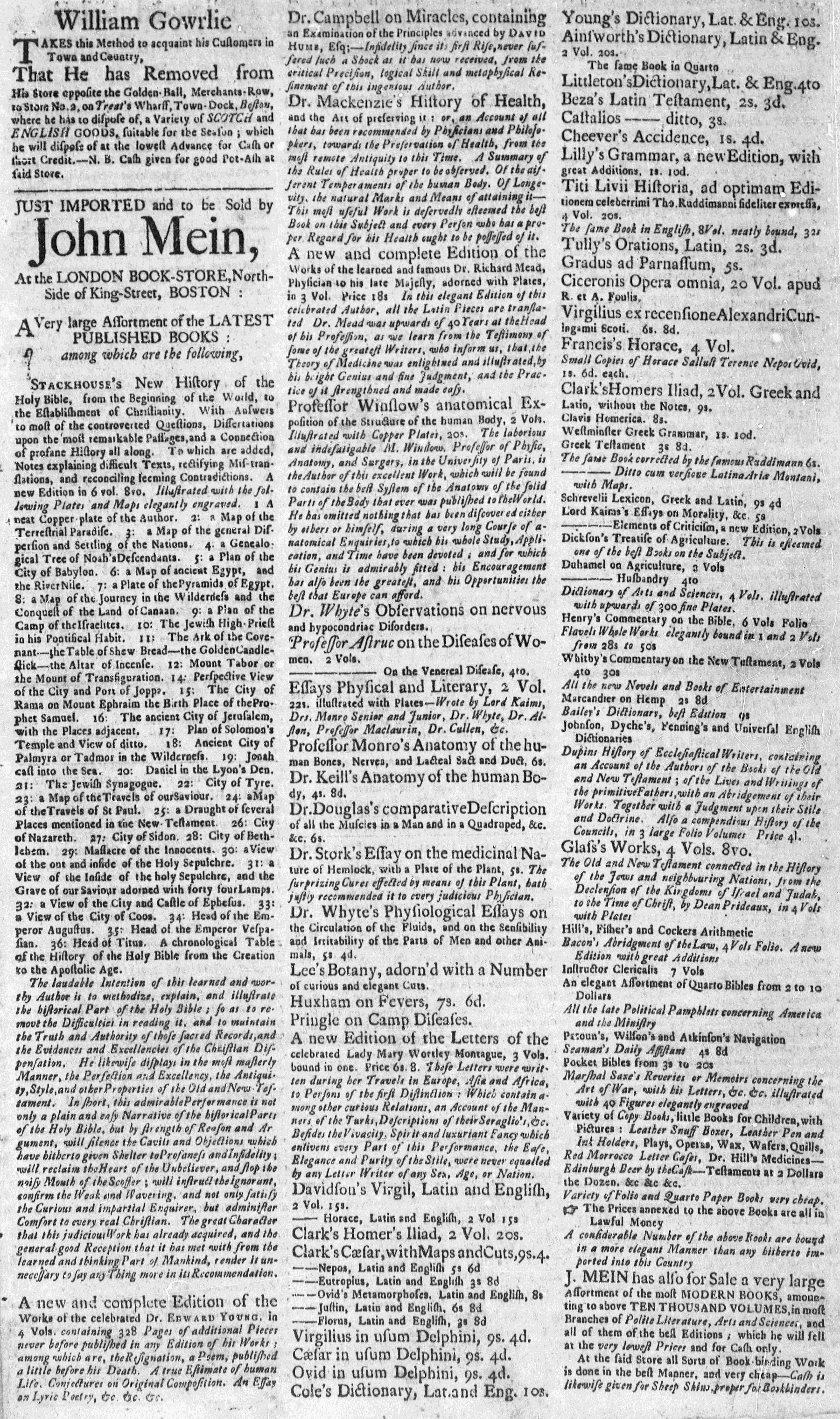
Apr 8 - John Mein Advertisement 4:3:1766 Massachusetts Gazette
Massachusetts Gazette (April 3, 1766).

Look at this wonderful advertisement from bookseller John Mein! Except for a small notice in the upper left corner, Mein’s advertisement covered the entire page of this issue. What an investment for him to make! This was not the first time in 1766 that an entire page of the Massachusetts Gazette was devoted to listing Mein’s stock. I couldn’t just let it pass by once again.

This item intrigues me in part because it challenges the concept of genre when it comes to eighteenth-century advertising and print culture. Technically, it is indeed a newspaper advertisement, but it is a very particular sort of newspaper advertisement that replicates a book catalogue, specifically a broadside book catalogue. Similar items circulated separately as standalone book catalogues in the eighteenth-century. This raises an interesting question: what are the parameters for determining what qualifies as a book catalogue? If this newspaper advertisement is an alternate form of a book catalogue, then does any advertisement that includes a list of books also count as a book catalogue? Are there a minimum number of books that must be listed? Or a minimum amount of space that the advertisement must cover on the page?

Perhaps it is worth spending a few moments exploring eighteenth-century book catalogues, one of those advertising media – along with trade cards, billheads, furniture labels, and other printed items – that supplemented newspaper advertising. Among their other innovations and marketing strategies, printers and booksellers introduced the consuming public to catalogue shopping as a way to try to attract customers. Participants in the book trade on both sides of the Atlantic frequently compiled a list of titles available for sale and distributed them to potential customers in a catalogue. Philadelphia printer, publisher, and bookseller Mathew Carey certainly believed in the benefits of distributing catalogues to attract potential customers of all backgrounds. Writing to bookseller N. Magruder in March of 1796, Carey expressed his regret that “sales have so considerably diminished” in his colleague’s town, but he also offered encouragement that “the distribution of the Catelogues will give a new spring to the business.”[1] Similarly, a year earlier he informed James Arthur that “if you draw me out a list of your books, I shall have some catalogues printed for you to distribute throughout the country, which will probably increase your sales considerably.”[2] Carey apparently trusted that the catalogues would indeed drum up new business for Arthur, in turn generating additional orders from and profits for his supplier in Philadelphia. Carey seemed so sure of the eventual benefits of using the catalogues to market Arthur’s stock that he promised to print and send the catalogues at “no charge” if only his associate would follow his instructions in regards to drawing up a list.

Robert B. Winans has identified 286 extant American book catalogues that circulated in the colonies and the young republic during the eighteenth century, as well as an additional four hundred unlocated catalogues identified by earlier bibliographers.[3] Winans groups these catalogues into several categories, including bookseller’s catalogues, social library catalogues, and college library catalogues. The catalogues from three of his categories are of immediate relevance to the marketing of books in early America: booksellers’ catalogues (140 titles), auction catalogues (22 titles) and publishers’ catalogues (6 titles).

Excluding catalogues published by libraries and colleges, the catalogues intended to market books and other printed materials to the general public amount to just over half of the book catalogues printed in eighteenth-century America. Of these, nearly half were distributed during the final decade of the century, and only eleven predate the 1750s. After mid-century the number of catalogues published each decade steadily increased, with a slight decline only during the 1770s, most likely as the result of the war. Not surprisingly, booksellers in Philadelphia, Boston, and New York distributed the vast majority of these catalogues. Catalogues from Philadelphia accounted for more than the other two cities combined. The catalogues issued in smaller towns tended to come from social and circulating libraries, but sometimes booksellers in places like Petersburgh, Virginia, used catalogues to inform the public of their wares.

Next week I would like to examine the evolution of American book catalogues during the eighteenth century. For now, if you were unaware that book catalogues even existed in early America I hope that John Mein’s newspaper advertisement – in its similarities to broadside book catalogues – opens up a method of advertising that you had not previously considered. Catalogue shopping became extremely popular in the late nineteenth century. Innovative as it was at that time, especially when linked with delivery via the postal service, catalogues themselves date back to a much earlier period.

**********

[1] Mathew Carey to N. Magruder, 13 March 1796, Mathew Carey Letterbook, Lea & Febiger Collection, Historical Society of Pennsylvania.

[2] Mathew Carey to James Arthur, 14 January 1795, Mathew Carey Letterbook, Lea & Febiger Collection, Historical Society of Pennsylvania.

[3] Robert D. Winans, A Descriptive Checklist of Book Catalogues Separately Printed in America, 1693-1800 (Worcester, MA: American Antiquarian Society, 1981).