
What was advertised in a colonial newspaper 250 years ago today?

“JUST Imported from London, by Jolley Allen.”
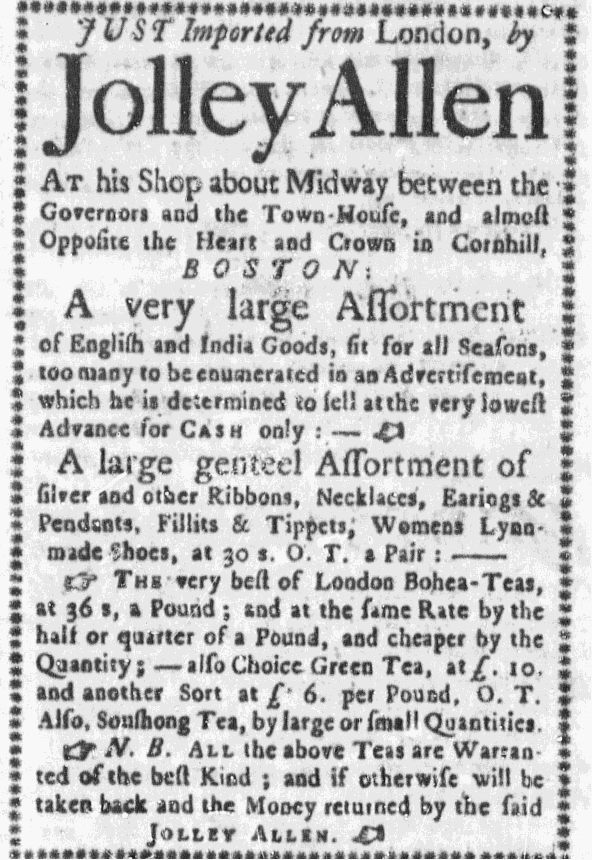
Shopkeeper Jolley Allen almost certainly played a role in designing this advertisement. As I have noted previously, the available evidence suggests that advertisers tended to write their own copy and printers tended to make decisions about layout and fonts when they set the type. Printers often adopted formats that were consistent from advertisement to advertisement, giving all commercial notices that appeared in a given newspaper similar visual qualities and making them easy to recognize at a glance.
Allen’s advertisement had a distinctive border that set it apart from other advertisements in the Boston Post-Boy. It seemed unlikely that the printer went through the additional effort of setting ornamental type of his own volition. What was more probable, I hypothesized, was that Allen made special arrangements with the printer (and perhaps paid more) to arrange for this special feature.

Allen’s advertisement in other newspapers published in Boston on the same day suggested that was indeed the case. His advertisement in the Boston Evening-Post also had a decorative border, though it was composed of different ornaments. Otherwise, the advertisement had the same copy and nearly identical layout. Another version of the advertisement appeared in the Boston-Gazette. While the copy was the same, the border consisted of yet another style of printing ornaments and the format had two columns within the advertisement. Finally, Allen’s advertisement had previously appeared in Boston’s other newspaper (the only one not distributed on Mondays), the Massachusetts Gazette. Except for yet another method of creating the decorative border, it was nearly identical to the advertisements in the Boston Post-Boy and the Boston Evening-Post. The copy was the same and the format nearly identical.
Jolley Allen placed his advertisement in four newspapers. In each instance, it had a decorative border that would have drawn attention to it, especially since such borders were not a standard part of other advertisements in any of those publications. Allen almost certainly designed that portion of his advertisement, even if he left it to the individual printers to make decisions about setting the rest of the type. Realizing that advertisements often tended to look the same, Allen devised a graphic design innovation intended to set his own apart from the crowd.

[…] to mark this advertisement as different, but a small number of other advertisers (such as Jolley Allen) also used borders to set their advertisements apart from their […]
[…] in the 1760s had such borders (though we have previously seen that Jolley Allen made sure that his advertisements in Boston’s newspapers were easily identified by their borders). In addition, Thompson and Arnold’s advertisement was much longer than most that appeared in the […]
[…] In addition, his advertisements consistently featured distinctive graphic design elements, namely a decorative border, intended to draw more eyes than competitors’ advertisements that appeared elsewhere on the page. […]
[…] to the Boston Evening-Post. (The November 6, 1766, issue of the Massachusetts Gazette also included Jolley Allen’s advertisement with its distinctive border created with printing […]
[…] on the same day. Allen devised a brand, of sorts, for his advertising. Each notice featured a border composed of printing ornaments, making his advertisements immediately recognizable, especially for regular readers of Boston’s […]
[…] typographical elements of most eighteenth-century advertisements. There were occasional exceptions. Jolley Allen and William Palfrey, for instance, both negotiated for specific design aspects of their […]
[…] surprise. No, that would have resulted from the design of the advertisement. It did not feature a border comprised of printing ornaments, a distinctive aspect of Allen’s advertising that had practically become his trademark in all of […]
[…] Allen made arrangements with printers to have them enclosed in decorative borders. This was a consistent feature from one newspaper to another, a relatively rare example of an advertiser exerting influence over typographical decisions in the […]
[…] borders surrounding entire advertisements were exceptionally rare. Jolley Allen experimented with rudimentary borders for his advertisements in Boston’s newspapers the previous year, but they looked primitive […]
[…] the Boston Evening-Post, the Boston-Gazette, the Boston Post-Boy, and the Massachusetts Gazette – all featured a decorative border. Readers familiar with his advertising in one publication would have readily identified his […]
[…] designers. Yet on relatively rare occasions some advertisements retained specific visual elements, such as a decorative border, across multiple publications, indicating that an advertiser did indeed have a hand in determining […]
[…] from others that appeared in Boston’s newspapers in the late 1760s. Sometimes he arranged to have borders composed of printing ornaments surround his advertisements. Other times he dominated the page with lengthy list-style […]
[…] of graphic design elements in Allen’s advertisements across multiple newspapers, whether borders enclosing his lists of goods or ornamental type flanking his name in the headline, demonstrate that Allen negotiated with […]
[…] division was not a hard and fast rule. On occasion, similarities in graphic design in multiple newspapers suggested that advertisers provided instructions or negotiated for particular design elements, but […]
[…] that did not incorporate borders or other decorative type. In July 1766, Jolley Allen placed the same advertisement in four newspapers published in Boston. They had identical copy but different formats. Borders enclosed all of […]
[…] was not the first advertiser in Boston to incorporate a border into a newspaper advertisement. As early as 1766, Jolley Allen made borders around his entire notices a signature element of his marketing. […]
[…] some advertisers made special requests or gave instructions, as seems to have been the case with Jolley Allen and the decorative borders that regularly enclosed his advertisements that ran simultaneously in multiple newspapers in […]