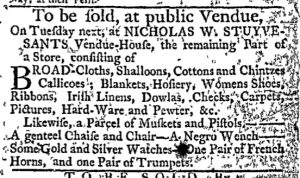
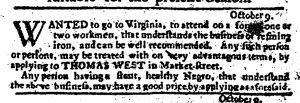
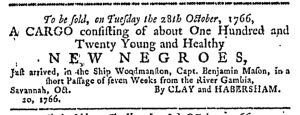
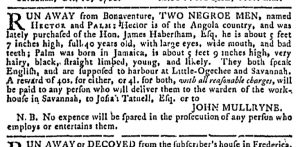
The Slavery Adverts 250 Project chronicles the role of newspaper advertising in perpetuating slavery in the era of the American Revolution. The project seeks to reveal the ubiquity of slavery in eighteenth-century life from New England to Georgia by republishing advertisements about enslaved people – for sale as individuals or in groups, wanted to purchase or for hire for short periods, runaways who liberated themselves, and those who were subsequently captured and confined in jails and workhouses – in daily digests on this site as well as in real time via the @SlaveAdverts250 Twitter feed, utilizing twenty-first-century media to stand in for the print media of the eighteenth century.
The project aims to provide modern audiences with a sense of just how often colonizers encountered these advertisements in their daily lives. Enslaved men, women, and children appeared in print somewhere in the colonies almost every single day. Those advertisements served as a constant backdrop for social, cultural, economic, and political life in colonial and revolutionary America. Colonizers who did not purport to own enslaved people were still confronted with slavery as well as invited to maintain the system by purchasing enslaved men, women, and children or assisting in the capture of so-called “runaways” who sought to free themselves from bondage. The frequency of these newspaper advertisements suggests just how embedded slavery was in colonial and revolutionary American culture in everyday interactions beyond the printed page.
These advertisements also testify to the experiences of enslaved men, women, and children, though readers must consider that those experiences have been remediated through descriptions offered by enslavers rather than enslaved people themselves. Often unnamed in the advertisements, enslaved men, women, and children were not invisible or unimportant in early America.
These advertisements appeared in colonial American newspapers 250 years ago today.
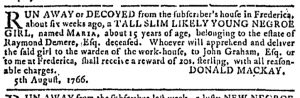
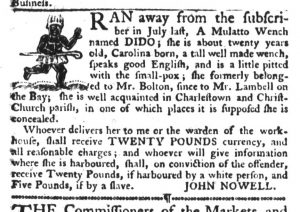
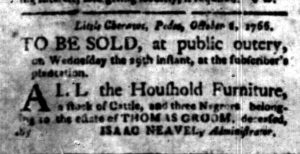
New-York Journal (October 23, 1766).
**********
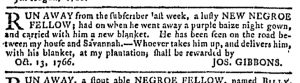
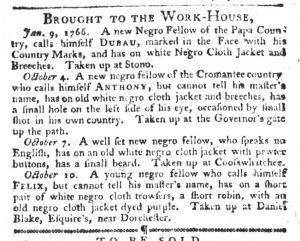
New-York Journal (October 23, 1766).
**********
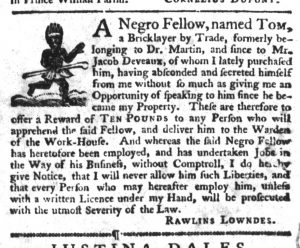
New-York Journal (October 23, 1766).
**********
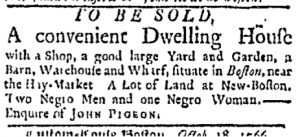
New-York Journal (October 23, 1766).
**********
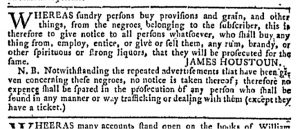
Supplement to the New-York Journal (October 23, 1766).
**********
Supplement to the New-York Journal (October 23, 1766).
**********
Supplement to the New-York Journal (October 23, 1766).
I have always loved learning about colonial America. As silly as it may sound, Plimoth Plantation is one of my favorite places, because it allows the visitor to experience what it felt like to be a colonist. Through this project I got a similar experience; it was very interesting reading though colonial newspapers and putting myself in a colonist’s shoes. I believe there is a misconception that the colonists’ lives were insular and their goods were obtained primarily from trade within the local community. However, from the Adverts 250 Project, it was plain to see that although they did not live in the type of global society on the same scale we live in today, colonists lives were interconnected with faraway places in many ways.
One big difference between people of the twenty-first century and the colonial era is that they lived more simply, with less excess, very much in contrast to the way most people live today. Many colonial newspaper advertisements were very specific to consumers’ needs. Consumers purchased items based on the information in the advertisements. The colonists were sometimes limited in access to products and offers. The insight into commercial behavior that the Adverts 250 Project provided is something that has changed the way I look at colonial America.
Consumerism was never something I really thought of as being part of the culture in colonial America. The large size of the colonial consumer market was very surprising. This intrigued me and made me want to find out about the products, the target consumer, and the methods the sellers used to motivate colonists to buy their products. I always thought of consumer psychology as something much more recent than the colonial era. However, as I was reading the primary sources and the advertisements, I found them to have a psychological component involved in enticing people to want to come to their stores or buy what they were selling over the competition. Using consumer psychology to determine ways to persuade customers to purchase products relies – and relied — on fundamentally understanding human nature, not on learned behavior, which was something that became very evident to me through this project.
When I first started doing this project I thought that the hardest part was going to be writing the analysis for the advertisements. I was worried that I would not have enough to say, or my point would get lost and I would not be able to find primary sources to back it up. However, this was one of the easiest parts. With the help of Professor Keyes, I was able to reflect on colonial consumerism in a logical and cohesive way that was reinforced by primary sources. I really enjoyed looking at the different sources that led me to draw my conclusions. It was a very interesting learning experience because there are not a lot of classes where for seven days you get to learn about something unique that really interests you. I really loved the sense of freedom and independence that I got from doing this project. It allowed me to grow immensely as a student. The hardest part was definitely tweeting for the project. It was hard to condense something that I had become very passionate about into just 140 characters. I like detail, and being succinct proved to be very difficult for me.
This project has made an impact on me. It has forced me to go outside of my comfort zone and has allowed me to research and learn in a new way. I learned much, not only from participating in the project, but also from reading other contributors’ entries. I will continue to be an active reader of the Adverts 250 Project.
Who was the subject of an advertisement in a colonial American newspaper 250 years ago today?
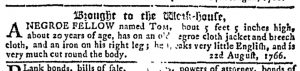
Georgia Gazette (October 22, 1766).
“Who is as good a cooper as any of his colour in this province.”
The word “cooper” was new to me. After doing some research I learned that it means someone who makes casks or barrels. David Waldstreicher talks about how important it was to owners that slaves had a trade because it allowed them to be more useful than just another farmhand.[1] Being a good cooper would have been a very useful skill; it would have made this ‘HEALTHY YOUNG NEGROE MAN” more valuable, to both the seller and the new owner.
In many other advertisements goods tended to be sold by the cask or barrel. For slave owners who wanted to sell things they were producing by the barrel having a slave who was able to produce the barrels would have been desirable. It would have been a way to save money, because they would not have to pay a third party. All the owner would have to do was buy the supplies and then have the slave make the casks. Waldstreicher talks about how different slaves had different value to their owners and “A HEALTHY YOUNG NEGROE MAN” who had a trade would be a slave that would have been considered profitable.
**********
ADDITIONAL COMMENTARY: Carl Robert Keyes
This advertisement, which ran for several weeks, has already been featured on the Slavery Adverts 250 Project. That project, however, limits the description and analysis of each advertisement to a single tweet. At the end of the semester, the curators will write an essay about slavery in colonial America that draws from the work they have done for the Slavery Adverts 250 Project and other course material. That means that the bulk of the analysis has been delayed. It might also have the unintended consequence of guest curators for the Adverts 250 Project choosing to examine other sorts of advertisements and not including advertisements for slaves in the rotation of commercial notices they select for research and analysis. I’ve made a commitment to including advertisements that treated slaves as commodities from the very start of this project. In selecting today’s advertisement, Lindsay has further augmented that aspect of the Adverts 250 Project.
Every time that I have encountered this advertisement I have been struck by the backhanded compliment about the enslaved young man’s skill as an artisan: “as good a cooper as any of his colour in this province.” The seller worked toward two very different purposes, creating an astounding dissonance within the advertisement. To gain the best price and make the slave as attractive as possible, the seller underscored his skill as a cooper. As Lindsay notes, this would have added value for a variety of reasons. As with other advertisements for enslaved tradesmen, it also demonstrates that slaves contributed expertise and experience to the colonial economy, in addition to labor.
Yet the seller also found it necessary to qualify the remark about the skills the enslaved cooper possessed. He was not as good as any cooper in the colony but rather as good “as any of his colour.” This diminished his skill by implying that white coopers were categorically better at their trade. No matter how skilled this “HEALTHY YOUNG NEGROE MAN” may have been, the seller perpetuated a hierarchy in which the enslaved cooper was still inferior to white artisans.
**********
[1] David Waldstreicher, “Reading the Runaways: Self-Fashioning, Print Culture, and Confidence in Slavery in the Eighteenth-Century Mid-Atlantic,” William and Mary Quarterly 56, no. 2 (April 1999): 244.
These tables indicate how many advertisements for slaves appeared in colonial American newspapers during the week of October 9-15, 1766. Data for both tables was compiled by Nicholas Commesso.
Note: These tables are as comprehensive as currently digitized sources permit, but they may not be an exhaustive account. They includes all newspapers that have been digitized and made available via Accessible Archives, Colonial Williamsburg’s Digital Library, and Readex’s America’s Historical Newspapers. There are several reasons some newspapers may not have been consulted:
Issues that are no longer extant;
Issues that are extant but have not yet been digitized; and
Newspapers published in a language other than English (including the Wochentliche Philadelphische Staatsbote).
**********
Slavery Advertisements Published October 16-22, 1766: By Date
************
Slavery Advertisements Published October 16-22, 1766: By Region
The Slavery Adverts 250 Project chronicles the role of newspaper advertising in perpetuating slavery in the era of the American Revolution. The project seeks to reveal the ubiquity of slavery in eighteenth-century life from New England to Georgia by republishing advertisements about enslaved people – for sale as individuals or in groups, wanted to purchase or for hire for short periods, runaways who liberated themselves, and those who were subsequently captured and confined in jails and workhouses – in daily digests on this site as well as in real time via the @SlaveAdverts250 Twitter feed, utilizing twenty-first-century media to stand in for the print media of the eighteenth century.
The project aims to provide modern audiences with a sense of just how often colonizers encountered these advertisements in their daily lives. Enslaved men, women, and children appeared in print somewhere in the colonies almost every single day. Those advertisements served as a constant backdrop for social, cultural, economic, and political life in colonial and revolutionary America. Colonizers who did not purport to own enslaved people were still confronted with slavery as well as invited to maintain the system by purchasing enslaved men, women, and children or assisting in the capture of so-called “runaways” who sought to free themselves from bondage. The frequency of these newspaper advertisements suggests just how embedded slavery was in colonial and revolutionary American culture in everyday interactions beyond the printed page.
These advertisements also testify to the experiences of enslaved men, women, and children, though readers must consider that those experiences have been remediated through descriptions offered by enslavers rather than enslaved people themselves. Often unnamed in the advertisements, enslaved men, women, and children were not invisible or unimportant in early America.
These advertisements appeared in colonial American newspapers 250 years ago today.
What was advertised in a colonial American newspaper 250 years ago this week?
South Carolina Gazette (October 20, 1766).
“RUM … superior in quality to what is usually imported.”
This advertisement is interesting because it closely resembles advertisements we would see today, playing on people’s emotions that this rum was better than what they usually drank. I learned about types of persuasion in my Social Psychology class taught by Professor Maria Parmley. I think the type of persuasion the seller used is peripheral route to persuasion. The advertisement called for consumers to make the decision based on emotion, not facts (like how the rum was made or why it was better quality). Potential customers were told that the rum they were used to drinking was lesser quality than this rum “FROM the Island of Grenada.” This type of precaution tactic is commonly seen in advertisements today; when many people see a commercial with a beautiful model using the product they are more likely to buy it because the product then becomes associated with the model’s beauty. It’s interesting that the way of inciting people to buy one product over another has changed very little in 250 years.
John J. McCusker shows the importance of rum in the colonial American economy.[1] Rum, which was made from sugar that was being produced in the Caribbean colonies, was an important part of the import and export trade. Drinking alcohol, like rum, became an essential part of life for many of the colonists, providing an escape from the pressures of everyday life. Social drinking was something that the colonists have in common with people today. Even though we may not always realize it we have more in common with the people who lived in colonial America than we might assume. Through this advertisement you can see two things that the colonists and people of the twenty-first century had in common, the way consumers can be persuaded to buy goods and how both people today and people then care about the quality of the alcohol they drink.
**********
ADDITIONAL COMMENTARY: Carl Robert Keyes
Lindsay’s analysis of the sophisticated tactics Anthony Lamotte used to market his rum made me wonder how it compared to other advertisements for rum in the same issue of the South Carolina Gazette. Two other notices featured rum prominently.
South Carolina Gazette (October 20, 1766).
One brief advertisement announced that William Gibbes(?) had “CHOICE JAMAICA RUM, best MUSCOVADO SUGAR, and COFFEE, to be sold cheap.” This advertisement included two of the most common appeals from eighteenth-century advertising: price (“to be sold cheap”) and quality (“CHOICE”). However, Gibbes did not compare the quality of his Jamaican rum to any other rum, whether from the same island, the Windward Islands, or any other place. (The “3M.” in brackets may have been a printer’s note indicating that the advertisement was to run for three months. Perhaps Gibbes relied on repetition of his advertisement, rather than other means of persuasion, to attract customers.)
South Carolina Gazette (October 20, 1766).
Thomas Shirley advertised a hodgepodge of imported commodities, from flour to iron to Windsor chairs. “A few Puncheons of Jamaica Rum” appeared in the middle of Shirley’s list. Like Gibbes (“to be sold cheap”) and Lamotte (“TO BE SOLD, reasonably”), Shirley made an appeal to price (“to be sold reasonably”), but he made no other effort to distinguish the rum he sold. Some modern readers may be tempted to think that listing Jamaica in italics was intended to highlight the origins of his rum for consumers that considered production in some places superior to others. However, listing place names in italics was common practice throughout eighteenth-century advertisements. In addition, printers – not the advertisers themselves – usually made the decisions about typography.
As Lindsay notes, rum was an extremely popular commodity in colonial America. Amid already high demand, advertisers like Anthony Lamotte worked to direct that demand in their favor. To do so, Lamotte used a marketing strategy that emphasized more than just price and quality. He promised potential customers that his rum was “superior in quality” to others, playing on their emotions in the absence of providing evidence to explain why it was a better product.
**********
[1] John J. McCusker, “The Rum Trade and the Balance of Payments of the Thirteen Continental Colonies, 1650-1775,” Journal of Economic History 30, no. 1 (March 1970): 244-246.
The Slavery Adverts 250 Project chronicles the role of newspaper advertising in perpetuating slavery in the era of the American Revolution. The project seeks to reveal the ubiquity of slavery in eighteenth-century life from New England to Georgia by republishing advertisements about enslaved people – for sale as individuals or in groups, wanted to purchase or for hire for short periods, runaways who liberated themselves, and those who were subsequently captured and confined in jails and workhouses – in daily digests on this site as well as in real time via the @SlaveAdverts250 Twitter feed, utilizing twenty-first-century media to stand in for the print media of the eighteenth century.
The project aims to provide modern audiences with a sense of just how often colonizers encountered these advertisements in their daily lives. Enslaved men, women, and children appeared in print somewhere in the colonies almost every single day. Those advertisements served as a constant backdrop for social, cultural, economic, and political life in colonial and revolutionary America. Colonizers who did not purport to own enslaved people were still confronted with slavery as well as invited to maintain the system by purchasing enslaved men, women, and children or assisting in the capture of so-called “runaways” who sought to free themselves from bondage. The frequency of these newspaper advertisements suggests just how embedded slavery was in colonial and revolutionary American culture in everyday interactions beyond the printed page.
These advertisements also testify to the experiences of enslaved men, women, and children, though readers must consider that those experiences have been remediated through descriptions offered by enslavers rather than enslaved people themselves. Often unnamed in the advertisements, enslaved men, women, and children were not invisible or unimportant in early America.
These advertisements appeared in colonial American newspapers 250 years ago today.
Supplement to the South-Carolina Gazette and Country Journal (October 21, 1766).
**********
South-Carolina Gazette and Country Journal (October 21, 1766).
**********
South-Carolina Gazette and Country Journal (October 21, 1766).
**********
South-Carolina Gazette and Country Journal (October 21, 1766).
**********
South-Carolina Gazette and Country Journal (October 21, 1766).
**********
South-Carolina Gazette and Country Journal (October 21, 1766).
**********
South-Carolina Gazette and Country Journal (October 21, 1766).
**********
South-Carolina Gazette and Country Journal (October 21, 1766).
**********
South-Carolina Gazette and Country Journal (October 21, 1766).
What was advertised in a colonial American newspaper 250 years ago today?
Boston Post-Boy (October 20, 1766).
“CHOICE FRESH RAISINS.”
Why did William Whitwell emphasize “RAISINS” in his advertisement? In Food in Colonial and Federal America, Sandra Oliver describes how colonists ate and cooked with raisins. Raisins were one the most common dried fruits imported in the colonies. However, the raisins that colonists ate were dried with seeds in them so they were much larger than the ones we have today. When cooking with raisins many recipes called for them to be “stoned” or deseeded meaning the colonists had to rehydrate them. Raisins were baked into cakes, eaten with nuts and other fruits, and even soaked in rum and eaten with a spoon.[1] They had diverse uses to the colonists and they lasted for long periods of time. Raisins were not only something that would keep well in storage, they were also a good source of fiber. They also contained antioxidants that might not have been present in other stored foods.
Colonists in Boston understood how harsh and unpredictable New England winters could be. In October they started preparing for the storms to come. Having the opportunity to buy dried fruit in advance of winter was probably very welcome. New England’s erratic weather patterns called for extra precaution and preparedness. This advertisement provided one way to get ready for the oncoming winter.
Even living in the twenty-first century we can sometimes be ill prepared for what a New England winter might entail, waiting until the last minute to take precautions when we hear that a big storm could be coming. We all know what it is like to go to the grocery story before a big storm, sometimes arriving a little too late. We live with many more amenities, like radars that can tell us a storm is coming or another grocery story a few miles down the road. The colonists, however, did not have these luxuries and had to gear up well in advance if they were going to make it to the spring. Living in colonial Massachusetts meant being as prepared as possible and storing food that would keep well into the winter months. The way raisins could be transformed into many other recipes with a few other ingredients, had a great nutritional value, and kept well made them a hot commodity for the colonists.
**********
ADDITIONAL COMMENTARY: Carl Robert Keyes
On the whole, raisins have probably received less scholarly attention than other grocery items listed in eighteenth-century advertisements, especially sugar and spices. Still, historians of food, commerce, and consumer culture have not completely ignored the humble raisin. Lindsay consulted Sandra Louise Oliver’s Food in Colonial and Federal America to uncover several aspects of eating and cooking with raisins that differ quite significantly from modern practices. In the process, she offered a helpful reminder that even commodities that might appear familiar have changed over time. Raisins once came with seeds (until the late nineteenth century when seedless grapes were developed). Sugar once came in loafs. Colonists ate foods that modern Americans would consider simultaneously familiar and foreign.
In Consumerism and the Emergence of the Middle Class in Colonial America, Christina J. Hodge elaborates on raisins and their uses in the eighteenth century. “Raisins were used in cooking as a sweetener and, if soaked in water, to produce homemade vinegar (a useful preservative).” How many modern consumers realize that raisins had such versatile uses 250 years ago? Hodge also reports that raisins grown in Spain were considered superior, but “British trade laws made direct importation to America from Spain illegal.”[2] As a result, most raisins consumed by colonists likely came from grapes that had been locally grown. Advertisers were not the only colonists who promoted raisins in colonial newspapers. According to Hodge, in 1728 the Boston News-Letter ran an article of dietary suggestions for “Families of a Middling Figure, who bare the Character of being Genteel.” It listed raisins (along with currants, cranberries, and apples) as an appropriate supplement to be enjoyed as part of the main meal of the day.[3] It seems that raisins truly merited the oversized headline in William Whitwell’s advertisement.
**********
[1] Sandra L. Oliver, Food in Colonial and Federal America (Westport, CT: Greenwood Press, 2005), 69-70.
[2] Christina J. Hodge, Consumerism and the Emergence of the Middle Class in Colonial America (New York: Cambridge University Press, 2014), 88-89.
The Slavery Adverts 250 Project chronicles the role of newspaper advertising in perpetuating slavery in the era of the American Revolution. The project seeks to reveal the ubiquity of slavery in eighteenth-century life from New England to Georgia by republishing advertisements about enslaved people – for sale as individuals or in groups, wanted to purchase or for hire for short periods, runaways who liberated themselves, and those who were subsequently captured and confined in jails and workhouses – in daily digests on this site as well as in real time via the @SlaveAdverts250 Twitter feed, utilizing twenty-first-century media to stand in for the print media of the eighteenth century.
The project aims to provide modern audiences with a sense of just how often colonizers encountered these advertisements in their daily lives. Enslaved men, women, and children appeared in print somewhere in the colonies almost every single day. Those advertisements served as a constant backdrop for social, cultural, economic, and political life in colonial and revolutionary America. Colonizers who did not purport to own enslaved people were still confronted with slavery as well as invited to maintain the system by purchasing enslaved men, women, and children or assisting in the capture of so-called “runaways” who sought to free themselves from bondage. The frequency of these newspaper advertisements suggests just how embedded slavery was in colonial and revolutionary American culture in everyday interactions beyond the printed page.
These advertisements also testify to the experiences of enslaved men, women, and children, though readers must consider that those experiences have been remediated through descriptions offered by enslavers rather than enslaved people themselves. Often unnamed in the advertisements, enslaved men, women, and children were not invisible or unimportant in early America.
These advertisements appeared in colonial American newspapers 250 years ago today.
What was advertised in a colonial American newspaper 250 years ago this week?
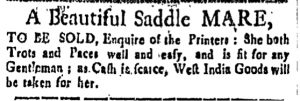
New-Hampshire Gazette (October 17, 1766).
“A Beautiful Saddle MARE”
Owning nice things was a luxury that not every colonist had the opportunity to experience because of their financial situation. This advertisement targeted someone who could afford the extravagance of having a horse that was intended to be an accessory and a marker of status. When the seller described the mare he said,“She Both Trots and Paces well and easy.” This showed that the mare was in good condition, was even tempered, and could be ridden for leisure and pleasure. The mare was probably not meant to be a working house. This seems clear because the seller did not provide her age and weight, whether she had had any colts, or whether she was healthy and fit to work and breed. He described her as “A Beautiful Saddle MARE,” one ready to be shown off.
Conspicuous consumption of this sort suggests a growing sense of individuality among the colonists. As time went on and as their farms and businesses flourished and grew many had the financial stability to purchase goods that they would not have been able to afford had they stayed in Europe. The colonists’ sense of self was starting to shine through more and more as their wealth grew. Many colonists were able to make purchases that reflected their desires rather than just obtaining necessities.
**********
ADDITIONAL COMMENTARY: Carl Robert Keyes
Newspapers advertisements provide revealing glimpses of how the colonial marketplace operated, but sometimes they fall frustratingly short of revealing all the details that would allow us to make sense of the transactions they promoted. Lindsay has selected an advertisement that tells only a portion of a longer story.
An unknown seller sought a buyer for “A Beautiful Saddle MARE,” noting that she was “fit for any Gentleman.” In this case, referring to the purchaser as a “Gentleman” most likely was not a courtesy but rather an indication that the owner of such a horse would be an individual of some stature in the community, somebody with the resources to maintain the mare as a status symbol.
The same was presumably true of the current owner of the “Beautiful Saddle MARE,” yet the advertisement does not reveal the seller’s identity. Instead, it merely stated “Enquire of the Printers.” Who was the seller? Why was the horse offered for sale? Why did the seller conceal his identity?
A dozen different stories and scenarios spring to mind, each of them pure conjecture because the advertisement offers so few clues. In that regard, this advertisement seems ideal for working on a project with students. It demonstrates the historians must work within the limits of the documents available to us. We can work imaginatively but responsibly with our sources. We can make inferences from the language and context, as Lindsay has done in positing that this was not a workhorse intended for labor on a farm. Doing so allowed her to imagine what else could be learned from this advertisement, even if it was not stated explicitly. In the process, she reconstructed the social meanings of colonists’ possessions, extrapolating from the advertisement.
In that regard, Lindsay demonstrates that this advertisement tells us more about colonial society than might have initially seemed apparent. However, some aspects of the advertisement remain out of reach. I was drawn to this advertisement because it indicated that since “Cash is scarce, West India Goods will be taken for her.” What did the seller intend to do with a quantity of “West India Goods” exchanged for “A Beautiful Saddle MARE” that was “fit for any Gentleman?” Would those goods have been put to personal use or would they have been traded or sold to other consumers? That is a story of the colonial marketplace that will remain untold.