October 18

GUEST CURATOR: Lindsay Hajjar

What was advertised in a colonial American newspaper 250 years ago today?
oct-18-10181766-providence-gazette
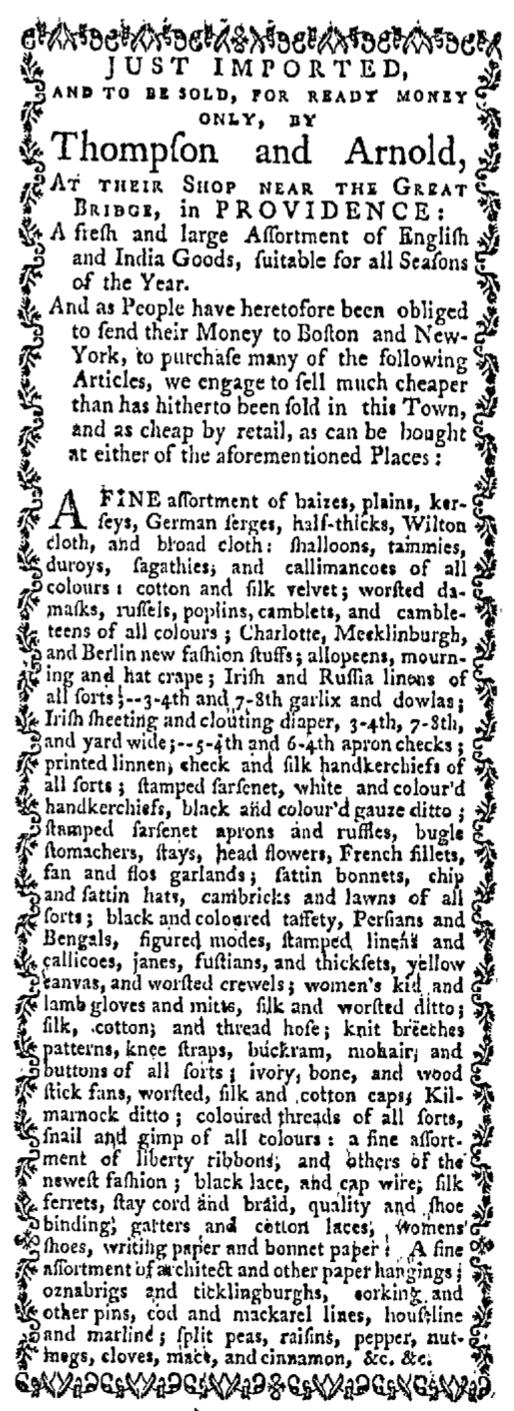
Providence Gazette (October 18, 1766).

“As people have heretofore been obliged to send their Money to Boston and New-York …”

This advertisement gave a long list of much of the merchandise sold by Thompson and Arnold at their shop in Providence. The shopkeepers were looking for customers who were in a financial position that they did not need to barter or buy on credit; their imported goods were “TO BE SOLD, FOR READY MONEY ONLY.” They stated that previously the residents of Providence would have had to travel to Boston and New York to acquire many of the goods in the advertisement, but now they could come to their shop and buy them in town and for a fair price, one that was cheaper than found in Boston or New York.

They tried to entice consumers in Providence with their abundance of goods that they sold and with two other advertising techniques that are very familiar today. First, they emphasized the fact that potential customers did not have to travel far to get them. They also promised low prices. Today consumers often expect prices to be more expensive in urban place. The same was true for the colonists; being able to get these goods close to home for a reasonable price was enticing.

As a second strategy, they compared their prices to other stores in Providence with the same goods. Today, consumers love comparing pricing and trying to get the best deals. Thompson and Arnold knew that this would be an effective tactic because it would draw people in and they could end up buying more than they originally intended.

American consumers have a long history of expecting to find what they need when they need it. T.H Breen confirms this: “after the 1740s American shoppers came to expect a much larger selection, and merchants had to maintain ever larger inventories.”[1] In colonial America consumers sometimes needed to make the compromise of either getting what they wanted close to home but at an escalated price or traveling and getting a better price. Thompson and Arnold made it possible for the consumers in Providence to get both convenience and low prices.

**********

ADDITIONAL COMMENTARY: Carl Robert Keyes

For my commentary on today’s advertisement, I must once again address the project’s methodology as well as my pedagogical goals. Once again one of the guest curators has selected an advertisement that should look very familiar to regular readers. At a glance, it appears that Lindsay has selected the same advertisement that guest curator Nicholas Commesso analyzed a few weeks ago. The same shopkeepers previously published the same list of goods with the same introductory remarks (the same copy from start to finish) and the same decorative border in the same publication. On closer inspection, I uncovered only one difference between the two advertisements: a colon substituted for a period at the end of the sentence immediately before the advertisement listed the goods available at Thompson and Arnold’s shop. (I have no ready explanation for why the printer would have made this change.) Technically, that single change qualifies this as a new advertisement.

That hardly seems like a satisfactory explanation or rationale for repeating an advertisement, deviating from the usual methodology and commitment to examining a new advertisement every day. Other factors played a more significant role in my decision. First of all, Thompson and Arnold published a very robust advertisement that made multiple implicit and explicit appeals to potential customers. Nick examined some of them when he selected this advertisement, but Lindsay picked up on others. Both students learned about aspects of colonial commerce and marketing; both contributed, in different ways, to the ongoing conversation at the Adverts 250 Project. One short entry about Thompson and Arnold’s advertisement was not sufficient to do it justice. In addition, featuring this advertisement a second time also underscores the frequency that some entrepreneurs resorted to advertising. Some shopkeepers ran an advertisement just once or for just a few weeks, but others, like Thompson and Arnold, ran their advertisements so many times that readers would have recognized them on sight. Repetition likely helped to cement Thompson and Arnold’s shop in the popular imagination around Providence.

The rhythm of newspaper publishing in colonial America also influenced my decision to allow Lindsay to feature this advertisement a second time. Nineteen newspapers (that have survived and have been digitized) were published during the week that Lindsay is serving as guest curator. Monday was the most popular day for publishing newspapers, with nine of the nineteen published on Monday. Saturday was one of the least popular days. The Providence Gazette was the only newspaper regularly published on Saturdays in 1766. That means that once a week the featured advertisement for the Adverts 250 Project should come from the Providence Gazette, the only newspaper published on that day 250 years ago. No newspapers were published on Sundays. The methodology for the project requires going back to the most recently published newspaper, which means that the featured advertisement should be drawn from the Providence Gazette twice a week. This places disproportionate emphasis on the Providence Gazette, a problem compounded by the fact that it included less advertising than some other newspapers (but more than others). Other newspapers, especially those printed in Philadelphia, New York, Boston, and Charleston, could better bear that burden, but between the relative scarcity of advertisements and the tendency to run them for weeks or months, the Adverts 250 Project has pretty much exhausted the advertisements for consumer goods and services printed in the Providence Gazette in the fall of 1766. I could have insisted that Lindsay go back one day earlier to select an advertisement from the New-London Gazette (which usually had even fewer advertisements), the New-Hampshire Gazette (which also had relatively few advertisements), or the Virginia Gazette (which typically ran many advertisements that have not yet been featured here). Future guest curators will have to do so, but I determined that even though today’s advertisement repeated an earlier one (except for that colon that replaced a period!) Thompson and Arnold still had something to tell us about colonial marketing and life in early America more generally.

**********

[1] T.H. Breen, “An Empire of Goods: The Anglicization of Colonial America, 1690-1776,” Journal of British Studies 25, no. 4 (October 1986): 489.

Slavery Advertisements Published October 18, 1766

GUEST CURATOR:  Nicholas Commesso

The Slavery Adverts 250 Project chronicles the role of newspaper advertising in perpetuating slavery in the era of the American Revolution. The project seeks to reveal the ubiquity of slavery in eighteenth-century life from New England to Georgia by republishing advertisements about enslaved people – for sale as individuals or in groups, wanted to purchase or for hire for short periods, runaways who liberated themselves, and those who were subsequently captured and confined in jails and workhouses – in daily digests on this site as well as in real time via the @SlaveAdverts250 Twitter feed, utilizing twenty-first-century media to stand in for the print media of the eighteenth century.

The project aims to provide modern audiences with a sense of just how often colonizers encountered these advertisements in their daily lives. Enslaved men, women, and children appeared in print somewhere in the colonies almost every single day. Those advertisements served as a constant backdrop for social, cultural, economic, and political life in colonial and revolutionary America. Colonizers who did not purport to own enslaved people were still confronted with slavery as well as invited to maintain the system by purchasing enslaved men, women, and children or assisting in the capture of so-called “runaways” who sought to free themselves from bondage. The frequency of these newspaper advertisements suggests just how embedded slavery was in colonial and revolutionary American culture in everyday interactions beyond the printed page.

These advertisements also testify to the experiences of enslaved men, women, and children, though readers must consider that those experiences have been remediated through descriptions offered by enslavers rather than enslaved people themselves. Often unnamed in the advertisements, enslaved men, women, and children were not invisible or unimportant in early America.

These advertisements appeared in colonial American newspapers 250 years ago today.

oct-18-providence-gazette-slavery-1
Providence Gazette (October 18, 1766).

October 17

GUEST CURATOR: Lindsay Hajjar

Who was the subject of an advertisement in a colonial American newspaper 250 years ago today?

oct-17-10171766-new-london-gazette
New-London Gazette (October 17, 1766).

“ALSO, An able body’d hearty Wench 16 Years old (with a sucking Child.”

This advertisement started with the sale of a twenty-nine-year old slave, described as “strong and healthy.” The seller then indicated where he was born and that he has skills in farming. Next, he stated he was selling a “Wench” who was sixteen years old. By calling her a wench he degraded her status as a woman even further. In this case, a female slave was held at even lower regard than a male slave, perhaps because of the fact that when she had a child it took away from her ability to do work. The girl being sold was “able-bodied” and could “do all Sorts of House Work,” but was being sold because of “her breeding.” The words “breeding” and “wench” show the seller’s opinion about women, especially enslaved women, as well as an assumption that because she was a women and a slave she should be good at housework because that was what she was born to do.

In “Work, Pregnancy, and Infant Mortality among Southern Slaves,” John Campbell talks about how in the South slave owners placed value not on the gender of slaves but rather their age and physical condition. Campbell also points out that both male and female slaves were “harvesting equal proportions of cotton,” showing that in the South it did not matter to the slave owners the gender of the slave as long as they were capable of doing the work.[1] However, this advertisement was printed in the northern colony of Connecticut during an earlier period; the seller’s tone was different. It changed, becoming more aggressive and angry when going from depicting the man to the girl being sold. It is as if the seller was annoyed that she had a child that was now going to be a burden on him and he had to sell them because the child would be a distraction to her. He was not willing to make the long-term investment in the child, showing that Northern slave owners in the colonial period were not as ambivalent about their slaves’ genders as Southern slave owners were in the nineteenth century. In his advertisement the seller said the young woman came “with a sucking child.” He seemed upset with the fact that she had a child and that the child was nothing but an inconvenience, because the child was still breastfeeding. Female slaves could be looked at as beneficial because they had the ability to produce more slaves for their owners but that could also be a shortcoming because when they were pregnant and while the child was dependent mothers were not able to work to the same capacity.

**********

ADDITIONAL COMMENTARY: Carl Robert Keyes

I appreciate how Lindsay compares the sentiments expressed in today’s advertisement to the attitudes adopted by slaveholders in another region during another period, underscoring that there was not a monolithic experience of slavery in America. Instead, different people (both enslaved and free) faced very different circumstances depending on the period and place in which they lived.

oct-17-10171766-puff-piece-new-london-gazette
New-London Gazette (October 17, 1766).

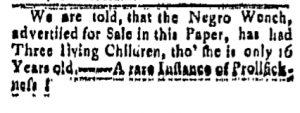
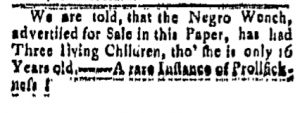
Another notice that appeared on the same page of the New-London Gazette further complicates today’s advertisement. “We are told,” an anonymous narrator (perhaps the printer) proclaimed, “that the Negro Wench advertised for Sale in this Paper, has had Three living Children, tho’ she is only 16 Years old. — A rare Instance of Prollfickness!” (Presumably the last word was supposed to be “prolificness.”) As Lindsay noted, the seller wished to be rid of this young woman solely because of her “breeding” and the inconveniences that it caused. The other notice, however, seemed to celebrate the young enslaved woman’s ability to produce children, promoting her fecundity as a selling point for potential buyers.

Who was responsible for the announcement that the sixteen-year-old “hearty Wench” already had three children? Was this an advertisement – a puff piece – placed by the current owner of the young woman in hopes of generating interest and making a sale? Or did the printer insert it of his own volition, as a point of interest he hoped would inform and entertain readers? The placement on the page makes it difficult to reach any particular conclusion. The notice appeared among the advertisements included in that issue of the New-London Gazette, but it appears at the bottom of the column immediately to the left of the column in which the advertisement for the “hearty Wench” was printed. It may have been positioned to prime readers to consider purchasing the young woman, but it also could have been intended as amusing filler when news and advertising did not completely fill the column. Either way, it now provides disheartening evidence concerning the levels of degradation one enslaved woman experienced at the hands of her captor and his community.

When Lindsay first presented this advertisement for my approval, I thought I might contemplate whether it suggested a family was being separated. When I examined it in the context of the rest of the issue, however, I discovered a much more revolting situation.

**********

[1] John Campbell, “Work, Pregnancy, and Infant Mortality among Southern Slaves,” Journal of Interdisciplinary History 14, no. 4 (Spring 1984): 797.

Slavery Advertisements Published October 17, 1766

GUEST CURATOR:  Nicholas Commesso

The Slavery Adverts 250 Project chronicles the role of newspaper advertising in perpetuating slavery in the era of the American Revolution. The project seeks to reveal the ubiquity of slavery in eighteenth-century life from New England to Georgia by republishing advertisements about enslaved people – for sale as individuals or in groups, wanted to purchase or for hire for short periods, runaways who liberated themselves, and those who were subsequently captured and confined in jails and workhouses – in daily digests on this site as well as in real time via the @SlaveAdverts250 Twitter feed, utilizing twenty-first-century media to stand in for the print media of the eighteenth century.

The project aims to provide modern audiences with a sense of just how often colonizers encountered these advertisements in their daily lives. Enslaved men, women, and children appeared in print somewhere in the colonies almost every single day. Those advertisements served as a constant backdrop for social, cultural, economic, and political life in colonial and revolutionary America. Colonizers who did not purport to own enslaved people were still confronted with slavery as well as invited to maintain the system by purchasing enslaved men, women, and children or assisting in the capture of so-called “runaways” who sought to free themselves from bondage. The frequency of these newspaper advertisements suggests just how embedded slavery was in colonial and revolutionary American culture in everyday interactions beyond the printed page.

These advertisements also testify to the experiences of enslaved men, women, and children, though readers must consider that those experiences have been remediated through descriptions offered by enslavers rather than enslaved people themselves. Often unnamed in the advertisements, enslaved men, women, and children were not invisible or unimportant in early America.

These advertisements appeared in colonial American newspapers 250 years ago today.

oct-17-new-london-gazette-slavery-1
New-London Gazette (October 17, 1766).

**********

oct-17-new-london-gazette-slavery-2
New-London Gazette (October 17, 1766).

**********

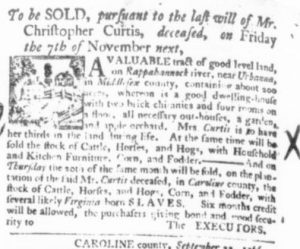
oct-17-virginia-gazette-slavery-1
Virginia Gazette (October 17, 1766).

**********

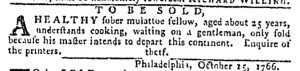
oct-17-virginia-gazette-slavery-2
Virginia Gazette (October 17, 1766).

**********

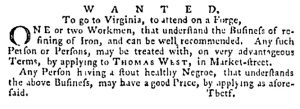
oct-17-virginia-gazette-slavery-3
Virginia Gazette (October 17, 1766).

**********

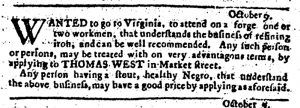
oct-17-virginia-gazette-slavery-4
Virginia Gazette (October 17, 1766).

**********

oct-17-virginia-gazette-slavery-5
Virginia Gazette (October 17, 1766).

October 16

GUEST CURATOR: Lindsay Hajjar

What was advertised in a colonial American newspaper 250 years ago today?

oct-16-10161766-boston-news-letter
Boston News-Letter (October 16, 1766).

In Union-Street, opposite to Mr. James Jackson’s; BOHEA Tea by the Chest.”

This advertisement was directed at consumers in the Boston area who not only knew their way around (including how to get to Union Street), but also who James Jackson was. Joseph Dennie pinpointed a very specific location and called upon readers to purchase distinct goods. The fact that the seller uses “Mr. James Jackson’s” as a landmark could mean that the seller did not have a shop sign of his own. The seller knew that the people of Boston were interested in the goods he had and that if he used a commonly known place such as “opposite to Mr. James Jackson’s” he would be able to turn over the most profit.

T.H Breen says how important it was for the colonist to stay connected to England for trade purposes because they wanted to feel as if they had never left England while at the same time having left. Being Anglicized, or making themselves feel English, was important for a lot of colonists because even though they were living in the New World the Old World connections gave them a sense of identity. Joseph Dennie knew that the good he was selling would be in high demand because they were valued throughout the British Empire.

**********

ADDITIONAL COMMENTARY: Carl Robert Keyes

Lindsay chose an advertisement that appears relatively plain at first glance, but it reveals quite a bit about how colonists navigated Boston and how they conjured imaginative maps of themselves as consumers.

In an era before American cities adopted standardized street numbers (an innovation ushered in shortly after the Revolution), urban residents and visitors used landmarks to give directions and find their way around. Some advertisers indicated that their shops were located on a certain street and specified the number of “doors” from the nearest intersection. Others, as Lindsay indicates, had their own shop signs. Dozens of shop signs crowded the streets of Boston in the eighteenth century. We know of most of them not because they survived but rather because they were included in advertisements from the period. Not every shopkeeper had his or her own sign, but some advertisers indicated their proximity to shop signs that would have been familiar to potential customers. Joseph Dennie used a similar method, but chose an individual, James Jackson, rather than a shop sign to orient his prospective clients.

Dennie’s short advertisement also mapped global networks of global commerce and identity. Lindsay notes that customers would have enjoyed the grocery items Dennie sold because they were also popular in England, but that tells only part of the story. The “BOHEA Tea by the Chest” came from China. Nutmegs, mace, and cloves came from the Spice Islands in the East Indies (modern Indonesia). Cinnamon came from Ceylon (modern Sri Lanka).

Many colonists were anxious about their status as Britons. They did, after all, live in faraway outposts of the empire. Importing, purchasing, and consuming exotic grocery items from distant lands helped to confirm their identity as they participated in the same rituals of consumption as their counterparts in London and throughout England.

Welcome, Guest Curator Lindsay Hajjar

Lindsay Hajjar is a junior at Assumption College, majoring in Elementary Education and History. She intends to focus on early childhood education when obtaining her master’s, but has a strong interest in Colonial and Revolutionary America. Outside the classroom, she is an active member of many different organizations on campus, including Class Assembly, Peers Advocating Wellness for Others, Human Services Club, and the Assumption College Chorale. Last spring she traveled with the Chorale to the Czech Republic and Austria. She has a passion for travel and cannot wait to explore more of the world. For now, history provides opportunities for her to see a lot of the world. She will be the guest curator for the Adverts 250 Project during the week of October 16 to 22, 2016, as well as guest curator for the Slavery Adverts 250 Project during the week of December 4 to 10, 2016.

Welcome, Lindsay Hajjar!

Slavery Advertisements Published October 16, 1766

GUEST CURATOR:  Nicholas Commesso

The Slavery Adverts 250 Project chronicles the role of newspaper advertising in perpetuating slavery in the era of the American Revolution. The project seeks to reveal the ubiquity of slavery in eighteenth-century life from New England to Georgia by republishing advertisements about enslaved people – for sale as individuals or in groups, wanted to purchase or for hire for short periods, runaways who liberated themselves, and those who were subsequently captured and confined in jails and workhouses – in daily digests on this site as well as in real time via the @SlaveAdverts250 Twitter feed, utilizing twenty-first-century media to stand in for the print media of the eighteenth century.

The project aims to provide modern audiences with a sense of just how often colonizers encountered these advertisements in their daily lives. Enslaved men, women, and children appeared in print somewhere in the colonies almost every single day. Those advertisements served as a constant backdrop for social, cultural, economic, and political life in colonial and revolutionary America. Colonizers who did not purport to own enslaved people were still confronted with slavery as well as invited to maintain the system by purchasing enslaved men, women, and children or assisting in the capture of so-called “runaways” who sought to free themselves from bondage. The frequency of these newspaper advertisements suggests just how embedded slavery was in colonial and revolutionary American culture in everyday interactions beyond the printed page.

These advertisements also testify to the experiences of enslaved men, women, and children, though readers must consider that those experiences have been remediated through descriptions offered by enslavers rather than enslaved people themselves. Often unnamed in the advertisements, enslaved men, women, and children were not invisible or unimportant in early America.

These advertisements appeared in colonial American newspapers 250 years ago today.

oct-16-new-york-journal-slavery-1
New-York Journal (October 16, 1766).

**********

oct-16-new-york-journal-slavery-2
New-York Journal (October 16, 1766).

**********

oct-16-new-york-journal-slavery-3
New-York Journal (October 16, 1766).

**********

oct-16-new-york-journal-supplement-slavery-1
Supplement to the New-York Journal (October 16, 1766).

**********

oct-16-new-york-journal-supplement-slavery-2
Supplement to the New-York Journal (October 16, 1766).

**********

oct-16-pennsylvania-gazette-slavery-1
Pennsylvania Gazette (October 16, 1766).

**********

oct-16-pennsylvania-gazette-slavery-2
Pennsylvania Gazette (October 16, 1766).

**********

oct-16-pennsylvania-gazette-slavery-3
Pennsylvania Gazette (October 16, 1766).

**********

oct-16-pennsylvania-gazette-supplement-slavery-1
Supplement to the Pennsylvania Gazette (October 16, 1766).

**********

oct-16-pennsylvania-gazette-supplement-slavery-2
Supplement to the Pennsylvania Gazette (October 16, 1766).

**********

oct-16-pennsylvania-gazette-supplement-slavery-3
Supplement to Pennsylvania Gazette (October 16, 1766).

**********

oct-16-pennsylvania-journal-slavery-1
Pennsylvania Journal (October 16, 1766).

**********

oct-16-pennsylvania-journal-slavery-2
Pennsylvania Journal (October 16, 1766).

Reflections from Guest Curator Jordan Russo

I felt as in the past years of learning history I was just told facts and was tested on them. This project allowed me to do a lot more than just memorize facts. Facts are just a starting point while the process of doing history was much more. This process of doing history allowed me to become the researcher and better understand what I was learning. The searching and analyzing of the advertisements allowed me to actually comprehend and see what the colonists were like. This project allowed me to be even more active about my learning. The advertisements allowed me to learn about the colonist as individuals, understand what they went through, and compare myself and others from the twenty-first century to them.

I have actually been using primary sources in two other classes as well this semester so I was prepared to use the advertisements and knew how important primary sources are. Most of the primary sources I have been using, however, are books and pictures and not digitized sources. Using of the internet introduces other really great sources. It allows people from all over the world to find primary sources. I never realized how important the use of technology was because we are so used to just always having the internet right there. Digitized sources are definitely a main attribute of this project. Without digitized sources, using eighteenth-century newspapers may have been impossible. Using primary sources was important because I got to look at the advertisements as they were created and experienced by colonists. They were not changed or summarized. The primary sources allowed me to dig deeper because they were not simplified. The more I found out about these advertisements the more I connected the colonists to life in America today.

That was probably the most rewarding part of the project. It is interesting to see that a lot of things have not changed over long periods of time. A lot of the advertisements were directed towards women and the fashion, just like advertisements today. People are directed towards things that will make them look better and even the colonists felt like this, which I thought was interesting. I figured the colonists would be concerned about a lot of different things, like food and supplies, but fashion was still just as important. Another thing I thought was interesting was that advertisements made it a point to say they had cheap prices. People today still want the best deal for their money. The advertisements from the 1760s influenced how people advertise today. I found this rewarding because it shows we still have a connection to people from colonial times. We still have similar interests and concerns as people back them; their history is telling us where we came from. Because I found the advertisements so interesting I did not find this project as difficult as I thought it was going to be.

I really liked looking at the newspapers so that also made the project easier than I thought. At first it was challenging to read the advertisements because of the mixing of the F for the S. In addition to reading the articles I had to look more into what they were selling and why they were selling those items; the answers were not always obvious. I found it difficult at some points to understand why they were selling those items but then it became easier as the week went on. I liked looking into what colonists bought 250 years. I went home last weekend and showed my parents what I have been researching.

As this past week went on I learned a lot more about the colonists and how they lived. It made me wonder what other historical things I could research more to find connections to our lives today. History has affected us so much and I think more people need to realize that. This project allowed that to happen for me.

October 15

GUEST CURATOR: Jordan Russo

What was advertised in a colonial American newspaper 250 years ago today?

oct-15-10151766-georgia-gazette
Georgia Gazette (October 15, 1766).

“Goods, suitable for the season.”

Cowper and Telfairs’ store had just received a large assortment of items imported from London. After the lengthy list of items that they sold, the partners added that “they shortly expect other articles from England and Scotland to make a complete assortment of goods for this country and season.” It was good to add that they would be receiving other items so customers would come back and purchase more from their store.

This advertisement was in the newspaper in October; colonists would soon need items for the winter that was coming, even if it would not be as cold as in New England or even Virginia. The advertisement states the supplies and clothing were “suitable for the season,” making potential buyers aware that this store had goods that would help them get through the winter. Throughout the colonies, settlers made preparations. According to David Robinson, “Mothers taught daughters how to card wool and coax soft fibers from the hard stems of flax; how to spin fibers into threads; how to stitch and mend the heavy coats and hooded cloaks that soon must ward off the biting winds.” Cowper and Telfairs’ store had “a variety of other ready-made cloaths” that colonists could purchase as well as an assortment of textiles they could use to make coats, cloaks, and warmer clothing that they would need for winter weather, even if winter in Georgia was not as extreme as in colonies further north.

**********

ADDITIONAL COMMENTARY: Carl Robert Keyes

Not long ago guest curator Nicholas Commesso examined an advertisement from the Massachusetts Gazette in which William Palfrey marketed “Articles suitable for the approaching Season.” He noted that colonists in Boston and its hinterland needed to take into account that fall had commenced and winter would arrive soon. Palfrey attempted to sell his goods by reminding colonists that it was time to start making preparations.

In my additional commentary I noted that “suitable to the season” was a stock phrase deployed in newspaper advertisements in Philadelphia and, more generally, in New England the Middle Atlantic colonies. I have not worked as extensively with advertisements from the Chesapeake or the Lower South, so I was uncertain if that was the case in those locales or if regional differences existed. I suggested that this merited further investigation.

Jordan turned her eye to that question today, identifying the same language in an advertisement from a newspaper printed in the Georgia Gazette. While one advertisement does not demonstrate a pattern or widespread usage of “suitable for the season,” it does indicate that the phrase was not unknown in the area. Cowper and Telfairs likely meant something a bit different – or had somewhat different merchandise in mind – than William Palfrey did when they described their wares as “suitable for the season.” Each advertiser would have taken into account local conditions.

As Jordan notes, the shopkeepers concluded by describing the items “from England and Scotland” they intended to have in stock soon as “goods for this country and season.” In addition to attempting to lure customers back to their store for subsequent visits, Cowper and Telfairs also signaled that they knew exactly what kind of merchandise would be arriving on ships expected in port soon. Most likely they had negotiated with their contacts on the other side of the Atlantic and placed orders for specific goods. London merchants sometimes tried to pawn off surplus inventory, expecting colonial retailers to accept and sell whatever was sent to them, but Cowper and Telfairs suggested that their customers would be pleased with the selection they offered because their wares had been chosen with Georgia and its climate in mind.

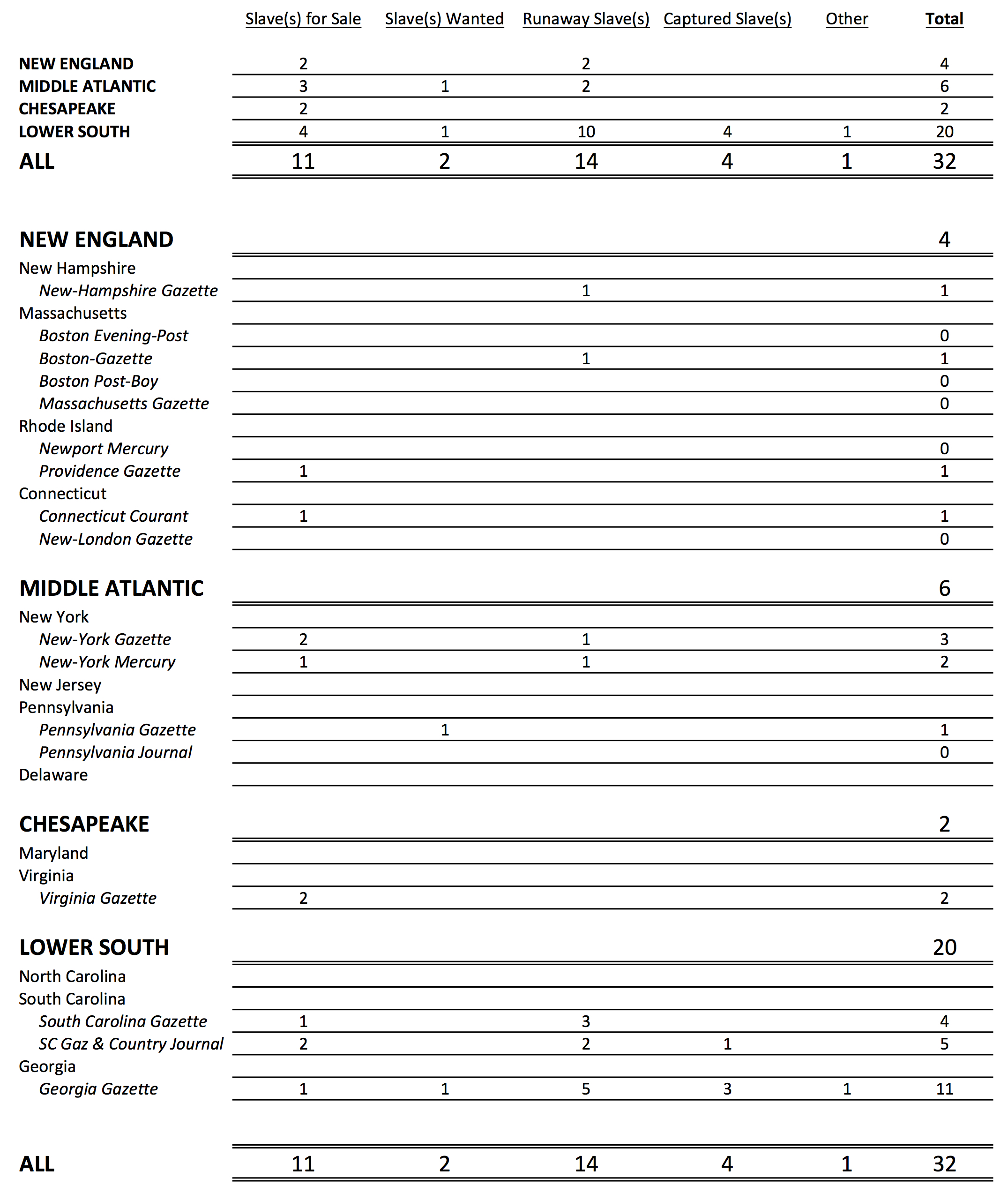
Summary of Slavery Advertisements Published October 9-15, 1766

These tables indicate how many advertisements for slaves appeared in colonial American newspapers during the week of October 9-15, 1766.  Data for both tables was compiled by Ceara Morse.

Note:  These tables are as comprehensive as currently digitized sources permit, but they may not be an exhaustive account.  They includes all newspapers that have been digitized and made available via Accessible Archives, Colonial Williamsburg’s Digital Library, and Readex’s America’s Historical Newspapers.  There are several reasons some newspapers may not have been consulted:

  • Issues that are no longer extant;
  • Issues that are extant but have not yet been digitized; and
  • Newspapers published in a language other than English (including the Wochentliche Philadelphische Staatsbote).

**********

Slavery Advertisements Published October 9-15, 1766:  By Date

slavery-adverts-tables-by-date-oct-9

**********

Slavery Advertisements Published October 9-15, 1766:  By Region

slavery-adverts-table-by-region-oct-9