September 10

What was advertised in a colonial American newspaper 250 years ago today?

Sep 10 - 9:10:1767 Virginia Gazette
Virginia Gazette (September 10, 1767).

“LOTTERY, For DISPOSING of certain LANDS, SLAVES, and STOCKS.”

Advertisements offering slaves for sale regularly appeared among the multitude of commercial notices in colonial newspapers. Sometimes masters sought to sell a single slave via a private sale. Other times merchants advertised auctions for dozens of slaves recently arrived in the colonies as part of the transatlantic slave trade. Especially in the Chesapeake and the Lower South, executors frequently placed notices concerning estate sales that included multiple slaves.

Thomas Moore, however, devised a different method for “DISPOSING of certain LANDS, SLAVES, and STOCKS.” Instead of selling his slaves via auction or negotiation, he ran a lottery with a limited number of tickets. Moore and his agents sought to sell 335 tickets. Forty-one would win prizes, but the other 294 were “Blanks.” Participants could calculate that each ticket had roughly a one in eight chance of winning one of the prizes.

Moore carefully delineated the forty-one prizes, listing a short description and value for each. A total of thirty slaves accounted for twenty of the prizes. The remainder consisted of seven prizes for land (with various improvements), ten for cattle, and four for horses. The total value of all the prizes amounted to £6700. Once all 335 tickets were sold at £20 each, Moore was assured of achieving the full value of the slaves, land, and livestock, a much less risky venture than going to auction and possibly coming up significantly short of the assessed value of his property.

The list of prizes included seven men, ten women, and thirteen children of various ages. Moore described some of the children as “boy” or “girl” rather than “man” or “woman,” suggesting that at least some of them may have been youths. In several instances, prizes consisted of multiple slaves sold together as families. In such cases, Moore used the word “child” and sometimes included an age, usually one or two years. He placed more emphasis, however, on the skills possessed by their parents. Harry, for instance, was “a fine sawer and clapboard carpenter.” York was “a fine gang leader.” Sarah was “a fine house servant, and a very good mantuamaker.”

Participants who purchased a single ticket and won cattle or horses broke even, but those who won slaves or land had a windfall. One slave, a “Negro woman named Sue,” was valued at £25. Ten others were valued at £30, £40, or £50 each. Jemmy, “as good a sawer as any in the colony,” merited £100 on his own. Each of the eight families had been assessed from £75 to £180. Any prize involving land had an even higher value, from £250 to £2000 for a tract of 500 acres and a house that would have been considered the grand prize.

It would not be accurate to say that giving away enslaved men, women, and children as prizes in a lottery was any more or less cruel than other methods of selling them. Moore’s advertisement for his lottery, however, does demonstrate yet another way that slaves, regardless of their family relations or skills, were treated as property and dehumanized in the colonial era.

Slavery Advertisements Published September 10, 1767

The Slavery Adverts 250 Project chronicles the role of newspaper advertising in perpetuating slavery in the era of the American Revolution. The project seeks to reveal the ubiquity of slavery in eighteenth-century life from New England to Georgia by republishing advertisements about enslaved people – for sale as individuals or in groups, wanted to purchase or for hire for short periods, runaways who liberated themselves, and those who were subsequently captured and confined in jails and workhouses – in daily digests on this site as well as in real time via the @SlaveAdverts250 Twitter feed, utilizing twenty-first-century media to stand in for the print media of the eighteenth century.

The project aims to provide modern audiences with a sense of just how often colonizers encountered these advertisements in their daily lives. Enslaved men, women, and children appeared in print somewhere in the colonies almost every single day. Those advertisements served as a constant backdrop for social, cultural, economic, and political life in colonial and revolutionary America. Colonizers who did not purport to own enslaved people were still confronted with slavery as well as invited to maintain the system by purchasing enslaved men, women, and children or assisting in the capture of so-called “runaways” who sought to free themselves from bondage. The frequency of these newspaper advertisements suggests just how embedded slavery was in colonial and revolutionary American culture in everyday interactions beyond the printed page.

These advertisements also testify to the experiences of enslaved men, women, and children, though readers must consider that those experiences have been remediated through descriptions offered by enslavers rather than enslaved people themselves. Often unnamed in the advertisements, enslaved men, women, and children were not invisible or unimportant in early America.

These advertisements appeared in colonial American newspapers 250 years ago today.

Sep 10 - New-York Gazette Weekly Post-Boy Slavery 1
New-York Gazette: Weekly Post-Boy (September 10, 1767).

**********

Sep 10 - New-York Journal Supplement Slavery 1
Supplement to the New-York Journal (September 10, 1767).

**********

Sep 10 - New-York Journal Supplement Slavery 2
Supplement to the New-York Journal (September 10, 1767).

**********

Sep 10 - New-York Journal Supplement Slavery 3
Supplement to the New-York Journal (September 10, 1767).

**********

Sep 10 - Pennsylvania Gazette Slavery 1
Pennsylvania Gazette (September 10, 1767).

**********

Sep 10 - Pennsylvania Gazette Slavery 2
Pennsylvania Gazette (September 10, 1767).

**********

Sep 10 - Pennsylvania Gazette Slavery 3
Pennsylvania Gazette (September 10, 1767).

**********

Sep 10 - Pennsylvania Gazette Slavery 4
Pennsylvania Gazette (September 10, 1767).

**********

Sep 10 - Pennsylvania Gazette Supplement Slavery 1
Supplement to the Pennsylvania Gazette (September 10, 1767).

**********

Sep 10 - Virginia Gazette Slavery 1
Virginia Gazette (September 10, 1767).

**********

Sep 10 - Virginia Gazette Slavery 2
Virginia Gazette (September 10, 1767).

**********

Sep 10 - Virginia Gazette Slavery 5
Virginia Gazette (September 10, 1767).

**********

Sep 10 - Virginia Gazette Slavery 3
Virginia Gazette (September 10, 1767).

**********

Sep 10 - Virginia Gazette Slavery 4
Virginia Gazette (September 10, 1767).

September 9

What was advertised in a colonial American newspaper 250 years ago today?

Sep 9 - 9:9:1767 Georgia Gazette
Georgia Gazette (September 9, 1767).

“My apprentice Patrick Nihell will make his escape.”

Throughout the eighteenth century, runaway advertisements were one of the most common types of notices inserted in newspapers. Slaveholders advertised runaway slaves. Masters advertised runaway indentured servants. Husbands advertised runaway wives. Military officers advertised runaway soldiers who had deserted. Masters advertised runaway apprentices. For people in subordinate positions, for people who were often exploited by others, running away from those who exercised power and authority over them was a means of attempting to remedy their situation.

Some of these advertisements appeared more frequently than others. Advertisements for runaway slaves and runaway servants were most common, though their proportion varied from region to region based on how extensively the local economy depended each type of labor. Newspapers in the Chesapeake and Lower South disseminated many advertisements for runaway slaves, but far fewer advertisements for runaway servants. Their counterparts in the Middle Atlantic regularly featured many of both types of advertisements, though careful quantitative analysis would likely reveal that advertisements for runaway servants significantly outnumbered advertisements for runaway slaves in that region. In New England, on the other hand, advertisements for runaway slaves appeared only occasionally and less frequently than advertisements for runaway servants.

Husbands advertised runaway wives throughout the colonies. Not surprisingly, newspapers in the largest urban ports – Boston, Charleston, New York, and Philadelphia – had the highest concentration of such advertisements, corresponding to the size of their populations, yet such notices also appeared in newspapers published in smaller towns. Advertisements for runaway soldiers were the least common, but readers also encountered them in newspapers throughout the colonies.

Finally, advertisements for runaway apprentices ran in newspapers in every region of colonial America, but tended to be most heavily concentrated in those regions that had higher numbers of indentured servants rather than slaves. In running away, abused apprentices sought to escape mistreatment by their masters. In today’s advertisements, Thomas Lee, Jr., updated the standard format for such advertisements. His apprentice, Patrick Nihell, had not run away, but their relationship had apparently deteriorated to the point that Lee suspected Nihell would “make his escape.” In anticipation, Lee preemptively warned “all masters of vessels and others” not to assist Nihell in any way if he did attempt to abscond. He concluded by threatening anyone who colluded with the apprentice “may depend to be prosecuted to the utmost rigour of the law.”

Summary of Slavery Advertisements Published September 3-9, 1767

These tables indicate how many advertisements for slaves appeared in colonial American newspapers during the week of September 3-9, 1767.

Note:  These tables are as comprehensive as currently digitized sources permit, but they may not be an exhaustive account.  They includes all newspapers that have been digitized and made available via Accessible Archives, Colonial Williamsburg’s Digital Library, and Readex’s America’s Historical Newspapers.  There are several reasons some newspapers may not have been consulted:

  • Issues that are no longer extant;
  • Issues that are extant but have not yet been digitized (including the Pennsylvania Journal); and
  • Newspapers published in a language other than English (including the Wochentliche Philadelphische Staatsbote).

**********

Slavery Advertisements Published September 3-9, 1767:  By Date

Slavery Adverts Tables 1767 By Date Sep 3

**********

Slavery Advertisements Published September 3-9, 1767:  By Region

Slavery Adverts Tables 1767 By Region Sep 3

Slavery Advertisements Published September 9, 1767

The Slavery Adverts 250 Project chronicles the role of newspaper advertising in perpetuating slavery in the era of the American Revolution. The project seeks to reveal the ubiquity of slavery in eighteenth-century life from New England to Georgia by republishing advertisements about enslaved people – for sale as individuals or in groups, wanted to purchase or for hire for short periods, runaways who liberated themselves, and those who were subsequently captured and confined in jails and workhouses – in daily digests on this site as well as in real time via the @SlaveAdverts250 Twitter feed, utilizing twenty-first-century media to stand in for the print media of the eighteenth century.

The project aims to provide modern audiences with a sense of just how often colonizers encountered these advertisements in their daily lives. Enslaved men, women, and children appeared in print somewhere in the colonies almost every single day. Those advertisements served as a constant backdrop for social, cultural, economic, and political life in colonial and revolutionary America. Colonizers who did not purport to own enslaved people were still confronted with slavery as well as invited to maintain the system by purchasing enslaved men, women, and children or assisting in the capture of so-called “runaways” who sought to free themselves from bondage. The frequency of these newspaper advertisements suggests just how embedded slavery was in colonial and revolutionary American culture in everyday interactions beyond the printed page.

These advertisements also testify to the experiences of enslaved men, women, and children, though readers must consider that those experiences have been remediated through descriptions offered by enslavers rather than enslaved people themselves. Often unnamed in the advertisements, enslaved men, women, and children were not invisible or unimportant in early America.

These advertisements appeared in colonial American newspapers 250 years ago today.

Sep 9 - Georgia Gazette Slavery 1
Georgia Gazette (September 9, 1767).

**********

Sep 9 - Georgia Gazette Slavery 2
Georgia Gazette (September 9, 1767).

**********

Sep 9 - Georgia Gazette Slavery 3
Georgia Gazette (September 9, 1767).

**********

Sep 9 - Georgia Gazette Slavery 4
Georgia Gazette (September 9, 1767).

**********

Sep 9 - Georgia Gazette Slavery 5
Georgia Gazette (September 9, 1767).

**********

Sep 9 - Georgia Gazette Slavery 6
Georgia Gazette (September 9, 1767).

**********

Sep 9 - Georgia Gazette Slavery 8
Georgia Gazette (September 9, 1767).

**********

Sep 9 - Georgia Gazette Slavery 7
Georgia Gazette (September 9, 1767).

September 8

What was advertised in a colonial American newspaper 250 years ago today?

Sep 8 - 9:8:1767 South-Carolina Gazette and Country Journal
South-Carolina Gazette and Country Journal (September 8, 1767).

“Checks by the piece so low as 4s. 6d.”

Robert and Nathaniel Stott advertised a “General assortment” of textiles they imported from Liverpool to Charleston. They informed readers of the South-Carolina Gazette and Country Journal that they carried “checks, striped hollands, handkerchiefs; India dimothies, figured and plain; counterpanes, black velvets, velverets and jenets” that they “bought from the manufacturers.” Revealing their supply chain allowed the Stotts to more convincingly make an appeal to price. For readers who approached their advertisement with healthy skepticism, the Stotts explained that they could indeed sell imported fabrics for “much lower than the usual advance” because they did not procure their merchandise through fellow merchants on the other side of the Atlantic. Instead, they eliminated the middlemen, reducing prices for their customers in the process.

To demonstrate the veracity of their claim, the Stotts quoted a specific price for checks: “by the piece so low as 4s. 6d. per yard.” Consumers already familiar with the going rate for checks could assess for themselves what kind of bargain the Stotts offered, but those were not the only prospective customers who benefitted. The Stotts made it easier for all readers to compare prices when visiting local competitors, a process that might cause shoppers to visit the Stotts to purchase other items as well. After all, they sold “other widths in proportion” to the low prices for checks and other fabrics “upon very reasonable terms.”

Most eighteenth-century merchants and shopkeepers did not indicate specific prices in their advertisements, though significant numbers made general statements about their “low rates” or deployed other formulaic language. On its own, the Stotts’ invocation of “very reasonable terms” fit that trend, but committing to a specific price – four shillings and six pence per yard – distinguished their advertisement from others by making a concrete promise to consumers. The Stotts replaced vague reassurances with tangible evidence in their efforts to increase sales at their store in Beadon’s Alley.

Slavery Advertisements Published September 8, 1767

The Slavery Adverts 250 Project chronicles the role of newspaper advertising in perpetuating slavery in the era of the American Revolution. The project seeks to reveal the ubiquity of slavery in eighteenth-century life from New England to Georgia by republishing advertisements about enslaved people – for sale as individuals or in groups, wanted to purchase or for hire for short periods, runaways who liberated themselves, and those who were subsequently captured and confined in jails and workhouses – in daily digests on this site as well as in real time via the @SlaveAdverts250 Twitter feed, utilizing twenty-first-century media to stand in for the print media of the eighteenth century.

The project aims to provide modern audiences with a sense of just how often colonizers encountered these advertisements in their daily lives. Enslaved men, women, and children appeared in print somewhere in the colonies almost every single day. Those advertisements served as a constant backdrop for social, cultural, economic, and political life in colonial and revolutionary America. Colonizers who did not purport to own enslaved people were still confronted with slavery as well as invited to maintain the system by purchasing enslaved men, women, and children or assisting in the capture of so-called “runaways” who sought to free themselves from bondage. The frequency of these newspaper advertisements suggests just how embedded slavery was in colonial and revolutionary American culture in everyday interactions beyond the printed page.

These advertisements also testify to the experiences of enslaved men, women, and children, though readers must consider that those experiences have been remediated through descriptions offered by enslavers rather than enslaved people themselves. Often unnamed in the advertisements, enslaved men, women, and children were not invisible or unimportant in early America.

These advertisements appeared in colonial American newspapers 250 years ago today.

Sep 8 - South-Carolina Gazette and Country Journal Slavery 1
South-Carolina Gazette and Country Journal (September 8, 1767).

**********

Sep 8 - South-Carolina Gazette and Country Journal Slavery 2
South-Carolina Gazette and Country Journal (September 8, 1767).

**********

Sep 8 - South-Carolina Gazette and Country Journal Slavery 3
South-Carolina Gazette and Country Journal (September 8, 1767).

**********

Sep 8 - South-Carolina Gazette and Country Journal Slavery 4
South-Carolina Gazette and Country Journal (September 8, 1767).

**********

Sep 8 - South-Carolina Gazette and Country Journal Slavery 5
South-Carolina Gazette and Country Journal (September 8, 1767).

September 7

What was advertised in a colonial American newspaper 250 years ago today?

Sep 7 - 9:7:1767 Boston-Gazette
Boston-Gazette (September 7, 1767).

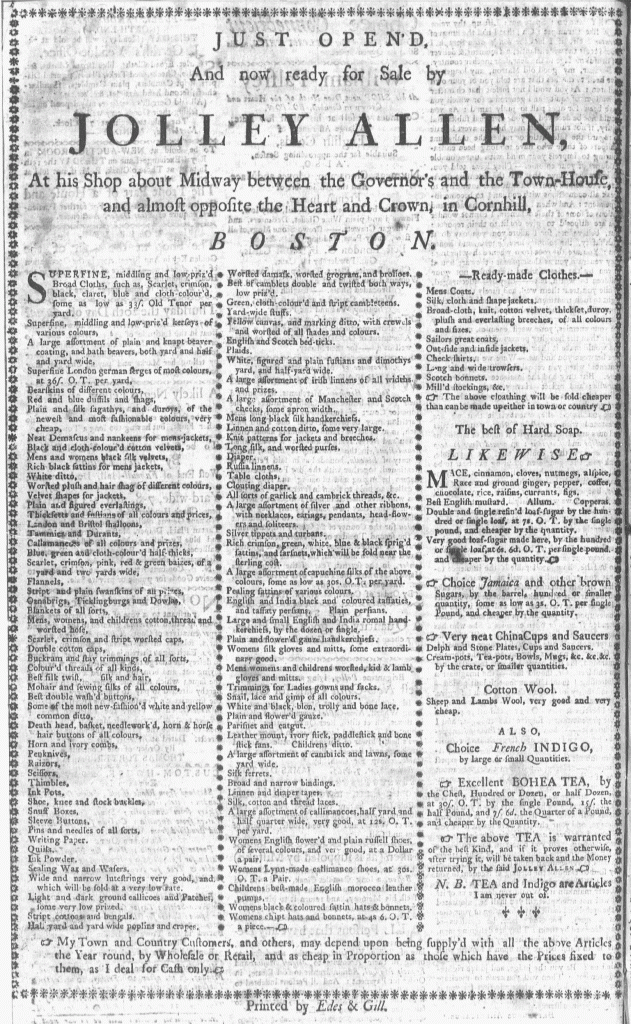
“Now ready for Sale by JOLLEY ALLEN, At his Shop.”

Jolley Allen regularly placed advertisements in the Boston-Gazette and other newspapers published in the port city. On most occasions, readers could readily identify his notices, even at just a glance, because Allen made arrangements with printers to have them enclosed in decorative borders. This was a consistent feature from one newspaper to another, a relatively rare example of an advertiser exerting influence over typographical decisions in the eighteenth century. In most cases, advertisers generated copy but compositors made determinations about format and layout. Realizing the value of making his commercial notices easy to distinguish from others on the page, Allen insisted on retaining control over some of the visual aspects. Distinctive borders created with printing ornaments became his brand in multiple newspapers.

Allen neglected to utilize a border in some of his advertising during the summer of 1767, a decision he reversed in the September 7 edition of the Boston-Gazette. The border around his advertisement in that issue, however, was not its most distinctive element. Except for the colophon, Allen’s advertisement filled the entire final page. Spread over three columns, the merchant listed an assortment of imported goods – from textiles to groceries – that he sold “Wholesale and Retail” to customers in both town and country. Even without the decorative border, the size of the advertisement alone demanded attention. Eighteenth-century newspapers featured few full-page advertisements, each of them all the more noteworthy considering that a standard issue consisted of only four pages. The printers gave over a significant amount of space that might otherwise contain additional advertisements or news items.

Experimenting with a full-page advertisement must have been an expensive investment for Allen. He usually placed identical advertisements in all four of Boston’s newspapers, but not during the week that his full-page advertisement ran in the Boston-Gazette. None of the other local newspapers carried any advertising by Allen. He may have exhausted the money he budgeted for marketing in a single advertisement. He might also have wished to see what kind of response it garnered, waiting to place full-page advertisements in other publications only if he determined doing so was worth the investment.

Historians of advertising and print culture usually describe full-page advertisements as nineteenth-century innovations, but colonial merchants and shopkeepers had already experimented with the format. Though uncommon, such advertisements were not unknown in eighteenth-century America.

Slavery Advertisements Published September 7, 1767

The Slavery Adverts 250 Project chronicles the role of newspaper advertising in perpetuating slavery in the era of the American Revolution. The project seeks to reveal the ubiquity of slavery in eighteenth-century life from New England to Georgia by republishing advertisements about enslaved people – for sale as individuals or in groups, wanted to purchase or for hire for short periods, runaways who liberated themselves, and those who were subsequently captured and confined in jails and workhouses – in daily digests on this site as well as in real time via the @SlaveAdverts250 Twitter feed, utilizing twenty-first-century media to stand in for the print media of the eighteenth century.

The project aims to provide modern audiences with a sense of just how often colonizers encountered these advertisements in their daily lives. Enslaved men, women, and children appeared in print somewhere in the colonies almost every single day. Those advertisements served as a constant backdrop for social, cultural, economic, and political life in colonial and revolutionary America. Colonizers who did not purport to own enslaved people were still confronted with slavery as well as invited to maintain the system by purchasing enslaved men, women, and children or assisting in the capture of so-called “runaways” who sought to free themselves from bondage. The frequency of these newspaper advertisements suggests just how embedded slavery was in colonial and revolutionary American culture in everyday interactions beyond the printed page.

These advertisements also testify to the experiences of enslaved men, women, and children, though readers must consider that those experiences have been remediated through descriptions offered by enslavers rather than enslaved people themselves. Often unnamed in the advertisements, enslaved men, women, and children were not invisible or unimportant in early America.

These advertisements appeared in colonial American newspapers 250 years ago today.

Sep 7 - Boston Post-Boy Slavery 1
Boston Post-Boy (September 7, 1767).

**********

Sep 7 - Boston Post-Boy Slavery 2
Boston Post-Boy (September 7, 1767).

**********

Sep 7 - Boston-Gazette Slavery 1
Boston-Gazette (September 7, 1767).

**********

Sep 7 - Boston-Gazette Slavery 2
Boston-Gazette (September 7, 1767).

**********

Sep 7 - Connecticut Courant Slavery 1
Connecticut Courant (September 7, 1767).

**********

Sep 7 - New-York Gazette Slavery 1
New-York Gazette (September 7, 1767).

**********

Sep 7 - New-York Gazette Slavery 2
New-York Gazette (September 7, 1767).

**********

Sep 7 - New-York Mercury Slavery 1
New-York Mercury (September 7, 1767).

**********

Sep 7 - New-York Mercury Slavery 2
New-York Mercury (September 7, 1767).

**********

Sep 7 - New-York Mercury Slavery 3
New-York Mercury (September 7, 1767).

**********

Sep 7 - New-York Mercury Slavery 4
New-York Mercury (September 7, 1767).

**********

Sep 7 - New-York Mercury Slavery 5
New-York Mercury (September 7, 1767).

**********

Sep 7 - New-York Mercury Slavery 6
New-York Mercury (September 7, 1767).

**********

Sep 7 - New-York Mercury Slavery 7
New-York Mercury (September 7, 1767).

**********

Sep 7 - Newport Mercury Slavery 1
Newport Mercury (September 7, 1767).

**********

Sep 7 - Newport Mercury Slavery 2
Newport Mercury (September 7, 1767).

**********

Sep 7 - Newport Mercury Slavery 3
Newport Mercury (September 7, 1767).

**********

Sep 7 - Pennsylvania Chronicle Slavery 1
Pennsylvania Chronicle (September 7, 1767).

**********

Sep 7 - Pennsylvania Chronicle Slavery 2
Pennsylvania Chronicle (September 7, 1767).

**********

Sep 7 - Pennsylvania Chronicle Slavery 3
Pennsylvania Chronicle (September 7, 1767).

September 6

What was advertised in a colonial American newspaper 250 years ago this week?

Sep 6 - 9:3:1767 New-York Journal
New-York Journal (September 3, 1767).

“BLANCH WHITE, UPHOLSTERER FROM LONDON.”

Colonists lived in an era of intense geographic mobility. In the decade before the Revolution, the flow of immigrants from across the Atlantic accelerated. Even colonists born in North America moved from place to place as they searched for economic opportunities. Many residents of cities and towns up and down the Atlantic coast could not claim to be from the place they now lived. For various reasons, some continued to emphasize their origins even as they became members of new communities.

This was often the case with tailors, cabinetmakers, and other artisans, especially as newcomers attempting to promote their livelihoods in local newspapers. They needed customers, yet determined that maintaining some aspects of their outsider status would effectively attract patrons who were unfamiliar with them and the goods they produced. Artisans who placed advertisements frequently asserted their connections to cosmopolitan centers in Europe. This gave them a certain cachet, suggesting that they made and sold items that were particularly fashionable. In some instances connections to London and other European cities also implied specialized training superior to any undertaken in the colonies.

In the September 3, 1767, edition of the New-York Journal, Blanch White introduced himself to potential customers as an UPHOLSTERER FROM LONDON.” In the same issue, readers also learned of the services of “Charles Le Frou, From PARIS, Perriwig-maker and hair Dresser.” Recent arrivals often used such designations to identify and distinguish themselves, though many advertisements obscured precisely how much time had elapsed since the artisan had lived and worked in London or another cosmopolitan center of fashion and commerce.

White’s advertisement provided some clarification. Even though he pronounced that he was “FROM LONDON,” he also indicated that he “has followed the Business for many Years past in Philadelphia.” Apparently his connection to London was not recent, yet the upholsterer still considered it a selling point worth mentioning to prospective customers. Some advertisers would have been content not to provide additional information about any extended interim between departing London and setting up shop locally, but White sensed an opportunity in acknowledging the time he spent in Philadelphia. Given that he seemed to specialize in martial supplies, he believed that he “must be known to some Gentlemen of the Military in this City.” He extended a direct appeal to former customers and acquaintances that served as an indirect endorsement.

Years after migrating across the Atlantic, Blanch White continued to identify himself as “FROM LONDON,” at least for the purposes of promoting his business in print. Yet he also found value in underscoring the work he had done and the clients he had served for “many Years” in the largest city in the colonies.