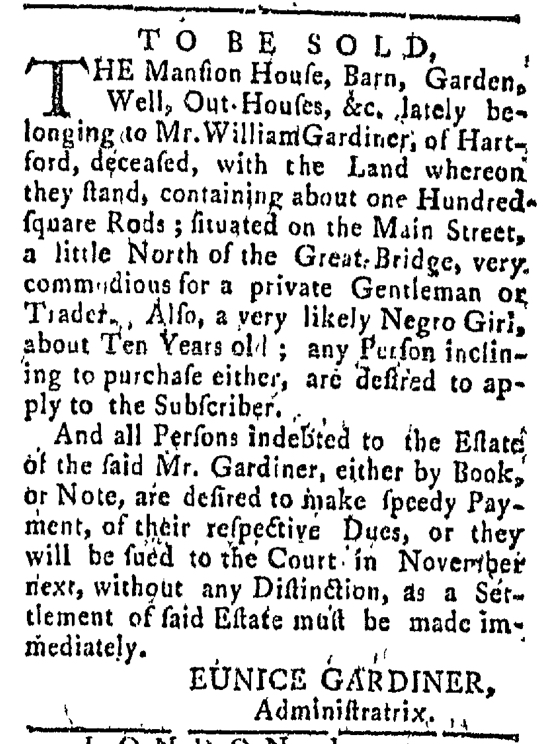
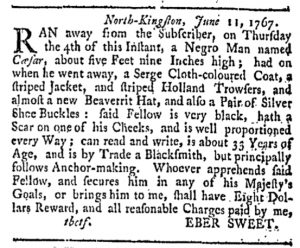
Slavery Advertisements Published September 16, 1767

The Slavery Adverts 250 Project chronicles the role of newspaper advertising in perpetuating slavery in the era of the American Revolution. The project seeks to reveal the ubiquity of slavery in eighteenth-century life from New England to Georgia by republishing advertisements about enslaved people – for sale as individuals or in groups, wanted to purchase or for hire for short periods, runaways who liberated themselves, and those who were subsequently captured and confined in jails and workhouses – in daily digests on this site as well as in real time via the @SlaveAdverts250 Twitter feed, utilizing twenty-first-century media to stand in for the print media of the eighteenth century.

The project aims to provide modern audiences with a sense of just how often colonizers encountered these advertisements in their daily lives. Enslaved men, women, and children appeared in print somewhere in the colonies almost every single day. Those advertisements served as a constant backdrop for social, cultural, economic, and political life in colonial and revolutionary America. Colonizers who did not purport to own enslaved people were still confronted with slavery as well as invited to maintain the system by purchasing enslaved men, women, and children or assisting in the capture of so-called “runaways” who sought to free themselves from bondage. The frequency of these newspaper advertisements suggests just how embedded slavery was in colonial and revolutionary American culture in everyday interactions beyond the printed page.

These advertisements also testify to the experiences of enslaved men, women, and children, though readers must consider that those experiences have been remediated through descriptions offered by enslavers rather than enslaved people themselves. Often unnamed in the advertisements, enslaved men, women, and children were not invisible or unimportant in early America.

These advertisements appeared in colonial American newspapers 250 years ago today.
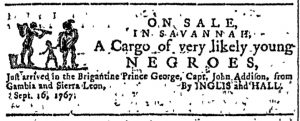
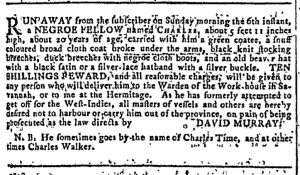
Sep 16 - Georgia Gazette Slavery 1
Georgia Gazette (September 16, 1767).

**********

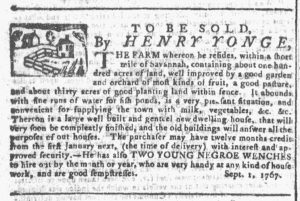
Sep 16 - Georgia Gazette Slavery 2
Georgia Gazette (September 16, 1767).

**********
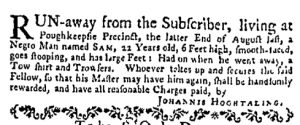
Sep 16 - Georgia Gazette Slavery 3
Georgia Gazette (September 16, 1767).

**********
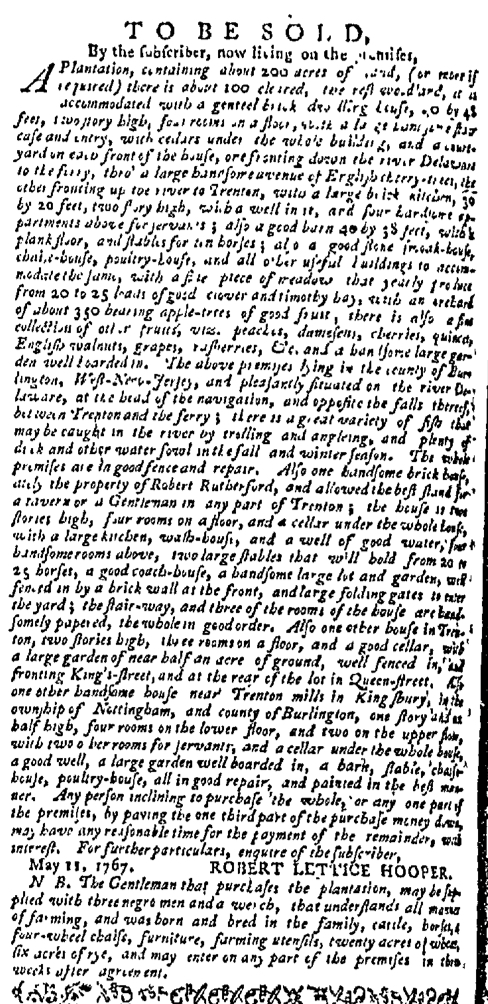
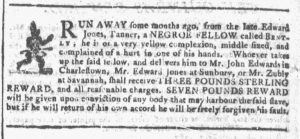
Sep 16 - Georgia Gazette Slavery 4
Georgia Gazette (September 16, 1767).

**********

Sep 16 - Georgia Gazette Slavery 5
Georgia Gazette (September 16, 1767).

**********
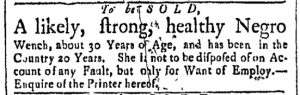
Sep 16 - Georgia Gazette Slavery 6
Georgia Gazette (September 16, 1767).

**********
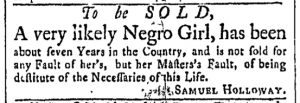
Sep 16 - Georgia Gazette Slavery 7
Georgia Gazette (September 16, 1767).

**********

Sep 16 - Georgia Gazette Slavery 9
Georgia Gazette (September 16, 1767).

**********

Sep 16 - Georgia Gazette Slavery 10
Georgia Gazette (September 16, 1767).

**********

Sep 16 - Georgia Gazette Slavery 8
Georgia Gazette (September 16, 1767).

September 15

What was advertised in a colonial American newspaper 250 years ago today?

Sep 15 - 9:15:1767 South-Carolina Gazette and Country Journal
South-Carolina Gazette and Country Journal (September 15, 1767).

“HESTER is now become a sole trader.”

Throughout the eighteenth century the laws of coverture prevented most married women in Britain’s American colonies from operating businesses independently of their husbands. Upon marriage, the wife became a feme covert, her legal rights and obligations subsumed by her husband. Married women were barred from owning property and could not make contracts or sign legal documents in their own names. They also could not incur debts; instead, husbands were responsible for financial obligations their wives initiated (which helps to explain why so many advertisements for runaway wives stated that husbands would not pay any debts the absent wives contracted; it was a means of exercising control). A feme covert was literally “covered” by her husband in a legal fiction that the two had become one person. An unmarried woman, known as a feme sole, on the other hand, had not surrendered those rights. Single and widowed women operated businesses without the permission or oversight of husbands, but in most colonies married women did not have that option.

The colonial governments in Pennsylvania and South Carolina, however, did pass feme sole trader laws that allowed married women to conduct business in their own names, assuming all the risks yet exercising all the responsibilities. South Carolina passed two such laws, first in 1712 and again in 1744. According to the Elizabeth Murray Project, “the title of the 1712 law suggests that it was designed to make married women traders more responsible for their own debts.” The 1744 expanded on that purpose by offering certain protections to married businesswomen, especially allowing for “women to sue debtors in their own names.”

In the late summer of 1767 Hester Fulcker became an entrepreneur in her own right, but only after receiving permission from her husband. Henry Fulcker placed an advertisement in the South-Carolina Gazette and Country Journal announcing that Hester “is now become a sole trader by his consent.” Accordingly, “any body may trust her as such on her separate account, independent of him.” This gave Hester greater freedom to operate her business, but it also shielded Henry from any financial liability if she failed. Compared to married women in most other colonies, Hester Fulcker experienced significantly greater opportunities for participating in the marketplace as a retailer and supplier rather than solely as a consumer, thanks to her feme sole trader status.

Slavery Advertisements Published September 15, 1767

The Slavery Adverts 250 Project chronicles the role of newspaper advertising in perpetuating slavery in the era of the American Revolution. The project seeks to reveal the ubiquity of slavery in eighteenth-century life from New England to Georgia by republishing advertisements about enslaved people – for sale as individuals or in groups, wanted to purchase or for hire for short periods, runaways who liberated themselves, and those who were subsequently captured and confined in jails and workhouses – in daily digests on this site as well as in real time via the @SlaveAdverts250 Twitter feed, utilizing twenty-first-century media to stand in for the print media of the eighteenth century.

The project aims to provide modern audiences with a sense of just how often colonizers encountered these advertisements in their daily lives. Enslaved men, women, and children appeared in print somewhere in the colonies almost every single day. Those advertisements served as a constant backdrop for social, cultural, economic, and political life in colonial and revolutionary America. Colonizers who did not purport to own enslaved people were still confronted with slavery as well as invited to maintain the system by purchasing enslaved men, women, and children or assisting in the capture of so-called “runaways” who sought to free themselves from bondage. The frequency of these newspaper advertisements suggests just how embedded slavery was in colonial and revolutionary American culture in everyday interactions beyond the printed page.

These advertisements also testify to the experiences of enslaved men, women, and children, though readers must consider that those experiences have been remediated through descriptions offered by enslavers rather than enslaved people themselves. Often unnamed in the advertisements, enslaved men, women, and children were not invisible or unimportant in early America.

These advertisements appeared in colonial American newspapers 250 years ago today.

Sep 15 - South-Carolina Gazette and Country Journal Slavery 8
South-Carolina Gazette and Country Journal (September 15, 1767).

**********
Sep 15 - South-Carolina Gazette and Country Journal Slavery 1
South-Carolina Gazette and Country Journal (September 15, 1767).

**********
Sep 15 - South-Carolina Gazette and Country Journal Slavery 2
South-Carolina Gazette and Country Journal (September 15, 1767).

**********

Sep 15 - South-Carolina Gazette and Country Journal Slavery 3
South-Carolina Gazette and Country Journal (September 15, 1767).

**********

Sep 15 - South-Carolina Gazette and Country Journal Slavery 4
South-Carolina Gazette and Country Journal (September 15, 1767).

**********

Sep 15 - South-Carolina Gazette and Country Journal Slavery 5
South-Carolina Gazette and Country Journal (September 15, 1767).

**********

Sep 15 - South-Carolina Gazette and Country Journal Slavery 6
South-Carolina Gazette and Country Journal (September 15, 1767).

**********

Sep 15 - South-Carolina Gazette and Country Journal Slavery 7
South-Carolina Gazette and Country Journal (September 15, 1767).

**********

Sep 15 - South-Carolina Gazette and Country Journal Supplement Slavery 1
Supplement to the South-Carolina Gazette and Country Journal (September 15, 1767).

**********

Sep 15 - South-Carolina Gazette and Country Journal Supplement Slavery 2
Supplement to the South-Carolina Gazette and Country Journal (September 15, 1767).

**********

Sep 15 - South-Carolina Gazette and Country Journal Supplement Slavery 3
Supplement to the South-Carolina Gazette and Country Journal (September 15, 1767).

**********

Sep 15 - South-Carolina Gazette and Country Journal Supplement Slavery 4
Supplement to the South-Carolina Gazette and Country Journal (September 15, 1767).

**********

Sep 15 - South-Carolina Gazette and Country Journal Supplement Slavery 5
Supplement to the South-Carolina Gazette and Country Journal (September 15, 1767).

**********

Sep 15 - South-Carolina Gazette and Country Journal Supplement Slavery 6
Supplement to the South-Carolina Gazette and Country Journal (September 15, 1767).

**********

Sep 15 - South-Carolina Gazette and Country Journal Supplement Slavery 7
Supplement to the South-Carolina Gazette and Country Journal (September 15, 1767).

September 14

What was advertised in a colonial American newspaper 250 years ago today?

Sep 14 - 9:14:1767 Boston Evening-Post
Boston Evening-Post (September 14, 1767).

“Just opened and now read for Sale, by Jolley Allen.”

A week ago I examined Jolley Allen’s extraordinary full-page advertisement in the September 7, 1767, edition of the Boston-Gazette. Given that Allen was prone to inserting the same advertisement in all four Boston newspapers, I noted that he had not placed that particular advertisement in the other two local newspapers distributed on the same day, nor the other one printed later in the week. The expense may have explained Allen’s decision, but space constraints may have played a role as well. The printers may not have been able to accommodate him at that time; after all, other advertisers had also contracted their services. It very well could have been a combination of the two factors, expense and limited space.

Allen’s full-page advertisement did not run a second time in the Boston-Gazette, but the following week a similar advertisement appeared in both the Boston Evening-Post and the Boston Post-Boy on September 14. In each case, the notice contained the same content, the same extensive list of merchandise, but had been condensed to two columns instead of three. Allen shared the page with other advertisers, reducing both expense and space. While the revised format may not have had the same impact as a full-page advertisement, taking up two columns was still an impressive feat that deviated from the vast majority of newspaper advertisements published in eighteenth-century America. Allen’s advertisement eventually ran in the Massachusetts Gazette, again condensed to two columns, on September 24, two and a half weeks after the full-page advertisement occupied the entire final page of the Boston-Gazette. It continued to appear sporadically in some, but not all, of Boston’s newspapers in October.

The two-column version lacked Allen’s signature decorative border in all three newspapers, but it did add an ornate printing device that flanked Allen’s name (itself printed in larger font than anything else in any of those newspapers, with the exception of the mastheads). In the absence of a border, Allen still managed to achieve visual consistency in his advertisements across three of Boston’s four newspapers.

Jolley Allen, a prolific advertiser, did not merely place notices in newspapers. Instead, he developed marketing campaigns that included advertising in multiple newspapers and consistent use of graphic design elements across those publications. He usually launched new advertisements through simultaneous publication in all of Boston’s newspapers, but the ability to do so with a full-page advertisement in September 1767 eluded him. Various factors may have been at play, yet Allen still managed to devise an advertising campaign of much greater magnitude than anything attempted by his competitors in Boston or his counterparts elsewhere in the colonies.

Slavery Advertisements Published September 14, 1767

The Slavery Adverts 250 Project chronicles the role of newspaper advertising in perpetuating slavery in the era of the American Revolution. The project seeks to reveal the ubiquity of slavery in eighteenth-century life from New England to Georgia by republishing advertisements about enslaved people – for sale as individuals or in groups, wanted to purchase or for hire for short periods, runaways who liberated themselves, and those who were subsequently captured and confined in jails and workhouses – in daily digests on this site as well as in real time via the @SlaveAdverts250 Twitter feed, utilizing twenty-first-century media to stand in for the print media of the eighteenth century.

The project aims to provide modern audiences with a sense of just how often colonizers encountered these advertisements in their daily lives. Enslaved men, women, and children appeared in print somewhere in the colonies almost every single day. Those advertisements served as a constant backdrop for social, cultural, economic, and political life in colonial and revolutionary America. Colonizers who did not purport to own enslaved people were still confronted with slavery as well as invited to maintain the system by purchasing enslaved men, women, and children or assisting in the capture of so-called “runaways” who sought to free themselves from bondage. The frequency of these newspaper advertisements suggests just how embedded slavery was in colonial and revolutionary American culture in everyday interactions beyond the printed page.

These advertisements also testify to the experiences of enslaved men, women, and children, though readers must consider that those experiences have been remediated through descriptions offered by enslavers rather than enslaved people themselves. Often unnamed in the advertisements, enslaved men, women, and children were not invisible or unimportant in early America.

These advertisements appeared in colonial American newspapers 250 years ago today.

Sep 14 - Boston Post-Boy Slavery 1
Boston Post-Boy (September 14, 1767).

**********

Sep 14 - Boston-Gazette Slavery 1
Boston-Gazette (September 14, 1767).

**********

Sep 14 - Boston-Gazette Slavery 2
Boston-Gazette (September 14, 1767).

**********

Sep 14 - Boston-Gazette Slavery 3
Boston-Gazette (September 14, 1767).

**********

Sep 14 - Boston-Gazette Slavery 4
Boston-Gazette (September 14, 1767).

**********

Sep 14 - Boston-Gazette Slavery 5
Boston-Gazette (September 14, 1767).

**********

Sep 14 - Connecticut Courant Slavery 1
Connecticut Courant (September 14, 1767).

**********

Sep 14 - New-York Mercury Slavery 1
New-York Mercury (September 14, 1767).

**********

Sep 14 - New-York Mercury Slavery 2
New-York Mercury (September 14, 1767).

**********

Sep 14 - New-York Mercury Slavery 3
New-York Mercury (September 14, 1767).

**********

Sep 14 - New-York Mercury Slavery 4
New-York Mercury (September 14, 1767).

**********

Sep 14 - New-York Mercury Slavery 5
New-York Mercury (September 14, 1767).

**********

Sep 14 - Newport Mercury Slavery 1
Newport Gazette (September 14, 1767).

**********

Sep 14 - Newport Mercury Slavery 2
Newport Gazette (September 14, 1767).

**********

Sep 14 - Newport Mercury Slavery 3
Newport Gazette (September 14, 1767).

**********

Sep 14 - Pennsylvania Chronicle Slavery 1
Pennsylvania Chronicle (September 14, 1767).

**********

Sep 14 - Pennsylvania Chronicle Slavery 2
Pennsylvania Chronicle (September 14, 1767).

**********

Sep 14 - Pennsylvania Chronicle Slavery 3
Pennsylvania Chronicle (September 14, 1767).

September 13

What was advertised in a colonial American newspaper 250 years ago this week?

Sep 13 - 9:10:1767 New-York Journal
New-York Journal (September 10, 1767).

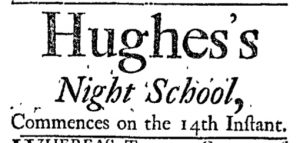
“Hughes’s Night School, Commences on the 14th Instant.”

In early September 1767, Hughes turned to the New-York Journal to advertise the opening of his night school in the middle of the month. His entire notice consisted of only eight words: “Hughes’s Night School, Commences on the 14th Instant.” Given the brevity of this advertisement, especially in comparison to those placed by other schoolmasters throughout the colonies, Hughes must have assumed that the general public was already aware of all the important details, everything from the curriculum to the hours of instruction to the location.

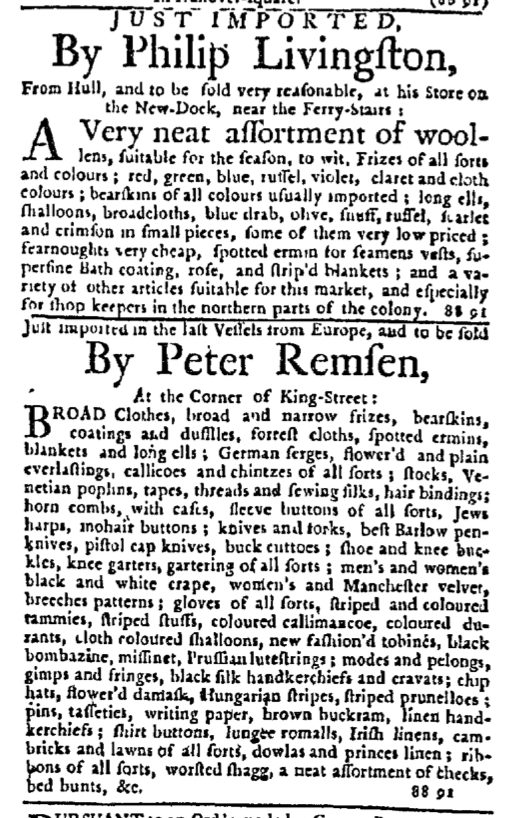
What Hughes’s advertisement lacked in relaying information it made up for in experimenting with layout designed to attract the attention of potential students. John Holt, the printer of the New-York Journal, and the compositor had developed a fairly standard visual appearance for advertisements inserted in that newspaper. They used a single font size for news items and most of the text included in advertisements, but headlines for advertisements (most often an advertiser’s name) appeared in a significantly larger font, regardless of the length of the advertisement. The first line of the body of the advertisement often featured a font only slightly larger than that used for the remainder. Advertisements by Philip Livingston and Peter Remsen that appeared in the same column as Hughes’s advertisement fit the general pattern when it came to the graphic design of paid notices in the New-York Journal.

Sep 13 - Extra Adverts from New-York Journal
New-York Journal (September 10, 1767).

Every word and every line of Hughes’s advertisement appeared in larger font sizes. The size of “Commences on the 14th instant,” the smallest in this advertisement, paralleled that of headlines in other advertisements throughout the standard issue and the supplement. The size of “Night School” rivaled the size of the newspaper’s title in the masthead. The size of the schoolmaster’s name far exceeded anything else printed in the issue or the supplement. Hughes’s message to potential students was short and straightforward, but the visual aspects had been designed to distinguish it from everything else on the page.

Newspapers published in colonial America’s largest cities in the 1760s often had a surplus of advertising, so much that they often had to print supplements to accommodate all of them. Space was limited, causing printers and compositors to standardize some of the visual aspects, including limiting the size of most text in advertisements. On occasion, however, they experimented with other formats that would have had a much different effect on readers accustomed to a particular style. Hughes’s relatively short advertisement for his “Night School” certainly stood out on the page.

September 12

What was advertised in a colonial American newspaper 250 years ago today?

Sep 12 - 9:12:1767 Providence Gazette
Providence Gazette (September 12, 1767).

The useful and necessary Business of Printing in this Town.”

Throughout the eighteenth century, printers regularly turned to the pages of their own newspapers to insert notices calling on subscribers (and sometimes advertisers) to settle their accounts by paying their overdue bills. Printers often accompanied these reminders with threats to sue recalcitrant subscribers who did not respond.

Sarah Goddard and Company took a different approach when they called on “all those who have not yet settled for the last Year’s Papers.” First, they extended their “most sincere Thanks” to all subscribers, but then lauded the “Example of those who have already paid.” The printers pointed to them as role models to emulate; in so doing, they also implicitly shamed their counterparts who had not yet paid.

In addition, Goddard and Company suggested that the future of their printing business depended on settling accounts, yet it was not only their own livelihood at stake. Instead, the entire community benefitted from the “useful and necessary Business of Printing” undertaken by Goddard and Company. They positioned the Providence Gazette, revived thirteen months earlier after a hiatus that had lasted more than a year, as a public service, one that had met with great approval. More than just a service, the printers proclaimed that their newspaper was “absolutely necessary for many of the most useful Members of Society amongst us.”

Goddard and Company could have wheedled subscribers and threatened legal action. Instead, they asked readers to consider the benefits associated with the continuation of the Providence Gazette. They anticipated that such idealistic appeals would “enduce all our former Subscribers” to renew their commitment to the publication through a “Continuance of their past Favors.” They also expected this argument to convince others who had not previously subscribed to “encourage this Work.” Rather than inserting an ugly admonition, Goddard and Company challenged the community to provide “ready Assistance” and join in common cause in “promoting the Growth and extending the Progress of our Gazette” for the benefit of its printers and readers alike.

Slavery Advertisements Published September 12, 1767

The Slavery Adverts 250 Project chronicles the role of newspaper advertising in perpetuating slavery in the era of the American Revolution. The project seeks to reveal the ubiquity of slavery in eighteenth-century life from New England to Georgia by republishing advertisements about enslaved people – for sale as individuals or in groups, wanted to purchase or for hire for short periods, runaways who liberated themselves, and those who were subsequently captured and confined in jails and workhouses – in daily digests on this site as well as in real time via the @SlaveAdverts250 Twitter feed, utilizing twenty-first-century media to stand in for the print media of the eighteenth century.

The project aims to provide modern audiences with a sense of just how often colonizers encountered these advertisements in their daily lives. Enslaved men, women, and children appeared in print somewhere in the colonies almost every single day. Those advertisements served as a constant backdrop for social, cultural, economic, and political life in colonial and revolutionary America. Colonizers who did not purport to own enslaved people were still confronted with slavery as well as invited to maintain the system by purchasing enslaved men, women, and children or assisting in the capture of so-called “runaways” who sought to free themselves from bondage. The frequency of these newspaper advertisements suggests just how embedded slavery was in colonial and revolutionary American culture in everyday interactions beyond the printed page.

These advertisements also testify to the experiences of enslaved men, women, and children, though readers must consider that those experiences have been remediated through descriptions offered by enslavers rather than enslaved people themselves. Often unnamed in the advertisements, enslaved men, women, and children were not invisible or unimportant in early America.

These advertisements appeared in colonial American newspapers 250 years ago today.

Sep 12 - Providence Gazette Slavery 1
Providence Gazette (September 12, 1767).

**********

Sep 12 - Providence Gazette Slavery 2
Providence Gazette (September 12, 1767).

September 11

What was advertised in a colonial American newspaper 250 years ago today?

Sep 11 - 9:11:1767 New-London Gazette
New-London Gazette (September 11, 1767).

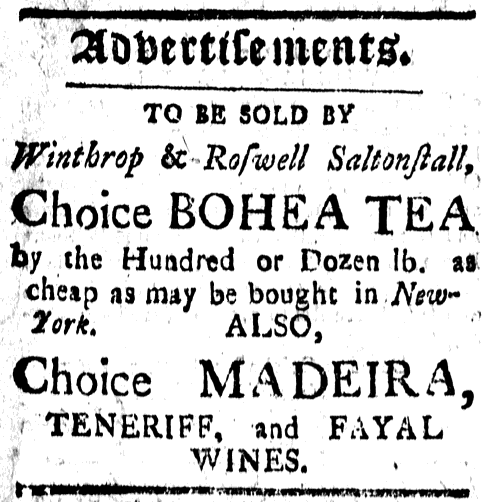
“Choice MADEIRA, TENERIFE, and FAYAL WINES.”

Some newspaper advertisements presented consumers with lengthy lists of manufactured goods imported from England, but others promoted foods and beverages that originated in places outside Britain’s global empire. In the September 11, 1767, edition of the New-London Gazette, for instance, Winthrop and Roswell Saltonstall announced that they sold “Choice … WINES” imported from islands in the eastern Atlantic. Madeira and Fayal wines came from Portuguese outposts. Madeira, a fortified wine, derived its name from the main island in the Madeira archipelago. Fayal (an English variation of Faial) wines came from one of the islands in the central group of the Azores, an archipelago consisting of nine islands. Tenerife wines came from the largest of the seven Canary Islands, conquered and colonized by Spain. In consuming wines from Madeira, Tenerife, and Fayal, colonists participated in vibrant networks of exchange that crisscrossed the Atlantic. Such networks often crossed imperial boundaries, even as nation-states attempted to enforce mercantilist policies.

Given that the Saltonstalls advertised these wines in the public prints, they most likely had imported them legally. Yet a variety of commodities – sugar, molasses, rum, foodstuffs, and wine – found their way to colonial markets via smuggling. “The case of wine is a good example,” according to David Hancock. “Not just in war but also in peace, the varieties and amounts of wine available in British America were greater than those allowed by law and recorded at the customs house.”[1] As the Saltonstalls’ advertisement suggests, colonists could identify many types of wine and made associations with their places of origin. Just as they were accustomed to extensive choices when it came to textiles and housewares, they expected wine merchants to present an assortment so they could make their own selections. Without going into elaborate detail, the Saltonstalls listed three different wines to signal the diversity of their stock to prospective customers.

[1] David Hancock, “Rethinking The Economy of British America,” in The Economy of Early America: Historical Perspectives and New Directions, ed. Cathy Matson (University Park: Pennsylvania State University Press, 2006), 81.

Slavery Advertisements Published September 11, 1767

The Slavery Adverts 250 Project chronicles the role of newspaper advertising in perpetuating slavery in the era of the American Revolution. The project seeks to reveal the ubiquity of slavery in eighteenth-century life from New England to Georgia by republishing advertisements about enslaved people – for sale as individuals or in groups, wanted to purchase or for hire for short periods, runaways who liberated themselves, and those who were subsequently captured and confined in jails and workhouses – in daily digests on this site as well as in real time via the @SlaveAdverts250 Twitter feed, utilizing twenty-first-century media to stand in for the print media of the eighteenth century.

The project aims to provide modern audiences with a sense of just how often colonizers encountered these advertisements in their daily lives. Enslaved men, women, and children appeared in print somewhere in the colonies almost every single day. Those advertisements served as a constant backdrop for social, cultural, economic, and political life in colonial and revolutionary America. Colonizers who did not purport to own enslaved people were still confronted with slavery as well as invited to maintain the system by purchasing enslaved men, women, and children or assisting in the capture of so-called “runaways” who sought to free themselves from bondage. The frequency of these newspaper advertisements suggests just how embedded slavery was in colonial and revolutionary American culture in everyday interactions beyond the printed page.

These advertisements also testify to the experiences of enslaved men, women, and children, though readers must consider that those experiences have been remediated through descriptions offered by enslavers rather than enslaved people themselves. Often unnamed in the advertisements, enslaved men, women, and children were not invisible or unimportant in early America.

These advertisements appeared in colonial American newspapers 250 years ago today.

Sep 11 - New-Hampshire Gazette Slavery 1
New-Hampshire Gazette (September 11, 1767).

**********

Sep 11 - New-London Gazette Slavery 1
New-London Gazette (September 11, 1767).

**********

Sep 11 - New-London Gazette Slavery 2
New-London Gazette (September 11, 1767).

**********

Sep 11 - South-Carolina and American General Gazette Slavery 1
South-Carolina and American General Gazette (September 11, 1767).

**********

Sep 11 - South-Carolina and American General Gazette Slavery 2
South-Carolina and American General Gazette (September 11, 1767).