Slavery Advertisements Published December 22, 1767

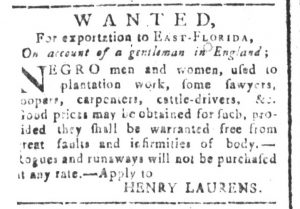
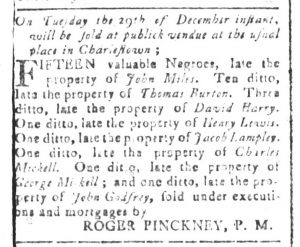
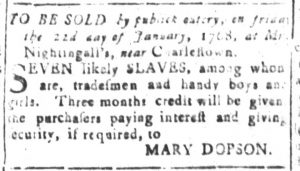
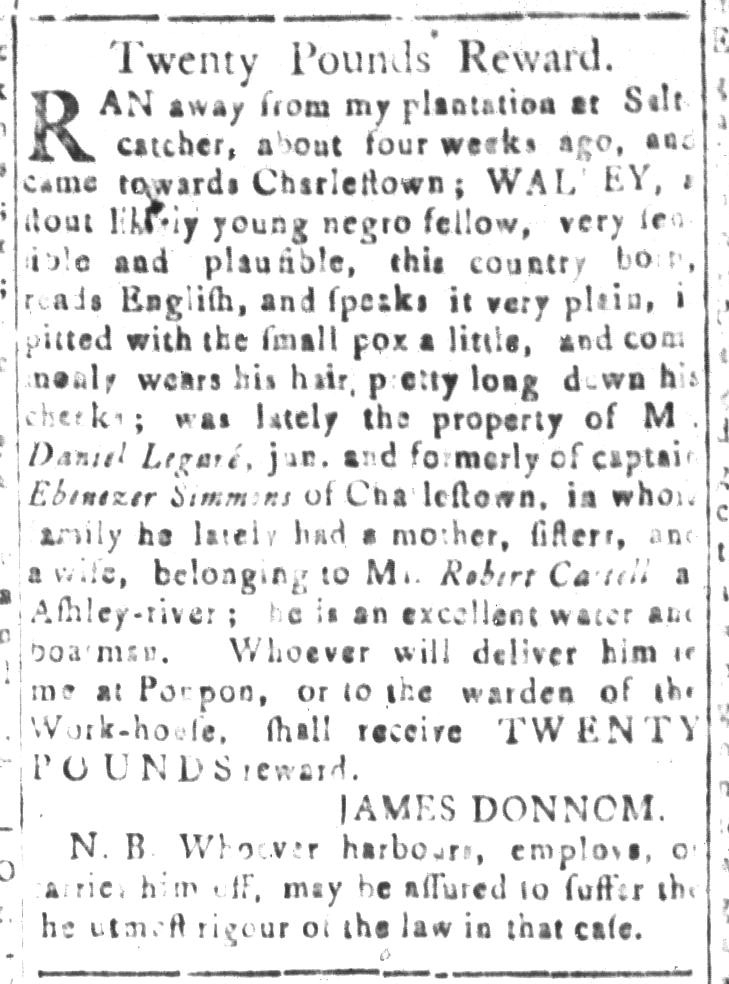
The Slavery Adverts 250 Project chronicles the role of newspaper advertising in perpetuating slavery in the era of the American Revolution. The project seeks to reveal the ubiquity of slavery in eighteenth-century life from New England to Georgia by republishing advertisements about enslaved people – for sale as individuals or in groups, wanted to purchase or for hire for short periods, runaways who liberated themselves, and those who were subsequently captured and confined in jails and workhouses – in daily digests on this site as well as in real time via the @SlaveAdverts250 Twitter feed, utilizing twenty-first-century media to stand in for the print media of the eighteenth century.

The project aims to provide modern audiences with a sense of just how often colonizers encountered these advertisements in their daily lives. Enslaved men, women, and children appeared in print somewhere in the colonies almost every single day. Those advertisements served as a constant backdrop for social, cultural, economic, and political life in colonial and revolutionary America. Colonizers who did not purport to own enslaved people were still confronted with slavery as well as invited to maintain the system by purchasing enslaved men, women, and children or assisting in the capture of so-called “runaways” who sought to free themselves from bondage. The frequency of these newspaper advertisements suggests just how embedded slavery was in colonial and revolutionary American culture in everyday interactions beyond the printed page.

These advertisements also testify to the experiences of enslaved men, women, and children, though readers must consider that those experiences have been remediated through descriptions offered by enslavers rather than enslaved people themselves. Often unnamed in the advertisements, enslaved men, women, and children were not invisible or unimportant in early America.

These advertisements appeared in colonial American newspapers 250 years ago today.
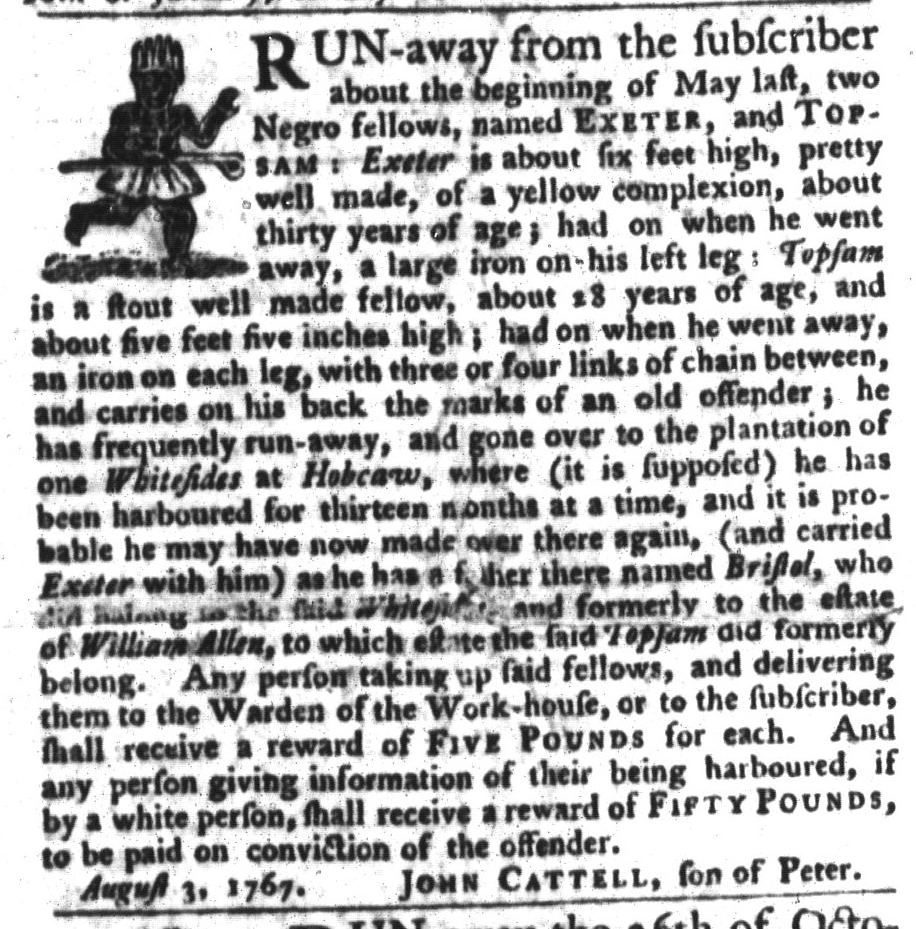
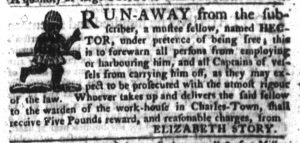
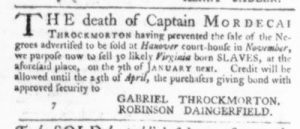
Dec 22 - South-Carolina Gazette and Country Journal Slavery 1
South-Carolina Gazette and Country Journal (December 22, 1767).

**********

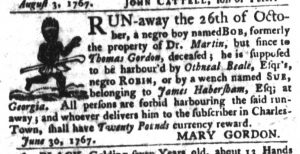
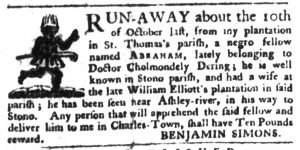
Dec 22 - South-Carolina Gazette and Country Journal Slavery 2
South-Carolina Gazette and Country Journal (December 22, 1767).

**********

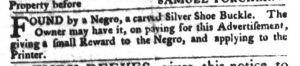
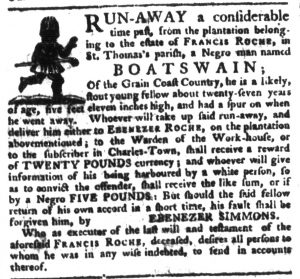
Dec 22 - South-Carolina Gazette and Country Journal Slavery 3
South-Carolina Gazette and Country Journal (December 22, 1767).

**********

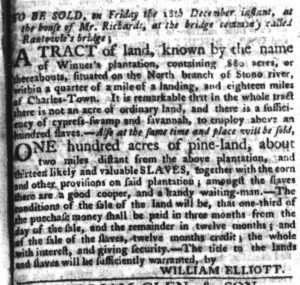
Dec 22 - South-Carolina Gazette and Country Journal Slavery 4
South-Carolina Gazette and Country Journal (December 22, 1767).

**********

Dec 22 - South-Carolina Gazette and Country Journal Slavery 5
South-Carolina Gazette and Country Journal (December 22, 1767).

**********

Dec 22 - South-Carolina Gazette and Country Journal Slavery 6
South-Carolina Gazette and Country Journal (December 22, 1767).

**********

Dec 22 - South-Carolina Gazette and Country Journal Slavery 7
South-Carolina Gazette and Country Journal (December 22, 1767).

**********

Dec 22 - South-Carolina Gazette and Country Journal Slavery 8
South-Carolina Gazette and Country Journal (December 22, 1767).

**********

Dec 22 - South-Carolina Gazette and Country Journal Slavery 9
South-Carolina Gazette and Country Journal (December 22, 1767).

**********

Dec 22 - South-Carolina Gazette and Country Journal Slavery 10
South-Carolina Gazette and Country Journal (December 22, 1767).

**********

Dec 22 - South-Carolina Gazette and Country Journal Slavery 11
South-Carolina Gazette and Country Journal (December 22, 1767).

**********

Dec 22 - South-Carolina Gazette and Country Journal Supplement Slavery 1
South-Carolina Gazette and Country Journal (December 22, 1767).

**********
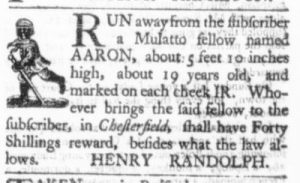
Dec 22 - South-Carolina Gazette and Country Journal Supplement Slavery 2
South-Carolina Gazette and Country Journal (December 22, 1767).

**********

Dec 22 - South-Carolina Gazette and Country Journal Supplement Slavery 3
South-Carolina Gazette and Country Journal (December 22, 1767).

**********

Dec 22 - South-Carolina Gazette and Cuntry Journal Supplement Slavery 4
South-Carolina Gazette and Country Journal (December 22, 1767).

**********

Dec 22 - South-Carolina Gazette and Cuntry Journal Supplement Slavery 5
South-Carolina Gazette and Country Journal (December 22, 1767).

**********

Dec 22 - South-Carolina Gazette and Cuntry Journal Supplement Slavery 6
South-Carolina Gazette and Country Journal (December 22, 1767).

**********

Dec 22 - South-Carolina Gazette and Cuntry Journal Supplement Slavery 7
South-Carolina Gazette and Country Journal (December 22, 1767).

December 21

What was advertised in a colonial American newspaper 250 years ago today?

Dec 21 - 12:21:1767 Boston Post-Boy
Boston Post-Boy (December 21, 1767).

John M’Lane stop’d last Wednesday Night a Large Silver Spoon.”

Watchmaker John McLane advertised his services in the Boston Post-Boy for several weeks in December 1767. He relied on two marketing strategies to attract potential clients, one commonly used by artisans and the other a clever innovation that testified to his character in addition to his credentials.

McLane opened his advertisement with a recitation of his training to assure customers that he was qualified to work as a watchmaker. He had completed an apprenticeship, having “serv’d his Time in Dublin to one of the best Finishers there.” On its own, this might have impressed prospective clients, but McLane also reported that he received additional training when he “work’d in London for improvement.” Artisans who migrated across the Atlantic frequently asserted their connections to the largest and most cosmopolitan cities in the empire, often providing details about their previous training and work.

McLane’s second strategy, however, deviated from colonial artisans’ usual marketing practices. He appended a nota bene that reported he had “stop’d last Wednesday Night a large Silver Spoon.” In other words, a man that McLane deemed untrustworthy had attempted to sell him a spoon, but the watchmaker suspected stolen goods. He confiscated the spoon and advertised descriptions of both the spoon and the man who attempted to sell it to him. The owner, upon recognizing the monogram or “Marks of the Spoon,” could contact McLane to have it returned.

When he “stop’d” the silver spoon, McLane prevented it from circulating in an informal economy or black market, an alternative means for many colonists to participate in the consumer revolution. Less scrupulous artisans would have purchased it at a bargain price and not questioned how the stranger who presented the spoon had acquired it. By taking this action, McLane demonstrated his character to potential customers in a manner they might remember longer than they would recall his training in Dublin and additional experience in London. Not only was he skilled, he was also trustworthy.

Slavery Advertisements Published December 21, 1767

The Slavery Adverts 250 Project chronicles the role of newspaper advertising in perpetuating slavery in the era of the American Revolution. The project seeks to reveal the ubiquity of slavery in eighteenth-century life from New England to Georgia by republishing advertisements about enslaved people – for sale as individuals or in groups, wanted to purchase or for hire for short periods, runaways who liberated themselves, and those who were subsequently captured and confined in jails and workhouses – in daily digests on this site as well as in real time via the @SlaveAdverts250 Twitter feed, utilizing twenty-first-century media to stand in for the print media of the eighteenth century.

The project aims to provide modern audiences with a sense of just how often colonizers encountered these advertisements in their daily lives. Enslaved men, women, and children appeared in print somewhere in the colonies almost every single day. Those advertisements served as a constant backdrop for social, cultural, economic, and political life in colonial and revolutionary America. Colonizers who did not purport to own enslaved people were still confronted with slavery as well as invited to maintain the system by purchasing enslaved men, women, and children or assisting in the capture of so-called “runaways” who sought to free themselves from bondage. The frequency of these newspaper advertisements suggests just how embedded slavery was in colonial and revolutionary American culture in everyday interactions beyond the printed page.

These advertisements also testify to the experiences of enslaved men, women, and children, though readers must consider that those experiences have been remediated through descriptions offered by enslavers rather than enslaved people themselves. Often unnamed in the advertisements, enslaved men, women, and children were not invisible or unimportant in early America.

These advertisements appeared in colonial American newspapers 250 years ago today.

Dec 21 - Boston Evening-Post Slavery 1
Boston Evening-Post (December 21, 1767).

**********

Dec 21 - Boston Evening-Post Slavery 2
Boston Evening-Post (December 21, 1767).

**********

Dec 21 - Boston Evening-Post Slavery 3
Boston Evening-Post (December 21, 1767).

**********

Dec 21 - Boston Evening-Post Slavery 4
Boston Evening-Post (December 21, 1767).

**********

Dec 21 - Boston Post-Boy Slavery 1
Boston Post-Boy (December 21, 1767).

**********

Dec 21 - Boston-Gazette Slavery 1
Boston-Gazette (December 21, 1767).

**********

Dec 21 - Boston-Gazette Slavery 2
Boston-Gazette (December 21, 1767).

**********

Dec 21 - Boston-Gazette Slavery 3
Boston-Gazette (December 21, 1767).

**********

Dec 21 - New-York Mercury Slavery 1
New-York Mercury (December 21, 1767).

**********

Dec 21 - Newport Mercury Slavery 1
Newport Mercury (December 21, 1767).

**********

Dec 21 - Newport Mercury Slavery 2
Newport Mercury (December 21, 1767).

December 20

What was advertised in a colonial American newspaper 250 years ago this week?

Dec 20 - 12:17:1767 Pennsylvania Gazette
Pennsylvania Gazette (December 17, 1767).

“At the Sign of.”

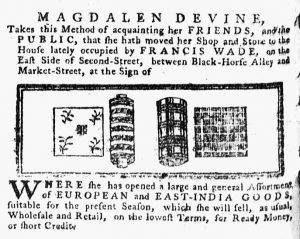
Magdalen Devine frequently placed advertisements in the Pennsylvania Gazette throughout 1767. Often a woodcut depicting some of her merchandise, two rolls of fabric and two swatches showcasing the patterns, accompanied her advertisements. This effectively created a logo for Devine, making her advertisements instantly recognizable without potential customers needing to even read a word.

For many eighteenth-century shopkeepers and artisans, the woodcuts that supplemented their advertisements illustrated the signs that marked the places where they conducted business. The devices in the woodcuts reflected the descriptions of shop signs in many advertisements, but that did not necessarily mean that those woodcuts exactly replicated the signs they represented. For instance, leather dressers James Haslett and Matthew Haslett included several visual variations on “the Sign of the Buck and Glove” in their advertisements in the New-Hampshire Gazette. One may have faithfully duplicated the actual sign; the others offered a similar likeness that distinguished their advertisements from others, attracted the attention of readers, and helped guide potential customers to their shop. Similarly, other woodcuts in eighteenth-century newspaper advertisements likely provided representations but not exact replications of shop signs, hinting at what colonial consumers saw when they traversed the streets.

Devine, however, suggested that the woodcut in her advertisements did indeed accurately reproduce her shop sign. In the course of giving directions to her shop, she indicated that she had recently moved “to the House lately occupied by FRANCIS WADE, on the East Side of Second-Street, between Black-Horse Alley and Market-Street.” To further aid “her FRIENDS, and the PUBLIC” in finding her, she noted that her shop was “at the Sign of” but did not conclude the sentence with a description or name for the sign. Instead, she inserted the woodcut that by then served as her logo. While other advertisers implied that woodcuts in their advertisements depicted their signs without commenting on how well they did so, Magdalen Devine provided one of the most explicit indications that what readers saw in the newspaper replicated the actual sign that marked her shop.

December 19

What was advertised in a colonial American newspaper 250 years ago today?

Dec 19 - 12:19:1767 Providence Gazette
Providence Gazette (December 19, 1767).

“By far the largest and best Assortment in this Town.”

In their attempt to incite consumer demand and attract customers, Joseph and William Russell filled their advertisement for “English, India, and Hard-Ware GOODS” with superlatives. Not content to rely on adjectives commonly used in retail advertisements (“large, neat, and compleat”) to describe their assortment of goods, they proclaimed that their inventory was “by far the largest and best Assortment in this Town.” Potential customers did not need to even entertain the notion of browsing in other shops because the Russells were certain to carry all the items they needed and wanted.

In case their selection alone did not entice consumers, the Russells guaranteed the lowest prices in Providence. They promised to sell “as CHEAP, if not CHEAPER, than any Person in this Town,” a claim that both Jonathan Russell and Thompson and Arnold disputed in their advertisements on the following page. The former advised consumers that he was “determined to sell at the very cheapest rate,” while the latter declared that they were “determined to sell as low as can be bought in any Shop or Store in this Town, or any other in New-England.” The Russells expressed confidence in their ability to charge the lowest prices because “they purchased [their goods] in England themselves.” Six weeks earlier they published a full-page advertisement that provided more explanation. William Russell had just returned from a trip to England and “brought over with him a large, neat, and compleat Assortment of … GOODS … which he purchased from the first Hands.” Eliminating English merchants from their supply chain allowed the Russells to pass along savings to their customers.

For readers not yet convinced to patronize the Russells’ shop, they also presented an argument that their business promoted the local welfare and customers could consider buying from them an act of civic responsibility. The shopkeepers stated that since “their Trade tends greatly to the Benefit of this Town, and the Country round” that “they doubt not but all the good People … will favour them with their Custom, instead of such Shops as send all the Money they receive out of the Government.” In the late 1760s a trade imbalance between the colonies and England contributed to a scarcity of specie as retailers engaged in trade with English merchants. By acquiring their merchandise directly the producers, “from the best Hands” in England, the Russells remitted less specie to associates on the other side of the Atlantic. In addition, they imported their wares “directly from LONDON,” but some of their local competitors acquired their merchandise via Boston and New York, enriching neighboring colonies at the expense of Rhode Island.

The Russells argued that customers who chose their shop enjoyed multiple advantages. They immediately benefited from the large selection and low prices, but their decisions as consumers also had ramifications for the collective economic welfare of Providence and the surrounding area.

December 18

What was advertised in a colonial American newspaper 250 years ago today?

Dec 18 - 12:18:1767 New-Hampshire Gazette
New-Hampshire Gazette (December 18, 1767).

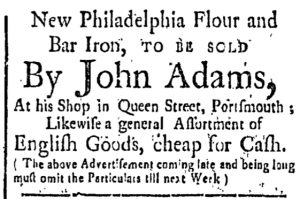
“The above Advertisement coming late and being long must omit the Particulars till next Week.”

John Adams placed an advertisement in the December 18, 1767, edition of the New-Hampshire Gazette to inform readers that he sold “Philadelphia Flour and Bar Iron” and “a general Assortment of English Goods” at his shop on Queen Street in Portsmouth. An editorial note accompanied Adams’s notice: “The above Advertisement coming late and being long must omit the Particulars till next Week.” The shopkeeper’s much lengthier advertisement did appear in the next issue, but until then readers had to imagine what it might contain. Although they would not have been able to name all the “Particulars,” colonial consumers were so steeped in the print culture of marketing via newspaper advertisements that most would have accurately predicted that the complete notice included a lengthy list of merchandise that presented a multitude of choices. Adams did not benefit from sharing that list with potential customers in the December 18 issue, but when it did appear it concluded with a general description of “a variety of other Articles.” Even when allocated space for the entire advertisement, Adams chose to publish a partial list of his inventory and prompted consumers to imagine what other treasures they might discover if they visited his shop. The editorial note explaining that the advertisement had been abbreviated achieved the same purpose.

That note had at least three audiences. The first consisted of residents of Portsmouth who could easily visit Adams’s shop as part of their usual routines at some point in the coming week. The entire advertisement notified them that Adams carried an array of goods – so many that they could not all be listed in the current edition – that he sold “cheap for Cash.” Readers of the New-Hampshire Gazette who resided in Portsmouth’s hinterland comprised the second audience. They might visit town only occasionally, limiting their access to any of the shops there. The editorial note alerted them that Adams would soon publish more “Particulars” about his inventory, information that they could eventually take into account when planning their excursions into Portsmouth or sending their orders to the shopkeeper. Adams himself was the third audience for the editorial note. It may not have been apparent at the time he submitted his advertisement that it would not appear in its entirety. Even if Adams had been aware in advance, the note provided an acknowledgment and assurances that the printers would allocate sufficient space for his advertisement the following week. It simultaneously informed readers that the shopkeeper had intended to share much more with them. While not the copy Adams intended to publish, the editorial note served to incite interest in his merchandise and anticipation for the complete advertisement.

Slavery Advertisements Published December 18, 1767

The Slavery Adverts 250 Project chronicles the role of newspaper advertising in perpetuating slavery in the era of the American Revolution. The project seeks to reveal the ubiquity of slavery in eighteenth-century life from New England to Georgia by republishing advertisements about enslaved people – for sale as individuals or in groups, wanted to purchase or for hire for short periods, runaways who liberated themselves, and those who were subsequently captured and confined in jails and workhouses – in daily digests on this site as well as in real time via the @SlaveAdverts250 Twitter feed, utilizing twenty-first-century media to stand in for the print media of the eighteenth century.

The project aims to provide modern audiences with a sense of just how often colonizers encountered these advertisements in their daily lives. Enslaved men, women, and children appeared in print somewhere in the colonies almost every single day. Those advertisements served as a constant backdrop for social, cultural, economic, and political life in colonial and revolutionary America. Colonizers who did not purport to own enslaved people were still confronted with slavery as well as invited to maintain the system by purchasing enslaved men, women, and children or assisting in the capture of so-called “runaways” who sought to free themselves from bondage. The frequency of these newspaper advertisements suggests just how embedded slavery was in colonial and revolutionary American culture in everyday interactions beyond the printed page.

These advertisements also testify to the experiences of enslaved men, women, and children, though readers must consider that those experiences have been remediated through descriptions offered by enslavers rather than enslaved people themselves. Often unnamed in the advertisements, enslaved men, women, and children were not invisible or unimportant in early America.

These advertisements appeared in colonial American newspapers 250 years ago today.

Dec 18 - New-Hampshire Gazette Slavery 1
New-Hampshire Gazette (December 18, 1767).

**********

Dec 18 - South-Carolina and American General Gazette Slavery 1
South-Carolina and American General Gazette (December 18, 1767).

**********

Dec 18 - South-Carolina and American General Gazette Slavery 2
South-Carolina and American General Gazette (December 18, 1767).

**********

Dec 18 - South-Carolina and American General Gazette Slavery 3
South-Carolina and American General Gazette (December 18, 1767).

**********

Dec 18 - South-Carolina and American General Gazette Slavery 4
South-Carolina and American General Gazette (December 18, 1767).

**********

Dec 18 - South-Carolina and American General Gazette Slavery 5
South-Carolina and American General Gazette (December 18, 1767).

**********

Dec 18 - South-Carolina and American General Gazette Slavery 6
South-Carolina and American General Gazette (December 18, 1767).

**********

Dec 18 - South-Carolina and American General Gazette Slavery 7
South-Carolina and American General Gazette (December 18, 1767).

**********

Dec 18 - South-Carolina and American General Gazette Slavery 8
South-Carolina and American General Gazette (December 18, 1767).

**********

Dec 18 - South-Carolina and American General Gazette Slavery 9
South-Carolina and American General Gazette (December 18, 1767).

**********

Dec 18 - South-Carolina and American General Gazette Slavery 10
South-Carolina and American General Gazette (December 18, 1767).

**********

Dec 18 - South-Carolina and American General Gazette Slavery 11
South-Carolina and American General Gazette (December 18, 1767).

**********

Dec 18 - South-Carolina and American General Gazette Slavery 12
South-Carolina and American General Gazette (December 18, 1767).

December 17

What was advertised in a colonial American newspaper 250 years ago today?

Dec 17 - 12:17:1767 Pennsylvania Gazette
Pennsylvania Gazette (December 17, 1767).

“He intends to keep an Auction of BOOKS and JEWELLERY.”

Shopkeepers who advertised merchandise for retail sale in colonial newspapers competed with vendue masters (or auctioneers) who provided a popular alternative means of acquiring consumer goods, both new and secondhand. Announcements for vendue sales, often accompanied by lists of items up for auction, appeared in some eighteenth-century newspapers nearly as frequently as advertisements placed by shopkeepers. Compared to retailers, however, many vendue masters did not devote as much effort to marketing goods soon to go up for bidding, perhaps because one of the most common appeals deployed by shopkeepers – low prices – was an inherent part of auction sales. Vendue masters could not guarantee bargains, but each and every sale promised the possibility of a great deal that could not be beat by haggling with shopkeepers. Although their advertisements did not go into as much detail as those placed by retailers, auctioneers also incorporated other popular appeals to attract potential customers, including quality, fashion, and consumer choice. Shopkeepers may have refined these strategies and created other innovative methods of marketing their wares as a means of competing with the deep discounts made possible by selling goods to the highest bidders.

That their newspaper notices differed from shopkeepers’ advertisements does not mean, however, that vendue masters were indifferent marketers. They invested their energy in other means of inciting demand and enticing potential customers to visit their action rooms. In December 1767, for instance, the “PUBLIC VENDUE MASTER” in Philadelphia announced that he “intends to keep an Auction of BOOKS and JEWELLERY.” He called on colonists “who have any to dispose of” to contact him with a list of items they wished to include in the auction. He requested that sellers contact him by the end of the month so their items “may be inserted in the first Catalogue.” In compiling and distributing auction catalogs, vendue masters added another genre to the extensive array of eighteenth-century printed advertising media that included broadsides, trade cards, billheads, furniture labels, magazine wrappers, and newspaper notices. Auction catalogs served many purposes. In contrast to relatively short advertisements in newspapers, they much more effectively invoked consumer choice by elaborating on the goods going up for bidding. Catalogs prompted potential customers to imagine possessing the items listed and to anticipate participating in the vendue. In addition to making purchases, that participation could include socializing with others who gathered for the sale before, during, and after the auction. Catalogs also guided consumers through vendues, operating as programs that they could follow or even annotate.

Philadelphia’s public vendue master alerted potential customers about an upcoming auction for books and jewelry, but publication and dissemination of an auction catalog allowed for targeted marketing of colonists most likely to participate in this sale. To that end, catalogs offered certain advantages over newspaper advertisements.

Slavery Advertisements Published December 17, 1767

The Slavery Adverts 250 Project chronicles the role of newspaper advertising in perpetuating slavery in the era of the American Revolution. The project seeks to reveal the ubiquity of slavery in eighteenth-century life from New England to Georgia by republishing advertisements about enslaved people – for sale as individuals or in groups, wanted to purchase or for hire for short periods, runaways who liberated themselves, and those who were subsequently captured and confined in jails and workhouses – in daily digests on this site as well as in real time via the @SlaveAdverts250 Twitter feed, utilizing twenty-first-century media to stand in for the print media of the eighteenth century.

The project aims to provide modern audiences with a sense of just how often colonizers encountered these advertisements in their daily lives. Enslaved men, women, and children appeared in print somewhere in the colonies almost every single day. Those advertisements served as a constant backdrop for social, cultural, economic, and political life in colonial and revolutionary America. Colonizers who did not purport to own enslaved people were still confronted with slavery as well as invited to maintain the system by purchasing enslaved men, women, and children or assisting in the capture of so-called “runaways” who sought to free themselves from bondage. The frequency of these newspaper advertisements suggests just how embedded slavery was in colonial and revolutionary American culture in everyday interactions beyond the printed page.

These advertisements also testify to the experiences of enslaved men, women, and children, though readers must consider that those experiences have been remediated through descriptions offered by enslavers rather than enslaved people themselves. Often unnamed in the advertisements, enslaved men, women, and children were not invisible or unimportant in early America.

These advertisements appeared in colonial American newspapers 250 years ago today.

Dec 17 - New-York Journal Slavery 1
New-York Journal (December 17, 1767).

**********

Dec 17 - Pennsylvania Gazette Slavery 1
Pennsylvania Gazette (December 17, 1767).

**********

Dec 17 - Pennsylvania Gazette Supplement Slavery 1
Supplement to the Pennsylvania Gazette (December 17, 1767).

**********

Dec 17 - Pennsylvania Gazette Supplement Slavery 2
Supplement to the Pennsylvania Gazette (December 17, 1767).

**********

Dec 17 - Pennsylvania Gazette Supplement Slavery 3
Supplement to the Pennsylvania Gazette (December 17, 1767).

**********

Dec 17 - Virginia Gazette Slavery 1
Virginia Gazette (December 17, 1767).

**********

Dec 17 - Virginia Gazette Slavery 2
Virginia Gazette (December 17, 1767).

**********

Dec 17 - Virginia Gazette Slavery 3
Virginia Gazette (December 17, 1767).

**********

Dec 17 - Virginia Gazette Slavery 4
Virginia Gazette (December 17, 1767).

**********

Dec 17 - Virginia Gazette Slavery 5
Virginia Gazette (December 17, 1767).

**********

Dec 17 - Virginia Gazette Slavery 6
Virginia Gazette (December 17, 1767).

December 16

What was advertised in a colonial American newspaper 250 years ago today?

Dec 16 - 12:16:1767 Georgia Gazette
Georgia Gazette (December 16, 1767).

“The SOUTH-CAROLINA & GEORGIA ALMANACK, FOR THE YEAR OF OUR LORD 1768.”

During the final months of the year colonial newspapers published advertisements for almanacs with increasing frequency. Throughout the fall and into the winter they became a standard feature in newspapers as printers and booksellers first encouraged colonists to acquire their almanacs before the new year commenced and later attempted to sell surplus copies before too much of the new year passed.

In Savannah, James Johnston, Messrs. Clay and Habersham, and Mr. Zubly advertised the “SOUTH-CAROLINA & GEORGIA ALMANACK, FOR THE YEAR OF OUR LORD 1768” in the Georgia Gazette. Like their counterparts who sold almanacs in other colonies, they provided readers with a volume specifically intended for the local market. The calculations were “Fitted for the Latitude of 33 Degrees North,” but that was not the only reference material unique to local conditions. The contents also included “a Tide Table for the Bar and Harbour of Charlestown” as well as “Tables of Roads” to facilitate travel and commerce in the region.

Just as John Holt had done in promoting Freeman’s New-York Almanack in the New-York Journal earlier in the same week, the booksellers in Savannah enticed customers with a preview of the contents, concluding with a poem that introduced readers to the verses they would find in the South-Carolina and Georgia Almanack. Also like Holt, they informed prospective customers that the almanac contained a mixture of useful (“an Interest Table at Eight per cent”) and entertaining (“Remarkable Sayings”) entries, though they did not provide such elaborate detail as their counterpart in New York. A relative lack of competition may have explained the difference: readers in New York could choose among many almanacs printed and advertised there, but colonists in Georgia had far fewer options. Still, the local booksellers apprised customers that the South-Carolina and Georgia Almanack was well worth nine pence because it included so much valuable content “besides what is common in Almanacks,” including “a curious Preface, containing Nostradamus’s Prophecy.” For colonists who had not yet obtained almanacs for the coming year, such hints were intended to pique their interest and convince them to make their purchases. This was an early modern version of the current practice of giving consumers access to the table of contents when advertising books online.