Slavery Advertisements Published January 2, 1769

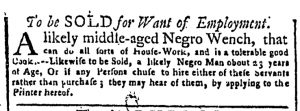
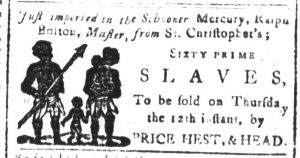
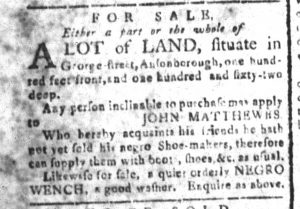
The Slavery Adverts 250 Project chronicles the role of newspaper advertising in perpetuating slavery in the era of the American Revolution. The project seeks to reveal the ubiquity of slavery in eighteenth-century life from New England to Georgia by republishing advertisements for slaves – for sale, wanted to purchase, runaways, captured fugitives – in daily digests on this site as well as in real time via the @SlaveAdverts250 Twitter feed, utilizing twenty-first-century media to stand in for the print media of the eighteenth century.

The project aims to provide modern audiences with a sense of just how often colonists encountered these advertisements in their daily lives. Enslaved men, women, and children appeared in print somewhere in the colonies almost every single day. Those advertisements served as a constant backdrop for social, cultural, economic, and political life in colonial and revolutionary America. Colonists who did not own slaves were still confronted with slavery as well as invited to maintain the system by purchasing slaves or assisting in the capture of runaways. The frequency of these newspaper advertisements suggests just how embedded slavery was in colonial and revolutionary American culture in everyday interactions beyond the printed page.

These advertisements also testify to the experiences of enslaved men, women, and children, though readers must consider that those experiences have been remediated through descriptions offered by slaveholders rather than the slaves themselves. Often unnamed in the advertisements, enslaved men, women, and children were not invisible or unimportant in early America.

These advertisements appeared in colonial American newspapers 250 years ago today.

Boston Evening-Post (January 2, 1769).

**********

Boston-Gazette (January 2, 1769).

**********

Massachusetts Gazette [Green and Russell] (January 2, 1769).

**********

Newport Mercury (January 2, 1769).

**********

Newport Mercury (January 2, 1769).

**********

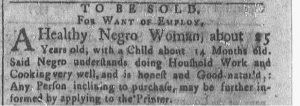
Supplement to the New-York Gazette and Weekly Mercury (January 2, 1769).

**********

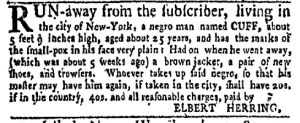
Supplement to the New-York Gazette and Weekly Mercury (January 2, 1769).

**********

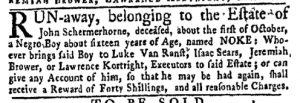
Supplement to the New-York Gazette and Weekly Mercury (January 2, 1769).

**********

Supplement to the New-York Gazette and Weekly Mercury (January 2, 1769).

**********

Supplement to the New-York Gazette and Weekly Mercury (January 2, 1769).

**********

Supplement to the New-York Gazette and Weekly Mercury (January 2, 1769).

**********

New-York Gazette: Or, the Weekly Post-Boy (January 2, 1769).

**********

New-York Gazette: Or, the Weekly Post-Boy (January 2, 1769).

**********

South-Carolina and American General Gazette (January 2, 1769).

**********

South-Carolina and American General Gazette (January 2, 1769).

**********

South-Carolina and American General Gazette (January 2, 1769).

**********

South-Carolina and American General Gazette (January 2, 1769).

**********

South-Carolina and American General Gazette (January 2, 1769).

**********

South-Carolina and American General Gazette (January 2, 1769).

January 1

What was advertised in a colonial American newspaper 250 years ago today?

Massachusetts Gazette [Draper] (December 29, 1768).
“Choice Fresh Lemmons.”

Readers of the December 29, 1768, edition of Richard Draper’s Massachusetts Gazette encountered two advertisements placed by John Crosby. One appeared at the bottom of the center column on the first page, the other at the top of the center column on the final page. In both, Crosby directed prospective customers to his shop “at the Sign of the Basket of Lemmons” in the South End of Boston. Placing two advertisements in a single issue was an innovative strategy. It became common practice by the end of the eighteenth century, but by then daily newspapers provided much more space for advertising than the weeklies published prior to the American Revolution. Advertisers who attempted to saturate the marketplace instead opted to insert the same advertisement in multiple newspapers rather than a series of advertisements in a single issue.

Crosby adopted that more familiar strategy as well. On December 26, the Boston-Gazette and Green and Russell’s Massachusetts Gazette carried advertisements that announced “JOHN CROSBY, Lemmon Trader, at the Sign of the Basket of Lemmons” sold “CHOICE good and fresh Lisbon LEMMONS” that were as large and as a good as any sold in Boston. The same advertisement appeared in the January 2, 1769, edition of the Boston Chronicle. The typography of the advertisements varied according to the discretion of the compositors in each printing office, but the advertising copy was consistent across all three newspapers. Crosby presented himself, his shop sign, and his merchandise to readers of multiple newspapers, increasing the likelihood that prospective customers would see his advertisement and reinforcing his marketing messages for those who happened to read more than one of Boston’s newspapers.

Yet neither of Crosby’s two advertisements in Draper’s Massachusetts Gazette was the one that ran in the other newspapers. The shorter one, similar in length, hawked oranges and potatoes. The lengthier one, complete with a headline that proclaimed “Choice Fresh Lemmons,” listed a variety of other merchandise available at Crosby’s shop. In addition to lemons, limes, and oranges, he also sold “stone Necklaces,” “small tooth fine Tortoiseshell Combs,” and “labell’d Decanters with the Word MADEIRA on them.” Crosby may not have considered it necessary to insert the same advertisement that ran in the other newspapers. Although this lengthier advertisement lacked the appeals to quality, it did specify the same prices. It also presented a greater array of choices to consumers, an alternate means of attracting customers. Instead of following an established practice of placing the same advertisement in every newspaper, Crosby experimented with running one advertisement in several newspapers while simultaneously inserting more than one advertisement in yet another newspaper. He did not rely on a single method for enhancing his visibility in the colonial marketplace.