January 7

What was advertised in a colonial American newspaper 250 years ago today?

Providence Gazette (January 7, 1769).

“A HORSE stolen!”

Among the new advertisements that ran in the January 7, 1769, edition of the Providence Gazette, one proclaimed “A HORSE stolen!” Following that headline, the advertisement included further details, such as a description of the horse (“14 Hands and a half high, well set, 9 Years old, a dark Sorrel, intermixed with some white Hairs, and has some Spots under the Saddle”) and the date and time it had been stolen (“Tuesday Evening, the 27th of December”). The thief had made off with the saddle, bridle, and saddlebags as well. Finally, the advertisement offered two rewards: five dollars for finding and returning the horse or ten dollars for capturing the thief along with locating the horse.

While most of contents of the advertisement were standard for the genre, the lively headline, including the exclamation point, was not. The headline did, however, echo the headline in another advertisement in the same issue, the Once more! that introduced an estate notice placed by executors Joseph Olney, Jr., and Jonathan Arnold. That advertisement also ran in the previous issue. Perhaps Samuel Danielson, Jr., had seen Olney and Arnold’s estate notice. Perhaps it had influenced him to devise a bold headline for his own advertisement. The signature at the end of Danielson’s advertisement indicated that he composed it on January 5 (even though the theft took place on December 27). He certainly could have seen the contents of the December 31 edition, including Olney and Arnold’s “Once more!” notice, before composing the copy for his own advertisement.

Danielson’s “A HORSE stolen!” headline suggests that eighteenth-century readers noted innovations in advertising and that some advertisers adopted those innovations when placing their own notices in the public prints. Yet they did so unevenly. Many other advertisers continued to place notices that deployed their names as the headlines or did not feature headlines at all. Notable for their innovation in the eighteenth century, headlines like “Once more!” and “A HORSE stolen!” were precursors of a common strategy later incorporated into newspaper advertisements in the nineteenth century.

Slavery Advertisements Published January 7, 1769

The Slavery Adverts 250 Project chronicles the role of newspaper advertising in perpetuating slavery in the era of the American Revolution. The project seeks to reveal the ubiquity of slavery in eighteenth-century life from New England to Georgia by republishing advertisements for slaves – for sale, wanted to purchase, runaways, captured fugitives – in daily digests on this site as well as in real time via the @SlaveAdverts250 Twitter feed, utilizing twenty-first-century media to stand in for the print media of the eighteenth century.

The project aims to provide modern audiences with a sense of just how often colonists encountered these advertisements in their daily lives. Enslaved men, women, and children appeared in print somewhere in the colonies almost every single day. Those advertisements served as a constant backdrop for social, cultural, economic, and political life in colonial and revolutionary America. Colonists who did not own slaves were still confronted with slavery as well as invited to maintain the system by purchasing slaves or assisting in the capture of runaways. The frequency of these newspaper advertisements suggests just how embedded slavery was in colonial and revolutionary American culture in everyday interactions beyond the printed page.

These advertisements also testify to the experiences of enslaved men, women, and children, though readers must consider that those experiences have been remediated through descriptions offered by slaveholders rather than the slaves themselves. Often unnamed in the advertisements, enslaved men, women, and children were not invisible or unimportant in early America.

These advertisements appeared in colonial American newspapers 250 years ago today.

Providence Gazette (January 7, 1769).

January 6

What was advertised in a colonial American newspaper 250 years ago today?

New-Hampshire Gazette (January 6, 1769).

Printed on Paper made in New-England.”

Daniel Fowle and Robert Fowle, the printers of the New-Hampshire Gazette, found themselves in a predicament at the beginning of 1769. They could not acquire paper of the same size as they usually printed the newspaper, forcing them to publish it on smaller broadsheets. As a result, the first issue of the new year consisted of two columns per page rather than three, significantly reducing space available for news and advertising.

The Fowles could have avoided this inconvenience if they had been willing to print the New-Hampshire Gazette on paper imported from England. They explained the situation to readers in a notice that appeared as the first item in the January 6 edition. First, they extended an apology for distributing an issue “on so small a Paper.” Then they noted that “For some Time past it has not only been printed on paper made in New-England, but some of it our of the very Rags collected in Portsmouth.” At various times, the Fowles had encouraged colonists to donate, barter, or sell rags for the purpose of making paper. Their efforts paralleled those of others who manufactured paper in the colonies, including an emphasis on the politics of domestic consumption. The Fowles declared that they were “determined to make use of as little as possible on which the Duties must be paid,” referring to indirect taxes imposed by Parliament via the Townshend Act. In their own act of resistance, they “declined sending to London for any, for some Time” and instead “spared no Pains to get such as is manufactured here.” They anticipated that supplies of larger broadsheets produced locally would soon become available once again, but for the moment they once again apologized and extended “the Compliments of the Season” to their subscribers and other readers.

This notice implicitly reminded colonists of an important role they could play in opposing the Townshend Act: turning their linen rags over to printers and paper manufacturers. Those who already did so likely read issues of the New-Hampshire Gazette printed on paper produced from some of their own rags. More explicitly, the Fowles linked the production of their newspaper to the politics of the period, asserting that even their choice of paper had ramifications. They boycotted imported paper in order to avoid paying the duties, choosing instead to join the movement for the production and consumption of domestic goods. Each time colonists read or placed an advertisement in the New-Hampshire Gazette, they indirectly participated in that movement as well.

Slavery Advertisements Published January 6, 1769

The Slavery Adverts 250 Project chronicles the role of newspaper advertising in perpetuating slavery in the era of the American Revolution. The project seeks to reveal the ubiquity of slavery in eighteenth-century life from New England to Georgia by republishing advertisements for slaves – for sale, wanted to purchase, runaways, captured fugitives – in daily digests on this site as well as in real time via the @SlaveAdverts250 Twitter feed, utilizing twenty-first-century media to stand in for the print media of the eighteenth century.

The project aims to provide modern audiences with a sense of just how often colonists encountered these advertisements in their daily lives. Enslaved men, women, and children appeared in print somewhere in the colonies almost every single day. Those advertisements served as a constant backdrop for social, cultural, economic, and political life in colonial and revolutionary America. Colonists who did not own slaves were still confronted with slavery as well as invited to maintain the system by purchasing slaves or assisting in the capture of runaways. The frequency of these newspaper advertisements suggests just how embedded slavery was in colonial and revolutionary American culture in everyday interactions beyond the printed page.

These advertisements also testify to the experiences of enslaved men, women, and children, though readers must consider that those experiences have been remediated through descriptions offered by slaveholders rather than the slaves themselves. Often unnamed in the advertisements, enslaved men, women, and children were not invisible or unimportant in early America.

These advertisements appeared in colonial American newspapers 250 years ago today.

Connecticut Journal (January 6, 1769).

January 5

What was advertised in a colonial American newspaper 250 years ago today?

Boston Weekly News-Letter (January 5, 1768).

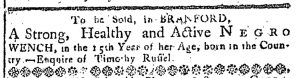
“A Strong and healthy Negro MAN … addicted to be out of Nights.”

An advertisement in the January 5, 1768, edition of the Boston Weekly News-Letter offered a “Strong and healthy Negro MAN, about twenty Years old” for sale. The advertiser also proposed swapping the enslaved man “for a Negro Girl.” The notice did not offer many other details about the slave except to specify that he was “most suitable for the Country,” not because of any particular skills that he possessed but instead because he was “addicted to be out of Nights.” The anonymous advertiser implied that the enslaved man would be easier to manage when removed from an urban environment.

In that regard, this advertisement seeking to sell an enslaved man differed from most others that listed enslaved men, women, and children for sale. When describing why they intended to part with their human property, advertisers frequently declared that they were “for sale for no fault, but the want of employ” (as was the case in a notice that ran in the Pennsylvania Gazette on the same day). Other times advertisers reported that they were selling their possessions in advance of leaving the colony or provided other reasons that assured prospective buyers that the enslaved men, women, or children were not for sale because they were disobedient, disabled, or in poor health. This advertisement, on the other hand, did identify a fault, though one that could be managed in the right circumstances. In so doing, it offered a story of resistance not present in other advertisements that presented enslaved men, women, and children for sale.

Another category of advertisements concerning slaves regularly recounted stories of resistance. Advertisements for runaway slaves, as well as advertisements for captured fugitives who had been imprisoned, described their subjects in very different ways. Such advertisements purposefully adopted derogatory language, including adjectives like “cunning,” “artful,” and “bold” to report that runaways were intelligent, creative, and courageous. Advertisers offering slaves for sale avoided such disparaging characterizations or else risk scaring away buyers. The anonymous advertiser who wished to sell or exchange a “Strong and healthy Negro MAN,” however, apparently did not believe that he or she could avoid disclosing that the enslaved man was indeed sometimes difficult to control.

Read from the perspective of the enslaved man “addicted to be out of Nights,” this advertisement reveals an inquisitive young person who refused to be confined when a bustling port city offered so many possibilities for exploring and interacting with others outside of the supervision of the slaveholder. The friends and associates that he chose may have been as much a concern as his absence at nights. The unnamed “Strong and healthy Negro MAN” could have made a habit of departing in the evenings in order to be intentionally disruptive, fully realizing that such behavior inconvenienced and angered the slaveholder who perpetuated his bondage. That the advertiser did not sign the notice but instead instructed interested parties to “Enquire at Draper’s Printing Office” further suggests that the slaveholder did not want it widely known that he or she failed to exercise sufficient authority to keep the recalcitrant slave in check. Although advertisements for runaways categorically told stories of resistance, advertisements offering slaves for sale also sometimes related stories of resistance and challenges to the racial hierarchy in early America.

Slavery Advertisements Published January 5, 1769

The Slavery Adverts 250 Project chronicles the role of newspaper advertising in perpetuating slavery in the era of the American Revolution. The project seeks to reveal the ubiquity of slavery in eighteenth-century life from New England to Georgia by republishing advertisements for slaves – for sale, wanted to purchase, runaways, captured fugitives – in daily digests on this site as well as in real time via the @SlaveAdverts250 Twitter feed, utilizing twenty-first-century media to stand in for the print media of the eighteenth century.

The project aims to provide modern audiences with a sense of just how often colonists encountered these advertisements in their daily lives. Enslaved men, women, and children appeared in print somewhere in the colonies almost every single day. Those advertisements served as a constant backdrop for social, cultural, economic, and political life in colonial and revolutionary America. Colonists who did not own slaves were still confronted with slavery as well as invited to maintain the system by purchasing slaves or assisting in the capture of runaways. The frequency of these newspaper advertisements suggests just how embedded slavery was in colonial and revolutionary American culture in everyday interactions beyond the printed page.

These advertisements also testify to the experiences of enslaved men, women, and children, though readers must consider that those experiences have been remediated through descriptions offered by slaveholders rather than the slaves themselves. Often unnamed in the advertisements, enslaved men, women, and children were not invisible or unimportant in early America.

These advertisements appeared in colonial American newspapers 250 years ago today.

Boston Weekly News-Letter (January 5, 1769).

**********

Boston Weekly News-Letter (January 5, 1769).

**********

Pennsylvania Gazette (January 5, 1769).

**********

Pennsylvania Gazette (January 5, 1769).

**********

Virginia Gazette [Rind] (January 5, 1769).

**********

Virginia Gazette [Rind] (January 5, 1769).

**********

Virginia Gazette [Rind] (January 5, 1769).

**********

Virginia Gazette [Rind] (January 5, 1769).

**********

Virginia Gazette [Rind] (January 5, 1769).

**********

Virginia Gazette [Rind] (January 5, 1769).

**********

Virginia Gazette [Rind] (January 5, 1769).

**********

Virginia Gazette [Rind] (January 5, 1769).

**********

Virginia Gazette [Rind] (January 5, 1769).

**********

Virginia Gazette [Rind] (January 5, 1769).

**********

Virginia Gazette [Rind] (January 5, 1769).

January 4

What was advertised in a colonial American newspaper 250 years ago today?

Georgia Gazette (January 4, 1769).

“They desire all persons indebted to them … to settle their respective debts.”

Among purveyors of consumer goods in Savannah, the partnership of Inglis and Hall placed the lengthiest advertisements in the Georgia Gazette in the late 1760s. They also advertised more frequently than many of their counterparts, so regular readers of the colony’s only newspaper were probably not surprised that the first issue for 1769 included an advertisement from Inglis and Hall. As a new advertisement, it appeared first among all of the paid notices in that edition.

With the arrival of the new year, the partners took the opportunity to announce that they “HAVE now on hand, A Neat Assortment of Dry Goods, consisting of a great variety of the most useful articles.” In many of their advertisements Inglis and Hall elaborated on this appeal to consumer choice by listing dozens of items included among their inventory. They placed less emphasis on enticing end-use consumers among colonists than cultivating clients who participated in “the Indian Trade.” They did list strouds, an especially popular textile among Indians who bartered with colonial traders, “Trading Guns, Tomahawks, Gunpowder, Ball, &c. &c.” When it came to those items, they offered a discount “to any person taking a quantity” or the entire stock. They began the new year with an attempt to dispose of significant portions of their inventory in large transactions.

Inglis and Hall also seized on the first of the year as an appropriate time to call on customers and associates to settle accounts. Instead of “N.B.” (for nota bene or “take notice”), they used three stars to call attention to that request: “They desire all persons indebted to them by bond, note, or book account, to settle their respective debts on or before the first day of March.” Unlike other advertisers throughout the colonies, they did not allude to the ramifications of neglecting to make payment. That could wait for subsequent advertisements if “persons indebted to them” did not respond to the initial notice.

Although Inglis and Hall’s first newspaper advertisement for 1769 did promote consumer goods, the partners devoted much more space to other business operations: settling accounts and wholesale transactions with colonists involved in “the Indian Trade.” Merchants, shopkeepers, and other purveyors of consumer goods often pursued multiple purposes in their newspaper advertisements in the eighteenth century, providing an overview of their business practices.

Slavery Advertisements Published January 4, 1769

The Slavery Adverts 250 Project chronicles the role of newspaper advertising in perpetuating slavery in the era of the American Revolution. The project seeks to reveal the ubiquity of slavery in eighteenth-century life from New England to Georgia by republishing advertisements for slaves – for sale, wanted to purchase, runaways, captured fugitives – in daily digests on this site as well as in real time via the @SlaveAdverts250 Twitter feed, utilizing twenty-first-century media to stand in for the print media of the eighteenth century.

The project aims to provide modern audiences with a sense of just how often colonists encountered these advertisements in their daily lives. Enslaved men, women, and children appeared in print somewhere in the colonies almost every single day. Those advertisements served as a constant backdrop for social, cultural, economic, and political life in colonial and revolutionary America. Colonists who did not own slaves were still confronted with slavery as well as invited to maintain the system by purchasing slaves or assisting in the capture of runaways. The frequency of these newspaper advertisements suggests just how embedded slavery was in colonial and revolutionary American culture in everyday interactions beyond the printed page.

These advertisements also testify to the experiences of enslaved men, women, and children, though readers must consider that those experiences have been remediated through descriptions offered by slaveholders rather than the slaves themselves. Often unnamed in the advertisements, enslaved men, women, and children were not invisible or unimportant in early America.

These advertisements appeared in colonial American newspapers 250 years ago today.

Georgia Gazette (January 4, 1769).

**********

Georgia Gazette (January 4, 1769).

**********

Georgia Gazette (January 4, 1769).

**********

Georgia Gazette (January 4, 1769).

**********

Georgia Gazette (January 4, 1769).

**********

Georgia Gazette (January 4, 1769).

**********

Georgia Gazette (January 4, 1769).

**********

Georgia Gazette (January 4, 1769).

**********

Georgia Gazette (January 4, 1769).

**********

Georgia Gazette (January 4, 1769).

**********

Georgia Gazette (January 4, 1769).

**********

Georgia Gazette (January 4, 1769).

January 3

What was advertised in a colonial American newspaper 250 years ago today?

Essex Gazette (January 3, 1768).

The Declaration and Confession of Ruth Blay will be printed To-morrow.”

Infanticide and a public execution: read all about it! When compiling the contents for the first issue of the Essex Gazette for 1769, printer Samuel Hall devised one item that was part news and part advertisement. “We hear from Portsmouth,” the notice began, “That last Friday the unfortunate Ruth Blay was executed there, pursuant to her Sentence.” Hall did not go into great detail about the sequence of events, likely assuming that most readers were already familiar with the infamous case of an unmarried schoolmistress who had been convicted of concealing the birth of an illegitimate child in southern New Hampshire. The printer did report that Blay “behaved in a very penitent Manner, but denied … Murdering her Infant Child.” Before her execution, the schoolmistress “sign’d a Declaration and Confession.” Hall reprinted a portion of that document, both to inform readers and to entice them to purchase a copy of their own. The notice ended with an announcement, printed in italics and larger type to garner attention, that “The Declaration and Confession of Ruth Blay will be printed To-morrow.”

Hall leveraged current events in the service of earning revenues. He stoked interest in the Blay case by providing a teaser from the “Declaration and Confession” in advance of publishing his own edition. Daniel Fowle and Robert Fowle, the printers of the New-Hampshire Gazette, had already published Blay’s appeal early in the morning on the day of her execution, at “2 o’clock Friday morning December 30, 1768” according to the imprint. Hall apparently acquired a copy, perhaps from the same messenger who brought news that Blay’s execution had finally occurred after she had received a series of reprieves. No known copy of an edition printed by Hall survives, but the Peabody Essex Museum and the Harry Ransom Center at the University of Texas at Austin both have copies of the broadside attributed to the Fowles. The promised edition advertised in the Essex Gazette may never have gone to press, but Hall certainly could have printed copies of the broadside to offer for sale shortly after prospective customers saw the notice in the newspaper. He certainly would not have been the only printer who marketed memorabilia related to crimes and executions. First Thomas Green and Samuel Green and later printers in Boston printed and advertised a pamphlet about “the Life and Abominable Thefts” of Isaac Frasier in the wake of his execution for burglary in September 1768. Hall’s notice, part news and part advertisement, suggests that he also saw an opportunity to profit from print culture that entertained readers with the story of an infamous criminal.

For more on Ruth Blay, see Sharon L. Jansen’s “Ruth Blay and the Crime of Concealing the Birth of a ‘Bastard’ Child,” which includes an image of the Portsmouth Athenaeum’s photocopy of the “Declaration & Confession of Ruth Blay” printed by the Fowles.

January 2

What was advertised in a colonial American newspaper 250 years ago today?

“Received many intimations and advices, from numbers of our Subscribers.”

Boston Chronicle (January 2, 1769).

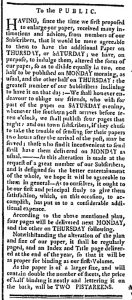
When the Boston Chronicle concluded its first year of publication, printers John Mein and John Fleeming inserted a lengthy notice that listed several proposed “Amendments and Additions.” These included “enlarg[ing] the size of our Paper one half more,” starting on the first Monday of January 1769. When that day arrived, however, Mein and Fleeming published a new address “To the PUBLIC” to explain that they had further revised their proposals in response to requests received “from numbers of our Subscribers.” Rather than a larger newspaper delivered once a week on Mondays, those subscribers stated a preference for an “additional Paper on THURSDAY, or SATURDAY.”

While certainly informal compared to modern standards, this feedback amounted to market research for the printers. Mein and Fleeming weighed the evidence before making their final determination about the new plan for their publication. In choosing between Thursday and Saturday for a second edition, they opted for Thursday due to “the greatest number of our Subscribers inclining to have it on that day.” Yet they did not wish to disappoint those who desired a Saturday edition. To that end, they devised an alternative when circumstances permitted: “to oblige our friends, who wish for part of the paper on SATURDAY evening, whenever the southern post arrives before seven o’clock, we shall publish four pages that night.” Subscribers who lived in town could send for their newspapers two hours after the arrival of the post. Any who declined to do so could depend on the newspaper being delivered on Monday as usual.

Mein and Fleeming underscored that they made these changes in acknowledgment of the needs and desires expressed by their customers: “this alteration is made at the request of a great number of our Subscribers, and is designed for the better entertainment of the whole.” The printers made it their “first and principal study to give them satisfaction.” In other words, when presented with the results of rudimentary market research, Mein and Fleeming adjusted their business model accordingly in order to better serve their customers. In so doing, they commenced a new publication schedule unlike that of any other newspaper in the city. The Boston Evening-Post, the Boston-Gazette, the Boston Post-Boy, the Boston Weekly News-Letter, Draper’s Massachusetts Gazette, and Green and Russell’s Massachusetts Gazette all continued as weeklies. The Boston Chronicle became a semiweekly in response to customer demand, at least according to the address “To the PUBLIC” the printers inserted in the first issue for 1769.