
What was advertised in a revolutionary American newspaper 250 years ago today?
“The Presses, the important vehicles of instruction and amusement, must soon be reduced to the same unhappy situation.”
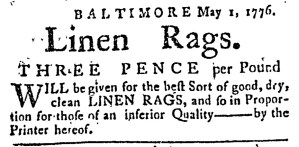
During an ongoing shortage of paper, John Dixon and William Hunter, the printers of the Virginia Gazette in Williamsburg, were not the only printers in the Chesapeake who inserted a call for “CLEAN LINEN RAGS” to recycle into paper in their newspaper in June 1776. Frederick Green, the printer of the Maryland Gazette in Annapolis, inserted such a notice in the June 20 edition: “THREE PENCE per pound is given for fine white LINEN RAGS, and one penny per pound for coarse, by the Printer hereof.” On June 19, the printers of both newspapers published in Baltimore ran similar notices. Mary Katharine Goddard, the printer of the Maryland Journal, ran (once again!) an advertisement similar to Green’s notice. Since May 1, she had been informing readers that “THREE PENCE per Pound WILL be given for the best Sort of good, dry, clean LINEN RAGS, and so in Proportion for those of an inferior Quality.” To draw attention, she used “Linen Rags” in a much larger font as a headline for the advertisement.
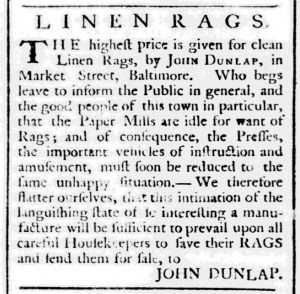
John Dunlap composed a more elaborate notice for Dunlap’s Maryland Gazette. Beneath a headline that proclaimed, “LINEN RAGS,” in capital letters, he informed readers that the “highest price is given for clean Linen Rags, by JOHN DUNLAP.” He went on to explain to “the Public in general, and the good people of this town in particular” that “the Paper Mills are idle for want of Rags.” As a result, “the Presses, the important vehicles of instruction and amusement” – and news about politics, commerce, and current events as the war continued and the Continental Congress moved closer and closer to declaring independence – “must soon be reduced to the same unhappy situation” of sitting idle. “We therefore flatter ourselves,” Dunlap confidently asserted, “that this intimation of the languishing state of so interesting a manufacture will be sufficient to prevail upon all careful Housekeepers to save their RAGS and send them for sale.” In other words, anyone who wanted to continue receiving the news via Dunlap’s Maryland Gazette or any other newspaper needed to do their part in supplying rags for the paper mills. Women in particular, those “careful Housekeepers,” had an important role to play in making it possible for newspapers to disseminate the “FRESHEST ADVICES, both FOREIGN and DOMESTIC,” promised in the masthead of the Maryland Journal and other newspapers.