January 25

What was advertised in a colonial American newspaper 250 years ago today?

Jan 25 - 1:25:1770 New-York Journal
New-York Journal (January 25, 1770).

“A new Non-Importation Agreement.”

“A Likely Negro Man and a Wench.”

The first two advertisements that appeared in the January 25, 1770, edition of the New-York Journal tell very different stories about the era of the American Revolution. The first addressed efforts to resist the abuses of Parliament, the figurative enslavement of the colonies. The second offered a Black man and woman for sale, perpetuating their enslavement rather than setting them free. That one advertisement followed immediately after the other testifies to the uneven rhetoric of the era as well as the stark tension between liberty (for some) and slavery (for many) at the time of the nation’s founding.

The first advertisement called on the “Signers of the Agreement relative to the Traders of Rhode-Island” to meet and discuss how to proceed in their dealings with the merchants in that nearby colony. The trouble arose when Rhode Island did not adhere to nonimportation agreements adopted throughout the rest of New England as well as in New York and Pennsylvania. In response, merchants, shopkeepers, and others in New York decided that they would no longer engage in trade with their counterparts in Rhode Island, broadening the nonimportation agreement to include fellow colonists who acted contrary to the interests of the colonies. When New York received word from Newport of “a new Non-importation Agreement, lately come into at that Place,” those who had ceased trade with the colony met to reconsider once the merchants there had been brought into line.

The second advertisement presented “A Likely Negro Man and a Wench,” instructing “Any person inclining to purchase them” to enquire of the printer. The unnamed advertiser described the enslaved man and woman as “fit for a Farmer, or any private Family” and offered assurances of their health by noting that they “both had the Small-Pox and Measles” so would not contract those diseases again. The advertiser added a nota bene asserting that the man and woman treated no differently than commodities were “Both young,” one more attempt to incite interest from potential buyers. The anonymous enslaver opened with advertisement with an explanation that that Black man and women were “To be sold, for no Fault, but Want of Cash.” In other words, they were not disobedient, difficult to manage, or ill. The enslaver simply needed to raise some ready money; selling the man and woman provided a convenient means of doing so.

One advertisement addressed a widespread movement to use commerce as a political tool to prevent the colonies from being enslaved by Parliament. The other depicted the continued enslavement and disregard for a “Negro Man and a Wench” not entitled to the same liberty that white New Yorkers claimed for themselves. The colonial press, in collaboration with colonists who placed newspaper notices, maintained and even bolstered the contradictory discourse contained in the two advertisements.

Slavery Advertisements Published January 25, 1770

The Slavery Adverts 250 Project chronicles the role of newspaper advertising in perpetuating slavery in the era of the American Revolution. The project seeks to reveal the ubiquity of slavery in eighteenth-century life from New England to Georgia by republishing advertisements for slaves – for sale, wanted to purchase, runaways, captured fugitives – in daily digests on this site as well as in real time via the @SlaveAdverts250 Twitter feed, utilizing twenty-first-century media to stand in for the print media of the eighteenth century.

The project aims to provide modern audiences with a sense of just how often colonists encountered these advertisements in their daily lives. Enslaved men, women, and children appeared in print somewhere in the colonies almost every single day. Those advertisements served as a constant backdrop for social, cultural, economic, and political life in colonial and revolutionary America. Colonists who did not own slaves were still confronted with slavery as well as invited to maintain the system by purchasing slaves or assisting in the capture of runaways. The frequency of these newspaper advertisements suggests just how embedded slavery was in colonial and revolutionary American culture in everyday interactions beyond the printed page.

These advertisements also testify to the experiences of enslaved men, women, and children, though readers must consider that those experiences have been remediated through descriptions offered by slaveholders rather than the slaves themselves. Often unnamed in the advertisements, enslaved men, women, and children were not invisible or unimportant in early America.

These advertisements appeared in colonial American newspapers 250 years ago today.

Jan 25 1770 - Maryland Gazette Slavery 1
Maryland Gazette (January 25, 1770).

**********

Jan 25 1770 - Maryland Gazette Slavery 2
Maryland Gazette (January 25, 1770).

**********

Jan 25 1770 - New-York Journal Slavery 1
New-York Journal (January 25, 1770).

**********

Jan 25 1770 - New-York Journal Slavery 2
New-York Journal (January 25, 1770).

**********

Jan 25 1770 - New-York Journal Slavery 3
New-York Journal (January 25, 1770).

**********

Jan 25 1770 - South-Carolina Gazette Slavery 1
South-Carolina Gazette (January 25, 1770).

**********

Jan 25 1770 - South-Carolina Gazette Slavery 2
South-Carolina Gazette (January 25, 1770).

**********

Jan 25 1770 - South-Carolina Gazette Slavery 3
South-Carolina Gazette (January 25, 1770).

**********

Jan 25 1770 - South-Carolina Gazette Slavery 4
South-Carolina Gazette (January 25, 1770).

**********

Jan 25 1770 - South-Carolina Gazette Slavery 5
South-Carolina Gazette (January 25, 1770).

**********

Jan 25 1770 - South-Carolina Gazette Slavery 6
South-Carolina Gazette (January 25, 1770).


January 24

What was advertised in a colonial American newspaper 250 years ago today?

Jan 24 - 1:24:1770 Georgia Gazette
Georgia Gazette (January 24, 1770).

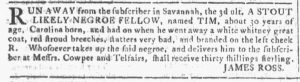
“RUN AWAY … A STOUT LIKELY NEGROE FELLOW, named TIM.”

A dozen advertisements about enslaved men, women, and children ran in the January 24, 1770, edition of the Georgia Gazette. Some offered them for sale like commodities. One sought skilled laborers, sawyers and squarers, “on Hire by the Year,” with the wages going to the enslaver rather than the workers. A regular feature, the “Brought to the Work-house” notice that often appeared as the last item on the final page of the Georgia Gazette, described four “NEGROE FELLOWS” captured and confined until those who asserted ownership claimed them.

In the midst of all the depictions of selling and imprisoning of enslaved people spread throughout the colony’s only newspaper, the vast majority of them unnamed in the advertisements, two notices did include names, at least the names that enslavers called those they held in bondage. Charlotte, a woman born in the colonies and “well known about Savannah,” escaped from William Mackenzie a week earlier. Tim, a man “about 30 years of age, Carolina born,” escaped more than a month earlier. Readers could recognize him by his “white whitney great coat, [and] red stroud breeches” as well as by his stutter if they attempted to engage him in conversation or challenge him with questions. Perhaps most distinctively, at some point Tim had been “branded on the left cheek” with the letter “R,” perhaps denoting “runaway” after a previous unsuccessful attempt to make good on his escape.

Like all of the advertisements concerning enslaved men, women, and children, filtered through the perspectives of enslavers, these two advertisements for “runaways” tell exceptionally abbreviated stories about their experiences. Although incomplete, they testify to a spirit of resistance and survival in the era of the American Revolution. As colonists decried their figurative enslavement to Parliament during the imperial crisis, Charlotte and Tim did not need a tutorial on the meaning of liberty. The fragmentary evidence in newspaper advertisements does not allow historians and others to reconstruct their stories as completely as the stories of white colonists who left behind more documents, but those notices do give us a glimpse of other struggles for freedom that took place during the imperial crisis. Enslaved men, women, and children had been seizing their own liberty by escaping from their captors long before the era of the American Revolution. They would continue to do so for nearly another century until slavery was abolished throughout the United States after the Civil War.

Slavery Advertisements Published January 24, 1770

The Slavery Adverts 250 Project chronicles the role of newspaper advertising in perpetuating slavery in the era of the American Revolution. The project seeks to reveal the ubiquity of slavery in eighteenth-century life from New England to Georgia by republishing advertisements for slaves – for sale, wanted to purchase, runaways, captured fugitives – in daily digests on this site as well as in real time via the @SlaveAdverts250 Twitter feed, utilizing twenty-first-century media to stand in for the print media of the eighteenth century.

The project aims to provide modern audiences with a sense of just how often colonists encountered these advertisements in their daily lives. Enslaved men, women, and children appeared in print somewhere in the colonies almost every single day. Those advertisements served as a constant backdrop for social, cultural, economic, and political life in colonial and revolutionary America. Colonists who did not own slaves were still confronted with slavery as well as invited to maintain the system by purchasing slaves or assisting in the capture of runaways. The frequency of these newspaper advertisements suggests just how embedded slavery was in colonial and revolutionary American culture in everyday interactions beyond the printed page.

These advertisements also testify to the experiences of enslaved men, women, and children, though readers must consider that those experiences have been remediated through descriptions offered by slaveholders rather than the slaves themselves. Often unnamed in the advertisements, enslaved men, women, and children were not invisible or unimportant in early America.

These advertisements appeared in colonial American newspapers 250 years ago today.

Jan 24 1770 - Georgia Gazette Slavery 1
Georgia Gazette (January 24, 1770).

**********

Jan 24 1770 - Georgia Gazette Slavery 2
Georgia Gazette (January 24, 1770).

**********

Jan 24 1770 - Georgia Gazette Slavery 3
Georgia Gazette (January 24, 1770).

**********

Jan 24 1770 - Georgia Gazette Slavery 4
Georgia Gazette (January 24, 1770).

**********

Jan 24 1770 - Georgia Gazette Slavery 5
Georgia Gazette (January 24, 1770).

**********

Jan 24 1770 - Georgia Gazette Slavery 6
Georgia Gazette (January 24, 1770).

**********

Jan 24 1770 - Georgia Gazette Slavery 12
Georgia Gazette (January 24, 1770).

**********

Jan 24 1770 - Georgia Gazette Slavery 7
Georgia Gazette (January 24, 1770).

**********

Jan 24 1770 - Georgia Gazette Slavery 8
Georgia Gazette (January 24, 1770).

**********

Jan 24 1770 - Georgia Gazette Slavery 9
Georgia Gazette (January 24, 1770).

**********

Jan 24 1770 - Georgia Gazette Slavery 10
Georgia Gazette (January 24, 1770).

**********

Jan 24 1770 - Georgia Gazette Slavery 11
Georgia Gazette (January 24, 1770).

January 23

What was advertised in a colonial American newspaper 250 years ago today?

Jan 23 - 1:23:1770 South-Carolina Gazette and Country Journal
South-Carolina Gazette and Country Journal (January 23, 1770).

“SUBSCRIPTIONS are taken in by the Printer of this Paper.”

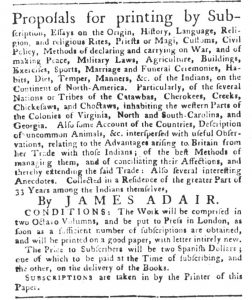
The many and various advertisements for consumer goods and services in the January 23, 1770, edition of the South-Carolina Gazette and Country Journal included a subscription notice for “Essays on … the Indians, on the Continent of North-America” by James Adair, who had resided “the greater Part of 33 Years among the Indians themselves.” Those essays focused “Particularly” on the Catawbas, Cherokees, Creeks, Chickasaws, and Choctaws “inhabiting the western Parts of the Colonies of Virginia, North and South-Carolina, and Georgia.” Given their proximity, the author or publisher expected that the proposed book would resonate with prospective subscribers in South Carolina … and in Georgia. The same subscription notice ran on several occasions in the Georgia Gazette in late 1769 and early 1770.

Charles Crouch, printer of the South-Carolina Gazette and Country Journal, and James Johnston, printer of the Georgia Gazette, acted as local agents on behalf of the author or publisher. The book would not go to press until enough “subscribers” expressed interest and confirmed their intention to buy it by putting down a deposit in advance. By enlisting local agents and seeking subscribers in South Carolina, Georgia, and likely other places as well, the author or publisher aimed to enlarge the market and make the proposed book a viable endeavor.

The advertisements in the two newspapers contained exactly the same copy (except for the final word, “Paper” instead of “Gazette”). The author or publisher may have written out the advertisement once and then carefully copied it into letters directed to multiple printing offices. Alternately, the subscription notice may have appeared once in one newspaper and then the author or publisher forwarded clippings along with requests to insert the notice in other newspapers when soliciting the cooperation of additional local agents. Depending on the sophistication of the marketing efforts, the author or publisher may even have distributed broadside subscription notices with space for subscribers to sign their names. The copy for newspaper advertisements could have been drawn directly from such broadsides.
Regardless of how the South-Carolina Gazette and Country Journal and the Georgia Gazette ended up publishing advertisements with identical copy, readers in the two colonies encountered the same subscription notice within a single week. This contributed to the creation of an imagined community among colonists, a common identity as readers and consumers, as the press presented the same news items, reprinted from one newspaper to another to yet another, and, sometimes, the same advertisements as well.

Slavery Advertisements Published January 23, 1770

The Slavery Adverts 250 Project chronicles the role of newspaper advertising in perpetuating slavery in the era of the American Revolution. The project seeks to reveal the ubiquity of slavery in eighteenth-century life from New England to Georgia by republishing advertisements for slaves – for sale, wanted to purchase, runaways, captured fugitives – in daily digests on this site as well as in real time via the @SlaveAdverts250 Twitter feed, utilizing twenty-first-century media to stand in for the print media of the eighteenth century.

The project aims to provide modern audiences with a sense of just how often colonists encountered these advertisements in their daily lives. Enslaved men, women, and children appeared in print somewhere in the colonies almost every single day. Those advertisements served as a constant backdrop for social, cultural, economic, and political life in colonial and revolutionary America. Colonists who did not own slaves were still confronted with slavery as well as invited to maintain the system by purchasing slaves or assisting in the capture of runaways. The frequency of these newspaper advertisements suggests just how embedded slavery was in colonial and revolutionary American culture in everyday interactions beyond the printed page.

These advertisements also testify to the experiences of enslaved men, women, and children, though readers must consider that those experiences have been remediated through descriptions offered by slaveholders rather than the slaves themselves. Often unnamed in the advertisements, enslaved men, women, and children were not invisible or unimportant in early America.

These advertisements appeared in colonial American newspapers 250 years ago today.

Jan 23 1770 - South-Carolina Gazette and Country Journal Slavery 1
South-Carolina Gazette and Country Journal (January 23, 1770).

**********

Jan 23 1770 - South-Carolina Gazette and Country Journal Slavery 2
South-Carolina Gazette and Country Journal (January 23, 1770).

**********

Jan 23 1770 - South-Carolina Gazette and Country Journal Slavery 3
South-Carolina Gazette and Country Journal (January 23, 1770).

**********

Jan 23 1770 - South-Carolina Gazette and Country Journal Slavery 4
South-Carolina Gazette and Country Journal (January 23, 1770).

**********

Jan 23 1770 - South-Carolina Gazette and Country Journal Slavery 5
South-Carolina Gazette and Country Journal (January 23, 1770).

**********

Jan 23 1770 - South-Carolina Gazette and Country Journal Slavery 6
South-Carolina Gazette and Country Journal (January 23, 1770).

**********

Jan 23 1770 - South-Carolina Gazette and Country Journal Slavery 7
South-Carolina Gazette and Country Journal (January 23, 1770).

**********

Jan 23 1770 - South-Carolina Gazette and Country Journal Slavery 8
South-Carolina Gazette and Country Journal (January 23, 1770).

**********

Jan 23 1770 - South-Carolina Gazette and Country Journal Slavery 9
South-Carolina Gazette and Country Journal (January 23, 1770).

**********

Jan 23 1770 - South-Carolina Gazette and Country Journal Slavery 10
South-Carolina Gazette and Country Journal (January 23, 1770).

**********

Jan 23 1770 - South-Carolina Gazette and Country Journal Slavery 11
South-Carolina Gazette and Country Journal (January 23, 1770).

**********

Jan 23 1770 - South-Carolina Gazette and Country Journal Slavery 12
South-Carolina Gazette and Country Journal (January 23, 1770).

**********

Jan 23 1770 - South-Carolina Gazette and Country Journal Slavery 13
South-Carolina Gazette and Country Journal (January 23, 1770).

January 22

What was advertised in a colonial American newspaper 250 years ago today?

Jan 22 - 1:22:1770 New-York Gazette and Weekly Mercury
New-York Gazette and Weekly Mercury (January 22, 1770).

He has brought with him ample Certificates of his Character.”

When John Girault, “A Native of FRANCE,” arrived in New York, he turned to the New-York Gazette and Weekly Mercury to introduce himself to the residents of that city. He also sought employment, stating that he “proposes to teach the French Language.” His origins testified to his knowledge of the language, but also raised suspicions. Less than a decade had passed since the Seven Years War concluded. That war began in the Ohio River valley, contested territory claimed by both Britain and France, but spread far beyond North America. Battles took place around the globe in what became a great war for empire that resulted in France ceding its claim to territory in North America. Yet the enmity between Britain, a Protestant nation-state, and France, a Catholic nation-state, extended back centuries. Colonists in New York had long been suspicious of French and Catholic threats to their colony as well as anxious that strangers from nearby New France would attempt to infiltrate the bustling port city for nefarious purposes.

Girault understood that he faced such suspicions when he migrated to New York. As part of his introduction, he announced that he “has brought with him ample Certificates of his Character, from the Consistory of a Protestant Congregation at Poitou in France, of which he was an Elder, and from the Consistory of a French Church in London, where he has resided for several Years.” As a “Stranger” in the colony, he offered reassurances that he was not a threat, but he did not merely ask his new neighbors to take him at his word. He arrived with documents that they could examine for themselves, in addition to offering “Messrs. James Buvelot, and Francis Bosset” as local references. At the same time that he declared himself “A Native of FRANCE” to establish his qualifications “to teach the French Language,” he also distanced himself from his place of origin by noting that he had lived in London for several years. Perhaps most importantly, he proclaimed himself a Protestant, hoping to alleviate suspicion about what might be his true purpose in the city. Even as New Yorkers and other colonists vied with Parliament over the Townshend Acts, they continued to have other concerns as members of the British Empire. Girault did what he could to address them in order to settle peacefully and to encourage students to take lessons from him.

For more on New Yorkers’ anxieties about French infiltrators in the first two thirds of the eighteenth century, see Serena R. Zabin, Dangerous Economies: Status and Commerce in Imperial New York.

Slavery Advertisements Published January 22, 1770

The Slavery Adverts 250 Project chronicles the role of newspaper advertising in perpetuating slavery in the era of the American Revolution. The project seeks to reveal the ubiquity of slavery in eighteenth-century life from New England to Georgia by republishing advertisements for slaves – for sale, wanted to purchase, runaways, captured fugitives – in daily digests on this site as well as in real time via the @SlaveAdverts250 Twitter feed, utilizing twenty-first-century media to stand in for the print media of the eighteenth century.

The project aims to provide modern audiences with a sense of just how often colonists encountered these advertisements in their daily lives. Enslaved men, women, and children appeared in print somewhere in the colonies almost every single day. Those advertisements served as a constant backdrop for social, cultural, economic, and political life in colonial and revolutionary America. Colonists who did not own slaves were still confronted with slavery as well as invited to maintain the system by purchasing slaves or assisting in the capture of runaways. The frequency of these newspaper advertisements suggests just how embedded slavery was in colonial and revolutionary American culture in everyday interactions beyond the printed page.

These advertisements also testify to the experiences of enslaved men, women, and children, though readers must consider that those experiences have been remediated through descriptions offered by slaveholders rather than the slaves themselves. Often unnamed in the advertisements, enslaved men, women, and children were not invisible or unimportant in early America.

These advertisements appeared in colonial American newspapers 250 years ago today.

Jan 22 1770 - Massachusetts Gazette and Boston Post-Boy Slavery 1
Massachusetts Gazette and Boston Post-Boy (January 22, 1770).

**********

Jan 22 1770 - Massachusetts Gazette and Boston Post-Boy Slavery 2
Massachusetts Gazette and Boston Post-Boy (January 22, 1770).

**********

Jan 22 1770 - New-York Gazette and Weekly Mercury Slavery 1
New-York Gazette and Weekly Mercury (January 22, 1770).

**********

Jan 22 1770 - New-York Gazette and Weekly Mercury Slavery 2
New-York Gazette and Weekly Mercury (January 22, 1770).

**********

Jan 22 1770 - New-York Gazette and Weekly Mercury Slavery 3
New-York Gazette and Weekly Mercury (January 22, 1770).

**********

Jan 22 1770 - New-York Gazette and Weekly Mercury Slavery 4
New-York Gazette and Weekly Mercury (January 22, 1770).

**********

Jan 22 1770 - New-York Gazette and Weekly Mercury Slavery 5
New-York Gazette and Weekly Mercury (January 22, 1770).

**********

Jan 22 1770 - New-York Gazette and Weekly Mercury Slavery 6
New-York Gazette and Weekly Mercury (January 22, 1770).

**********

Jan 22 1770 - New-York Gazette and Weekly Mercury Slavery 7
New-York Gazette and Weekly Mercury (January 22, 1770).

**********

Jan 22 1770 - New-York Gazette or Weekly Post-Boy Slavery 1
New-York Gazette or Weekly Post-Boy (January 22, 1770).

**********

Jan 22 1770 - New-York Gazette or Weekly Post-Boy Slavery 2
New-York Gazette or Weekly Post-Boy (January 22, 1770).

**********

Jan 22 1770 - Pennsylvania Chronicle Slavery 1
Pennsylvania Chronicle (January 22, 1770).

January 21

What was advertised in a colonial American newspaper 250 years ago this week?

Jan 21 - 1:18:1770 Pennsylvania Gazette
Pennsylvania Gazette (January 18, 1770).

“Every lover of his country will encourage … American manufactures.”

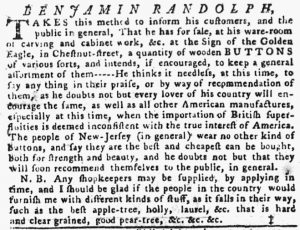
Benjamin Randolph, one of Philadelphia’s most prominent and successful cabinetmakers, was also a savvy advertiser. He inserted notices in the city’s newspapers, but he also distributed an elegant trade card that clearly demonstrated the influence of Thomas Chippendale’s Gentleman and Cabinet-maker’s Director (1754). Known for his furniture, Randolph also promoted other carved items produced in his shop “at the Sign of the Golden Eagle,” including “a quantity of wooden BUTTONS of various sorts.”

Buttons often appeared among the extensive lists of imported merchandise published in advertisements placed by merchants and shopkeepers. When consumers purchased textiles and trimmings to make garments, they also acquired buttons. At a time when colonists participated in nonimportation agreements to protest the duties on imported goods imposed by the Townshend Acts, Randolph offered an alternative to buttons from England. He made it clear to prospective customers that purchasing his buttons served a political function; doing so signaled support for the American cause. Rather than depend on consumer’s familiarity with current events and popular discourse about the political meaning of goods, Randolph plainly stated, “[E]very lover of his country will encourage [his buttons by purchasing them], as well as all other American manufactures, especially at this time, when the importation of British superfluities is deemed inconsistent with the true interest of America.” Randolph encouraged colonists to reject the “Baubles of Britain,” as T.H. Breen has so memorably named the consumer goods produced on the other side of the Atlantic and sent to American markets. Randolph made a bid not only for support of the items he produced but also others made in the colonies, showing solidarity with fellow artisans as they did their part in opposition to Parliament.
Such efforts, however, did not depend solely on Randolph and other artisans. Ultimately, consumers determined the extent of the effectiveness of producing “American manufactures” through the decisions they made about which and how many items to purchase and which to boycott. Randolph had “a quantity” of buttons on hand, but producing more depended on the reception he received from the residents of Philadelphia and its hinterlands. He would “keep a general assortment of them” but only “if encouraged.” Consumers had to demonstrate that they would partner with him in this act of resistance once Randolph presented them with the opportunity.

January 20

What was advertised in a colonial American newspaper 250 years ago today?

Jan 20 - 1:20:1770 Providence Gazette
Providence Gazette (January 20, 1770).

“WEST’s ALMANACKS … To be sold by the Printer hereof.”

In late January 1770, John Carter, publisher of both the Providence Gazette and Benjamin West’s New-England Almanack, continued to advertise the almanac in the newspaper, though he shifted his strategy. He commenced the new year by running the lengthy advertisement that previously ran in the Providence Gazette for many weeks once again in the January 6 edition, but then he did not advertise the almanac the following week. An advertisement appeared once again in the January 20 edition, though much abbreviated. Rather than enticing prospective customers with an extensive description of the almanac’s useful and entertaining contents, the new advertisement simply announced, “WEST’s ALMANACKS, For the present Year … To be sold by the Printer hereof.”

Perhaps Carter weighed the space occupied in the Providence Gazette by continuing to insert the longer advertisement against how many surplus copies of the almanac remained in stock. As time passed, it became less likely that readers would purchase an almanac for 1770, but they did desire “the freshest ADVICES, Foreign and Domestic,” as the masthead described the news. Carter may have determined that he better served his subscribers and, in turn, his own business interests by designating space in subsequent issues for news items and editorials rather than an advertisement for an almanac with decreasing prospects of being purchased. He continued to promote the almanac in hopes of reducing his inventory, but he did so less intensively.

In the same short advertisement, Carter also noted that he sold West’s “ACCOUNT of the TRANSIT of VENUS,” another publication previously the subject of more extensive advertisements that ran in the Providence Gazette for multiple weeks. He also kept that title before the eyes of readers who might decide to purchase it, but devoted much less space to it.

The same short advertisement ran the following week, in the final issue of the newspaper for the month of January, but in the lower right corner of the final page, the very last item in that issue. Its placement may have been intended to leave an impression on readers who perused the Providence Gazette from start to finish, but it also suggests that Carter inserted the advertisement only after allocating space for news items and advertisements placed and paid for by other colonists. In compiling the contents of those issues of the Providence Gazette, he balanced his responsibilities as editor and publisher of the newspaper and his interests as printer and bookseller, choosing the shorter advertisements for the goods he sold.