February 18

What was advertised in a colonial American newspaper 250 years ago this week?

Feb 18 - 2:15:1770 Massachusetts Gazette and Boston Weekly News-Letter
Massachusetts Gazette and Boston Weekly Mercury (February 15, 1770).

“All of which were imported before the Non-Importation Agreement took Place.”

Colonial merchants and shopkeepers frequently incorporated details about how they came into possession of their imported goods into their efforts to convince consumers to purchase them.  Many newspaper advertisements began with a recitation of which vessels had transported the wares across the Atlantic along with the names of the captains and the ports or origin.  This formulaic introduction to advertisements for consumer goods often began with the phrase “just imported,” meant to signal to prospective customers that purveyors of goods did not expect them to purchase inventory that had been lingering on their shelves or in their storehouses for extended periods.

In the late 1760s and early 1770s, however, many advertisers abandoned that marketing strategy in favor of another.  When the duties placed on imported paper, glass, lead, paint, and tea via the Townshend Acts motivated colonists to protest by boycotting a broad array of goods imported from Britain, the phrase “just imported” took on a different meaning, one with political overtones.  Once nonimportation agreements were place for months, the newness of goods no longer had the same value.  Items “just imported” from London and other English ports lost their cachet when they became symbols of both British oppression and the complicity of any who dared to violate community standards by continuing to import and sell such goods.

Many advertisers developed a new marketing appeal contingent on the politics of the period.  They underscored that they did indeed sell goods that arrived in the colonies many months earlier, perhaps grateful that conspicuously adhering to nonimportation agreements presented an opportunity to sell surplus inventory that had indeed lingered on their shelves or in their storehouses longer than was healthy for balancing their own accounts.  Whatever their motives, they harnessed politics in their attempts to drum up business, informing prospective customers that they acquired their wares in advance of the boycotts going into effect.  Such was the case for William Bant who had “yet on Hand a few English Goods” in February 1770.  He made sure that consumers knew that all those items “were imported before the Non-Importation Agreement took Place.”  He did his patriotic duty … and prospective customers did not have to worry about shirking theirs when they visited his shop.

February 17

What was advertised in a colonial American newspaper 250 years ago today?

Feb 17 - 2:17:1770 Providence Gazette
Providence Gazette (February 17, 1770).

Providence.”

This semester I am teaching my department’s Research Method’s course, an upper-level class required for all History majors before they enroll in the capstone research seminar in their senior year.  Teaching that class has allowed for many opportunities to introduce students to the primary sources at the center of the Adverts 250 Project and the Slavery Adverts 250 Project as well as the various resources that allow historians to access those sources.  In particular, we have learned how to navigate several databases of digitized eighteenth-century newspapers, each with a different interface and internal logic.

Throughout the process, I have cautioned students that they must be careful when consulting these databases.  If they encounter something that deviates from what they expected to find, then they need to ask why.  Historians must often act as detectives, interrogating what happened in the past but also interrogating the manner in which sources have been presented to them.  This is in part because no matter how careful any historian or archivist or librarian or cataloger who contributes to the production of these databases it is impossible to exclude human error from the process of making historical documents available for scholars, students, and others to consult.

Feb 17 - Providence Gazette Calendar
Calendar of Issues of Providence Gazette for February 1770 Available via America’s Historical Newspapers.

Consider the February 17, 1770, edition of the Providence Gazette.  When consulting the calendar of issues available via Readex’s America’s Historical Newspapers it appears that either John Carter did not publish the Providence Gazette on that day or no extant copies have yet been digitized for the database.  Yet the February 17 edition is indeed in the database, just not in the place that users expect to find it.  Anyone going through the Providence Gazette in order, issue by issue, as is the methodology for this project, would discover that the February 17 edition has been digitized and made available as part of the February 10 edition.  In fact, the calendar indicates that multiple copies of the February 10 edition are available.  Upon closer investigation however, it turns out that the first copy is the standard four-page issue for February 10 and the second copy comes in two parts, a two-page Supplement to the Providence Gazette for February 10 and the standard four-page edition of the Providence Gazette for February 17.  The database has complete coverage of the Providence Gazette, just not organized as expected or labeled correctly.

This is a minor inconvenience for historians and other users of the database, but it does effectively demonstrate that readers must be careful when examining their sources.  The date appears at the top of each page of the Providence Gazette, alerting database users that the issue they expected to find is not the issue they acquired.  I advise students that America’s Historical Newspapers rarely deviates from its internal logic, but no database or other method of cataloging historical sources is perfect.  Just as we carefully examine and ask questions of our sources, we must also carefully examine and ask questions of the methods for making those sources accessible to us.

February 16

What was advertised in a colonial American newspaper 250 years ago today?

Feb 16 - 2:16:1770 New-London Gazette
New-London Gazette (February 16, 1770).

“A choice Collection of genuine Patent Medicines.”

As was a common practice for colonial printers, Timothy Green often inserted multiple advertisements in the newspaper that he published.  The February 16, 1770, edition of the New-London Gazette, for instance, included two advertisements placed by Green.  One announced that he sold the “Connecticut Colony Law-Book.”  The other advised prospective customers of a “choice Collection of genuine Patent Medicines, Just come to Hand, and TO BE SOLD” by the printer. Green aimed to supplement revenues generated in his printing office.

Patent medicines might seem like unlikely merchandise for a printer to peddle, but after job printing, blanks, books, and stationery wares printers throughout the colonies advertised such nostrums and elixirs more than any other kind of goods and services.  Selling patent medicines seems to have been a side business frequently associated with printers.  In addition to advertising patent medicines in the newspapers they published, some printers also listed them in the book catalogs they distributed and in advertisements in the almanacs they printed.

Stocking and selling patent medicines may have been a relatively easy endeavor for printers.  Green marketed “Turlington’s Balsam of Life,” “Anderson’s Pills,” “Hooper’s Female Pills,” “Daffy’s Elixir,” “Dr. Hill’s Essence for Sore Eyes.” “Bateman’s Drops,” “Godfry’s Cordial,” and several other familiar medicines that purported to alleviate or eliminate specific symptoms.  Many consumers already knew the advantages of “Stoughton’s Elixir” versus “Locker’s Pills,” so Green did not have to play the role of apothecary in making recommendations.  Many patent medicines came in packaging with printed directions; Green did not have to offer instructions when he sold those items.  Printers who sold patent medicines did not take on the responsibilities associated with apothecaries.  Instead, they invited customers to participate in the eighteenth-century version of purchasing over-the-counter medications.  Selling patent medicines did not require much additional time or labor, making them attractive as an alternate source of revenue for printers who ran busy printing offices.

Slavery Advertisements Published February 16, 1770

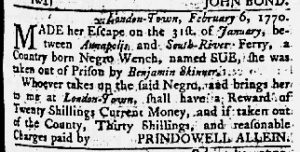
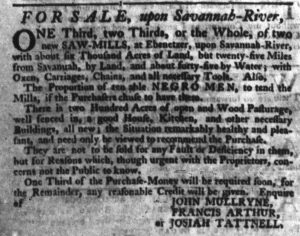
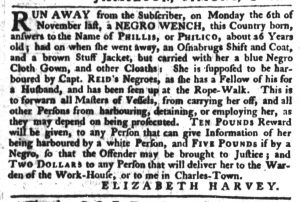
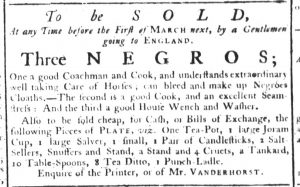
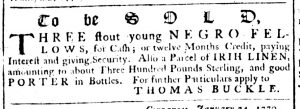
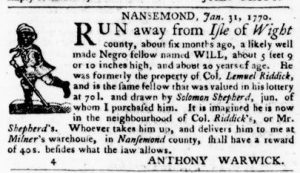
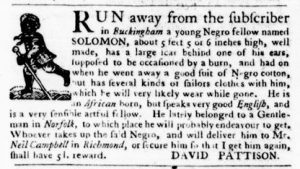
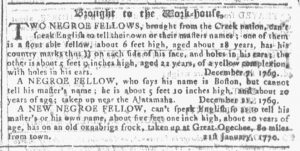
The Slavery Adverts 250 Project chronicles the role of newspaper advertising in perpetuating slavery in the era of the American Revolution. The project seeks to reveal the ubiquity of slavery in eighteenth-century life from New England to Georgia by republishing advertisements for slaves – for sale, wanted to purchase, runaways, captured fugitives – in daily digests on this site as well as in real time via the @SlaveAdverts250 Twitter feed, utilizing twenty-first-century media to stand in for the print media of the eighteenth century.

The project aims to provide modern audiences with a sense of just how often colonists encountered these advertisements in their daily lives. Enslaved men, women, and children appeared in print somewhere in the colonies almost every single day. Those advertisements served as a constant backdrop for social, cultural, economic, and political life in colonial and revolutionary America. Colonists who did not own slaves were still confronted with slavery as well as invited to maintain the system by purchasing slaves or assisting in the capture of runaways. The frequency of these newspaper advertisements suggests just how embedded slavery was in colonial and revolutionary American culture in everyday interactions beyond the printed page.

These advertisements also testify to the experiences of enslaved men, women, and children, though readers must consider that those experiences have been remediated through descriptions offered by slaveholders rather than the slaves themselves. Often unnamed in the advertisements, enslaved men, women, and children were not invisible or unimportant in early America.

These advertisements appeared in colonial American newspapers 250 years ago today.

Feb 16 1770 - New-Hampshire Gazette Slavery 1
New-Hampshire Gazette (February 16, 1770).

February 15

What was advertised in a colonial American newspaper 250 years ago today?

Feb 15 - 2:15:1770 New-York Journal
New-York Journal (February 15, 1770).

“The Sons of Liberty in general, might there commemorate the Anniversary of the Repeal of the Stamp-Act.”

As the fourth anniversary of the repeal of the Stamp Act approached, the Sons of Liberty in New York prepared to commemorate the occasion. They encountered some obstacles, however, in planning their celebration. Newspaper advertisements first announced one plan, then later clarified a different one.

The first public notice appeared in the New-York Gazette and Weekly Mercury and the New-York Gazette or Weekly Post-Boy on Monday, February 5.   Advertisements in both newspapers extended a brief invitation: “THE sons of LIBERTY, are desired to meet at the house of Mr. De La Montanye’s, on Monday the 19th day of March next, to celebrate the repeal of the detestable and inglorious STAMP-ACT.” A slightly longer version appeared in the New-York Journal three days later. It advised that the “friends to Liberty and Trade, who formerly associated together at Barden’s, Jones’s and Smith’s to celebrate the anniversary of the repeal of the Stamp Act. Are requested to meet for that purpose on Monday the 19th of March next, at the house of Mr. Abraham De La Montagnie.”

Plans for a celebration were off to a good start, except that apparently no one had consulted with de la Montaigne about gathering at his house. He inserted his own advertisement in the February 8 edition of the New-York Journal in response to “AN Advertisement having appeared in last Monday’s papers, inviting the Sons of Liberty to dine at my house … to celebrate the anniversary of the repeal of the Stamp Act.” De la Montaigne did indeed plan to host a celebration, but not for those who had placed an advertisement without his knowledge. He asserted that his establishment had already been booked “by a great number of other gentlemen” and, as a result, he “shall not be able to entertain any other company than those gentlemen and their connections who engaged my house for that day.” The compositor thoughtfully positioned the two advertisements, with their conflicting information about an upcoming gather of the Sons of Liberty, one after the other.

A week later the organizers announced a new plan to “commemorate the Anniversary of the Repeal of the Stamp-Act.” When they discovered that de la Montaigne’s house was not available, a “Number of the Sons of Liberty in this City” set about “purchasing a proper House for the Accommodation of all Lovers of freedom on that Day, and for their Use on future Occasions, in the Promotion of the Common Cause.” They acquired a “Corner House in the Broad-Way,” appropriately located “near “Liberty-Pole.” In contrast to the event slated for de la Montaigne’s house, the celebration at this corner house was open “without Discrimination” to “all the Sons of Liberty … who choose to commemorate that Glorious Day.” In addition, the advertisement extended an invitation to “Sons of Liberty” to meet at the house on Tuesday evening as well, presumably to continue organizing against abuses inflicted on the colonies by Parliament.

This series of advertisements in New York’s newspapers demonstrates some disorder when it came to marking the anniversary of such an important event at a time when colonists in that city and elsewhere worked for the repeal of the Townshend Acts that infringed on their liberty much like the Stamp Act had done. One cohort of celebrants confined their event to a small number of gentlemen, while organizers of another event emphasized that all were welcome to participate in the “Promotion of the Common Cause.” Who participated in these two commemorative events? Was the one at de la Montaigne’s house limited only to the better sorts who claimed leadership of the Sons of Liberty? Did patriots from humble backgrounds plan and participate in the commemoration at the corner house “near Liberty-Pole”? Did participants in the two events share a vision of what they hoped to accomplish in their struggle against Parliament? These advertisements suggest that New Yorkers may have attached different meanings to the repeal of the Stamp Act and what they hoped to accomplish as they pursued further resistance efforts in the early 1770s.

Slavery Advertisements Published February 15, 1770

The Slavery Adverts 250 Project chronicles the role of newspaper advertising in perpetuating slavery in the era of the American Revolution. The project seeks to reveal the ubiquity of slavery in eighteenth-century life from New England to Georgia by republishing advertisements for slaves – for sale, wanted to purchase, runaways, captured fugitives – in daily digests on this site as well as in real time via the @SlaveAdverts250 Twitter feed, utilizing twenty-first-century media to stand in for the print media of the eighteenth century.

The project aims to provide modern audiences with a sense of just how often colonists encountered these advertisements in their daily lives. Enslaved men, women, and children appeared in print somewhere in the colonies almost every single day. Those advertisements served as a constant backdrop for social, cultural, economic, and political life in colonial and revolutionary America. Colonists who did not own slaves were still confronted with slavery as well as invited to maintain the system by purchasing slaves or assisting in the capture of runaways. The frequency of these newspaper advertisements suggests just how embedded slavery was in colonial and revolutionary American culture in everyday interactions beyond the printed page.

These advertisements also testify to the experiences of enslaved men, women, and children, though readers must consider that those experiences have been remediated through descriptions offered by slaveholders rather than the slaves themselves. Often unnamed in the advertisements, enslaved men, women, and children were not invisible or unimportant in early America.

These advertisements appeared in colonial American newspapers 250 years ago today.

Feb 15 1770 - Maryland Gazette Slavery 1
Maryland Gazette (February 15, 1770).

**********

Feb 15 1770 - Massachusetts Gazette and Boston Weekly News-Letter Slavery 1
Massachusetts Gazette and Boston Weekly News-Letter (February 15, 1770).

**********

Feb 15 1770 - Massachusetts Gazette and Boston Weekly News-Letter Slavery 2
Massachusetts Gazette and Boston Weekly News-Letter (February 15, 1770).

**********

Feb 15 1770 - Massachusetts Gazette and Boston Weekly News-Letter Slavery 3
Massachusetts Gazette and Boston Weekly News-Letter (February 15, 1770).

**********

Feb 15 1770 - New-York Journal Slavery 1
New-York Journal (February 15, 1770).

**********

Feb 15 1770 - New-York Journal Supplement Slavery 1
Supplement to the New-York Journal (February 15, 1770).

**********

Feb 15 1770 - Pennsylvania Gazette Supplement Slavery 1
Supplement to the Pennsylvania Gazette (February 15, 1770).

**********

Feb 15 1770 - Pennsylvania Gazette Supplement Slavery 2
Supplement to the Pennsylvania Gazette (February 15, 1770).

**********

Feb 15 1770 - Pennsylvania Gazette Supplement Slavery 3
Supplement to the Pennsylvania Gazette (February 15, 1770).

**********

Feb 15 1770 - South-Carolina Gazette Slavery 2
South-Carolina Gazette (February 15, 1770).

**********

Feb 15 1770 - South-Carolina Gazette Slavery 3
South-Carolina Gazette (February 15, 1770).

**********

Feb 15 1770 - South-Carolina Gazette Slavery 4
South-Carolina Gazette (February 15, 1770).

**********

Feb 15 1770 - South-Carolina Gazette Slavery 5
South-Carolina Gazette (February 15, 1770).

**********

Feb 15 1770 - South-Carolina Gazette Slavery 6
South-Carolina Gazette (February 15, 1770).

**********

Feb 15 1770 - South-Carolina Gazette Slavery 7
South-Carolina Gazette (February 15, 1770).

**********

Feb 15 1770 - South-Carolina Gazette Slavery 8
South-Carolina Gazette (February 15, 1770).

**********

Feb 15 1770 - South-Carolina Gazette Slavery 9
South-Carolina Gazette (February 15, 1770).

**********

Feb 15 1770 - South-Carolina Gazette Slavery 10
South-Carolina Gazette (February 15, 1770).

**********

Feb 15 1770 - South-Carolina Gazette Slavery 11
South-Carolina Gazette (February 15, 1770).

**********

Feb 15 1770 - South-Carolina Gazette Supplement Slavery 1
Supplement to the South-Carolina Gazette (February 15, 1770).

**********

Feb 15 1770 - South-Carolina Gazette Supplement Slavery 2
Supplement to the South-Carolina Gazette (February 15, 1770).

**********

Feb 15 1770 - South-Carolina Gazette Supplement Slavery 3
Supplement to the South-Carolina Gazette (February 15, 1770).

**********

Feb 15 1770 - South-Carolina Gazette Supplement Slavery 4
Supplement to the South-Carolina Gazette (February 15, 1770).

**********

Feb 15 1770 - South-Carolina Gazette Supplement Slavery 5
Supplement to the South-Carolina Gazette (February 15, 1770).

**********

Feb 15 1770 - South-Carolina Gazette Supplement Slavery 6
Supplement to the South-Carolina Gazette (February 15, 1770).

**********

Feb 15 1770 - South-Carolina Gazette Supplement Slavery 7
Supplement to the South-Carolina Gazette (February 15, 1770).

**********

Feb 15 1770 - South-Carolina Gazette Supplement Slavery 8
Supplement to the South-Carolina Gazette (February 15, 1770).

**********

Feb 15 1770 - South-Carolina Gazette Supplement Slavery 9
Supplement to the South-Carolina Gazette (February 15, 1770).

**********

Feb 15 1770 - South-Carolina Gazette Supplement Slavery 10
Supplement to the South-Carolina Gazette (February 15, 1770).

**********

Feb 15 1770 - South-Carolina Gazette Supplement Slavery 11
Supplement to the South-Carolina Gazette (February 15, 1770).

**********

Feb 15 1770 - South-Carolina Gazette Supplement Slavery 12
Supplement to the South-Carolina Gazette (February 15, 1770).

**********

Feb 15 1770 - Virginia Gazette Purdie & Dixon Slavery 1
Virginia Gazette [Purdie and Dixon] (February 15, 1770).

**********

Feb 15 1770 - Virginia Gazette Purdie & Dixon Slavery 2
Virginia Gazette [Purdie and Dixon] (February 15, 1770).

**********

Feb 15 1770 - Virginia Gazette Purdie & Dixon Slavery 3
Virginia Gazette [Purdie and Dixon] (February 15, 1770).

**********

Feb 15 1770 - Virginia Gazette Purdie & Dixon Slavery 4
Virginia Gazette [Purdie and Dixon] (February 15, 1770).

**********

Feb 15 1770 - Virginia Gazette Purdie & Dixon Slavery 5
Virginia Gazette [Purdie and Dixon] (February 15, 1770).

**********

Feb 15 1770 - Virginia Gazette Purdie & Dixon Slavery 7
Virginia Gazette [Purdie and Dixon] (February 15, 1770).

**********

Feb 15 1770 - Virginia Gazette Purdie & Dixon Slavery 6
Virginia Gazette [Purdie and Dixon] (February 15, 1770).

**********

Feb 15 1770 - Virginia Gazette Purdie & Dixon Slavery 8
Virginia Gazette [Purdie and Dixon] (February 15, 1770).

**********

Feb 15 1770 - Virginia Gazette Purdie & Dixon Slavery 9
Virginia Gazette [Purdie and Dixon] (February 15, 1770).

**********

Feb 15 1770 - Virginia Gazette Purdie & Dixon Slavery 10
Virginia Gazette [Purdie and Dixon] (February 15, 1770).

**********

Feb 15 1770 - Virginia Gazette Rind Slavery 1
Virginia Gazette [Rind] (February 15, 1770).

**********

Feb 15 1770 - Virginia Gazette Rind Slavery 2
Virginia Gazette [Rind] (February 15, 1770).

**********

Feb 15 1770 - Virginia Gazette Rind Slavery 4
Virginia Gazette [Rind] (February 15, 1770).

**********

Feb 15 1770 - Virginia Gazette Rind Slavery 3
Virginia Gazette [Rind] (February 15, 1770).

**********

Feb 15 1770 - Virginia Gazette Rind Slavery 5
Virginia Gazette [Rind] (February 15, 1770).

February 14

What was advertised in a colonial American newspaper 250 years ago today?

Feb 14 - 2:14:1770 South-Carolina and American General Gazette
South-Carolina and American General Gazette (February 14, 1770).

“Messrs. JOHN SKETCHLEY, & Co.”

Robert Wells, the printer of the South-Carolina and American General Gazette, apparently experienced a disruption in his paper supply in February 1770, perhaps as a result of the duties imposed on imported paper by the Townshend Acts. His newspaper usually featured four columns per page. The February 14 edition did have four columns per page, but the fourth column was narrower, with the contents rotated so that the text ran perpendicular to the other three. Printers and compositors often deployed this strategy when forced to print newspapers on paper of a different size than usual. It allowed them to insert as much content as possible while efficiently using type already set. Notably, advertisements that ran in the previous issue of the South-Carolina and American General Gazette comprised the entirety of the material rotated to fit on the page for the February 13 edition.

This evidence allows me to confidently state that Wells used broadsheets of two different sizes in February 1770. I cannot make this claim, however, as the result of comparing the actual dimensions of those sheets. The Adverts 250 Project relies primarily on databases of eighteenth-century newspapers that have been digitized to allow for greater access. Indeed, this project would not be possible without the resources made available by Readex’s America’s Historical Newspapers, Accessible Archives’s South Carolina Newspapers, Colonial Williamsburg’s Digital Library, and the Maryland State Archives’s Maryland Gazette Collection. Each of these databases allows for significantly enhanced access to the content of eighteenth-century newspapers. In the process, however, they negate some of the material aspects of those newspapers, including any indication of size. Each issue becomes the size of the computer screen or whatever size users make them as they zoom in and out to observe various details.

That means that readers must relay on visual cues to make determinations about the relative size of newspaper pages. This makes it impossible to compare, say, the South-Carolina and American General Gazette to the Connecticut Courant, but it is possible to make comparisons among various issues of a particular newspaper. The mastheads for the February 7 and February 14 editions of the South-Carolina and American General Gazette do not match. Wells or a compositor who worked in his printing office reset the type, adjusting the masthead to fit a smaller broadsheet. In combination with the advertisements rotated to fit a narrower fourth column, this confirms that Wells used a smaller sheet. Careful attention to the format reveals the reason for the unusual appearance of the February 14 issue, something that would have been readily apparent when examining the original copies. Scholars who rely on digital surrogates, however, have to develop strategies for making assessments about the relative sizes of pages and explain why printers and compositors made certain decisions about how to format advertisements and other content.

Slavery Advertisements Published February 14, 1770

The Slavery Adverts 250 Project chronicles the role of newspaper advertising in perpetuating slavery in the era of the American Revolution. The project seeks to reveal the ubiquity of slavery in eighteenth-century life from New England to Georgia by republishing advertisements for slaves – for sale, wanted to purchase, runaways, captured fugitives – in daily digests on this site as well as in real time via the @SlaveAdverts250 Twitter feed, utilizing twenty-first-century media to stand in for the print media of the eighteenth century.

The project aims to provide modern audiences with a sense of just how often colonists encountered these advertisements in their daily lives. Enslaved men, women, and children appeared in print somewhere in the colonies almost every single day. Those advertisements served as a constant backdrop for social, cultural, economic, and political life in colonial and revolutionary America. Colonists who did not own slaves were still confronted with slavery as well as invited to maintain the system by purchasing slaves or assisting in the capture of runaways. The frequency of these newspaper advertisements suggests just how embedded slavery was in colonial and revolutionary American culture in everyday interactions beyond the printed page.

These advertisements also testify to the experiences of enslaved men, women, and children, though readers must consider that those experiences have been remediated through descriptions offered by slaveholders rather than the slaves themselves. Often unnamed in the advertisements, enslaved men, women, and children were not invisible or unimportant in early America.

These advertisements appeared in colonial American newspapers 250 years ago today.

Feb 14 1770 - Georgia Gazette Slavery 1
Georgia Gazette (February 14, 1770).

**********

Feb 14 1770 - Georgia Gazette Slavery 2
Georgia Gazette (February 14, 1770).

**********

Feb 14 1770 - Georgia Gazette Slavery 3
Georgia Gazette (February 14, 1770).

**********

Feb 14 1770 - Georgia Gazette Slavery 4
Georgia Gazette (February 14, 1770).

**********

Feb 14 1770 - Georgia Gazette Slavery 5
Georgia Gazette (February 14, 1770).

**********

Feb 14 1770 - Georgia Gazette Slavery 6
Georgia Gazette (February 14, 1770).

**********

Feb 14 1770 - South-Carolina and American General Gazette Slavery 1
South-Carolina and American General Gazette (February 14, 1770).

**********

Feb 14 1770 - South-Carolina and American General Gazette Slavery 2
South-Carolina and American General Gazette (February 14, 1770).

**********

Feb 14 1770 - South-Carolina and American General Gazette Slavery 3
South-Carolina and American General Gazette (February 14, 1770).

**********

Feb 14 1770 - South-Carolina and American General Gazette Slavery 3
South-Carolina and American General Gazette (February 14, 1770).

**********

Feb 14 1770 - South-Carolina and American General Gazette Slavery 5
South-Carolina and American General Gazette (February 14, 1770).

**********

Feb 14 1770 - South-Carolina and American General Gazette Slavery 7
South-Carolina and American General Gazette (February 14, 1770).

**********

Feb 14 1770 - South-Carolina and American General Gazette Slavery 6
South-Carolina and American General Gazette (February 14, 1770).

**********

Feb 14 1770 - South-Carolina and American General Gazette Slavery 8
South-Carolina and American General Gazette (February 14, 1770).

**********

Feb 14 1770 - South-Carolina and American General Gazette Slavery 9
South-Carolina and American General Gazette (February 14, 1770).

**********

Feb 14 1770 - South-Carolina and American General Gazette Slavery 10
South-Carolina and American General Gazette (February 14, 1770).

**********

Feb 14 1770 - South-Carolina and American General Gazette Slavery 11
South-Carolina and American General Gazette (February 14, 1770).

February 13

What was advertised in a colonial American newspaper 250 years ago today?

Feb 13 - 2:13:1770 Essex Gazette
Essex Gazette (February 13, 1770).

All the above Articles, were imported before the Agreement, entered into by the Merchants for Non-importation, took Place.”

Thomas Lewis’s advertisement for an assortment of goods available at his shop in Marblehead cataloged dozens of items and extended nearly an entire column. In that regard, it matched advertisements placed by merchants and shopkeepers in other newspapers, especially those published in the largest port cities, but greatly exceeded the length of most that ran in the Essex Gazette in the late 1760s and early 1770s. Lewis listed everything from “ivory horn combs” to “large white stone dishes” to “men’s white and brown thread gloves.”

He apparently determined that if he was going to assume the expense of such a lengthy advertisement that he should extend it a little bit more to address concerns that members of his community might have about his inventory. After concluding his list, he informed readers that “All the above Articles, were imported before the Agreement, entered into by the Merchants for Non-importation, took Place.” Lewis had not violated the boycott in place as a means of protesting the duties Parliament imposed on imported paper, glass, paint, lead, and tea in the Townshend Acts. Prospective customers could confidently purchase his wares without worrying that they became accomplices in undermining the nonimportation agreement. Reputation mattered, to both purveyors of goods and consumers. Lewis aimed to avoid drawing controversy to himself and his customers.

He did, however, provide one clarification concerning “a few Cheshire and Glocester cheeses,” stating that they were “sold by Consent of the Committee.” He did not offer additional details about how and when he came into possession of the cheese or why he had been granted an exception, but in mentioning that he acquired the “Consent of the Committee” that ferreted out violators of the nonimportation agreement Lewis indicated that he operated his shop under the supervision of members of the community entrusted to oversee the public welfare. He demonstrated that he was sufficiently concerned about abiding by the agreement that he consulted with those responsible for overseeing it.

Lewis was one of a growing number of shopkeepers who appended such notices to their newspaper advertisements in the late 1760s and early 1770s. The consumption of goods became an increasingly political act. Purveyors of goods played a significant role in that discourse as they made new kinds of appeals in their advertisements, simultaneously shaping discourse about the politics of goods and reacting to it.

Slavery Advertisements Published February 13, 1770

The Slavery Adverts 250 Project chronicles the role of newspaper advertising in perpetuating slavery in the era of the American Revolution. The project seeks to reveal the ubiquity of slavery in eighteenth-century life from New England to Georgia by republishing advertisements for slaves – for sale, wanted to purchase, runaways, captured fugitives – in daily digests on this site as well as in real time via the @SlaveAdverts250 Twitter feed, utilizing twenty-first-century media to stand in for the print media of the eighteenth century.

The project aims to provide modern audiences with a sense of just how often colonists encountered these advertisements in their daily lives. Enslaved men, women, and children appeared in print somewhere in the colonies almost every single day. Those advertisements served as a constant backdrop for social, cultural, economic, and political life in colonial and revolutionary America. Colonists who did not own slaves were still confronted with slavery as well as invited to maintain the system by purchasing slaves or assisting in the capture of runaways. The frequency of these newspaper advertisements suggests just how embedded slavery was in colonial and revolutionary American culture in everyday interactions beyond the printed page.

These advertisements also testify to the experiences of enslaved men, women, and children, though readers must consider that those experiences have been remediated through descriptions offered by slaveholders rather than the slaves themselves. Often unnamed in the advertisements, enslaved men, women, and children were not invisible or unimportant in early America.

These advertisements appeared in colonial American newspapers 250 years ago today.

Feb 13 1770 - South-Carolina Gazette and Country Journal Slavery 1
South-Carolina Gazette and Country Journal (February 13, 1770).

**********

Feb 13 1770 - South-Carolina Gazette and Country Journal Slavery 2
South-Carolina Gazette and Country Journal (February 13, 1770).

**********

Feb 13 1770 - South-Carolina Gazette and Country Journal Slavery 3
South-Carolina Gazette and Country Journal (February 13, 1770).

**********

Feb 13 1770 - South-Carolina Gazette and Country Journal Slavery 4
South-Carolina Gazette and Country Journal (February 13, 1770).

**********

Feb 13 1770 - South-Carolina Gazette and Country Journal Slavery 5
South-Carolina Gazette and Country Journal (February 13, 1770).

**********

Feb 13 1770 - South-Carolina Gazette and Country Journal Slavery 6
South-Carolina Gazette and Country Journal (February 13, 1770).

**********

Feb 13 1770 - South-Carolina Gazette and Country Journal Slavery 7
South-Carolina Gazette and Country Journal (February 13, 1770).

**********

Feb 13 1770 - South-Carolina Gazette and Country Journal Slavery 8
South-Carolina Gazette and Country Journal (February 13, 1770).

**********

Feb 13 1770 - South-Carolina Gazette and Country Journal Slavery 9
South-Carolina Gazette and Country Journal (February 13, 1770).

**********

Feb 13 1770 - South-Carolina Gazette and Country Journal Slavery 10
South-Carolina Gazette and Country Journal (February 13, 1770).

**********

Feb 13 1770 - South-Carolina Gazette and Country Journal Slavery 11
South-Carolina Gazette and Country Journal (February 13, 1770).

**********

Feb 13 1770 - South-Carolina Gazette and Country Journal Slavery 12
South-Carolina Gazette and Country Journal (February 13, 1770).

**********

Feb 13 1770 - South-Carolina Gazette and Country Journal Slavery 13
South-Carolina Gazette and Country Journal (February 13, 1770).

**********

Feb 13 1770 - South-Carolina Gazette and Country Journal Slavery 14
South-Carolina Gazette and Country Journal (February 13, 1770).

**********

Feb 13 1770 - South-Carolina Gazette and Country Journal Slavery 15
South-Carolina Gazette and Country Journal (February 13, 1770).

**********

Feb 13 1770 - South-Carolina Gazette and Country Journal Slavery 16
South-Carolina Gazette and Country Journal (February 13, 1770).