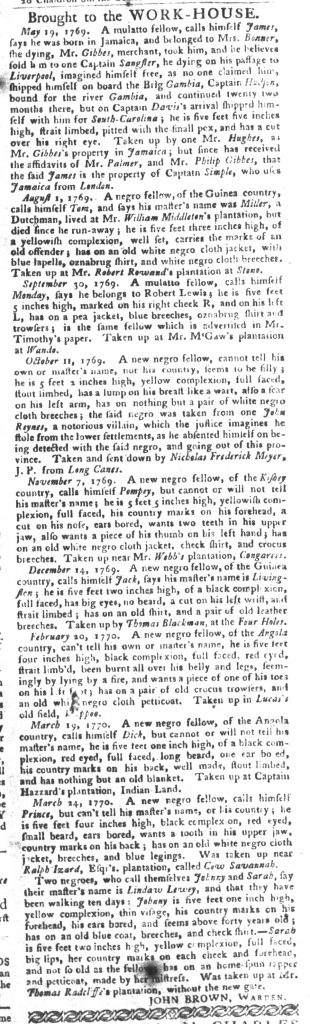
Slavery Advertisements Published April 3, 1770

The Slavery Adverts 250 Project chronicles the role of newspaper advertising in perpetuating slavery in the era of the American Revolution. The project seeks to reveal the ubiquity of slavery in eighteenth-century life from New England to Georgia by republishing advertisements for slaves – for sale, wanted to purchase, runaways, captured fugitives – in daily digests on this site as well as in real time via the @SlaveAdverts250 Twitter feed, utilizing twenty-first-century media to stand in for the print media of the eighteenth century.

The project aims to provide modern audiences with a sense of just how often colonists encountered these advertisements in their daily lives. Enslaved men, women, and children appeared in print somewhere in the colonies almost every single day. Those advertisements served as a constant backdrop for social, cultural, economic, and political life in colonial and revolutionary America. Colonists who did not own slaves were still confronted with slavery as well as invited to maintain the system by purchasing slaves or assisting in the capture of runaways. The frequency of these newspaper advertisements suggests just how embedded slavery was in colonial and revolutionary American culture in everyday interactions beyond the printed page.

These advertisements also testify to the experiences of enslaved men, women, and children, though readers must consider that those experiences have been remediated through descriptions offered by slaveholders rather than the slaves themselves. Often unnamed in the advertisements, enslaved men, women, and children were not invisible or unimportant in early America.

These advertisements appeared in colonial American newspapers 250 years ago today.

Apr 3 1770 - South-Carolina Gazette and Country Journal Slavery 1
South-Carolina Gazette and Country Journal (April 3, 1770).

**********

Apr 3 1770 - South-Carolina Gazette and Country Journal Slavery 2
South-Carolina Gazette and Country Journal (April 3, 1770).

**********

Apr 3 1770 - South-Carolina Gazette and Country Journal Slavery 3
South-Carolina Gazette and Country Journal (April 3, 1770).

**********

Apr 3 1770 - South-Carolina Gazette and Country Journal Slavery 4
South-Carolina Gazette and Country Journal (April 3, 1770).

**********

Apr 3 1770 - South-Carolina Gazette and Country Journal Slavery 5
South-Carolina Gazette and Country Journal (April 3, 1770).

**********

Apr 3 1770 - South-Carolina Gazette and Country Journal Slavery 6
South-Carolina Gazette and Country Journal (April 3, 1770).

**********

Apr 3 1770 - South-Carolina Gazette and Country Journal Slavery 7
South-Carolina Gazette and Country Journal (April 3, 1770).

**********

Apr 3 1770 - South-Carolina Gazette and Country Journal Slavery 8
South-Carolina Gazette and Country Journal (April 3, 1770).

**********

Apr 3 1770 - South-Carolina Gazette and Country Journal Slavery 9
South-Carolina Gazette and Country Journal (April 3, 1770).

**********

Apr 3 1770 - South-Carolina Gazette and Country Journal Slavery 10
South-Carolina Gazette and Country Journal (April 3, 1770).

**********

Apr 3 1770 - South-Carolina Gazette and Country Journal Slavery 11
South-Carolina Gazette and Country Journal (April 3, 1770).

**********

Apr 3 1770 - South-Carolina Gazette and Country Journal Slavery 12
South-Carolina Gazette and Country Journal (April 3, 1770).

**********

Apr 3 1770 - South-Carolina Gazette and Country Journal Slavery 13
South-Carolina Gazette and Country Journal (April 3, 1770).

**********

Apr 3 1770 - South-Carolina Gazette and Country Journal Slavery 14
South-Carolina Gazette and Country Journal (April 3, 1770).

**********

Apr 3 1770 - South-Carolina Gazette and Country Journal Slavery 15
South-Carolina Gazette and Country Journal (April 3, 1770).

**********

Apr 3 1770 - South-Carolina Gazette and Country Journal Slavery 16
South-Carolina Gazette and Country Journal (April 3, 1770).

**********

Apr 3 1770 - South-Carolina Gazette and Country Journal Supplement Slavery 1
Supplement to the South-Carolina Gazette and Country Journal (April 3, 1770).

**********

Apr 3 1770 - South-Carolina Gazette and Country Journal Supplement Slavery 2
Supplement to the South-Carolina Gazette and Country Journal (April 3, 1770).

April 2

What was advertised in a colonial American newspaper 250 years ago today?

Apr 2 - 4:2:1770 Boston-Gazette
Boston-Gazette (April 2, 1770).

“An Original Print, representing the late horrid Massacre in King Street.”

Although Paul Revere’s engraving is more famous, Henry Pelham also produced a print depicting the Boston Massacre shortly after the event took place.  He marketed his engraving, The Fruits of Arbitrary Power, in the April 2, 1770, editions of the Boston Evening-Post and the Boston-Gazette, a week after Revere promoted his Bloody Massacre in those same newspapers.  The Boston Massacre occurred on March 5, so both men moved quickly to make a visual representation of the event available for public consumption.  Revere offered his print for sale just three weeks after soldiers from the 29th Regiment shot into a crowd, wounding several colonists.  Some died of their wounds on the spot; others died soon after.  By the time Revere and Pelham marketed their prints, five colonists had died.

Many consumers may have thought that Pelham’s Fruits of Arbitrary Power closely resembled Revere’s Bloody Massacre, but the opposite was actually the case.  Pelham shared his drawing with Revere, then expressed dismay that his fellow engraver moved forward with his own print based on the drawing and beat Pelham to market by a week.  Their advertisements also resembled each other, neither of them particularly flashy considering the products they presented to consumers.  Pelham’s advertisement simply stated, “To be Sold by EDES and GILL and T. and J. FLEET, (Price Eight Pence) The Fruits of Arbitrary Power, an Original Print, representing the late horrid Massacre in King Street, taken from the Spot.”  (The version in the Boston Evening-Post switched the order of the printers who sold the print.  Each partnership gave itself top billing.). In stating that Fruits of Arbitrary Power was “an Original Print,” Pelham took a swipe at Revere and attempted to set the record straight.

Perhaps neither Revere nor Pelham considered it necessary to devise flashy advertisements for their competing prints.  After all, the Boston Massacre occurred only weeks earlier.  It received extensive newspaper coverage, including descriptions of the funeral procession honoring the victims.  Coverage continued as Boston prepared for a trial of Captain Thomas Preston and soldiers from the 29th Regiment.  Beyond the several newspapers printed in the busy port, the Boston Massacre was surely the talk of the town.  Neither the engravers who produced the prints nor the printers who sold them needed to explain their significance beyond noting that they depicted the “horrid Massacre” and offering brief commentary.  The title of Pelham’s engraving, The Fruits of Arbitrary Power, summed up the political calculus of the event.  He apparently considered that sufficient to convince consumers that they needed to acquire his memento of the Boston Massacre.  Consumption played a vital role in commemoration.

Slavery Advertisements Published April 2, 1770

The Slavery Adverts 250 Project chronicles the role of newspaper advertising in perpetuating slavery in the era of the American Revolution. The project seeks to reveal the ubiquity of slavery in eighteenth-century life from New England to Georgia by republishing advertisements for slaves – for sale, wanted to purchase, runaways, captured fugitives – in daily digests on this site as well as in real time via the @SlaveAdverts250 Twitter feed, utilizing twenty-first-century media to stand in for the print media of the eighteenth century.

The project aims to provide modern audiences with a sense of just how often colonists encountered these advertisements in their daily lives. Enslaved men, women, and children appeared in print somewhere in the colonies almost every single day. Those advertisements served as a constant backdrop for social, cultural, economic, and political life in colonial and revolutionary America. Colonists who did not own slaves were still confronted with slavery as well as invited to maintain the system by purchasing slaves or assisting in the capture of runaways. The frequency of these newspaper advertisements suggests just how embedded slavery was in colonial and revolutionary American culture in everyday interactions beyond the printed page.

These advertisements also testify to the experiences of enslaved men, women, and children, though readers must consider that those experiences have been remediated through descriptions offered by slaveholders rather than the slaves themselves. Often unnamed in the advertisements, enslaved men, women, and children were not invisible or unimportant in early America.

These advertisements appeared in colonial American newspapers 250 years ago today.

Apr 2 1770 - Boston Evening-Post Slavery 1
Boston Evening-Post (April 2, 1770).

**********

Apr 2 1770 - Boston Evening-Post Slavery 2
Boston Evening-Post (April 2, 1770).

**********

Apr 2 1770 - Boston-Gazette Slavery 1
Boston-Gazette (April 2, 1770).

**********

Apr 2 1770 - New-York Gazette and Weekly Mercury Slavery 1
New-York Gazette and Weekly Mercury (April 2, 1770).

**********

Apr 2 1770 - New-York Gazette or Weekly Post-Boy Slavery 1
New-York Gazette or Weekly Post-Boy (April 2, 1770).

**********

Apr 2 1770 - New-York Gazette or Weekly Post-Boy Slavery 2
New-York Gazette or Weekly Post-Boy (April 2, 1770).

**********

Apr 2 1770 - New-York Gazette or Weekly Post-Boy Slavery 3
New-York Gazette or Weekly Post-Boy (April 2, 1770).

**********

Apr 2 1770 - New-York Gazette or Weekly Post-Boy Slavery 4
New-York Gazette or Weekly Post-Boy (April 2, 1770).

April 1

What was advertised in a colonial American newspaper 250 years ago this week?

Apr 1 - 3:29:1770 South-Carolina Gazette
South-Carolina Gazette (March 29, 1770).

“ASSORTMENT of GOODS, Agreeable to the RESOLUTIONS.”

The partnership of Smith and Atkinson informed consumers in and around Boston that they stocked “A small Assortment of English Goods, (imported before the late Agreements of the Merchants)” in an advertisement in the March 29, 1770, edition of the Massachusetts Gazette and Boston Weekly News-Letter.  On the same day, James McCall took to the pages of the South-Carolina Gazette to announce that he carried an “ASSORTMENT of GOODS” imported in the Sea Venturefrom Bristol “Agreeable to the RESOLUTIONS.”  This marketing strategy was less common in the newspapers published in Charleston than in Boston, but not unknown.

In both cities, purveyors of goods believed that asserting that they acquired their goods according to the terms of nonimportation agreements adopted in protest of import duties Parliament imposed on paper, glass, lead, paint, and tea would incite demand.  They offered colonists the opportunity to continue participating in the consumer revolution without violating the political principles that inspired the “RESOLUTIONS” or the “late Agreements.”  Yet their newspaper notices did more than reassure prospective customers.  McCall intended to safeguard his own reputation, as did Smith and Atkinson.  They wanted all readers and, by extension, the entire community to know that they abided by the nonimportation agreements.  Making such declarations not only amounted to good business sense but also aided in maintaining their status and relationships.

In Charleston and Boston, both advertisers and prospective customers spoke a common language of consumption that was inflected with politics.  T.H. Breen makes in this argument in The Marketplace of Revolution:  How Consumer Politics Shaped American Independence.  At the nexus of consumer culture and print culture, newspaper advertisements for consumer goods and services played an important role in developing and propagating the language of consumption.  This yielded what Benedict Anderson termed imagined communities – communities of readers and communities of consumers – that made colonists in faraway places like Boston and Charleston feel as though they shared a common identity.