April 8

What was advertised in a colonial American newspaper 250 years ago this week?

Apr 8 - 4:5:1770 New-York Journal
New-York Journal (April 5, 1770).

“A few Casks of Liverpool Ale, imported before the Non-Importations Agreement.”

For four weeks in March and April 1770, John, Thomas, and Samuel Franklin inserted an advertisement for “BEST Spermaceti Candles,” “a few Boxes of Tin Plate,” and “red, green and scarlet Rattinets,” along with other goods, in the New-York Journal.  Among their wares, they listed “a few Casks of Liverpool Ale, imported before the Non-Importation Agreement.”  In so doing, they acknowledged the political movement to boycott goods imported from Britain for as long as Parliament continued to impose duties on imported paper, glass, paint, lead, and tea.  Neither the Franklins nor anyone else in New York knew it for certain at the time, but a partial repeal of the Townshend Acts was in the works on the other side of the Atlantic.

On March 5, Lord North, the new prime minister, presented a motion in the House of Commons.  It called for a repeal of the Revenue Act of 1767, eliminating the duties on paper, glass, paint, and lead.  When this Repeal Act received royal assent on April 12, only the duty on tea remained in place.  It would take weeks for news to arrive in the colonies.  When it did, the merchants and traders who signed the nonimportation agreements, associations, and resolutions in New York and other colonies considered this sufficient victory to justify discontinuing the boycott, just as they previously ended another boycott of British goods when Parliament repealed the Stamp Act.

For a time, marketing strategies shifted as purveyors emphasized that their goods had not recently arrived in the latest ships from London but instead had been on hand for months or even years.  “Just Imported” had been a standard part of many advertisements for consumer goods prior to the boycotts, a signal that customers did not have to settle for leftover merchandise that had lingered on the shelves.  Commentary on nonimportation and domestic manufactures became a familiar aspect of advertising, reflecting the editorials and current events covered elsewhere in newspapers.  As the political situation shifted and merchants and shopkeepers once again acquired goods from Britain, the language of advertising reverted back to the appeals that had been much more common before the nonimportation agreement went into effect.

April 7

What was advertised in a colonial American newspaper 250 years ago today?

Apr 7 - 4:7:1770 South-Carolina Gazette and Country Journal Supplement
Supplement to the South-Carolina Gazette and Country Journal (April 7, 1770).

“RUN-AWAY … a NEGRO FELLOW, named MONDAY.”

Newspaper coverage of the Boston Massacre in the weeks after it happened resulted in greater dissemination of advertisements entreating surveillance of Black men in South Carolina.  How did the one cause the other?  Following widespread custom, colonial printers did not write original articles about the Massacre but instead reprinted items from other newspapers.  Thus, the same story about the funeral procession for the victims appeared in both the South-Carolina Gazette and the South-Carolina Gazette and Country Journal within a couple of days of each other, copied either from its original source in the Boston-Gazette or another newspaper that reprinted the story from the Boston-Gazette.  Peter Timothy ran it in the April 5, 1770, edition of the South-Carolina Gazette, exactly one month after the Boston Massacre took place.  The story first appeared in the March 12 edition of the Boston-Gazette.  It took nearly four weeks for it to appear in a newspaper printed in South Carolina.

Charles Crouch, printer of the South-Carolina Gazette and Country Journal, did not allow Timothy, his competitor, to provide the colony’s only coverage of the shocking event.  He had just published his newspaper on April 3.  Given that most colonial newspapers distributed one issue per week, the South-Carolina Gazette and Country Journal was not scheduled for another edition until April 10 … but this news was too momentous to wait that long to take it to press.  Instead, Crouch published a two-page supplement on April 7.  The entire front and much of the back of that broadsheet featured news from Boston, including a woodcut of four coffins that closely replicated the one that accompanied the original article in the Boston-Gazette.  Although other newspapers that reprinted the story included woodcuts, none were as detailed as the one in the Boston-Gazette.  That being the case, Crouch most likely drew his coverage directly from that newspaper rather than another that reprinted it.
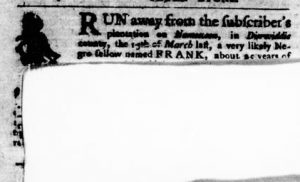
The space required for the news from Boston left a column and a half for other content.  Crouch filled that space with advertisements, including two advertisements for enslaved men who escaped from colonists who held them in bondage.  John Marley described “a neg[r]o fellow named GEORGE” who seized his own liberty five months earlier in November.  Humphry Sommers advertised “a NEGRO FELLOW, named MONDAY,” who escaped the day before the Boston Massacre took place hundreds of miles away in Massachusetts.  Both advertisements encouraged readers to engage in careful scrutiny of Black men to determine if they might be George or Monday.  Both Marley and Sommers offered rewards to colonists who helped capture the Black men they claimed as property.  Arguably, these notices received greater attention for having appeared in a supplement devoted to the Boston Massacre than when they ran in the standard issue of the South-Carolina Gazette and Country Journal.  Had it not been for Crouch issuing that supplement, these advertisements encouraging the surveillance of Black men would not have circulated as widely.

Apr 7 - Boston Massacre in South-Carolina Gazette and Country Journal Supplement
Supplement to the South-Carolina Gazette and Country Journal (April 7, 1770).

Slavery Advertisements Published April 7, 1770

The Slavery Adverts 250 Project chronicles the role of newspaper advertising in perpetuating slavery in the era of the American Revolution. The project seeks to reveal the ubiquity of slavery in eighteenth-century life from New England to Georgia by republishing advertisements for slaves – for sale, wanted to purchase, runaways, captured fugitives – in daily digests on this site as well as in real time via the @SlaveAdverts250 Twitter feed, utilizing twenty-first-century media to stand in for the print media of the eighteenth century.

The project aims to provide modern audiences with a sense of just how often colonists encountered these advertisements in their daily lives. Enslaved men, women, and children appeared in print somewhere in the colonies almost every single day. Those advertisements served as a constant backdrop for social, cultural, economic, and political life in colonial and revolutionary America. Colonists who did not own slaves were still confronted with slavery as well as invited to maintain the system by purchasing slaves or assisting in the capture of runaways. The frequency of these newspaper advertisements suggests just how embedded slavery was in colonial and revolutionary American culture in everyday interactions beyond the printed page.

These advertisements also testify to the experiences of enslaved men, women, and children, though readers must consider that those experiences have been remediated through descriptions offered by slaveholders rather than the slaves themselves. Often unnamed in the advertisements, enslaved men, women, and children were not invisible or unimportant in early America.

These advertisements appeared in colonial American newspapers 250 years ago today.

Apr 7 1770 - Providence Gazette Slavery 1
Providence Gazette (April 7, 1770).

**********

Apr 7 1770 - South-Carolina Gazette and Country Journal Supplement Slavery 1
Supplement to the South-Carolina Gazette and Country Journal (April 7, 1770).

**********

Apr 7 1770 - South-Carolina Gazette and Country Journal Supplement Slavery 2
Supplement to the South-Carolina Gazette and Country Journal (April 7, 1770).

**********

Apr 7 1770 - South-Carolina Gazette and Country Journal Supplement Slavery 3
Supplement to the South-Carolina Gazette and Country Journal (April 7, 1770).

April 6

What was advertised in a colonial American newspaper 250 years ago today?

Apr 6 - 4:6:1770 Massachusetts Gazette and Boston Weekly News-Letter
Massachusetts Gazette and Boston Weekly News-Letter (April 6, 1770).

“Seeds.”

It was a sign of spring.  Just as advertisements for almanacs told readers of colonial newspapers that fall had arrived and the new year was coming, advertisements for seeds signified that winter was coming to an end and spring would soon be upon them.  In the newspapers published in Boston in the late 1760s and early 1770s, this meant a dramatic increase in female entrepreneurs among those who placed advertisements.  Women who sold goods or provided services appeared only sporadically among newspaper notices throughout the rest of the year, but turned out in much greater numbers to peddle seeds in the spring.

Although printers and compositors did not usually organize or classify advertisements according to their purpose in eighteenth-century newspapers, they did tend to group together notices placed by women selling seeds.  Consider the last column of the final page of the April 6, 1770, edition of the Massachusetts Gazette and Boston Weekly News-Letter.  Although it concluded with a legal notice, advertisements for seeds sold by women comprised the rest of the column. Bethiah Oliver hawked seeds available at her shop “opposite the Rev. Dr. Sewall’s Meeting House.”  The appropriately named Elizabeth Greenleaf advised prospective customers to visit her shop “at the End of Union-Street, over-against the BLUE-BALL.”:  Elizabeth Clark and Elizabeth Nowell sold seeds at their shop “six Doors to the Southward of the Mill-Bridge.”  Susanna Renken also carried seeds at her shop “In Fore Street, near the Draw-Bridge.”  She was the only member of this sorority who advertised other wares, declaring that she stocked “all sorts of English Goods, imported before the Non-importation Agreement took Place.”  She was also the only one who sometimes advertised at other times during the year.  Did the others sell only seeds and operate seasonal businesses?  Or did they also carry other wares but refrain from advertising?

Spring planting was a ritual for colonists, including women who kept gardens to help feed their families.  Placing advertisements about seeds for growing peas, beans, onions, turnips, lettuce, and other produce was a ritual for the female seed sellers of Boston.  Encountering those advertisements in the city’s newspapers became one or many markers of the passage of time and the progression of the seasons for readers of those newspapers.  The news changed from year to year, but advertisements for seeds in the spring was a constant feature of the Massachusetts Gazette and Boston Weekly News-Letter and other newspaper.

Slavery Advertisements Published April 6, 1770

The Slavery Adverts 250 Project chronicles the role of newspaper advertising in perpetuating slavery in the era of the American Revolution. The project seeks to reveal the ubiquity of slavery in eighteenth-century life from New England to Georgia by republishing advertisements for slaves – for sale, wanted to purchase, runaways, captured fugitives – in daily digests on this site as well as in real time via the @SlaveAdverts250 Twitter feed, utilizing twenty-first-century media to stand in for the print media of the eighteenth century.

The project aims to provide modern audiences with a sense of just how often colonists encountered these advertisements in their daily lives. Enslaved men, women, and children appeared in print somewhere in the colonies almost every single day. Those advertisements served as a constant backdrop for social, cultural, economic, and political life in colonial and revolutionary America. Colonists who did not own slaves were still confronted with slavery as well as invited to maintain the system by purchasing slaves or assisting in the capture of runaways. The frequency of these newspaper advertisements suggests just how embedded slavery was in colonial and revolutionary American culture in everyday interactions beyond the printed page.

These advertisements also testify to the experiences of enslaved men, women, and children, though readers must consider that those experiences have been remediated through descriptions offered by slaveholders rather than the slaves themselves. Often unnamed in the advertisements, enslaved men, women, and children were not invisible or unimportant in early America.

These advertisements appeared in colonial American newspapers 250 years ago today.

Apr 6 1770 - New-Hampshire Gazette Slavery 1
New-Hampshire Gazette (April 6, 1770).

**********

Apr 6 1770 - New-Hampshire Gazette Slavery 2
New-Hampshire Gazette (April 6, 1770).

**********

Apr 6 1770 - South-Carolina and American General Gazette Slavery 1
South-Carolina and American General Gazette (April 6, 1770).

**********

Apr 6 1770 - South-Carolina and American General Gazette Slavery 2
South-Carolina and American General Gazette (April 6, 1770).

**********

Apr 6 1770 - South-Carolina and American General Gazette Slavery 3
South-Carolina and American General Gazette (April 6, 1770).

**********

Apr 6 1770 - South-Carolina and American General Gazette Slavery 4
South-Carolina and American General Gazette (April 6, 1770).

April 5

What was advertised in a colonial American newspaper 250 years ago today?

Apr 5 - 4:5:1770 Pennsylvania Gazette
Pennsylvania Gazette (April 5, 1770).

“A real good INK.”

When it came to opposing the taxes inflicted on the American colonies by Parliament, every small act of resistance mattered.  That was the message that Benjamin Jackson delivered in a lengthy nota bene to his advertisement for “New invented PHILADELPHIA INK-POWDER” in the April 5, 1770, edition of the Pennsylvania Gazette.  Jackson participated in a movement to encourage “domestic manufactures,” goods produced in the colonies as alternatives to items imported from Britain.  This movement gained popularity at the same time as American merchants and traders signed nonimportation agreements in response to the duties placed on imported paper, glass, paint, and tea in the Townshend Acts, hoping to leverage their commercial power to achieve political goals.

“As all our American manufactures (tho’ ever so small),” Jackson proclaimed, “are attended with obvious good consequences to the British colonies in general” consumers had a duty to purchase his ink powder even “tho’ it is but a trifling manufacture.”  He suggested that small and repeated acts of resistance would amount to a bold collective statement.  Furthermore, “some of the chief ingredients of this excellent Ink-Powder, are the produce of this continent.”  Not only did Jackson manufacture his ink powder locally, he also acquired many of the materials he needed from domestic suppliers.  His enterprise had ripple effects that benefited producers and consumers alike.  Like many others who advertised domestic manufactures, Jackson also assured prospective customers that they need not sacrifice quality nor pay premiums for their political principles.  He asserted that he sold his ink powder “as cheap as the European can be imported, and will engage it superior to that in quality.”  In addition to substituting for goods no longer shipped across the Atlantic, domestic manufactures addressed a trade imbalance between Britain and the colonies that resulted in a scarcity of specie circulating in the colonies.  Jackson noted that buying his product would “help to keep and circulate money amongst us.”

Jackson made various arguments in favor of his ink powder, developing a sophisticated “Buy American” marketing campaign before the American Revolution.  Yet his efforts were not themselves innovative.  He joined a chorus or producers and retailers who increasingly encouraged American consumers to choose domestic manufactures in the late 1760s and early 1770s.

Slavery Advertisements Published April 5, 1770

The Slavery Adverts 250 Project chronicles the role of newspaper advertising in perpetuating slavery in the era of the American Revolution. The project seeks to reveal the ubiquity of slavery in eighteenth-century life from New England to Georgia by republishing advertisements for slaves – for sale, wanted to purchase, runaways, captured fugitives – in daily digests on this site as well as in real time via the @SlaveAdverts250 Twitter feed, utilizing twenty-first-century media to stand in for the print media of the eighteenth century.

The project aims to provide modern audiences with a sense of just how often colonists encountered these advertisements in their daily lives. Enslaved men, women, and children appeared in print somewhere in the colonies almost every single day. Those advertisements served as a constant backdrop for social, cultural, economic, and political life in colonial and revolutionary America. Colonists who did not own slaves were still confronted with slavery as well as invited to maintain the system by purchasing slaves or assisting in the capture of runaways. The frequency of these newspaper advertisements suggests just how embedded slavery was in colonial and revolutionary American culture in everyday interactions beyond the printed page.

These advertisements also testify to the experiences of enslaved men, women, and children, though readers must consider that those experiences have been remediated through descriptions offered by slaveholders rather than the slaves themselves. Often unnamed in the advertisements, enslaved men, women, and children were not invisible or unimportant in early America.

These advertisements appeared in colonial American newspapers 250 years ago today.

Apr 5 1770 - Maryland Gazette Slavery 1
Maryland Gazette (April 5, 1770).

**********

Apr 5 1770 - Maryland Gazette Slavery 2
Maryland Gazette (April 5, 1770).

**********

Apr 5 1770 - Maryland Gazette Slavery 3
Maryland Gazette (April 5, 1770).

**********

Apr 5 1770 - Maryland Gazette Slavery 4
Maryland Gazette (April 5, 1770).

**********

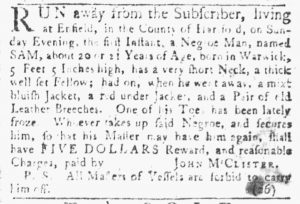
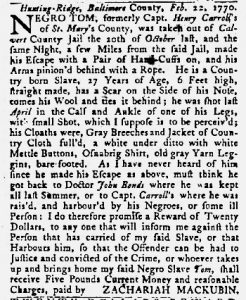
Apr 5 1770 - New-York Journal Slavery 1
New-York Journal (April 5, 1770).

**********

Apr 5 1770 - Pennsylvania Gazette Slavery 1
Pennsylvania Gazette (April 5, 1770).

**********

Apr 5 1770 - Pennsylvania Gazette Slavery 2
Pennsylvania Gazette (April 5, 1770).

**********

Apr 5 1770 - Pennsylvania Journal Slavery 1
Pennsylvania Journal (April 5, 1770).

**********

Apr 5 1770 - Pennsylvania Journal Slavery 2
Pennsylvania Journal (April 5, 1770).

**********

Apr 5 1770 - South-Carolina Gazette Supplement Slavery 1
Supplement to the South-Carolina Gazette (April 5, 1770).

**********

Apr 5 1770 - South-Carolina Gazette Supplement Slavery 2
Supplement to the South-Carolina Gazette (April 5, 1770).

**********

Apr 5 1770 - South-Carolina Gazette Supplement Slavery 3
Supplement to the South-Carolina Gazette (April 5, 1770).

**********

Apr 5 1770 - South-Carolina Gazette Supplement Slavery 4
Supplement to the South-Carolina Gazette (April 5, 1770).

**********

Apr 5 1770 - South-Carolina Gazette Supplement Slavery 5
Supplement to the South-Carolina Gazette (April 5, 1770).

**********

Apr 5 1770 - South-Carolina Gazette Supplement Slavery 6
Supplement to the South-Carolina Gazette (April 5, 1770).

**********

Apr 5 1770 - South-Carolina Gazette Supplement Slavery 7
Supplement to the South-Carolina Gazette (April 5, 1770).

**********

Apr 5 1770 - South-Carolina Gazette Supplement Slavery 8
Supplement to the South-Carolina Gazette (April 5, 1770).

**********

Apr 5 1770 - South-Carolina Gazette Supplement Slavery 9
Supplement to the South-Carolina Gazette (April 5, 1770).

**********

Apr 5 1770 - South-Carolina Gazette Supplement Slavery 10
Supplement to the South-Carolina Gazette (April 5, 1770).

**********

Apr 5 1770 - South-Carolina Gazette Supplement Slavery 11
Supplement to the South-Carolina Gazette (April 5, 1770).

**********

Apr 5 1770 - South-Carolina Gazette Supplement Slavery 12
Supplement to the South-Carolina Gazette (April 5, 1770).

**********

Apr 5 1770 - Virginia Gazette Purdie & Dixon Slavery 1
Virginia Gazette [Purdie and Dixon] (April 5, 1770).

**********

Apr 5 1770 - Virginia Gazette Purdie & Dixon Slavery 2
Virginia Gazette [Purdie and Dixon] (April 5, 1770).

**********

Apr 5 1770 - Virginia Gazette Purdie & Dixon Slavery 3
Virginia Gazette [Purdie and Dixon] (April 5, 1770).

**********

Apr 5 1770 - Virginia Gazette Purdie & Dixon Slavery 4
Virginia Gazette [Purdie and Dixon] (April 5, 1770).

**********

Apr 5 1770 - Virginia Gazette Purdie & Dixon Slavery 5
Virginia Gazette [Purdie and Dixon] (April 5, 1770).

**********

Apr 5 1770 - Virginia Gazette Purdie & Dixon Slavery 6
Virginia Gazette [Purdie and Dixon] (April 5, 1770).

**********

Apr 5 1770 - Virginia Gazette Rind Slavery 1
Virginia Gazette [Rind] (April 5, 1770).

April 4

What was advertised in a colonial American newspaper 250 years ago today?

Apr 4 - 4:4:1770 South-Carolina Gazette Supplement
Supplement to the South-Carolina Gazette (April 4, 1770).

“SHIP-CHANDLERY.”

William Price deployed typography to attract attention to his advertisement for “BEST Bridport CANVAS, and sundry other Articles” in the April 4, 1770, supplement to the South-Carolina Gazette.  A decorative border surrounded the headline for his advertisement, “SHIP-CHANDLERY,” making it one of only two advertisements in the supplement with that additional flourish.  The other announced “SALES by the Provost-Marshal,” an advertisement that was also a regular feature in the South-Carolina Gazette.  Its headline often appeared within a decorative border, which may have given Price the idea for enhancing his advertisement.  All of this suggests that Price made arrangements with the printer or compositor to spruce up his notice, though most advertisers merely supplied copy and left format to those who labored in the printing office.  Price may not have specified which printing ornaments should enclose his headline, but he most likely did offer some direction about the visual composition of his advertisement.

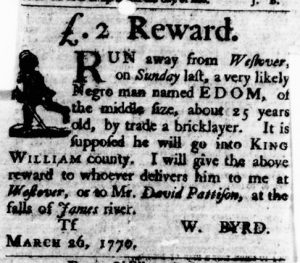
The border provided visual variation in a newspaper that consisted almost entirely of text.  Some advertisements included different fonts and font sizes to draw attention, as did Price’s notice, but consistencies among them suggest that compositors made such decisions, not advertisers.  Very few visual images appeared in eighteenth-century newspapers.  In the April 4 supplement, woodcuts accompanied only five of the thirty-five advertisements.  Three of those were real estate notices, two with woodcuts depicting a house and one with a woodcut showing a tree and a field.  An advertisement about a stray horse had a woodcut of a horse.  An advertisement describing an enslaved man who escaped featured a crude woodcut of a dark-skinned person that conflated characteristics associated with Africans and indigenous Americans.  All of those woodcuts belonged to the printer, as did woodcuts of ships at sea.  Price could have chosen one of those, but they were usually associated with vessels seeking freight and passengers, not ship chandlers looking to outfit ships before they departed from port.  He could have commissioned a woodcut depicting his merchandise, but he may not have considered that worth the expense, especially if he did not suspect that canvas or cordage would translate well via that medium.

The border that enclosed “SALES by the Provost-Marshal” and decorative type often used to separate “New Advertisements,” “Advertisements,” and, sometimes, news items from the content that appeared immediately above it suggested an alternative to prospective advertisers who wanted some sort of visual component in their notices.  As they perused the pages of the South-Carolina Gazette they encountered various means of creating a distinctive format for their advertisements even when they consisted almost entirely of text.  The pages of eighteenth-century newspapers may look fairly uniform to twenty-first-century eyes, but contemporary readers surely noticed the many variations in type, especially in the advertisements.

Slavery Advertisements Published April 4, 1770

The Slavery Adverts 250 Project chronicles the role of newspaper advertising in perpetuating slavery in the era of the American Revolution. The project seeks to reveal the ubiquity of slavery in eighteenth-century life from New England to Georgia by republishing advertisements for slaves – for sale, wanted to purchase, runaways, captured fugitives – in daily digests on this site as well as in real time via the @SlaveAdverts250 Twitter feed, utilizing twenty-first-century media to stand in for the print media of the eighteenth century.

The project aims to provide modern audiences with a sense of just how often colonists encountered these advertisements in their daily lives. Enslaved men, women, and children appeared in print somewhere in the colonies almost every single day. Those advertisements served as a constant backdrop for social, cultural, economic, and political life in colonial and revolutionary America. Colonists who did not own slaves were still confronted with slavery as well as invited to maintain the system by purchasing slaves or assisting in the capture of runaways. The frequency of these newspaper advertisements suggests just how embedded slavery was in colonial and revolutionary American culture in everyday interactions beyond the printed page.

These advertisements also testify to the experiences of enslaved men, women, and children, though readers must consider that those experiences have been remediated through descriptions offered by slaveholders rather than the slaves themselves. Often unnamed in the advertisements, enslaved men, women, and children were not invisible or unimportant in early America.

These advertisements appeared in colonial American newspapers 250 years ago today.

Apr 4 1770 - Georgia Gazette Slavery 1
Georgia Gazette (April 4, 1770).

**********

Apr 4 1770 - Georgia Gazette Slavery 2
Georgia Gazette (April 4, 1770).

**********

Apr 4 1770 - Georgia Gazette Slavery 3
Georgia Gazette (April 4, 1770).

**********

Apr 4 1770 - Georgia Gazette Slavery 4
Georgia Gazette (April 4, 1770).

**********

Apr 4 1770 - Georgia Gazette Slavery 5
Georgia Gazette (April 4, 1770).

**********

Apr 4 1770 - Georgia Gazette Slavery 6
Georgia Gazette (April 4, 1770).

**********

Apr 4 1770 - Georgia Gazette Slavery 7
Georgia Gazette (April 4, 1770).

**********

Apr 4 1770 - Georgia Gazette Slavery 8
Georgia Gazette (April 4, 1770).

**********

Apr 4 1770 - Georgia Gazette Slavery 9
Georgia Gazette (April 4, 1770).

**********

Apr 4 1770 - Georgia Gazette Slavery 10
Georgia Gazette (April 4, 1770).

**********

Apr 4 1770 - South-Carolina Gazette Supplement Slavery 1
Supplement to the South-Carolina Gazette Gazette (April 4, 1770).

**********

Apr 4 1770 - South-Carolina Gazette Supplement Slavery 2
Supplement to the South-Carolina Gazette Gazette (April 4, 1770).

**********

Apr 4 1770 - South-Carolina Gazette Supplement Slavery 3
Supplement to the South-Carolina Gazette Gazette (April 4, 1770).

April 3

What was advertised in a colonial American newspaper 250 years ago today?

Apr 3 - 4:3:1770 Essex Gazette
Essex Gazette (April 3, 1770).

“(None of which have been imported since the Year 1768.)”

When it came to infusing his advertisements for consumer goods with politics, Nathan Frazier was consistent while the nonimportation agreements were in effect in the late 1760s and early 1770s.  On September 26, 1769, he placed an advertisement in the Essex Gazette to inform prospective customers that he sold “a very good assortment of Fall and Winter GOODS, (a single article of which has not been imported since last year).”  He did not explicitly invoke the nonimportation agreement, but the significance would have been clear to readers.

Six months later, Frazier once again advertised in the Essex Gazette, proclaiming that he “HAS still lying on Hand, a great Variety of saleable Articles, suitable for all Seasons, more especially for that now approaching.”  He listed dozens of items available for purchase at his shop, demonstrating the range of consumer choice.  For that array of goods, he assured both prospective customers and the entire community that “none … have been imported since the Year 1768.”  Again, he did not make direct reference to the nonimportation agreements adopted by merchants in Boston and other towns throughout Massachusetts, but that was hardly necessary for readers to understand his point.

After all, news items that appeared elsewhere in the same issue underscored that colonists continued their boycott of goods imported from Britain to protest the duties levied on certain goods by the Townshend Acts.  On the page facing Frazier’s advertisement, for instance, an “Extract of a Letter from Bristol, Dec. 30,” reported, “The Ministry have assured some Persons in the American Trade, that so far as the King’s servants can promote the Repeal of the Duties on Tea, Paper, Glass and Paints, they will, so that the Spring Trade to the Colonies shall not be lost.”  The nonimportation agreements had not yet achieved their desired effect, but this extract inspired hope that if the colonists remained firm that they would eventually prevail.  Moreover, their success might come quickly in order to avoid disrupting the “Spring Trade.”

A news item that began on the facing page and concluded on the same page as Frazier’s advertisement also commented on the nonimportation agreements:  “It will perhaps be surprizing to the People of the neighbouring Provinces to be told, that there is not above one Seller of Tea in the Town of Boston who has not signed an Agreement not to dispose of any more of that Article, until the late Revenue Acts are repealed.”  Other news items also commented on tensions with Britain, though not the nonimportation agreements specifically.  A “LIST of Toasts drank at Newport … on the Commemoration of the Repeal of the Stamp-Act” asserted “the Principles of Civil and Religious Liberty” and remembered the “massacred martyrs to British and American Liberty” at the recent Boston Massacre.

That was the context in which Frazier inserted his advertisement for consumer goods in the Essex Gazette in the spring of 1770.  He did not need to comment at length on the politics of the day.  Instead, a brief note that he had not imported goods “since the Year 1768” told readers what they needed to know about the political significance of purchasing merchandise from his shop.