
What was advertised in a revolutionary American newspaper 250 years ago this week?
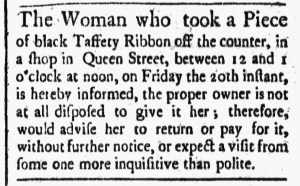
“Return or pay for it … or expect a visit from some one more inquisitive than polite.”
During the era of the American Revolution, newspapers frequently carried advertisements about thefts and burglaries, usually describing the items taken and offering rewards for bringing the culprits to justice. If possible, the victims also wanted the stolen goods returned, asking readers to “stop” or confiscate them if they encountered them in the marketplace. In some instances, the advertisements identified who had taken the items, but in most cases they relied on describing the goods as a means of identifying the burglars and thieves. Such instances gave some people, both those who stole the goods and those who purchased them via what Serena Zabin has termed an “informal economy,” opportunities to participate in the transatlantic consumer revolution.
The victim of a theft in Portsmouth, New Hampshire, in the fall of 1776 seemed to know who had taken “a Piece of back Taffety Ribbon off the counter, in a shop in Queen Street.” The unfortunate shopkeeper placed an advertisement in the October 5 edition of the Freeman’s Journal, informing the woman who absconded with the ribbon that “the proper owner is not at all disposed to give it to her.” The shopkeeper advised the shoplifter “to return or pay for” the ribbon “without further notice” or else “expect a visit from some one more inquisitive than polite.” Whether that person was the shopkeeper, someone with standing to arrest or prosecute the shoplifter, or someone with a more unsavory character, the advertisement did not specify, leaving it to the imagination of the woman who stole the ribbon. The shopkeeper also noted that the shoplifter took the ribbon “between 12 and 1 o’clock at noon, on Friday the 20th” of September, giving such precise details to imply that the shopkeeper did indeed know the identity of the shoplifter and could dispatch “some one more inquisitive than polite” to visit her to remedy the matter. Most advertisements about thefts and burglaries called on the public for assistance, but this advertisement about a shoplifter addressed a single reader, the shoplifter herself, as the shopkeeper took a different approach to using the power of the press to recover the stolen goods.