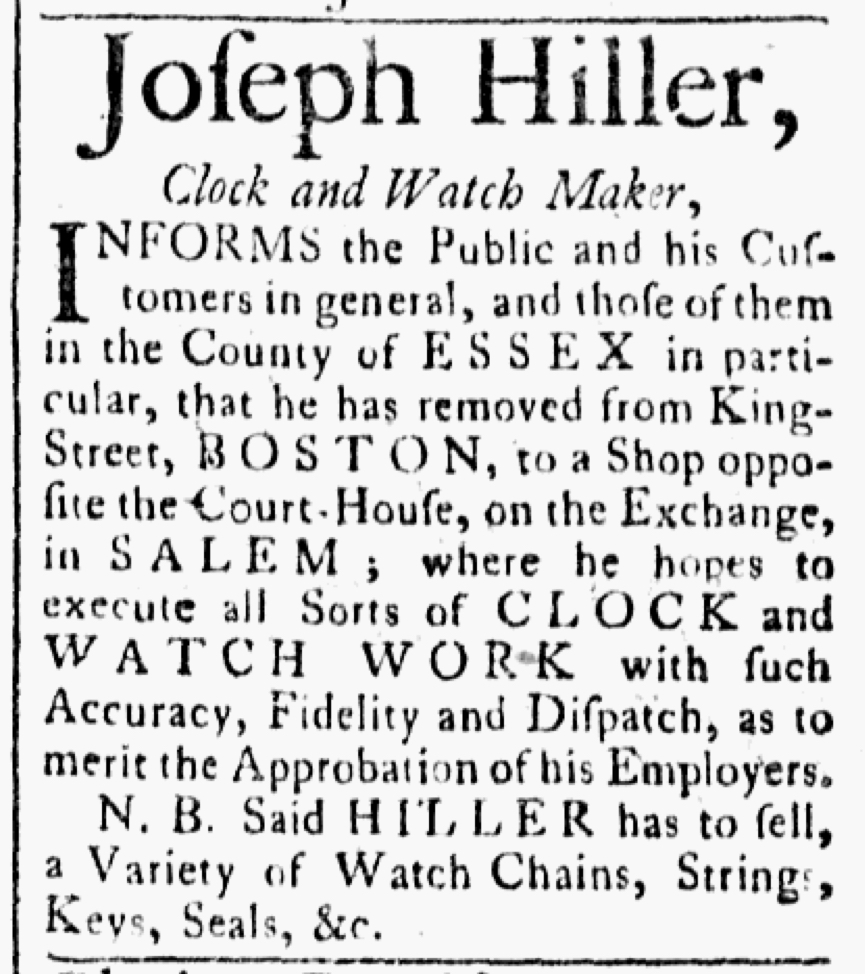
What was advertised in a colonial American newspaper 250 years ago this week?
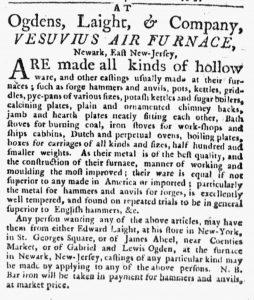
“Their ware is equal if not superior to any made in America or imported.”
Odgens, Laight, and Company, proprietors of the Vesuvius Air Furnace in Newark, New Jersey, placed an advertisement in the May 17, 1770, edition of the New-York Journal to inform prospective customers that they produced and sold “all kinds of hollow ware, and other castings.” Their inventory included forge hammers and anvils, pots, kettles, griddles, “iron stoves for work-shops and ships cabins,” and a variety of other items. Descriptions of some of their wares testified to their quality, such as “jamb and hearth plates neatly fitting each other,” yet Odgens, Laight, and Company made more extensive appeals to quality as well.
The partners proclaimed that “their metal is of the best quality” and underscored that “the construction of their furnace” as well as “manner of working and moulding” was “the most improved.” Accordingly, they could claim that the items they manufactured at the Vesuvius Air Furnace were “equal if not superior to any made in America or imported.” The comparison to imported goods held particular significance. As colonists adopted nonimportation agreements to protest duties on imported paper, glass, paint, lead, and tea that Parliament levied via the Townshend Acts, they also advocated supporting “domestic manufactures” as an alternate means of acquiring goods they needed and desired. Even though colonists declared their support for goods made in the colonies, newspaper advertisements suggest that consumers experienced some skepticism that those goods matched imported wares in terms of quality. Artisans and other who promoted domestic manufactures in the late 1760s and early 1770s frequently reassured prospective customers that they would not have to sacrifice quality in service to following their political principles. In addition to asserting that their wares were “equal if not superior” to imported goods, Ogdens, Laight, and Company singled out their hammers and anvils, explaining that “the metal … is excellently well tempered, and found on repeated trials to be in general superior English hammers.” They did not elaborate on who conducted those “repeated trials.” That claim echoed marketing strategies frequently invoked by other artisans: proclaiming that others with specialized knowledge of the product vouched for it.
Ogdens, Laight, and Company offered consumers an opportunity to demonstrate their support for the American colonies in their altercation with Parliament by purchasing goods made in the colonies rather than imported from England. In so doing, they joined other advertisers in the New-York Journal and throughout the colonies who offered domestic manufactures to prospective customers. The appeals they made in their advertisements resonated with the news that appeared elsewhere in the newspapers.






 Jenna Smith is a 2020 graduate of Assumption College. She double majored in History and Political Science. Jenna has taken a variety of history courses that cover different periods and parts of the world ranging from the ancient Middle East to the modern United States. Her true passion when researching and learning history is focused on the human element of every time period. She finds deep satisfaction and gratitude when hearing people’s stories or reading about them. Jenna earned a spot on the Dean’s List at Assumption College every semester. She lived and studied in Rome, Italy, and Berlin, Germany, during her time as an undergraduate at Assumption. Her passion for travel and connecting with different cultures was shown through her Study Abroad Ambassadorship. Jenna was also a History, Political Science, and Writing tutor at the Academic Support Center on campus. During her last semester at the school, she also participated in the Daniel Patrick Moynihan Model Senate Project where students recreated significant Senate debates that have occurred throughout the history of the United States. Jenna served as guest curator for the Slavery Adverts 250 Project during the Fall 2019 semester as part of her senior capstone seminar. She composed tweets for advertisements republished by the project during the fall and conducted the research and prepared the entries for six weeks in May and June 2020. The Assumption College History department presented her the Achievement in Public History award in 2020.