Slavery Advertisements Published May 15, 1770

The Slavery Adverts 250 Project chronicles the role of newspaper advertising in perpetuating slavery in the era of the American Revolution. The project seeks to reveal the ubiquity of slavery in eighteenth-century life from New England to Georgia by republishing advertisements for slaves – for sale, wanted to purchase, runaways, captured fugitives – in daily digests on this site as well as in real time via the @SlaveAdverts250 Twitter feed, utilizing twenty-first-century media to stand in for the print media of the eighteenth century.

The project aims to provide modern audiences with a sense of just how often colonists encountered these advertisements in their daily lives. Enslaved men, women, and children appeared in print somewhere in the colonies almost every single day. Those advertisements served as a constant backdrop for social, cultural, economic, and political life in colonial and revolutionary America. Colonists who did not own slaves were still confronted with slavery as well as invited to maintain the system by purchasing slaves or assisting in the capture of runaways. The frequency of these newspaper advertisements suggests just how embedded slavery was in colonial and revolutionary American culture in everyday interactions beyond the printed page.

These advertisements also testify to the experiences of enslaved men, women, and children, though readers must consider that those experiences have been remediated through descriptions offered by slaveholders rather than the slaves themselves. Often unnamed in the advertisements, enslaved men, women, and children were not invisible or unimportant in early America.

These advertisements appeared in colonial American newspapers 250 years ago today.

May 15 1770 - South-Carolina Gazette and Country Journal Slavery 1
South-Carolina Gazette and Country Journal (May 15, 1770).

**********

May 15 1770 - South-Carolina Gazette and Country Journal Slavery 2
South-Carolina Gazette and Country Journal (May 15, 1770).

**********

May 15 1770 - South-Carolina Gazette and Country Journal Slavery 3
South-Carolina Gazette and Country Journal (May 15, 1770).

May 14

What was advertised in a colonial American newspaper 250 years ago today?

May 14 - 5:14:1770 New-York Gazette and Weekly Mercury
New-York Gazette and Weekly Mercury (May 14, 1770).

“She has had the honour of being employed by several ladies in this city.”

Mary Morcomb did not indicate how recently she had arrived in New York in her advertisement, but it was recently enough that she described herself as a “Mantua-Maker, from London.”  After migrating to the colonies, she hoped to establish a new clientele.  To that end, she informed readers of the New-York Gazette and Weekly Mercury that she made “all sorts of negligees, Brunswick dresses, gowns, and every other sort of lady’s apparel.”  In addition, she extended her skills working with textiles to “cover[ing] UMBRELLOES in the neatest and most fashionable manner.”  Invoking her London origins testified to her access to the latest styles and taste, reassuring prospective customers that she did indeed produce both garments and umbrellas, a new and exotic accessory in the early 1770s, in the “most fashionable manner.”

As a newcomer who could not depend on a reputation established through interacting with clients and acquaintances over time, Morcomb instead attempted to accelerate the process.  She claimed that she already “had the honour of being employed by several ladies in this city.”  Those ladies, Morcomb reported, were satisfied with the garments she made for them and had “declared their approbation of her work.”  This was a secondhand testimonial, delivered by the provider of the goods and services, yet Morcomb hoped it would be sufficient to garner “encouragement from the ladies, in her business.”  She concluded by pledging that if prospective clients put their trust in her that they “May depend upon having their work done with all possible care and dispatch.”

In her effort to attract new customers, Morcomb deployed strategies often used by artisans, especially those in the garment trades, who only recently arrived in the colonies.  Many emphasized their connections to cosmopolitan cities where they had access to the latest fashions and then suggested that this already translated to serving select clients in their new location.  Although unfamiliar to many residents in their communities, Morcomb and other artisans attempted to incite demand by asserting that their services were already in demand.  Prospective customers should be eager to hire them, they proposed, because they had already successfully demonstrated their proficiency at their trades.

Slavery Advertisements Published May 14, 1770

The Slavery Adverts 250 Project chronicles the role of newspaper advertising in perpetuating slavery in the era of the American Revolution. The project seeks to reveal the ubiquity of slavery in eighteenth-century life from New England to Georgia by republishing advertisements for slaves – for sale, wanted to purchase, runaways, captured fugitives – in daily digests on this site as well as in real time via the @SlaveAdverts250 Twitter feed, utilizing twenty-first-century media to stand in for the print media of the eighteenth century.

The project aims to provide modern audiences with a sense of just how often colonists encountered these advertisements in their daily lives. Enslaved men, women, and children appeared in print somewhere in the colonies almost every single day. Those advertisements served as a constant backdrop for social, cultural, economic, and political life in colonial and revolutionary America. Colonists who did not own slaves were still confronted with slavery as well as invited to maintain the system by purchasing slaves or assisting in the capture of runaways. The frequency of these newspaper advertisements suggests just how embedded slavery was in colonial and revolutionary American culture in everyday interactions beyond the printed page.

These advertisements also testify to the experiences of enslaved men, women, and children, though readers must consider that those experiences have been remediated through descriptions offered by slaveholders rather than the slaves themselves. Often unnamed in the advertisements, enslaved men, women, and children were not invisible or unimportant in early America.

These advertisements appeared in colonial American newspapers 250 years ago today.

May 14 1770 - Boston-Gazette Slavery 1
Boston-Gazette (May 14, 1770).

**********

May 14 1770 - Boston-Gazette Slavery 2
Boston-Gazette (May 14, 1770).

**********

May 14 1770 - New-York Gazette and Weekly Mercury Slavery 1
New-York Gazette and Weekly Mercury (May 14, 1770).

**********

May 14 1770 - New-York Gazette and Weekly Mercury Slavery 2
New-York Gazette and Weekly Mercury (May 14, 1770).

**********

May 14 1770 - New-York Gazette and Weekly Mercury Slavery 3
New-York Gazette and Weekly Mercury (May 14, 1770).

**********
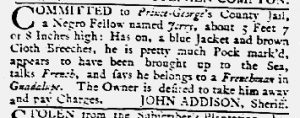
May 14 1770 - New-York Gazette and Weekly Mercury Supplement Slavery 1
Supplement to the New-York Gazette and Weekly Mercury (May 14, 1770).

**********

May 14 1770 - New-York Gazette and Weekly Mercury Supplement Slavery 2
Supplement to the New-York Gazette and Weekly Mercury (May 14, 1770).

**********

May 14 1770 - New-York Gazette or Weekly Post-Boy Slavery 1
New-York Gazette or Weekly Post-Boy (May 14, 1770).

**********

May 14 1770 - New-York Gazette or Weekly Post-Boy Slavery 2
New-York Gazette or Weekly Post-Boy (May 14, 1770).

**********

May 14 1770 - Pennsylvania Chronicle Slavery 1
Pennsylvania Chronicle (May 14, 1770).

May 13

What was advertised in a colonial American newspaper 250 years ago this week?

May 13 - 5:10:1770 Boston Chronicle
Boston Chronicle (May 10, 1770).

“WATT’S PSALMS … with a PREFACE of twenty four pages.”

John Mein and John Fleeming, printers of the Boston Chronicle, also printed and sold “WATT’S PSALMS WITH HIS HYMNS AND SPIRITUAL SONGS.”  Given the popularity of Isaac Watt’s Psalms, American printers produced several editions in the eighteenth century and booksellers imported others from London.  To incite demand for their edition, Mein and Fleeming sought to distinguish it from others.

They began by supplementing the title of the book with additional notes.  In writing the copy for advertisements for books, printers and booksellers often simply listed the title and extensive subtitle that doubled as a table of contents.  That preview gave prospective customers a glimpse of what they would encounter when they purchased and read books themselves.  In this case, however, Mein and Fleeming further embellished the subtitle of Watt’s Psalms: “IMITATED in the language of the NEW-TESTAMENT, and applied to the Christian state and worship, with a PREFACE of twenty four pages, being a Discourse on the right way of fitting the PSALMS of DAVID for Christian Worship.”  The underlined portion identifies deviations from the title page, which instead reads: “with the preface, or an enquiry in to the right way.”  Mein and Fleeming then described the contents of those twenty-four pages in greater detail before giving the same treatment to the “NOTES at the end of the PSALMS.”

The printers had good reason to be so particular.  They concluded their advertisement by proclaiming, “This is the only Edition of Dr. WATTS’s PSALMS and HYMNS printed in AMERICA, with the large Preface and Notes.”  They sought to underscore the value of their edition compared to others produced by local printers, drawing attention to the twenty-four pages in the preface as well as the notes and “proper directions for SINGING” that followed the hymns.  Although infamous loyalists, they appropriated the “Buy American” strategy deployed by supporters of the patriot cause in service of selling their edition of Watts’s Psalms.

May 12

What was advertised in a colonial American newspaper 250 years ago today?

May 12 - 5:12:1770 Providence Gazette
Providence Gazette (May 12, 1770).

“B L A N K S.”

John Carter, printer of the Providence Gazette, regularly inserted an advertisement for printed blanks into his own newspaper in 1770, using one element of his business to promote another.  Even when he did not run his notice for “BLANKS,” each edition concluded with a colophon that listed more than just Carter’s name and the place of publication.  It also advised readers that “all Manner of PRINTING-WORK is performed on reasonable Terms, with Fidelity and Expedition” at Carter’s printing office at “the Sign of Shakespeare’s Head” in Providence.  The advertisement for “BLANKS” often supplemented the perpetual advertisement for job printing at the bottom of the final page of the Providence Gazette.

Carter catered to a variety of prospective customers, producing blanks (or forms) for “Apprentices Indentures,” “Bills of Lading,” “Bonds of several sorts,” and “Long and short Powers of Attorney,” to name just a few.  He also carried “various Kinds of Blanks for the colony of CONNECTICUT” for anyone tending to legal or commercial matters in the neighboring colony.

This advertisement moved around within the pages of the Providence Gazette.  Eighteenth-century printers often saved advertisements for their own goods and services for the bottom of columns, bringing those columns to the desired length after first inserting news and paid notices submitted by their customers.  Perhaps to increase the likelihood that readers would take note of it, Carter moved his advertisement around the page from week to week.  In the May 12, 1770, edition it occupied a privileged place as the first advertisement.  It also appeared in the center of the page, drawing the eye due to the amount of white space created by listing only one item per line.  Both the news and the other advertisements on the page consisted of dense paragraphs with little variation of font sizes.  Carter’s advertisement with its headline, “B L A N K S” in the largest font on the page, and ample white space positioned at the center of the page would have been nearly impossible for readers of the Providence Gazette to overlook.

May 11

What was advertised in a colonial American newspaper 250 years ago today?

May 11 - 5:11:1770 South-Carolina and American General Gazette
South-Carolina and American General Gazette (May 11, 1770).

“May be had … till Capt. Schermerhorn’s Sloop sails.”

The colophon for the South-Carolina and American General Gazette indicated that it was published by Robert Wells “at the Old Printing-House, Great Stationary and Book Shop.”  Like many other eighteenth-century printers, Wells simultaneously operated several affiliated enterprises from his printing office.  An advertisement in the May 11, 1770, edition of his newspaper alerted prospective customers to an item for sale among the books and stationery at his shop, “A PLAN of the CITY of NEW-YORK by Capt. Ratzer, Engineer.”

The advertisement declared that this map was “most elegantly engraved,” but that was not the only marketing strategy deployed to incite demand among consumers.  The advertisement also proclaimed that the map was available for a limited time only.  Customers could acquire their own copies for one dollar each “till Capt. Schermerhorn’s Sloop sails, in which will be returned all the Copies then unsold.”  None would be held in reserve at the printing office to sell in the future.  Anyone potentially interested in this map, the advertisement warned, needed to visit Wells’s shop to examine the map and make a decision about purchasing it as soon as possible or else they would miss the opportunity to obtain it easily from a local bookseller.

May 11 - 10:15:1770 New-York Gazette and Weekly Mercury
New-York Gazette and Weekly Mercury (October 15, 1770).

In its notes on Plan of the City of New York, in North America: Surveyed in the Years 1766 & 1767, the Norman B. Leventhal Map & Education Center at the Boston Public Library cites two states of the map, the first “undated but about 1770” and the second from 1776.  Furthermore, the “attribution of 1770 for the first state of the map is based on a ‘New-York Gazette’ advertisement for the map in October 1770,” according to Margaret Beck Pritchard and Henry G. Taliaferro.  Although available for purchase in two of the largest urban ports in the colonies in 1770, there are “only two known examples of the map in the first state” today.  The advertisements aid historians in telling a more complete story of the production and distribution of the Plan of the City of New York in the late colonial era.

Slavery Advertisements Published May 11, 1770

The Slavery Adverts 250 Project chronicles the role of newspaper advertising in perpetuating slavery in the era of the American Revolution. The project seeks to reveal the ubiquity of slavery in eighteenth-century life from New England to Georgia by republishing advertisements for slaves – for sale, wanted to purchase, runaways, captured fugitives – in daily digests on this site as well as in real time via the @SlaveAdverts250 Twitter feed, utilizing twenty-first-century media to stand in for the print media of the eighteenth century.

The project aims to provide modern audiences with a sense of just how often colonists encountered these advertisements in their daily lives. Enslaved men, women, and children appeared in print somewhere in the colonies almost every single day. Those advertisements served as a constant backdrop for social, cultural, economic, and political life in colonial and revolutionary America. Colonists who did not own slaves were still confronted with slavery as well as invited to maintain the system by purchasing slaves or assisting in the capture of runaways. The frequency of these newspaper advertisements suggests just how embedded slavery was in colonial and revolutionary American culture in everyday interactions beyond the printed page.

These advertisements also testify to the experiences of enslaved men, women, and children, though readers must consider that those experiences have been remediated through descriptions offered by slaveholders rather than the slaves themselves. Often unnamed in the advertisements, enslaved men, women, and children were not invisible or unimportant in early America.

These advertisements appeared in colonial American newspapers 250 years ago today.

May 11 1770 - New-Hampshire Gazette Slavery 1
New-Hampshire Gazette (May 11, 1770).

**********

May 11 1770 - New-London Gazette Slavery 1
New-London Gazette (May 11, 1770).

**********

May 11 1770 - New-London Gazette Slavery 2
New-London Gazette (May 11, 1770).

**********

May 11 1770 - South-Carolina and American General Gazette Slavery 1
South-Carolina and American General Gazette (May 11, 1770).

**********

May 11 1770 - South-Carolina and American General Gazette Slavery 2
South-Carolina and American General Gazette (May 11, 1770).

**********

May 11 1770 - South-Carolina and American General Gazette Slavery 3
South-Carolina and American General Gazette (May 11, 1770).

**********

May 11 1770 - South-Carolina and American General Gazette Slavery 4
South-Carolina and American General Gazette (May 11, 1770).

**********

May 11 1770 - South-Carolina and American General Gazette Slavery 5
South-Carolina and American General Gazette (May 11, 1770).

**********

May 11 1770 - South-Carolina and American General Gazette Slavery 6
South-Carolina and American General Gazette (May 11, 1770).

**********

May 11 1770 - South-Carolina and American General Gazette Slavery 7
South-Carolina and American General Gazette (May 11, 1770).

**********

May 11 1770 - South-Carolina and American General Gazette Slavery 8
South-Carolina and American General Gazette (May 11, 1770).

**********

May 11 1770 - South-Carolina and American General Gazette Slavery 9
South-Carolina and American General Gazette (May 11, 1770).

**********

May 11 1770 - South-Carolina and American General Gazette Slavery 10
South-Carolina and American General Gazette (May 11, 1770).

**********

May 11 1770 - South-Carolina and American General Gazette Slavery 11
South-Carolina and American General Gazette (May 11, 1770).

**********

May 11 1770 - South-Carolina and American General Gazette Slavery 12
South-Carolina and American General Gazette (May 11, 1770).

May 10

What was advertised in a colonial American newspaper 250 years ago today?

May 10 - 5:10:1770 New-York Journal
New-York Journal (May 10, 1770).

Pencill’d China,” “Burnt Image China,” “Blue and white China.”

Like many other colonial shopkeepers, George Ball published an extensive list of his merchandise in an advertisement he placed in the May 10, 1770, edition of the New-York Journal.  Most advertisers who resorted to similar lists grouped all of their wares together into dense paragraphs of text.  A smaller number, like Ball, used graphic design to aid prospective customers in differentiating among their goods as they perused their advertisements.  Ball formatted his advertisement in columns with only one, two, or three items per line, just as Abeel and Byvanck, John Keating, and Jarvis Roebuck did elsewhere in the same issue.  Ball, however, instituted a further refinement that distinguished his notice from the others.  He cataloged his merchandise and inserted headers for the benefit of consumers.

Ball offered several categories of merchandise:  “Pencill’d China,” “Burnt Image China,” “Blue and white China,” “Brown China,” “White China,” “White Stone Ware,” “Delph Ware,” “Plain Glass Ware,” “Flower’d Glass,” “Iron Ware from England,” and “Queen Pattern Lamps.”  These headers appeared in italics and centered within their respective columns to set them apart from the rest of the list.  The goods that followed them elaborated on what Ball had in stock, allowing prospective customers to more easily locate items of interest or simply assess the range of goods Ball offered for sale.  His method could have benefited from further refinement.  The items that followed “Queen Pattern Lamps” were actually a miscellany that did not belong in any of the other categories.  Ball might have opted for “Other Goods” as a header instead.  Still, his attempt to catalog his merchandise at all constituted an innovation over the methods of other advertisers.

In most instances, eighteenth-century advertisers submitted copy and compositors determined the layout.  However, advertisements broken into columns suggest some level of consultation between advertisers and compositors, at the very least a request or simple instructions from one to the other.  Ball’s advertisement likely required an even greater degree of collaboration between advertiser and compositor.

Slavery Advertisements Published May 10, 1770

The Slavery Adverts 250 Project chronicles the role of newspaper advertising in perpetuating slavery in the era of the American Revolution. The project seeks to reveal the ubiquity of slavery in eighteenth-century life from New England to Georgia by republishing advertisements for slaves – for sale, wanted to purchase, runaways, captured fugitives – in daily digests on this site as well as in real time via the @SlaveAdverts250 Twitter feed, utilizing twenty-first-century media to stand in for the print media of the eighteenth century.

The project aims to provide modern audiences with a sense of just how often colonists encountered these advertisements in their daily lives. Enslaved men, women, and children appeared in print somewhere in the colonies almost every single day. Those advertisements served as a constant backdrop for social, cultural, economic, and political life in colonial and revolutionary America. Colonists who did not own slaves were still confronted with slavery as well as invited to maintain the system by purchasing slaves or assisting in the capture of runaways. The frequency of these newspaper advertisements suggests just how embedded slavery was in colonial and revolutionary American culture in everyday interactions beyond the printed page.

These advertisements also testify to the experiences of enslaved men, women, and children, though readers must consider that those experiences have been remediated through descriptions offered by slaveholders rather than the slaves themselves. Often unnamed in the advertisements, enslaved men, women, and children were not invisible or unimportant in early America.

These advertisements appeared in colonial American newspapers 250 years ago today.

May 10 1770 - Maryland Gazette Slavery 1
Maryland Gazette (May 10, 1770).

**********

May 10 1770 - Maryland Gazette Slavery 2
Maryland Gazette (May 10, 1770).

**********

May 10 1770 - Maryland Gazette Supplement Slavery 1
Maryland Gazette (May 10, 1770).

**********

May 10 1770 - New-York Journal Slavery 1
New-York Journal (May 10, 1770).

**********

May 10 1770 - Pennsylvania Gazette Slavery 1
Pennsylvania Gazette (May 10, 1770).

**********

May 10 1770 - Pennsylvania Gazette Slavery 2
Pennsylvania Gazette (May 10, 1770).

**********

May 10 1770 - Pennsylvania Gazette Slavery 3
Pennsylvania Gazette (May 10, 1770).

**********

May 10 1770 - Pennsylvania Gazette Supplement Slavery 1
Supplement to the Pennsylvania Gazette (May 10, 1770).

**********

May 10 1770 - Pennsylvania Journal Slavery 1
Pennsylvania Journal (May 10, 1770).

**********

May 10 1770 - South-Carolina Gazette Slavery 1
South-Carolina Gazette (May 10, 1770).

**********

May 10 1770 - South-Carolina Gazette Slavery 2
South-Carolina Gazette (May 10, 1770).

**********

May 10 1770 - South-Carolina Gazette Slavery 3
South-Carolina Gazette (May 10, 1770).

**********

May 10 1770 - South-Carolina Gazette Slavery 4
South-Carolina Gazette (May 10, 1770).

**********

May 10 1770 - South-Carolina Gazette Slavery 5
South-Carolina Gazette (May 10, 1770).

**********

May 10 1770 - South-Carolina Gazette Slavery 6
South-Carolina Gazette (May 10, 1770).

**********

May 10 1770 - South-Carolina Gazette Slavery 7
South-Carolina Gazette (May 10, 1770).

**********

May 10 1770 - South-Carolina Gazette Slavery 8
South-Carolina Gazette (May 10, 1770).

**********

May 10 1770 - South-Carolina Gazette Slavery 9
South-Carolina Gazette (May 10, 1770).

**********

May 10 1770 - South-Carolina Gazette Slavery 10
South-Carolina Gazette (May 10, 1770).

**********

May 10 1770 - South-Carolina Gazette Slavery 11
South-Carolina Gazette (May 10, 1770).

**********

May 10 1770 - South-Carolina Gazette Slavery 12
South-Carolina Gazette (May 10, 1770).

**********

May 10 1770 - South-Carolina Gazette Slavery 13
South-Carolina Gazette (May 10, 1770).

**********

May 10 1770 - South-Carolina Gazette Slavery 14
South-Carolina Gazette (May 10, 1770).

**********

May 10 1770 - South-Carolina Gazette Slavery 15
South-Carolina Gazette (May 10, 1770).

**********

May 10 1770 - South-Carolina Gazette Slavery 16
South-Carolina Gazette (May 10, 1770).

May 9

What was advertised in a colonial American newspaper 250 years ago today?

May 9 - 5:9:1770 Georgia Gazette
Georgia Gazette (May 9, 1770).

“No Part of the Cargo will be sold but in the Yard on the Day of Sale.”

It was the first advertisement readers encountered as they perused the May 9, 1770, edition of the Georgia Gazette.  John Graham informed the residents of Savannah and the rest of the colony that the Cavendish had recently arrived “from SIERRALEON on the Windward Coast” with “A CARGO” of 200 “Young and Healthy SLAVES.”  This “CARGO,” humans reduced to commodities, would be offered for sale in less than a week.  Graham asserted that the Africans experienced a “short Passage” across the Atlantic, suggesting that they had not had enough time to become ill while aboard the Cavendish.  Such advertisements never mentioned how many perished during the Middle Passage. Furthermore, neither Graham nor other enslavers worried much about the health of the enslaved Africans for their own sake.  Instead, Graham offered these assurances to convince prospective buyers of the value of the “CARGO” and bolster prices.

In addition to the usual information that appeared in advertisements of this sort, Graham added a final note: “That those who propose to become Purchasers may have an equal Chance, no Part of the Cargo will be sold but in the Yard on the Day of the Sale.”  In other words, prospective buyers could not arrange for private sales and select the best of this “CARGO” in advance of the sale open to all bidders on the designated day.  This starkly underscored the interests of those who participated in the slave trade while ignoring the humanity of the young Africans offered for sale.  For those who invested in the voyage, it tended to their interests by increasing the likelihood that multiple buyers would seek to outbid each other when they could select from among the entire “CARGO,” thus maximizing profits.  For prospective buyers, it tended to their interests as consumers, alerting them that they would not be deprived of the opportunity to examine all of the merchandise and choose their favorites, as if the Africans who arrived on the Cavendish were no different than textiles, housewares, hardware, and other goods imported to Savannah on other ships and then put on display in the town’s shops.  The note at the end of Graham’s advertisement addressed the desires of prospective purchasers, further obscuring the fact that the enslaved Africans were also imbued with desires of their own.