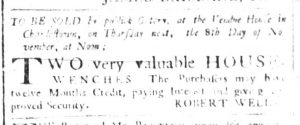
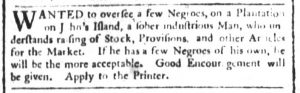
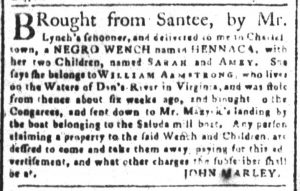
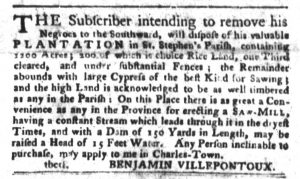
The Slavery Adverts 250 Project chronicles the role of newspaper advertising in perpetuating slavery in the era of the American Revolution. The project seeks to reveal the ubiquity of slavery in eighteenth-century life from New England to Georgia by republishing advertisements about enslaved people – for sale as individuals or in groups, wanted to purchase or for hire for short periods, runaways who liberated themselves, and those who were subsequently captured and confined in jails and workhouses – in daily digests on this site as well as in real time via the @SlaveAdverts250 Twitter feed, utilizing twenty-first-century media to stand in for the print media of the eighteenth century.
The project aims to provide modern audiences with a sense of just how often colonists encountered these advertisements in their daily lives. Enslaved men, women, and children appeared in print somewhere in the colonies almost every single day. Those advertisements served as a constant backdrop for social, cultural, economic, and political life in colonial and revolutionary America. Colonists who did not purport to own enslaved people were still confronted with slavery as well as invited to maintain the system by purchasing slaves or assisting in the capture of runaways who sought to free themselves from bondage. The frequency of these newspaper advertisements suggests just how embedded slavery was in colonial and revolutionary American culture in everyday interactions beyond the printed page.
These advertisements also testify to the experiences of enslaved men, women, and children, though readers must consider that those experiences have been remediated through descriptions offered by enslavers rather than enslaved people themselves. Often unnamed in the advertisements, enslaved men, women, and children were not invisible or unimportant in early America.
These advertisements appeared in colonial American newspapers 250 years ago today.
What was advertised in a colonial American newspaper 250 years ago today?
Pennsylvania Journal (November 8, 1770).
“Experience has taught him to cut hair according to art.”
Lewis Fay, a “Periwig Maker and Hair Dresser,” offered his services to the residents of Philadelphia, especially “the Ladies,” in an advertisement in the November 8, 1770, edition of the Pennsylvania Journal. His message to prospective clients was as elaborate as some of the styles that he created. As a newcomer in the city, he aimed for his advertisement to help establish his reputation.
To that end, he first informed readers that he was “From Paris,” perhaps the most cosmopolitan center of fashion on either side of the Atlantic. Hiring his services, he suggested, came with some extra cachet. Thanks to his Parisian origins, he was familiar with the “newest fashion” and had gained the experience “to cut hair according to art.” Fay proclaimed that he “can dress Ladies in fifty different manners with their own natural hair,” but for those “who have not sufficient hair” he could outfit them “with false curls so well as not to be distinguished from their natural ones.” He did so with such skill that others would not be able to recognize those “false curls” even “by the nearest inspection.” He also accepted male clients, stating that he “dresses also Gentlemen’s hair in thirty fashionable and different manners, agreeable to their faces and airs.” Fay apparently offered advice, consulting with his clients about which styles indeed suited their physical features and the impressions they wished to make on others. The hairdresser also provided ancillary services, including cutting children’s hair “at a reasonable rate” and selling products like “Pomatum, which changes the red and grey hair into black.”
Although he was new in town, Fay anticipated running a thriving shop in Strawberry Alley. Expecting that his services would certainly be in demand, the French hairdresser instructed ladies who would “favour him with their commands” to make appointments at least a day in advance. Otherwise, they might end up being “disappointed” due to “previous engagements” that would prevent Fay from dressing their hair. He sought to incite demand for his services through puffery that emphasized his origins and skills while lending the impression that his services were already popular among genteel ladies in the city.
The Slavery Adverts 250 Project chronicles the role of newspaper advertising in perpetuating slavery in the era of the American Revolution. The project seeks to reveal the ubiquity of slavery in eighteenth-century life from New England to Georgia by republishing advertisements about enslaved people – for sale as individuals or in groups, wanted to purchase or for hire for short periods, runaways who liberated themselves, and those who were subsequently captured and confined in jails and workhouses – in daily digests on this site as well as in real time via the @SlaveAdverts250 Twitter feed, utilizing twenty-first-century media to stand in for the print media of the eighteenth century.
The project aims to provide modern audiences with a sense of just how often colonists encountered these advertisements in their daily lives. Enslaved men, women, and children appeared in print somewhere in the colonies almost every single day. Those advertisements served as a constant backdrop for social, cultural, economic, and political life in colonial and revolutionary America. Colonists who did not purport to own enslaved people were still confronted with slavery as well as invited to maintain the system by purchasing slaves or assisting in the capture of runaways who sought to free themselves from bondage. The frequency of these newspaper advertisements suggests just how embedded slavery was in colonial and revolutionary American culture in everyday interactions beyond the printed page.
These advertisements also testify to the experiences of enslaved men, women, and children, though readers must consider that those experiences have been remediated through descriptions offered by enslavers rather than enslaved people themselves. Often unnamed in the advertisements, enslaved men, women, and children were not invisible or unimportant in early America.
These advertisements appeared in colonial American newspapers 250 years ago today.
Conor Meehan is a 2020 graduate of Assumption College (now Assumption University) in Worcester, Massachusetts. He majored in Global Studies with a minor in History.
Conor was not born in the United States (much to the surprise of many); he was adopted from the city of Perm, Russia. Since his adoption a few months after he was born, he resided in the town of Sudbury, Massachusetts. His brother and sister were also adopted from Russia, although from different cities. From an early age, their family raised them with activities that emphasized history, both of the United States and of other countries. Their ventures involved exploration of the Gettysburg battlefield; Ohio’s Serpent Mound; Massachusetts’ Minuteman National Park; the Lackawanna Coal Mine of Pennsylvania; Washington D.C.’s landmarks (including the Washington Monument and Lincoln Memorial); a few of the Spanish Missions of California; Italian landmarks such as the Colosseum and Circus Maximus; Ancient Mayan ruins of Mexico’s Yucatan Peninsula (encompassing such sites as Chichen Itza and Uxmal); and many more.
Perhaps not coincidentally, considering family trips regularly involved history of some sort, Conor was often most interested in courses with a heavy concentration on historic events. These courses immersed him in such topics as the Cold War and the early Islamic world. He also engaged in extracurricular activities such as screenings of documentaries, the Philosophy Club, and multi-college live feeds involving important political figures, notably former United States Secretary of State Henry Kissinger and former United States National Security Advisor Susan Rice.
For one semester, Conor joined Assumption College’s Rome Program. Activities regularly involved trips to some of Italy’s most noteworthy places, particularly in the context of the Roman Empire and the Renaissance: Pompeii, Florence, Asisi, and more. During breaks from classes, he took trips to other parts of Europe. The first of these he spent in the town of Interlaken, Switzerland, a town named for its location between two Alpine lakes. There, he went to a local nature park which housed some of the animals common in the region, went on a snowshoeing and sledding expedition in a town not far from Interlaken, and went on a guided tour which took a railway in the Jungfraujoch mountain pass. On another tripe, he traversed Hungary and Austria. To start, he traveled to the Hungarian capital Budapest, where he visited such locations as Matthias Church. His next destination was Vienna, Austria, where he embarked on a walking tour, which included one of the residences of composer Amadeus Mozart. Another stop was Salzburg, best known as both the birthplace of Mozart and for filming The Sound of Music.
Conor conducted the research for his current contributions as guest curator for the Slavery Adverts 250 Project when he was enrolled in HIS 400 – Research Methods: Vast Early America in Spring 2020.
What was advertised in a colonial American newspaper 250 years ago this week?
Supplement to the New-York Gazette and Weekly Mercury (November 5, 1770).
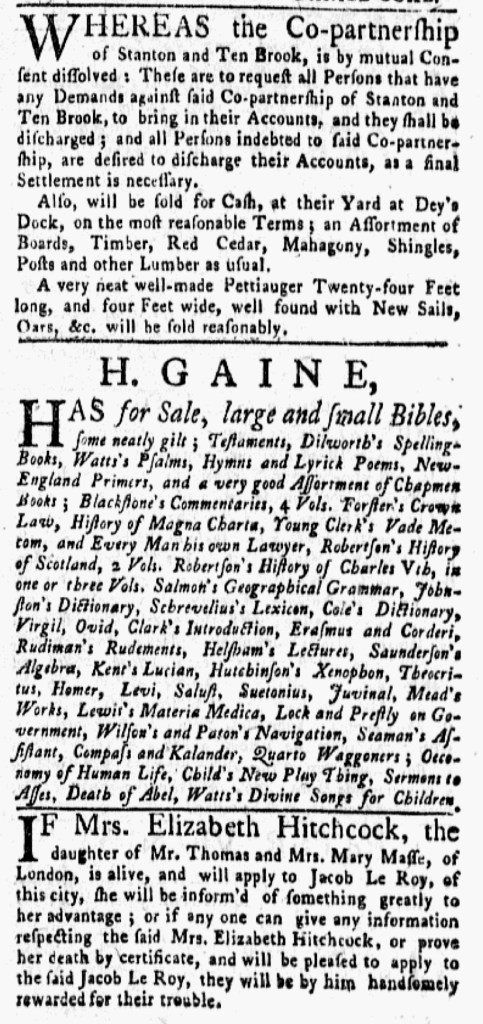
“The Co-partnership of Stanton and Ten Brook, is by mutual Consent dissolved.”
Hugh Gaine, the printer of the New-York Gazette and Weekly Mercury, had too much news and advertising to fit in a standard issue of his newspaper on November 5, 1770, so he resorted to a solution common among printers throughout the colonies. He published a two-page supplement to accompany the standard issue. In this case, he used a smaller sheet with only three columns per page (instead of four), filling both sides with advertisements.
Some of the advertisements in the supplement also appeared in the standard issue, including a notice about the partnership of Stanton and Ten Brook dissolving “by mutual Consent” and calling on associates to settle accounts, a notice seeking Elizabeth Hancock and informing her that “she will be inform’d of something greatly to her advantage” is she contacted Jacob Le Roy, and a list of books that Gaine himself offered for sale. Like many other printers, Gaine was also a bookseller.
Why did these advertisements run twice on the same day, first in the standard issue and again in the supplement? This suggests that the two placed by Le Roy and the partnership of Stanton and Ten Brook may not have generated additional revenue for the printer. Instead, he may very well have used them as filler to complete the page. All three appeared at the bottom of the third column, suggesting they were the last notices incorporated into the supplement. Gaine probably hoped that running his own advertisement a second time would yield greater sales for the bookselling segment of his enterprise, but it does not seem likely that he would have charged the others for an additional insertion of their advertisements.
Were any of the other advertisements in the supplement included to complete the page rather than because the advertisers instructed Gaine to run them again and agreed to pay for the service? Advertisements crowding the pages of colonial newspapers and overflowing into supplements usually represented significant revenues for printers, but this example suggests that was not always the case for every advertisement. Although including an advertisement twice on a single day was relatively rare, Gaine and other printers did run some notices sporadically and for far longer than advertisers may have requested. In some cases, it seems that printers valued advertisements as filler just as much as they valued them for the fees they earned.
What was advertised in a colonial American newspaper 250 years ago today?
South-Carolina and American General Gazette (November 6, 1770).
“AN ELEGY on the Reverend GEORGE WHITEFIELD.”
Following the death of George Whitefield, one of the most influential ministers associated with the eighteenth-century religious revivals now known as the Great Awakening, news radiated out from New England. Brief reports first appeared in Boston’s newspapers the day after the minister died. Other newspapers then reprinted the news, first in other colonies in New England and then in New York and Pennsylvania and eventually in Maryland, Virginia, and South Carolina. (The Georgia Gazette presumably carried the news as well, but few copies from 1770 survive.) Coverage of Whitefield’s death also included poems written in his memory, reprinted from newspaper to newspaper, and advertisements for commemorative items, all of them printed materials that ranged from broadsides to pamphlets to books.
The widespread marketing of that memorabilia amounted to the commodification of Whitefield’s death as printers and others sought to capitalize on the event. That does not mean that expressions of mourning among producers and consumers were not sincere. They were, however, mediated through acquiring goods that allowed consumers to experience a connection to the minister and feel as though they were participating in current events alongside others who mourned. Even as producers and sellers of the commemorative items facilitated that process, they also strove to generate revenues from Whitefield’s death.
The commodification began in New England almost as soon as newspapers published the news. In its first article about Whitefield’s death, published four days later, the Massachusetts Gazette and Boston Weekly News-Letter noted that a “FUNERAL HYMN” that the minister wrote several years earlier was for sale at another printing office in Boston. Not long after that, freestanding advertisements began appearing in all of the newspapers published in that city as well as in newspapers from other towns in New England. As news spread to other colonies, printers and booksellers in New York and Pennsylvania also ran advertisements that marketed Whitefield memorabilia. Due to the distance, it took more than three weeks for the news to reach South Carolina. Just two weeks after that, an advertisement for a commemorative item ran in the November 6, 1770, edition of the South-Carolina and American General Gazette.
That advertisement offered a short history of Whitefield’s death. Coverage had not been as extensive that far from New England, so the advertisement likely helped prospective customers recall the key details that Whitefield “departed this Life ay Newbury-Port in New-England, on the Morning of the Lord’s-Day, September 30th 1770, in the 56th Year of his Age.” The advertisement promoted an “ELEGY” in memory of the minister as well as “A HYMN, composed by the Rev, Mr. WHITEFIELD to be sung over his own Corpse.” By then the hymn had already been widely marketed in New England and additional advertisements ran in other colonies. The advertisement in the South-Carolina and American General Gazette indicated a different method of distributing the memorabilia than in most advertisements in other newspapers, stating that “CARRIERS of this GAZETTE” sold the elegy and hymn. A couple of advertisements published in New England offered discounts for shopkeepers and peddlers who bought large numbers for resale, but this was the first advertisement that specified that those who delivered newspapers also sold Whitefield commemorative items. Opportunities to purchase memorabilia in South Carolina apparently were not confined to the urban port of Charleston but instead available in places removed from the busy city.
Mourning, celebrating the life of a prominent minister, and business were intertwined as colonists reacted to the death of George Whitefield. His celebrity helped to make possible the commodification of his death and the appearance of newspaper advertisements hawking broadsides, pamphlets, and books. Although concentrated in New England, that commodification also occurred as far away as South Carolina. Colonists experienced print culture that informed them of the minister’s death, but they also participated in consumer culture that helped them to make meaning of it while simultaneously generating revenues for the producers and sellers of Whitefield commemorative items.
The Slavery Adverts 250 Project chronicles the role of newspaper advertising in perpetuating slavery in the era of the American Revolution. The project seeks to reveal the ubiquity of slavery in eighteenth-century life from New England to Georgia by republishing advertisements about enslaved people – for sale as individuals or in groups, wanted to purchase or for hire for short periods, runaways who liberated themselves, and those who were subsequently captured and confined in jails and workhouses – in daily digests on this site as well as in real time via the @SlaveAdverts250 Twitter feed, utilizing twenty-first-century media to stand in for the print media of the eighteenth century.
The project aims to provide modern audiences with a sense of just how often colonists encountered these advertisements in their daily lives. Enslaved men, women, and children appeared in print somewhere in the colonies almost every single day. Those advertisements served as a constant backdrop for social, cultural, economic, and political life in colonial and revolutionary America. Colonists who did not purport to own enslaved people were still confronted with slavery as well as invited to maintain the system by purchasing slaves or assisting in the capture of runaways who sought to free themselves from bondage. The frequency of these newspaper advertisements suggests just how embedded slavery was in colonial and revolutionary American culture in everyday interactions beyond the printed page.
These advertisements also testify to the experiences of enslaved men, women, and children, though readers must consider that those experiences have been remediated through descriptions offered by enslavers rather than enslaved people themselves. Often unnamed in the advertisements, enslaved men, women, and children were not invisible or unimportant in early America.
These advertisements appeared in colonial American newspapers 250 years ago today.
Essex Gazette (November 6, 1770).
**********
Essex Gazette (November 6, 1770).
**********
South-Carolina and American General Gazette (November 6, 1770).
**********
South-Carolina and American General Gazette (November 6, 1770).
**********
South-Carolina and American General Gazette (November 6, 1770).
**********
South-Carolina and American General Gazette (November 6, 1770).
**********
South-Carolina and American General Gazette (November 6, 1770).
**********
South-Carolina and American General Gazette (November 6, 1770).
**********
South-Carolina and American General Gazette (November 6, 1770).
**********
South-Carolina and American General Gazette (November 6, 1770).
**********
South-Carolina Gazette and Country Journal (November 6, 1770).
**********
South-Carolina Gazette and Country Journal (November 6, 1770).
**********
South-Carolina Gazette and Country Journal (November 6, 1770).
**********
South-Carolina Gazette and Country Journal (November 6, 1770).
**********
South-Carolina Gazette and Country Journal (November 6, 1770).
**********
South-Carolina Gazette and Country Journal (November 6, 1770).
**********
South-Carolina Gazette and Country Journal (November 6, 1770).
**********
South-Carolina Gazette and Country Journal (November 6, 1770).
**********
South-Carolina Gazette and Country Journal (November 6, 1770).
**********
South-Carolina Gazette and Country Journal (November 6, 1770).
**********
South-Carolina Gazette and Country Journal (November 6, 1770).
What was advertised in a colonial American newspaper 250 years ago today?
Massachusetts Gazette and Boston Post-Boy (November 5, 1770).
“The remainder of the Articles will be advertised next Week.”
Readers of Boston’s newspapers in the late 1760s and early 1770s would have been familiar with shopkeeper Frederick William Geyer thanks to his frequent advertising. On November 5, 1770, he placed a brief advertisement in the Massachusetts Gazette and Boston Post-Boy, but its length was not of his choosing. Instead, the printers truncated the notice that Geyer submitted for publication. The advertisement indicated that Geyer sold “a fine Assortment of Englishand India GOODS” at his shop on Union Street. It included a short list of textiles that extended only three lines that preceded a note from the printers that “The remainder of the Articles will be advertised next Week.” Indeed, the following week a more extensive advertisement did appear in the Massachusetts Gazette and Boston Post-Boy. It opened with identical copy, but then devoted forty-four lines, rather than just three, to enumerating the inventory available at Geyer’s shop.
Based on the placement of Geyer’s advertisement in the November 5 edition, it appears that the printers cut short his notice in order to make room for news items. Like most other newspapers of the era, an issue of the Massachusetts Gazette and Boston Post-Boy consisted of four pages created by printing two on each side of a broadsheet and then folding it in half. The first and fourth pages were often printed first. Printers held the second and third pages in reserve for news that arrived by messenger, post, or ship. Geyer’s notice ran in the final column on the third page, suggesting that it and other advertisements in that column filled out the issue once the printers inserted the news for the week. The news on that page included more than a column of content dated “Boston, November 5” that the printers apparently considered more pressing than Geyer’s advertisement.
This raises questions about the relationship between printers and advertisers. Did Geyer have to pay to have the truncated advertisement inserted in the Massachusetts Gazette and Boston Post-Boy? Printers usually charged by the amount of space an advertisement occupied, so Geyer might have paid a smaller amount for the brief version than he paid for the full version a week later. Alternately, recognizing that Geyer was a regular customer whose advertisements generated revenues for their newspaper, the printers could have inserted a short version gratis as a courtesy, giving Geyer and his goods at least some exposure in the public prints. The length of the truncated advertisement implies that the printers may have valued it as filler to complete the column. The note about the remainder of his merchandise appearing in the next edition was likely intended just as much for the advertiser as for prospective customers who would be interested in perusing the list. Questions about these printing practices and business decisions cannot be answered by examining the newspapers alone, but ledgers and correspondence that provide more detail may no longer exist.
The Slavery Adverts 250 Project chronicles the role of newspaper advertising in perpetuating slavery in the era of the American Revolution. The project seeks to reveal the ubiquity of slavery in eighteenth-century life from New England to Georgia by republishing advertisements about enslaved people – for sale as individuals or in groups, wanted to purchase or for hire for short periods, runaways who liberated themselves, and those who were subsequently captured and confined in jails and workhouses – in daily digests on this site as well as in real time via the @SlaveAdverts250 Twitter feed, utilizing twenty-first-century media to stand in for the print media of the eighteenth century.
The project aims to provide modern audiences with a sense of just how often colonists encountered these advertisements in their daily lives. Enslaved men, women, and children appeared in print somewhere in the colonies almost every single day. Those advertisements served as a constant backdrop for social, cultural, economic, and political life in colonial and revolutionary America. Colonists who did not purport to own enslaved people were still confronted with slavery as well as invited to maintain the system by purchasing slaves or assisting in the capture of runaways who sought to free themselves from bondage. The frequency of these newspaper advertisements suggests just how embedded slavery was in colonial and revolutionary American culture in everyday interactions beyond the printed page.
These advertisements also testify to the experiences of enslaved men, women, and children, though readers must consider that those experiences have been remediated through descriptions offered by enslavers rather than enslaved people themselves. Often unnamed in the advertisements, enslaved men, women, and children were not invisible or unimportant in early America.
These advertisements appeared in colonial American newspapers 250 years ago today.
Boston-Gazette (November 5, 1770).
**********
New-York Gazette and Weekly Mercury (November 5, 1770).
**********
New-York Gazette and Weekly Mercury (November 5, 1770).
**********
New-York Gazette and Weekly Mercury (November 5, 1770).
**********
Supplement to the New-York Gazette and Weekly Mercury (November 5, 1770).
**********
Supplement to the New-York Gazette and Weekly Mercury (November 5, 1770).
**********
Supplement to the New-York Gazette and Weekly Mercury (November 5, 1770).
**********
Supplement to the New-York Gazette and Weekly Mercury (November 5, 1770).
**********
Supplement to the New-York Gazette and Weekly Mercury (November 5, 1770).
**********
Supplement to the New-York Gazette and Weekly Mercury (November 5, 1770).
**********
Supplement to the New-York Gazette and Weekly Mercury (November 5, 1770).
**********
New-York Gazette or Weekly Post-Boy (November 5, 1770).
**********
New-York Gazette or Weekly Post-Boy (November 5, 1770).
What was advertised in a colonial American newspaper 250 years ago this week?
Pennsylvania Journal (November 1, 1770).
“His house is extremely well calculated for the accommodation of GRAND and SHERIFF’S JURIES.”
Josiah F. Davenport operated an inn and tavern, the Bunch of Grapes, in Philadelphia in the late 1760s and early 1770s. He occasionally placed newspaper advertisements, both in that in city and in New York to attract the attention of travelers who planned to visit for business or pleasure. When he commenced operations, Davenport focused on the amenities in his marketing efforts. He promoted the quality of the neighborhood, the food and drink served at the inn, the convenient stables, and the customer service extended to all guests. His advertisements often included a woodcut depicting a bunch of grapes, a logo that supplemented his branding efforts.
In an advertisement in the November 1, 1770, edition of the Pennsylvania Journal, Davenport deployed another marketing strategy. Rather than entice individual visitors, he invited groups to make use of his facilities. The innkeeper proclaimed that “his house is extremely well calculated for the accommodation of GRAND and SHERIFF’S JURIES.” Davenport suggested that he had already established a foothold in that market, asserting that such juries had “honoured him with their commands for two years past.” Based on when his advertisements indicate he began operations, Davenport had been serving those patrons almost from the start even if he did not incorporate that part of his business model into his advertisements until the fall of 1770.
For all of his customers, the innkeeper pledged “his constant and unwearied attention to give them satisfaction” and promised that he “furnish[ed] himself with everything necessary for that purpose.” He hoped that such hospitality would attract the attention of colonists planning meetings, realizing that providing accommodations for groups generated greater revenues than working solely with individual patrons. Davenport likely figured that guests who stayed there on business would choose his house of entertainment over competitors on other occasions. That juries would select the Bunch of Grapes also enhanced the establishment’s reputation. Before the hospitality industry became the distinct segment of the economy that it is today, Davenport identified the benefits of promoting his inn and tavern as an attractive location for meetings and events.