Kevin Nguyễn is senior majoring in History at Assumption College in Worcester, Massachusetts. He was born and raised in Worcester. Kevin is interested in learning about conflict in the twentieth and twenty-first centuries, geography, and advances in technology. He enjoys spending time in the d’Alzon Library, quietly studying and learning about new things there. Kevin conducted the research for his current contributions as guest curator for the Slavery Adverts 250 Project when he was enrolled in HIS 400 – Research Methods: Vast Early America in Spring 2020.
What was advertised in a colonial American newspaper 250 years ago this week?
Connecticut Courant (November 13, 1770).
“We here offer them a Specimen.”
Subscribers and others who regularly read the Connecticut Courant immediately notices something different about the November 13, 1770, edition. Thomas Green and Ebenezer Watson printed it on a larger sheet than usual. They acknowledged that they had done so in a message from “The PRINTERS to the PUBLIC” that filled the entire first column on the first page, making it difficult for readers to overlook. Published in Hartford since 1764, the Connecticut Courant had not been as extensive a newspaper as its counterparts published in bustling urban ports like Boston, New York, and Philadelphia. Many of those newspapers commenced publication decades earlier and evolved over time. Green and Watson desired for their newspaper to experience a similar evolution, acknowledging that they “have often been obliged, for Want of Room, either wholly to omit, or else give the Public but a very partial Account of many very interesting and important Articles of News which in larger Papers, are more fully and largely set forth.”
The printers intended to “remedy and redress” that “Inconvenience” by enlarging the Connecticut Courant. In addition to the lengthy message from Green and Watson on the first page, the entire November 13 edition served as an advertisement of sorts, “a Specimen” printed on larger sheets for the public to examine. The printers proclaimed that they were “determined to enlarge the Connecticut COURANT to a Size no less than that of the Boston or York Papers.” Such an upgrade would aid them in their efforts “of furnishing out the Paper with such Collections of News as will render it as entertaining, useful and profitable as lies in our Power.” Green and Watson further explained that the posts from Boston and New York both arrived in Hartford on Sundays, giving them sufficient time to review newspapers they received from those cities and reprint “the Whole of the most material and important Advices” in the Connecticut Courant on Tuesdays.
Access to more extensive coverage of news from other colonies and beyond came at a price. The “Enlargement will necessarily subject us to an additional Expence,” the printers explained as they informed readers that subscription rates would increase only modestly by one shilling per year. The new price, they assured the public, was no more expensive than printers of other newspapers of similar size charged their subscribers. Those who already subscribed had five weeks to decide if they wished to continue their subscriptions before Green and Watson transitioned to larger sheets and increased the rates for the Connecticut Courant. The printers also invited those who did not yet subscribe to consider doing so in order to receive the more extensive news coverage they would soon provide. At the same time, they called on “our good Customers who are in Arrears for the Paper, Advertisements, or any other Account” to make payment before the enlargement took place. Green and Watson needed the “Ready Cash” to purchase paper and pursue their goals for enhancing the newspaper. Furthermore, they would not publish any new advertisements without receiving payment in advance.
Green and Watson devoted a significant portion of the November 13 edition of the Connecticut Courant to promoting the newspaper itself. They outlined improvements in the works that would soon be implemented, while also demonstrating those enhancements to current and prospective subscribers. The entire issue was “a Specimen” intended to showcase the features of the new Connecticut Courant and convince readers that an extra shilling each year for a subscription would be money well spent.
What was advertised in a colonial American newspaper 250 years ago today?
Continuation to the South-Carolina Gazette and Country Journal (November 13, 1770).
“CONTINUATION to the South-Carolina Gazette, and Country Journal.”
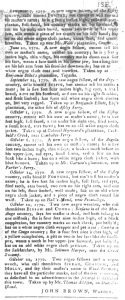
Like other newspapers published in colonial America, a standard issue of the South-Carolina Gazette and Country Journal consisted of four pages created by printing two pages on each side of a broadsheet and then folding it in half. Charles Crouch occasionally had more news, editorials, and advertisements than would fit in a standard issue, prompting him to distribute a supplement with the additional material. Some newspapers so often had surplus items, especially advertisements, that supplements themselves became practically standard.
November 13, 1770, was one of those days that all of the news and all of the advertising for the South-Carolina Gazette and Country Journal would not fit on four pages. Six pages did not provide enough room either. Crouch filled a two-page supplement and still had advertisements remaining. Advertisements generated important revenue for any printer. In this case, Crouch determined that they generated enough revenue to merit the additional expense of producing and distributing a four-page Continuation to the South-Carolina Gazette and Country Journal in addition to the supplement. The Continuation consisted entirely of advertisements.
The Continuation, however, was not printed on the same size sheet as the standard issue or the supplement. Digital remediations of eighteenth-century newspapers usually do not include metadata that includes dimensions, but differences in the sizes of sheets are often apparent even without knowing the precise measurements. The standard issue of the South-Carolina Gazette and Country Journal featured three columns per page. When printed on an 8.5×11 sheet of office paper, the type is relatively small. In contrast, the Continuation had only two columns per page. When printed on an 8.5×11 sheet, the type is relatively large. The sizes of the original broadsheets were obviously different. Furthermore, white space divides the columns in standard issues, but the columns nearly run together in the Continuation, separated by a line running down the middle. Rather than reset the type of advertisements that ran in previous issues, a time-consuming task, Crouch instead made them fit on the smaller sheet. The Continuation had four pages, but they did not double the size of that standard issue.
Still, subscribers and other readers encountered far more content than usual when they perused the November 13 edition of the South-Carolina Gazette and Country Journal along with its Supplement and Continuation. Close examination of the digital surrogate also suggests that Crouch printed the supplement on a smaller sheet than the standard issue, though one large enough to retain three columns with white space separating them. For most newspaper printers, advertisements represented significant revenues. Paid notices often accounted for a significant portion of the content in any given issue. In this instance, devoting a page to advertising was not sufficient. Crouch devised additional sheets to accompany the standard issue, incurring expenses yet generating revenues while simultaneously exposing readers to greater advertising content.
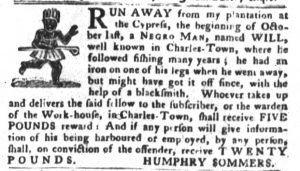
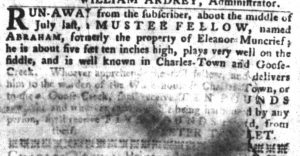
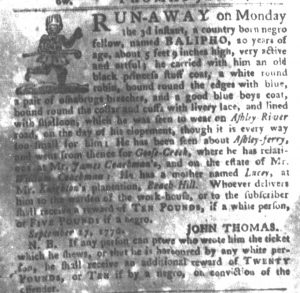
The Slavery Adverts 250 Project chronicles the role of newspaper advertising in perpetuating slavery in the era of the American Revolution. The project seeks to reveal the ubiquity of slavery in eighteenth-century life from New England to Georgia by republishing advertisements about enslaved people – for sale as individuals or in groups, wanted to purchase or for hire for short periods, runaways who liberated themselves, and those who were subsequently captured and confined in jails and workhouses – in daily digests on this site as well as in real time via the @SlaveAdverts250 Twitter feed, utilizing twenty-first-century media to stand in for the print media of the eighteenth century.
The project aims to provide modern audiences with a sense of just how often colonists encountered these advertisements in their daily lives. Enslaved men, women, and children appeared in print somewhere in the colonies almost every single day. Those advertisements served as a constant backdrop for social, cultural, economic, and political life in colonial and revolutionary America. Colonists who did not purport to own enslaved people were still confronted with slavery as well as invited to maintain the system by purchasing slaves or assisting in the capture of runaways who sought to free themselves from bondage. The frequency of these newspaper advertisements suggests just how embedded slavery was in colonial and revolutionary American culture in everyday interactions beyond the printed page.
These advertisements also testify to the experiences of enslaved men, women, and children, though readers must consider that those experiences have been remediated through descriptions offered by enslavers rather than enslaved people themselves. Often unnamed in the advertisements, enslaved men, women, and children were not invisible or unimportant in early America.
These advertisements appeared in colonial American newspapers 250 years ago today.
Essex Gazette (November 13, 1770).
**********
South-Carolina and American General Gazette (November 13, 1770).
**********
South-Carolina and American General Gazette (November 13, 1770).
**********
South-Carolina and American General Gazette (November 13, 1770).
**********
South-Carolina and American General Gazette (November 13, 1770).
**********
South-Carolina and American General Gazette (November 13, 1770).
**********
South-Carolina and American General Gazette (November 13, 1770).
**********
South-Carolina and American General Gazette (November 13, 1770).
**********
South-Carolina and American General Gazette (November 13, 1770).
**********
South-Carolina and American General Gazette (November 13, 1770).
**********
Continuation to the South-Carolina Gazette and Country Journal (November 13, 1770).
**********
Continuation to the South-Carolina Gazette and Country Journal (November 13, 1770).
**********
Continuation to the South-Carolina Gazette and Country Journal (November 13, 1770).
**********
Continuation to the South-Carolina Gazette and Country Journal (November 13, 1770).
**********
Continuation to the South-Carolina Gazette and Country Journal (November 13, 1770).
**********
South-Carolina Gazette and Country Journal (November 13, 1770).
**********
South-Carolina Gazette and Country Journal (November 13, 1770).
**********
South-Carolina Gazette and Country Journal (November 13, 1770).
**********
South-Carolina Gazette and Country Journal (November 13, 1770).
**********
South-Carolina Gazette and Country Journal (November 13, 1770).
**********
South-Carolina Gazette and Country Journal (November 13, 1770).
**********
Supplement to the South-Carolina Gazette and Country Journal (November 13, 1770).
**********
Supplement to the South-Carolina Gazette and Country Journal (November 13, 1770).
**********
Supplement to the South-Carolina Gazette and Country Journal (November 13, 1770).
**********
Supplement to the South-Carolina Gazette and Country Journal (November 13, 1770).
What was advertised in a colonial American newspaper 250 years ago today?
New-York Gazette and Weekly Mercury (November 12, 1770).
“Two valuable negro men, and a negro wench with a female child.”
Auctioneers Thomas William Moore and Company regularly advertised in the New-York Gazette and Weekly Mercury, advising prospective bidders of a constantly changing array of new and secondhand goods for sale at their “AUCTION-ROOM.” On November 12, 1770, for instance, they ran advertisement announcing that the next day they would continue “the sale of a large parcel of dry goods” that included textiles, ribbons and trimmings, “printed handkerchiefs,” and “ladies gloves.” They also had “a quantity of ironmongery” that included “scythes, frying pans, [and] wool cards” for the highest bidder.
In addition to the sales at their Auction Room, Moore and Company also sponsored other sales “On the Bridge, At the Coffee-House,” a popular meeting place for transacting business. The auctioneers advised that a “large parcel of genteel furniture” would be sold the same day that their advertisement ran in the New-York Gazette and Weekly Mercury. In addition, “two valuable negro men, and a negro wench with a female child” would go on the auction block the following day. The notice did not elaborate on the men and child, but did state that the woman was “honest, sober and good tempered.”
Enslaved people comprised a significant portion of the population of New York City during the era of the American Revolution. Advertisements offering enslaved men, women, and children for sale as well as notices offering rewards for capturing enslaved people who liberated themselves from those who held them in bondage frequently appeared in the New-York Gazette and Weekly Mercury and other newspapers published in the busy urban port. Some advertisements focused on enslaved people exclusively, such as a notice offering a “LIKELY young NEGRO MAN” for sale in the New-York Gazette or Weekly Post-Boy on the same day that Moore and Company ran their auction notice. Other advertisements, like the one placed by the auctioneers, embedded the sale of enslaved people among other aspects of daily life, like buying clothing and housewares. At a glance, it was not immediately apparent that Moore and Company’s advertisement was part of the infrastructure of the slave trade. That only became apparent on closer inspection, but offering two Black men, a Black woman, and a Black girl for sale would not have surprised newspaper readers. Casually inserting enslaved people among goods for sale was both insidious and ubiquitous, even in newspaper advertisements published in northern colonies. The consumer revolution of “printed handkerchiefs” and “ladies gloves” operated in tandem with the transatlantic slave trade and the maintenance of a system of exploitation in eighteenth-century America.
The Slavery Adverts 250 Project chronicles the role of newspaper advertising in perpetuating slavery in the era of the American Revolution. The project seeks to reveal the ubiquity of slavery in eighteenth-century life from New England to Georgia by republishing advertisements about enslaved people – for sale as individuals or in groups, wanted to purchase or for hire for short periods, runaways who liberated themselves, and those who were subsequently captured and confined in jails and workhouses – in daily digests on this site as well as in real time via the @SlaveAdverts250 Twitter feed, utilizing twenty-first-century media to stand in for the print media of the eighteenth century.
The project aims to provide modern audiences with a sense of just how often colonists encountered these advertisements in their daily lives. Enslaved men, women, and children appeared in print somewhere in the colonies almost every single day. Those advertisements served as a constant backdrop for social, cultural, economic, and political life in colonial and revolutionary America. Colonists who did not purport to own enslaved people were still confronted with slavery as well as invited to maintain the system by purchasing slaves or assisting in the capture of runaways who sought to free themselves from bondage. The frequency of these newspaper advertisements suggests just how embedded slavery was in colonial and revolutionary American culture in everyday interactions beyond the printed page.
These advertisements also testify to the experiences of enslaved men, women, and children, though readers must consider that those experiences have been remediated through descriptions offered by enslavers rather than enslaved people themselves. Often unnamed in the advertisements, enslaved men, women, and children were not invisible or unimportant in early America.
These advertisements appeared in colonial American newspapers 250 years ago today.
Boston-Gazette (November 12, 1770).
**********
New-York Gazette and Weekly Mercury (November 12, 1770).
**********
New-York Gazette and Weekly Mercury (November 12, 1770).
**********
New-York Gazette and Weekly Mercury (November 12, 1770).
**********
New-York Gazette and Weekly Mercury (November 12, 1770).
**********
New-York Gazette and Weekly Mercury (November 12, 1770).
**********
New-York Gazette and Weekly Mercury (November 12, 1770).
**********
New-York Gazette or Weekly Post-Boy (November 12, 1770).
**********
New-York Gazette or Weekly Post-Boy (November 12, 1770).
What was advertised in a colonial American newspaper 250 years ago this week?
New-York Journal (November 8, 1770).
“Just received per the Hopewell … 53 56.”
John Morton’s advertisement for a “Neat and general Assortment of Good suitable for the Season” appeared on the front page of the November 8, 1770, edition of the New-York Journal. Morton indicated that he had just received a shipment via “the Hopewell, Capt. SMITH, from LONDON.” The two numbers at the end of the advertisement, “53 56,” confirmed that it was the first time his notice ran in the newspaper. The compositor included those numbers as a shorthand to indicate the first and last issues to insert the advertisement. They corresponded to issue numbers in the masthead. The November 8 edition was “NUMB. 1453.” Morton’s advertisement was scheduled to run in issue 1454 on November 15, issue 1455 on November 22, and issue 1456 on November 29.
Morton’s advertisement was not the only one that included a combination of issue numbers and reference to Captain Smith and the Hopewell. Hallett and Hazard proclaimed that they had “just imported an assortment of goods “in the Hopewell, Capt. Smith.” Their advertisement ended with “53 6,” issue numbers intended for the compositor rather than readers. Similarly, William Neilson promoted “a large Assortment of Goods suitable for the Season, imported in the Hopewell, Capt Smith, from London.” His advertisement also ended with “53 6,” numbers not related to his merchandise but to bookkeeping in the printing office.
Morton, Neilson, and Hallett and Hazard all apparently placed advertisements as quickly as they could after acquiring new inventory transported across the Atlantic on the Hopewell. The shipping news, labelled “CUSTOM HOUSE NEW-YORK, INWARD ENTRIES,” included the “Snow Hopewell, Smith, London” among the several ships that arrived in the busy port since the previous issue of the New-York Journal. Readers may not have paid much attention to the correlation between the issue number and the notations at the end of advertisements, but they were more likely to have noticed the roster of vessels that had just arrived in New York. That would have helped them to calibrate how recently advertisers acquired the goods they hawked to consumers. That Morton received his wares via the Hopewell was not a quaint detail. It was not any more insignificant than the numbers at the end of his advertisement. Both delivered important information to eighteenth-century readers who understood the context.
What was advertised in a colonial American newspaper 250 years ago today?
Providence Gazette (November 10, 1770).
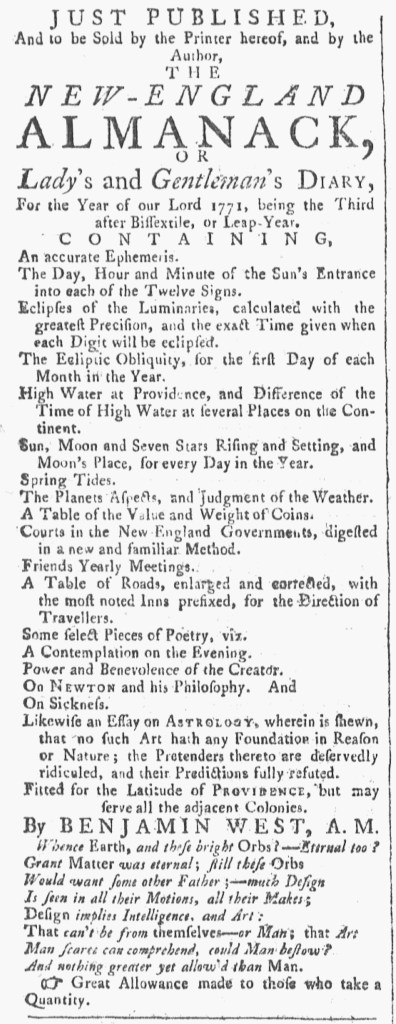
“NEW-ENGLAND ALMANACK, OR Lady’s and Gentleman’s DIARY, For the Year of our Lord 1771.”
In eighteenth-century America, November was one of the most important months for marketing almanacs. Advertisements began appearing as early as August or September in some newspapers, but those were usually brief notices that printers planned to publish almanacs in the coming weeks or months. More advertisements appeared with greater frequency in October, November, and December, many of them much more extensive than the earlier notices. Those advertisements often included lists of the contents to convince prospective buyers that almanacs contained a variety of practical, educational, and entertaining items. Sometimes they also featured excerpts taken from one of those features.
Benjamin West, the author of the “NEW-ENGLAND ALMANACK, OR Lady’s and Gentleman’s DIARY, For the Year of our Lord 1771,” and John Carter, the printer of both the almanac and the Providence Gazette, ran a lengthy advertisement on November 10, 1770. It extended more than half a column, much of that space filled with a list of its contents. Practical entries included “High Water at Providence, and Differences of the Time of High Water at several Places on the Continent” and “Courts in the New England Governments, digested in a new and familiar Method.” The almanac also contained items intended to educate or entertain or both, such as “select Pieces of Poetry” and “an Essay on ASTROLOGY.” A few verses appeared near the end of the advertisement, previewing what readers would encounter when they perused the almanac. The astronomical calculations were “Fitted for the Latitude of PROVIDENCE,” but the almanac also included useful information for anyone venturing beyond the city, such as a “Table of Roads, enlarged and corrected, with the most noted Inns prefixed, for the Direction of Travellers.”
West and Carter aimed their advertisement at both consumers and retailers. They promised “Great Allowance … to those who take a Quantity” or a discount for buying by volume. They hoped to supply shopkeepers, booksellers, peddlers, and others with almanacs to sell to their own customers, further disseminating them beyond what the author and printer could accomplish by themselves. The lengthy advertisement in the Providence Gazette also served the interests of those prospective retailers. They did not need to post their own extensive advertisements to convince buyers of the benefits of acquiring this particular almanac but could instead advise customers that they carried the New England Almanack. West and Carter already did much of the marketing for retailers gratis.
Readers of the Providence Gazette could expect to see similar advertisements throughout the remainder of November and into December and January before they tapered off in late winter. Just as falling leaves marked the change of the season in New England, the appearance and length of newspaper advertisements for almanacs also signaled that fall had arrived and winter was on its way.
The Slavery Adverts 250 Project chronicles the role of newspaper advertising in perpetuating slavery in the era of the American Revolution. The project seeks to reveal the ubiquity of slavery in eighteenth-century life from New England to Georgia by republishing advertisements about enslaved people – for sale as individuals or in groups, wanted to purchase or for hire for short periods, runaways who liberated themselves, and those who were subsequently captured and confined in jails and workhouses – in daily digests on this site as well as in real time via the @SlaveAdverts250 Twitter feed, utilizing twenty-first-century media to stand in for the print media of the eighteenth century.
The project aims to provide modern audiences with a sense of just how often colonists encountered these advertisements in their daily lives. Enslaved men, women, and children appeared in print somewhere in the colonies almost every single day. Those advertisements served as a constant backdrop for social, cultural, economic, and political life in colonial and revolutionary America. Colonists who did not purport to own enslaved people were still confronted with slavery as well as invited to maintain the system by purchasing slaves or assisting in the capture of runaways who sought to free themselves from bondage. The frequency of these newspaper advertisements suggests just how embedded slavery was in colonial and revolutionary American culture in everyday interactions beyond the printed page.
These advertisements also testify to the experiences of enslaved men, women, and children, though readers must consider that those experiences have been remediated through descriptions offered by enslavers rather than enslaved people themselves. Often unnamed in the advertisements, enslaved men, women, and children were not invisible or unimportant in early America.
These advertisements appeared in colonial American newspapers 250 years ago today.
What was advertised in a colonial American newspaper 250 years ago today?
New-London Gazette (November 9, 1770).
“Said Negro was seen on board Capt. John Rogers’s Sloop.”
When Pompey, an enslaved man, liberated himself by running away in the fall of 1770, Aaron Waitt enlisted the power of the press in his efforts to capture him. Waitt initially placed advertisements in his local newspaper, the Essex Gazette, to alert residents of Salem, Massachusetts, and the surrounding area that Pompey had departed without his permission. He provided a description, noting in particular that Pompey was about twenty-three years old, had a scar on his forehead, and wore a dark coat.
The advertisements in the Essex Gazette did not produce the results that Waitt desired, in large part because Pompey understood that mobility was one of the best strategies for freeing himself. According to advertisements that Waitt subsequently placed in the New-London Gazette, the New-York Gazette and Weekly Mercury, and the Providence Gazette, Pompey boarded “John Roger’s Sloop,” the Free Mason, “at East-Greenwich, in the Colony of Rhode Island” on October 18 and then sailed to New York. Pompey apparently tried to place himself out of reach of his enslaver, but that only prompted Waitt to broaden the scope of his advertising to newspapers in other colonies. When he did so, he added details to aid readers in identifying Pompey. Waitt noted the enslaved man’s height and reported that he was “a Leather-Dresser by Trade” who “speaks good English.
Waitt’s advertisements in several newspapers published in New England and New York contributed to a culture of surveillance of Black men already in place in the colonies. Advertisements for enslaved people who liberated themselves amounted to an eighteenth-century version of racial profiling, encouraging readers far and wide to scrutinize Black people when they encountered them. Waitt and others asked colonists to carefully observe the bodies, clothing, and comportment of Black men and women to determine whether they matched the descriptions published in newspapers. In the case of Waitt and Pompey, such efforts were not confined to one locality or media market but instead extended across an entire region as the enslaver inserted advertisements in multiple newspapers.