Slavery Advertisements Published April 19, 1771

The Slavery Adverts 250 Project chronicles the role of newspaper advertising in perpetuating slavery in the era of the American Revolution. The project seeks to reveal the ubiquity of slavery in eighteenth-century life from New England to Georgia by republishing advertisements about enslaved people – for sale as individuals or in groups, wanted to purchase or for hire for short periods, runaways who liberated themselves, and those who were subsequently captured and confined in jails and workhouses – in daily digests on this site as well as in real time via the @SlaveAdverts250 Twitter feed, utilizing twenty-first-century media to stand in for the print media of the eighteenth century.

The project aims to provide modern audiences with a sense of just how often colonists encountered these advertisements in their daily lives. Enslaved men, women, and children appeared in print somewhere in the colonies almost every single day. Those advertisements served as a constant backdrop for social, cultural, economic, and political life in colonial and revolutionary America. Colonists who did not purport to own enslaved people were still confronted with slavery as well as invited to maintain the system by purchasing enslaved men, women, and children or assisting in the capture of so-called “runaways” who sought to free themselves from bondage. The frequency of these newspaper advertisements suggests just how embedded slavery was in colonial and revolutionary American culture in everyday interactions beyond the printed page.

These advertisements also testify to the experiences of enslaved men, women, and children, though readers must consider that those experiences have been remediated through descriptions offered by enslavers rather than enslaved people themselves. Often unnamed in the advertisements, enslaved men, women, and children were not invisible or unimportant in early America.

These advertisements appeared in colonial American newspapers 250 years ago today.

Connecticut Journal (April 19, 1771).

April 18

What was advertised in a colonial American newspaper 250 years ago today?

New-York Journal (April 18, 1771).

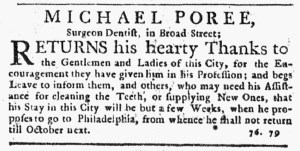
“His Stay in this City will be but a few Weeks.”

Michael Poree, a surgeon dentist, occasionally placed newspaper advertisements in New York in the late 1760s and early 1770s.  He offered a variety of services, including “cleaning the Teeth,” “supplying New Ones,” and providing patent medicines related to dental care.  Poree did not, however, make the busy port his permanent residence.  Instead, he moved back and forth between New York and Philadelphia, serving patients in both cities.

In the spring of 1771, he published advertisements simultaneously in the New-York Gazette and Weekly Mercury and the New-York Journal upon arriving in the city.  He began by renewing his acquaintance with former clients, extending “his hearty Thanks to the Gentlemen and Ladies of this City, for the Encouragement they have given him in his Profession.”  He then informed them “and others,” prospective new clients who needed dental care, that his stay in New York would be short, “but a few Weeks.”  He planned to return to Philadelphia and would not be back for nearly six months, not until “October next.”  Not unlike itinerant performers and peddlers, the surgeon dentists proclaimed that he would be in town for a limited time only as he persuaded customers to engage his services promptly or else miss their opportunity.

According to the colophon for the New-York Journal, Poree paid five shillings to insert his advertisement for four weeks.  He likely paid a similar amount to run the same notice in the New-York Gazette and Weekly Mercury.  That he advertised in two newspapers indicated that he considered the cost well worth the investment in terms of attracting a sufficient number of clients to make his stay in New York profitable.  Experience may have taught him that he served a greater number of patients, new and returning, when he placed newspaper notices.  Documenting the reception of advertisements remains an elusive endeavor.  That an itinerant surgeon dentist like Poree repeatedly paid to inform the public of his services and his schedule, however, suggests that he considered advertising an effective means of promoting his business.

Slavery Advertisements Published April 18, 1771

The Slavery Adverts 250 Project chronicles the role of newspaper advertising in perpetuating slavery in the era of the American Revolution. The project seeks to reveal the ubiquity of slavery in eighteenth-century life from New England to Georgia by republishing advertisements about enslaved people – for sale as individuals or in groups, wanted to purchase or for hire for short periods, runaways who liberated themselves, and those who were subsequently captured and confined in jails and workhouses – in daily digests on this site as well as in real time via the @SlaveAdverts250 Twitter feed, utilizing twenty-first-century media to stand in for the print media of the eighteenth century.

The project aims to provide modern audiences with a sense of just how often colonists encountered these advertisements in their daily lives. Enslaved men, women, and children appeared in print somewhere in the colonies almost every single day. Those advertisements served as a constant backdrop for social, cultural, economic, and political life in colonial and revolutionary America. Colonists who did not purport to own enslaved people were still confronted with slavery as well as invited to maintain the system by purchasing enslaved men, women, and children or assisting in the capture of so-called “runaways” who sought to free themselves from bondage. The frequency of these newspaper advertisements suggests just how embedded slavery was in colonial and revolutionary American culture in everyday interactions beyond the printed page.

These advertisements also testify to the experiences of enslaved men, women, and children, though readers must consider that those experiences have been remediated through descriptions offered by enslavers rather than enslaved people themselves. Often unnamed in the advertisements, enslaved men, women, and children were not invisible or unimportant in early America.

These advertisements appeared in colonial American newspapers 250 years ago today.
Maryland Gazette (April 18, 1771).

**********

Maryland Gazette (April 18, 1771).

**********

Maryland Gazette (April 18, 1771).

**********

New-York Journal (April 18, 1771).

**********

Supplement to the South-Carolina Gazette and Country Journal (April 18, 1771).

**********

South-Carolina Gazette (April 18, 1771).

**********

South-Carolina Gazette (April 18, 1771).

**********

South-Carolina Gazette (April 18, 1771).

**********

South-Carolina Gazette (April 18, 1771).

**********

South-Carolina Gazette (April 18, 1771).

**********

South-Carolina Gazette (April 18, 1771).

**********

South-Carolina Gazette (April 18, 1771).

**********

South-Carolina Gazette (April 18, 1771).

**********

South-Carolina Gazette (April 18, 1771).

**********

South-Carolina Gazette (April 18, 1771).

**********

South-Carolina Gazette (April 18, 1771).

**********

South-Carolina Gazette (April 18, 1771).

**********

South-Carolina Gazette (April 18, 1771).

**********

South-Carolina Gazette (April 18, 1771).

**********

Supplement to the South-Carolina Gazette (April 18, 1771).

**********

Supplement to the South-Carolina Gazette (April 18, 1771).

**********

Supplement to the South-Carolina Gazette (April 18, 1771).

**********

Supplement to the South-Carolina Gazette (April 18, 1771).

**********

Virginia Gazette [Purdie and Dixon] (April 18, 1771).

**********

Virginia Gazette [Purdie and Dixon] (April 18, 1771).

**********

Virginia Gazette [Purdie and Dixon] (April 18, 1771).

**********

Virginia Gazette [Purdie and Dixon] (April 18, 1771).

**********

Virginia Gazette [Purdie and Dixon] (April 18, 1771).

**********

Virginia Gazette [Purdie and Dixon] (April 18, 1771).

**********

Virginia Gazette [Purdie and Dixon] (April 18, 1771).

**********

Virginia Gazette [Purdie and Dixon] (April 18, 1771).

**********

Virginia Gazette [Purdie and Dixon] (April 18, 1771).

**********

Virginia Gazette [Purdie and Dixon] (April 18, 1771).

**********

Virginia Gazette [Purdie and Dixon] (April 18, 1771).

**********

Virginia Gazette [Purdie and Dixon] (April 18, 1771).

**********

Virginia Gazette [Purdie and Dixon] (April 18, 1771).

**********

Virginia Gazette [Purdie and Dixon] (April 18, 1771).

**********

Virginia Gazette [Purdie and Dixon] (April 18, 1771).

April 17

What was advertised in a colonial American newspaper 250 years ago today?

South-Carolina and American General Gazette (April 17, 1771).

“Grand Feast of Historical Entertainment … XENOPHONTICK BANQUET.”

Robert Bell advertised widely when he published an American edition of William Robertson’s History of the Reign of Charles the Fifth in 1771.  Though he printed the three-volume set in Philadelphia, he placed advertisements in newspapers from New England to South Carolina.  In seeking subscribers in advance of publication and buyers after the books went to press, Bell did not rely on the usual means of marketing books to consumers.  Instead, he adopted a more flamboyant style, an approach that became a trademark of his efforts to promote the American book trade in the late eighteenth century.

For instance, Bell announced “the Completion of the grand Feast of Historical Entertainment” with the imminent “Publication of the third Volume of Robertson’s celebrated History of Charles the Fifth” in an advertisement in the April 17, 1771, edition of the South-Carolina and American General Gazette.  He invited “all Gentlemen that possess a sentimental Taste” to participate in “this elegant XENOPONTICK BANQUET” by adding their names to the subscription list.  In continuing the metaphor of the feast, Bell invoked Xenophon of Athens, an historian and philosopher considered one of the greatest writers of the ancient world.  The phrase “XENOPHONTICK BANQUET” appeared in all capitals and a slightly larger font, as did “HISTORY,” the headline intended to draw attention to the advertisement.

Essex Gazette (April 16, 1771).

The previous day, a very similar advertisement ran in the Essex Gazette.  It featured “HISTORY” and “XENOPHONTIC BANQUET” in capital letters and larger font.  Most of the text was identical as well, though local printers adjusted the instructions for acquiring copies of the book.  The version in the South-Carolina and American General Gazette directed subscribers to “any of the Booksellers in Boston, New-York, Philadelphia, or to ROBERT WELLS,” bookseller and printer of the newspaper, “in Charlestown.”  The variant in the Essex Gazette also mentioned “Booksellers in Boston, New-York, [and] Philadelphia,” but also listed local agents in seven other towns, including Samuel Orne in Salem.  Wells also inserted a note that he sold writing paper and trunks in addition to the first and second volumes of Robertson’s History.

Published just a day apart in Charleston, South Carolina, and Salem, Massachusetts, these advertisements with such similar copy and format created a near simultaneous reading experience in towns located hundreds of miles distant.  Reprinting news accounts from one newspaper to another to another had a similar effect, though it took time to disseminate news in that manner.  Bell engineered an advertising campaign without the same time lapse as coverage of the “freshest Advices” among the news accounts.  Among the imagined community of readers and consumers in South Carolina and Massachusetts, the simultaneity of being encouraged to purchase an American edition of Robertson’s famed work was much less imagined than the simultaneity of keeping up with current events by reading the news.

Slavery Advertisements Published April 17, 1771

The Slavery Adverts 250 Project chronicles the role of newspaper advertising in perpetuating slavery in the era of the American Revolution. The project seeks to reveal the ubiquity of slavery in eighteenth-century life from New England to Georgia by republishing advertisements about enslaved people – for sale as individuals or in groups, wanted to purchase or for hire for short periods, runaways who liberated themselves, and those who were subsequently captured and confined in jails and workhouses – in daily digests on this site as well as in real time via the @SlaveAdverts250 Twitter feed, utilizing twenty-first-century media to stand in for the print media of the eighteenth century.

The project aims to provide modern audiences with a sense of just how often colonists encountered these advertisements in their daily lives. Enslaved men, women, and children appeared in print somewhere in the colonies almost every single day. Those advertisements served as a constant backdrop for social, cultural, economic, and political life in colonial and revolutionary America. Colonists who did not purport to own enslaved people were still confronted with slavery as well as invited to maintain the system by purchasing enslaved men, women, and children or assisting in the capture of so-called “runaways” who sought to free themselves from bondage. The frequency of these newspaper advertisements suggests just how embedded slavery was in colonial and revolutionary American culture in everyday interactions beyond the printed page.

These advertisements also testify to the experiences of enslaved men, women, and children, though readers must consider that those experiences have been remediated through descriptions offered by enslavers rather than enslaved people themselves. Often unnamed in the advertisements, enslaved men, women, and children were not invisible or unimportant in early America.

These advertisements appeared in colonial American newspapers 250 years ago today.

South-Carolina and American General Gazette (April 17, 1771).

**********

South-Carolina and American General Gazette (April 17, 1771).

**********

South-Carolina and American General Gazette (April 17, 1771).

**********

South-Carolina and American General Gazette (April 17, 1771).

**********

South-Carolina and American General Gazette (April 17, 1771).

**********

South-Carolina and American General Gazette (April 17, 1771).

**********

South-Carolina and American General Gazette (April 17, 1771).

**********

South-Carolina and American General Gazette (April 17, 1771).

**********

South-Carolina and American General Gazette (April 17, 1771).

**********

South-Carolina and American General Gazette (April 17, 1771).

**********

South-Carolina and American General Gazette (April 17, 1771).

**********

South-Carolina and American General Gazette (April 17, 1771).

**********

South-Carolina and American General Gazette (April 17, 1771).

**********

South-Carolina and American General Gazette (April 17, 1771).

**********

South-Carolina and American General Gazette (April 17, 1771).

**********

South-Carolina and American General Gazette (April 17, 1771).

**********

South-Carolina and American General Gazette (April 17, 1771).

April 16

What was advertised in a colonial American newspaper 250 years ago today?

Connecticut Courant (April 16, 1771).

“All gentlemen passengers, [who are] inclined to favour him with their custom[, will] meet with good usage, from their humb[le ser]vant.”

From the early spring through the late fall, Jeremiah Lord operated a “Passage-Boat” or ferry that transported passengers along the Connecticut River and crossed the Long Island Sound, connecting the inland village of Middletown, Connecticut, and the coastal towns of Saybrook, Connecticut, and Sag Harbor, New York.  The passage boat sailed from Middletown on the first and third Monday each month and returned from Sag Harbor the following Thursday, “winds and weather permitting.”  Each passenger paid “half a Dollar” if on foot and twice as much if transporting a horse.

Though dated “March 1771,” Lord’s advertisement first appeared in the Connecticut Courant, printed in Hartford, on April 9.  It then ran for two more weeks.  That it appeared more than once allows historians and other modern readers to discover many of the details obscured in the April 16 edition as a result of collection and preservation practices.  Many eighteenth-century newspapers currently in the collections of research libraries have not been preserved as single issues but instead have been bound together with others.  Depending on the size of the newspaper and its frequency of publication, those volumes include six months, an entire year, or even more issues.  Because they have been bound, the newspapers can no longer be laid flat.  For newspapers with generous margins, this does not matter, but for this with narrow margins it means that often some of the text has been absorbed into the binding.  Often this affects only a small portion of the text, perhaps the last couple of letters at the edge of the column, but in other instances even more text remains hidden by the binding.  Such is the case with the rightmost column on the first and last pages and the leftmost column on the second and third pages of the April 16 edition of the Connecticut Courant.

Modern readers interested in advertising overcome this obstacle by examining other issues.  Advertisements ran multiple times, their placement on the page usually changing.  Lord’s advertisement, for instance, did not appear in the column adjacent to the binding in the April 9 and April 23 editions.  It is more difficult to recover the contents of news accounts, letters, and other items usually printed only once.  Even when most of the print remains legible, other aspects of the production or preservation of historical newspapers conceal portions of the contents.

Slavery Advertisements Published April 16, 1771

The Slavery Adverts 250 Project chronicles the role of newspaper advertising in perpetuating slavery in the era of the American Revolution. The project seeks to reveal the ubiquity of slavery in eighteenth-century life from New England to Georgia by republishing advertisements about enslaved people – for sale as individuals or in groups, wanted to purchase or for hire for short periods, runaways who liberated themselves, and those who were subsequently captured and confined in jails and workhouses – in daily digests on this site as well as in real time via the @SlaveAdverts250 Twitter feed, utilizing twenty-first-century media to stand in for the print media of the eighteenth century.

The project aims to provide modern audiences with a sense of just how often colonists encountered these advertisements in their daily lives. Enslaved men, women, and children appeared in print somewhere in the colonies almost every single day. Those advertisements served as a constant backdrop for social, cultural, economic, and political life in colonial and revolutionary America. Colonists who did not purport to own enslaved people were still confronted with slavery as well as invited to maintain the system by purchasing enslaved men, women, and children or assisting in the capture of so-called “runaways” who sought to free themselves from bondage. The frequency of these newspaper advertisements suggests just how embedded slavery was in colonial and revolutionary American culture in everyday interactions beyond the printed page.

These advertisements also testify to the experiences of enslaved men, women, and children, though readers must consider that those experiences have been remediated through descriptions offered by enslavers rather than enslaved people themselves. Often unnamed in the advertisements, enslaved men, women, and children were not invisible or unimportant in early America.

These advertisements appeared in colonial American newspapers 250 years ago today.

Connecticut Courant (April 16, 1771).

**********

South-Carolina Gazette and Country Journal (April 16, 1771).

**********

South-Carolina Gazette and Country Journal (April 16, 1771).

**********

South-Carolina Gazette and Country Journal (April 16, 1771).

**********

South-Carolina Gazette and Country Journal (April 16, 1771).

**********

South-Carolina Gazette and Country Journal (April 16, 1771).

**********

South-Carolina Gazette and Country Journal (April 16, 1771).

**********

South-Carolina Gazette and Country Journal (April 16, 1771).

**********

South-Carolina Gazette and Country Journal (April 16, 1771).

**********

South-Carolina Gazette and Country Journal (April 16, 1771).

**********

South-Carolina Gazette and Country Journal (April 16, 1771).

**********

South-Carolina Gazette and Country Journal (April 16, 1771).

**********

South-Carolina Gazette and Country Journal (April 16, 1771).

**********

South-Carolina Gazette and Country Journal (April 16, 1771).

**********

South-Carolina Gazette and Country Journal (April 16, 1771).

**********

South-Carolina Gazette and Country Journal (April 16, 1771).

April 15

What was advertised in a colonial American newspaper 250 years ago today?

Boston-Gazette (April 15, 1771).

“The most strict Compliance with the Non-Importation Agreement.”

Colonial merchants and shopkeepers often included introductory remarks about the origins of their imported goods in their newspaper advertisements.  In the April 15, 1771, edition of the Boston-Gazette, for instance, William Jones advertised goods “JUST IMPORTED In the Ship LYDIA, JAMES SCOTT, Master, from LONDON.”  Similarly, Hugh Tarbett marketed goods “Imported in the Snow Jenny, Hector Orr, Master, from Glasgow.”  Both followed a format familiar to both advertisers and readers.  Samuel Eliot did so as well, announcing that he carried goods that he “has now IMPORTED in the Ships just arrived from LONDON.”  Eliot added an additional note that he sold those goods “after a long Suspension of Business by his strict Adherence to the late Non Importation Agreement.”  John Hancock did the same.  Like Jones and several others who advertised in that issue, Hancock received goods via the Lydia.  He proclaimed that he offered those items to customers “after the most strict Compliance with the Non-Importation Agreement during its Continuance.”

Eliot and Hancock both signaled their support of the patriot cause and suggested that consumers should purchase goods from them, now that trade with Britain commenced again, because they had faithfully obeyed the boycotts enacted in protest of duties imposed on certain imported goods by the Townshend Acts.  Hancock’s version of events, however, did not match coverage in the Boston Chronicle in the summer of 1769.  The committee of merchants who oversaw compliance with the nonimportation agreement singled out John Mein, loyalist printer of the Boston Chronicle, for continuing to import and sell British goods.  In turn, Mein published an exposé of prominent merchants who publicly claimed to support the nonimportation agreement yet continued to receive goods from Britain.  On August 21, 1769, he listed the cargoes of several ships, the owners of those vessels, and the merchants who ordered and received the goods.  That coverage included a “Manifest of the Cargo of the Brigantine Last Attempt, … Owner, JOHN HANCOCK,” a “Manifest of the Cargo of the Brigantine Lydia, … Owner, JOHN HANCOCK,” and a “Manifest of the Cargo of the Brigantine Paoli, … Owner JOHN HANCOCK.”  Mein called on the “PATRIOTIC GENTLEMAN” who owned those vessels to provide the public with more information.  Over the next two months, Mein continued his critique of Hancock and other patriot leaders.  In late October, he published character sketches that included one for “Johnny Dupe,” a jab at Hancock for duping the public by continuing to profit from importing goods despite claiming to support the boycott.  Not long after that, a mob attacked Mein.  He fled Boston, leaving the Boston Chronicle in the hands of his partner, John Fleeming.  The newspaper folded less than a year later.

Hancock’s claim that he sold an “Assortment of Goods” received from London only after “the most strict Compliance with the Non-Importation Agreement during its Continuance” was a polite fiction, at best.  He attempted to deploy patriotism as part of his marketing strategy, asking supporters of the American cause to endorse his version of events despite evidence to the contrary published in the Boston Chronicle two years earlier.  After all, that incident resulted in the disgrace and flight of a loyalist printer, not the prominent merchant and vocal supporter of the patriot cause.  When it came to marketing, image mattered, perhaps even more than reality.

**********

The Massachusetts Historical Society provides access to the August 21, 1769, edition of the Boston Chronicle via their online collections.

Slavery Advertisements Published April 15, 1771

The Slavery Adverts 250 Project chronicles the role of newspaper advertising in perpetuating slavery in the era of the American Revolution. The project seeks to reveal the ubiquity of slavery in eighteenth-century life from New England to Georgia by republishing advertisements about enslaved people – for sale as individuals or in groups, wanted to purchase or for hire for short periods, runaways who liberated themselves, and those who were subsequently captured and confined in jails and workhouses – in daily digests on this site as well as in real time via the @SlaveAdverts250 Twitter feed, utilizing twenty-first-century media to stand in for the print media of the eighteenth century.

The project aims to provide modern audiences with a sense of just how often colonists encountered these advertisements in their daily lives. Enslaved men, women, and children appeared in print somewhere in the colonies almost every single day. Those advertisements served as a constant backdrop for social, cultural, economic, and political life in colonial and revolutionary America. Colonists who did not purport to own enslaved people were still confronted with slavery as well as invited to maintain the system by purchasing enslaved men, women, and children or assisting in the capture of so-called “runaways” who sought to free themselves from bondage. The frequency of these newspaper advertisements suggests just how embedded slavery was in colonial and revolutionary American culture in everyday interactions beyond the printed page.

These advertisements also testify to the experiences of enslaved men, women, and children, though readers must consider that those experiences have been remediated through descriptions offered by enslavers rather than enslaved people themselves. Often unnamed in the advertisements, enslaved men, women, and children were not invisible or unimportant in early America.

These advertisements appeared in colonial American newspapers 250 years ago today.

Boston-Gazette (April 15, 1771).

**********

Boston-Gazette (April 15, 1771).

**********

Massachusetts Gazette and Boston Post-Boy (April 15, 1771).

**********

New-York Gazette and Weekly Mercury (April 15, 1771).

**********

New-York Gazette and Weekly Mercury (April 15, 1771).

**********

New-York Gazette and Weekly Mercury (April 15, 1771).

**********

Supplement to the New-York Gazette and Weekly Mercury (April 15, 1771).

April 14

What was advertised in a colonial American newspaper 250 years ago this week?

Pennsylvania Journal (April 11, 1771).

“A POEM. By Doctor GOLDSMITH, author of THE VICAR OF WAKEFIELD and THE TRAVELLER.”

In the spring of 1771, William Bradford and Thomas Bradford, printers in Philadelphia, published the first American edition of “The Deserted Village,” a poem penned by Oliver Goldsmith.  Later that year, John Holt published another edition in New York.  As they prepared their edition for press, the Bradfords also alerted the public that they would soon have copies available for sale at their printing office.  They placed an advertisement to that effect in the April 14 edition of the Pennsylvania Journal, the newspaper they published.

As many printers did when they inserted advertisements for other goods and services in their own newspapers, the Bradfords took advantage of their position to give their notice about “The Deserted Village” a privileged place.  It was the first advertisement in the April 14 issue, appearing immediately below the shipping news that listed vessels that arrived and departed in the past week.  That increased the likelihood that readers interested primarily in news would at least skim the advertisement even if they passed over the rest of the paid notices that appeared on the same page.  That the title of the poem ran in large capital letters, surrounded with plentiful white spice compared to the dense text in most other advertisements, most likely also drew eyes to the Bradfords’ notice.

The printers did not offer much additional information about this publication.  They did not describe the material qualities of the paper or type used in production, nor did they incorporate blurbs promoting the work to refined readers.  Some booksellers adopted those strategies in their advertisements, but many did not.  To incite demand, the Bradfords did introduce one innovation intended to resonate with consumers.  They noted that Goldsmith was also the “author of THE VICAR OF WAKEFIELD,” a popular novel, and “THE TRAVELLER,” another poem.  Both works enjoyed great popularity on both sides of the Atlantic.  Perhaps the Bradfords did not consider it necessary to elaborate on their edition of “The Deserted Village,” but instead expected Goldsmith’s popularity sufficient recommendation for prospective customers to acquire their own copies of the poem.