May 12

What was advertised in a colonial American newspaper 250 years ago this week?
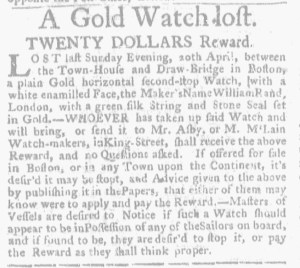
Massachusetts Gazette and Boston Weekly News-Letter (May 9, 1771).

“If offered for sale … it’s desir’d it may be stopt, and Advice given … by publishing it in the Papers.”

Lost and found advertisements regularly appeared in eighteenth-century newspapers.  Colonists sought to harness the power of the press in recovering garments, documents, currency, jewelry, and a variety of other items that they misplaced, dropped, or inadvertently left behind.  The watchmakers Asby and McLain published an advertisement concerning “A Gold Watch lost” on the evening of April 20, 1771, hoping that readers of the Boston-Gazette, the Massachusetts Gazette and Boston Post-Boy, and the Massachusetts Gazette and Boston Weekly News-Letter would assist in returning it.  To that end, they offered “TWENTY DOLLARS Reward.”

The watch went missing “between the Town-House and Draw-Bridge in Boston,” but Asby and McLain widened the search.  They realized that whoever might find the watch would not necessarily seek its owner but instead keep it or attempt to sell it.  The watchmakers enlisted the assistance of “Master of Vessels,” requesting that they observe their crew to see “if such a Watch should appear to be in Possession of any of the Sailors on board.”  Asby and McLain left discipline to captains, advising they either confiscate the watch or pay the reward “as they shall think proper” under the circumstances.  Anticipating the possibility that the watch might be “offered for sale in Boston, or in any Town upon the Continent,” the watchmakers asked that the watch “may be stopt” or confiscated and “Advice given … by publishing it in the Papers, that either of them may know w[h]ere to apply and pay the Reward.”

In giving those instructions, Asby and McLain suggested that newspapers would continue to play a role in their search for the watch beyond publishing their own advertisement.  They expected readers in Boston and other places to take note, testifying to the dissemination and reach of newspapers in the era of the American Revolution.  The watchmakers also suggested that they would scan the newspapers for an advertisement placed in response to their notice.  Even though they gave their location and anyone who found or confiscated the watch could communicate with them directly, Asby and McLain depended on the public prints as an alternative.

May 11

What was advertised in a colonial American newspaper 250 years ago today?

Providence Gazette (May 11, 1771).

“N.B. They have just received by the Ship Providence, Capt. Gilbert, a large and compleat Assortment of European and East India GOODS.”

The arrival of the Providence in Providence on May 1, 1771, was good for business for John Carter, the printer of the Providence Gazette.  Captain Phineas Gilbert brought a variety of information that quickly found its way into the town’s only newspaper.  He delivered newspapers from London and letters from distant correspondents to Carter.  In turn, the printer selected excerpts for publication in the Providence Gazette.  He also published updates about the progress made by several vessels the Providence encountered during its transatlantic voyage.

In addition to news, the Providence also generated advertising.  Merchants quickly placed advertisements announcing that they stocked consumer goods “JUST IMPORTED from LONDON … In the Ship Providence.”  John Brown made that pronouncement in the May 4 edition.  Joseph Russell and William Russell also advertised that Captain Gilbert delivered a “large Assortment of GOODS” to them.  A week later, several other entrepreneurs placed similar notices in the Providence Gazette.  The advertising section in the May 11 edition commenced with notification from “Nicholas, Joseph& Moses Brown, In Company” that they had “imported in the Ship Providence, Capt. Gilbert, a great Variety of English and India GOODS.”  Thurber and Cahoon made the same appeal, adding a nota bene to an advertisement that previously ran in the Providence Gazette.  The new copy asserted that Thurber and Cahoon “have just recently received by the Ship Providence, Capt. Gilbert, a large and compleat Assortment of European and East India GOODS.”  Nathaniel Wheaton did not mention the Providence in his new advertisement, but he did declare that he “just imported from London” an assortment of merchandise that he offered to “the Gentlemen and Ladies both of Town and Country.”  Most likely the Providence transported his goods.  Not all entrepreneurs who placed such advertisements had shops in Providence. Richard Matthewson of East Greenwich promoted goods he received via the Providence, noting that he set prices “as cheap as any in the Colony.”

While Carter certainly welcomed any news that Captain Gilbert carried, he likely appreciated the goods and, especially, the advertisements they inspired even more.  After all, he regularly reprinted news from London that appeared in newspapers published in Boston.  That allowed him to satisfy subscribers, but it did not generate additional revenue.  The number of advertisements for consumer goods in the Providence Gazette significantly increased after the Providencearrived in port and delivered its cargo to merchants and shopkeepers.  That meant both additional content and greater revenue for the newspaper.

May 10

Who were the subjects of advertisements in a colonial American newspaper 250 years ago today?

Connecticut Journal and New-Haven Post-Boy (May 10, 1771).

“RUN away last Tuesday Night, a Negro Man named GLASGOW.”

“RUN away last Tuesday Night, a Negro Man named ABEL.”

Sometime during the night of May 7, 1771, Glasgow, “a Negro Man,” made his escape from his enslaver, John Treat of Milford, Connecticut.  Three days later, Treat published an advertisement in the Connecticut Journal and New-Haven Post-Boy.  He provided a description that included Glasgow’s age, height, and clothing.  Treat also offered a reward for “Who ever shall take up and return said Negro.”  Like so many other enslavers, Treat proclaimed that Glasgow had “RUNaway.”  From Glasgow’s perspective, no doubt, he had instead liberated himself.

Glasgow was not the only enslaved man in Milford who seized his liberty that night.  According to Gideon Platt, Jr., Abel also escaped from bondage on May 7.  Platt also resorted to placing an advertisement in hopes that other colonists would take note of Black men they encountered, scrutinize them to determine whether they matched the description in the newspaper, and, if they spotted Abel, “take up said Negro, and return him to [Platt], or send Word so that he may have him again.”  Platt encouraged readers to attend to age and physical characteristics, but he also reported that Abel “talks good English.”  Linguistic ability as well as appearance could help identify this fugitive from enslavement.

Platt’s advertisement describing Abel appeared immediately below Treat’s advertisement offering a reward for the capture and return of Glasgow in the May 10 edition of the Connecticut Journal.  While not definitive evidence, that Abel and Glasgow happened to depart on the same evening suggests that they may have worked together in seeking freedom, believing that cooperation increased their chances of outsmarting their enslavers.  If they were initially unaware of this coincidence when separately submitting their notices to the printing office, Platt and Treat almost certainly recognized the possibility when they saw their advertisements in the newspaper.

Just as both enslavers told a story filtered through their own perspectives when they stated that Abel and Glasgow had “RUN away,” they likely did not present an account of events that accurately related all of the details or gave Abel and Glasgow credit for coordinating their escape.  Though it was not their intention, Platt and Treat published short narratives that testified to the agency and perseverance exhibited by Abel and Glasgow.  Still, those narratives were incomplete and did not reveal the experiences of the enslaved men as well as if they had recorded their own stories.

Slavery Advertisements Published May 10, 1771

The Slavery Adverts 250 Project chronicles the role of newspaper advertising in perpetuating slavery in the era of the American Revolution. The project seeks to reveal the ubiquity of slavery in eighteenth-century life from New England to Georgia by republishing advertisements about enslaved people – for sale as individuals or in groups, wanted to purchase or for hire for short periods, runaways who liberated themselves, and those who were subsequently captured and confined in jails and workhouses – in daily digests on this site as well as in real time via the @SlaveAdverts250 Twitter feed, utilizing twenty-first-century media to stand in for the print media of the eighteenth century.

The project aims to provide modern audiences with a sense of just how often colonists encountered these advertisements in their daily lives. Enslaved men, women, and children appeared in print somewhere in the colonies almost every single day. Those advertisements served as a constant backdrop for social, cultural, economic, and political life in colonial and revolutionary America. Colonists who did not purport to own enslaved people were still confronted with slavery as well as invited to maintain the system by purchasing enslaved men, women, and children or assisting in the capture of so-called “runaways” who sought to free themselves from bondage. The frequency of these newspaper advertisements suggests just how embedded slavery was in colonial and revolutionary American culture in everyday interactions beyond the printed page.

These advertisements also testify to the experiences of enslaved men, women, and children, though readers must consider that those experiences have been remediated through descriptions offered by enslavers rather than enslaved people themselves. Often unnamed in the advertisements, enslaved men, women, and children were not invisible or unimportant in early America.

These advertisements appeared in colonial American newspapers 250 years ago today.

Connecticut Journal (May 10, 1771).

**********

Connecticut Journal (May 10, 1771).

**********

Connecticut Journal (May 10, 1771).

**********

Connecticut Journal (May 10, 1771).

**********

Connecticut Journal (May 10, 1771).

May 9

What was advertised in a colonial American newspaper 250 years ago today?

Massachusetts Spy (May 9, 1771).

“An ODE set to Music, consecrated to the memory the Rev. GEORGE WHITEFIELD.”

In the months immediately after the death of George Whitefield on September 30, 1770, a variety of printers, booksellers, authors, and others produced and marketed an array of commemorative items that simultaneously commodified one of the most prominent ministers associated with the eighteenth-century religious revivals now known as the Great Awakening.  This trend tapered off by the end of the year, only to be reinvigorated in the spring of 1771 when vessels arrived from England carrying copies of Whitefield’s will and sermons preached in his memory in London.  Colonial printers produced and sold American editions.  They also distributed them to booksellers and other retailers, enlarging the market for such items.

The May 9, 1771, edition of the Massachusetts Gazette carried an advertisement for yet another piece of Whitefield memorabilia, one not previously promoted in the public prints.  John Boyles informed prospective customers that he sold “An ODE set to Music, consecrated to the memory of the Rev. GEORGE WHITEFIELD, A.M. By one of his friends in Boston, New England.”  According to the catalog entry maintained by the American Antiquarian Society, this broadside featured eight stanzas and included music for four voices, making it a unique entry among the broadsides, hymnals, and other commemorative items advertised in colonial newspapers.

The catalog entry also indicates that this broadside was presumably published in Boston by an unknown printer in 1770.  This advertisement, however, suggests that Boyles may have been the printer and that he published the broadside in the spring of 1771.  According to his advertisement in the April 1, 1771, edition of the Massachusetts Gazette and Boston Post-Boy, Boyles ran a “PRINTING-OFFICE, next Door to the THREE DOVES in Marlborough-Street.”  In advertisements for other Whitefield items published in the fall of 1770, Boyles appeared among the list of printers and booksellers who sold those items.  Upon seeing a resurgence of marketing for Whitefield memorabilia in the spring, Boyles may have decided to produce a commemorative item of his own, hoping to take advantage of renewed interest and consumer demand.  If so, he likely experienced steady sales of Whitefield items he carried in the fall and did not want to miss out on a potentially lucrative means of generating additional revenue.  In producing his own broadside, Boyles assumed greater risk, but also stood to earn more profits.

Advertisements for Whitefield memorabilia became a familiar sight in several newspapers in New England, New York, and Pennsylvania in the spring of 1771.  Printers and booksellers offered colonists several opportunities to commemorate the minister’s death by purchasing items created in his memory.  The “ODE set to Music” was a novel item that likely attracted interest among both consumers who previously purchased other memorabilia and those who had not yet expressed their regard for the minister through participation in the marketplace.

Slavery Advertisements Published May 9, 1771

The Slavery Adverts 250 Project chronicles the role of newspaper advertising in perpetuating slavery in the era of the American Revolution. The project seeks to reveal the ubiquity of slavery in eighteenth-century life from New England to Georgia by republishing advertisements about enslaved people – for sale as individuals or in groups, wanted to purchase or for hire for short periods, runaways who liberated themselves, and those who were subsequently captured and confined in jails and workhouses – in daily digests on this site as well as in real time via the @SlaveAdverts250 Twitter feed, utilizing twenty-first-century media to stand in for the print media of the eighteenth century.

The project aims to provide modern audiences with a sense of just how often colonists encountered these advertisements in their daily lives. Enslaved men, women, and children appeared in print somewhere in the colonies almost every single day. Those advertisements served as a constant backdrop for social, cultural, economic, and political life in colonial and revolutionary America. Colonists who did not purport to own enslaved people were still confronted with slavery as well as invited to maintain the system by purchasing enslaved men, women, and children or assisting in the capture of so-called “runaways” who sought to free themselves from bondage. The frequency of these newspaper advertisements suggests just how embedded slavery was in colonial and revolutionary American culture in everyday interactions beyond the printed page.

These advertisements also testify to the experiences of enslaved men, women, and children, though readers must consider that those experiences have been remediated through descriptions offered by enslavers rather than enslaved people themselves. Often unnamed in the advertisements, enslaved men, women, and children were not invisible or unimportant in early America.

These advertisements appeared in colonial American newspapers 250 years ago today.

Maryland Gazette (May 9, 1771).

**********

Maryland Gazette (May 9, 1771).

**********

Massachusetts Gazette and Boston Weekly News-Letter (May 9, 1771).

**********

New-York Journal (May 9, 1771).

**********

Pennsylvania Journal (May 9, 1771).

**********

Virginia Gazette [Purdie and Dixon] (May 9, 1771).

**********

Virginia Gazette [Purdie and Dixon] (May 9, 1771).

**********

Virginia Gazette [Purdie and Dixon] (May 9, 1771).

**********

Virginia Gazette [Purdie and Dixon] (May 9, 1771).

**********

Virginia Gazette [Purdie and Dixon] (May 9, 1771).

**********

Virginia Gazette [Purdie and Dixon] (May 9, 1771).

**********

Virginia Gazette [Purdie and Dixon] (May 9, 1771).

**********

Virginia Gazette [Purdie and Dixon] (May 9, 1771).

**********

Virginia Gazette [Purdie and Dixon] (May 9, 1771).

**********

Virginia Gazette [Rind] (May 9, 1771).

**********

Virginia Gazette [Rind] (May 9, 1771).

**********

Virginia Gazette [Rind] (May 9, 1771).

**********

Virginia Gazette [Rind] (May 9, 1771).

May 8

What was advertised in a colonial American newspaper 250 years ago this week?

Pennsylvania Chronicle (May 6, 1771).

“Mr. SAUNDERS’s stay in this City will be but a few weeks.”

Like many other itinerant performers, Hyman Saunders, an illusionist, placed newspaper advertisements to inform the public when he arrived in town and to attract audiences throughout his stay.  In February 1771, he placed a notice in the New-York Gazette and Weekly Mercury to announce that he planned to “CONTINUE his PERFORMANCES a few Nights” longer in that city, presumably extending his stay.  Anyone who wished to see him perform had only a limited time to do so.

Saunders apparently exaggerated how quickly he would move to a new town.  Three months later he arrived in Philadelphia and ran an advertisement in the Pennsylvania Chronicle, asserting that his “stay in this City will be but a few weeks.”  Once again, he attempted to attract audiences by proclaiming that they could see his show for a limited time only.  Local audiences had two options for seeing Saunder’s show, general admission at Josiah Davenport’s tavern or private functions.  He gave performances at the Bunch of Grapes on Monday, Wednesday, and Saturday evenings.  At other times, he “also performs in private to any select company, at any place they please to appoint.”

Describing his act helped Saunders incite interest among prospective audiences.  He declared that they would witness “a variety of new astonishing and entertaining performance, by dexterity of hand, surpassing any thing of the kind that has hitherto been seen or attempted on this side the Atlantic.”  Saunders promised a spectacle unlike anything audiences had ever seen.  Spread over three acts, his illusions would “deceive the eye of the nicest observer, and appear in a manner supernatural.”  Some of those previous observers included “his Excellency the Earl of DUNMORE, governor of New-York” as well as “nobility and gentry” on both sides of the Atlantic.  Saunders expected that performing before such dignitaries testified to the quality of the illusions he would soon present to audiences in Philadelphia.

In announcing his arrival and describing his act, Saunders relied on anticipation and exhilaration to entice audiences to catch a performance at the Bunch of Grapes or to hire him for a private exhibition.  He asked readers to imagine his show, building a sense of anticipation that would transform into exhilaration when they witnessed the spectacle of illusions unlike any others previously seen in the colonies.  Saunders also encouraged readers to anticipate his departure after a few weeks, warning them not to wait to attend his performance or risk not having an opportunity to see his “dexterity of hand” for themselves.

May 7

What was advertised in a colonial American newspaper 250 years ago today?

Supplement to the South-Carolina Gazette and Country Journal (May 7, 1771).

“Booksellers in Boston, New-York, Philadelphia, or … Charles-Town.”

Like many other colonial printers, Charles Crouch also sold books, pamphlets, and broadsides.  In the pages of the South-Carolina Gazette and Country Journal, he advertised titles available at his “Great Stationary and Book Shop.”  He also acted as a local agent for printers and booksellers in other cities, publishing subscription notices and handling local sales.  He did so on behalf of Robert Bell, the flamboyant bookseller responsible for publishing a three-volume American edition of “ROBERTSON’s celebrated History of CHARLES the Fifth.”  Bell coordinated an advertising campaign that extended from New England to South Carolina.  Local agents simultaneously published his subscription notice inviting readers to participate in an “elegant XENOPHONTICK BANQUET” through purchasing his American edition.

When Wells inserted that advertisement in the South-Carolina Gazette and Country Journal and listed himself as a local agent, he contributed to the creation of a community that extended far beyond Charleston.  Yet settling in for the “XENOPHONTICK BANQUET” was not the only means of joining a larger community that Wells offered to readers and prospective customers.  He appended to Bell’s subscription notice a brief note that he also sold “The Trial of the Soldiers of the 29th Regiment, for the Murders committed at Boston,” printed by John Fleeming in Boston, and “A Funeral Sermon on the Death of the Rev. Mr. Whitefield, by the Rev. Mr. Zubly,” printed by James Johnston in Savannah.  Those two items commemorated two of the most significant events of 1770, the Boston Massacre on March 5 and the death of George Whitefield on September 30.  Both events received extensive coverage in the colonial press.  Both of them also generated commemorative items ranging from broadsides and prints to sermons and orations.

In a single advertisement, Wells linked consumers in South Carolina to geographically dispersed communities that shared common interests not defined by the places individual members resided.  Colonists from New England to Georgia mourned Whitefield, just as they expressed outrage over British soldiers firing into a crowd and killing several people in Boston.  Many colonists also sought to participate in genteel communities defined in part by the books they read, joining in the “grand Feast of historical Entertainment” that booksellers in Boston, New York, Philadelphia, Charleston, and other towns offered to them.  Wells did not merely advertise three titles available at his shop; he marketed a sense of community.

Slavery Advertisements Published May 7, 1771

The Slavery Adverts 250 Project chronicles the role of newspaper advertising in perpetuating slavery in the era of the American Revolution. The project seeks to reveal the ubiquity of slavery in eighteenth-century life from New England to Georgia by republishing advertisements about enslaved people – for sale as individuals or in groups, wanted to purchase or for hire for short periods, runaways who liberated themselves, and those who were subsequently captured and confined in jails and workhouses – in daily digests on this site as well as in real time via the @SlaveAdverts250 Twitter feed, utilizing twenty-first-century media to stand in for the print media of the eighteenth century.

The project aims to provide modern audiences with a sense of just how often colonists encountered these advertisements in their daily lives. Enslaved men, women, and children appeared in print somewhere in the colonies almost every single day. Those advertisements served as a constant backdrop for social, cultural, economic, and political life in colonial and revolutionary America. Colonists who did not purport to own enslaved people were still confronted with slavery as well as invited to maintain the system by purchasing enslaved men, women, and children or assisting in the capture of so-called “runaways” who sought to free themselves from bondage. The frequency of these newspaper advertisements suggests just how embedded slavery was in colonial and revolutionary American culture in everyday interactions beyond the printed page.

These advertisements also testify to the experiences of enslaved men, women, and children, though readers must consider that those experiences have been remediated through descriptions offered by enslavers rather than enslaved people themselves. Often unnamed in the advertisements, enslaved men, women, and children were not invisible or unimportant in early America.

These advertisements appeared in colonial American newspapers 250 years ago today.

South-Carolina Gazette and Country Journal (May 7, 1771).

**********

South-Carolina Gazette and Country Journal (May 7, 1771).

**********

South-Carolina Gazette and Country Journal (May 7, 1771).

**********

South-Carolina Gazette and Country Journal (May 7, 1771).

**********

South-Carolina Gazette and Country Journal (May 7, 1771).

**********

South-Carolina Gazette and Country Journal (May 7, 1771).

**********

South-Carolina Gazette and Country Journal (May 7, 1771).

**********

South-Carolina Gazette and Country Journal (May 7, 1771).

**********

South-Carolina Gazette and Country Journal (May 7, 1771).

**********

South-Carolina Gazette and Country Journal (May 7, 1771).

**********

South-Carolina Gazette and Country Journal (May 7, 1771).

**********

South-Carolina Gazette and Country Journal (May 7, 1771).

**********

South-Carolina Gazette and Country Journal (May 7, 1771).

**********

South-Carolina Gazette and Country Journal (May 7, 1771).

**********

South-Carolina Gazette and Country Journal (May 7, 1771).

**********

South-Carolina Gazette and Country Journal (May 7, 1771).

**********

Supplement to the South-Carolina Gazette and Country Journal (May 7, 1771).

**********

Supplement to the South-Carolina Gazette and Country Journal (May 7, 1771).

**********

Supplement to the South-Carolina Gazette and Country Journal (May 7, 1771).

May 6

What was advertised in a colonial American newspaper 250 years ago today?

Boston-Gazette (May 6, 1771).

“AN ORATION … to COMMEMORATE the BLOODY TRAGEDY.”

In the spring of 1771, colonists had several opportunities to purchase memorabilia that marked the first anniversary of the Boston Massacre.  For the fourth consecutive week, Benjamin Edes and John Gill advertised James Lovell’s “ORATION … to COMMEMORATE the BLOODY TRAGEDY” in the May 6 edition of the Boston-Gazette.  Edes and Gill, printers of that newspaper, also printed the oration “by Order of the Town of BOSTON,” according to the imprint on the title page.

Lovell delivered the first oration commemorating the Boston Massacre sanctioned by the town of Boston on April 2, 1771, though Thomas Young also gave an address on the same theme a few weeks earlier and closer to the first anniversary of British soldiers firing into a crowd and killing several colonists.  No copy of Young’s address survives, but Edes and Gill took Lovell’s oration to press less than two weeks after he spoke to the residents of Boston.  Starting on April 15, they promoted the oration in the Boston-Gazette, informing readers that they could acquire copies of this commemorative item.  A week later, Samuel Hall, printer of the Essex Gazette, advised residents of Salem and its environs that he also carried Lovell’s oration.

Edes and Gill simultaneously marketedINNOCENT BLOOD CRYING TO GOD FROM THE STREETS OF BOSTON,” a sermon that John Lathrop, “Pastor of the Second Church in BOSTON,” delivered just days after the Boston Massacre.  Edes and Gill reprinted a London edition delivered to them by a ship captain who carried both news and consumer goods across the Atlantic.  In the case of the sermon, news and merchandise came packaged in a single pamphlet, ready for reprinting and dissemination throughout the busy port and into the countryside.  According to their advertisement, Edes and Gill sold the sermon single and by the dozen, an invitation to retailers to purchase and sell it in their shops.

Civic leaders in Boston encouraged a culture of commemoration around the Bloody Massacre, just as colonists in many towns marked the anniversary of the repeal of the Stamp Act.  Printers like Edes and Gill eagerly participated in that process, inspired by both their political principles and their desire to generate revenues.  Printing and marketing orations and sermons about the Boston Massacre helped to keep the event fresh in popular memory by making those addresses readily accessible long after the speakers delivered them.