May 18

What was advertised in a colonial American newspaper 250 years ago today?

Providence Gazette (May 18, 1771).

“Just imported in the Snow Tristram, Capt. Shand.”

The arrival of the ship Providence in Providence on May 1, 1771, had a significant impact on the contents of the next several issues of the Providence Gazette.  Captain Phineas Gilbert carried a variety of letters and newspapers that contained information not previously available in the colony.  John Carter, the printer of the Providence Gazette, selected excerpts to publish for his readers.  The Providence also transported consumer goods that soon found their way into local shops.  Several merchants advertised that their inventory now included merchandise “imported in the Ship Providence.”  No matter where they looked in the Providence Gazette, readers encountered content connected to the Providence.

In the time that advertisements for goods shipped via the Providence continued to run in the newspaper, other vessels arrived with more news and their own cargoes.  Immediately below the masthead in the May 18 edition of the Providence Gazette, Carter noted that he reprinted news he received “By the Snow Tristram, Captain SHAND, arrived here from London.”  A cluster of new advertisements made reference to the same vessel.  Amos Throop proclaimed that he sold “Fresh DRUGS and MEDICINES. Just imported in the Tristram, Captain Shand, from London,” echoing Carter’s attribution to his source for the news.  Joseph Russell and William Russell similarly announced that they stocked a “LARGE and compleat Assortment of English and Hard Ware GOODS” that crossed the Atlantic on the Tristram.  On another page of the same issue, an advertisement the Russells initially placed two weeks earlier once again promoted “a large Assortment of GOODS, suitable for the Season” that arrived via the Providence.  The partnership of “Nicholas, Joseph & Moses Brown, In Company,” also ran two advertisements, one for goods transported on the Tristram and the other for goods transported on the Providence.

Those advertisements meant greater revenues for the printer, but they also suggested more choices for prospective customers who, then as now, often equated newer with better.  That so many advertisements for consumer goods mentioned which ships carried those goods may seem quaint to modern readers, but that detail provided important context for eighteenth-century consumers who were less likely to pick over items that lingered on shelves for months than to browse new items that recently arrived.

May 17

Who was the subject of an advertisements published in an colonial American newspaper 250 years ago today?

Connecticut Journal (May 17, 1771).

“RUN away … a Negro Man named ABEL.”

Thomas Green and Samuel Green, the printers of the Connecticut Journal and New-Haven Post-Boy, had more content than would fit in a standard four-page issue on May 17, 1771, but not so much to justify a half sheet supplement.  To make room for everything they wished to squeeze into the issue, the Greens resorted to a method frequently deployed by eighteenth-century compositors.  They placed advertisements in the margins.

Doing so required rotating the type so it ran perpendicular to the rest of the contents of the newspaper.  That did not, however, require them to set new type for the advertisements that appeared in the margins.  Instead, they adapted notices that appeared in the previous issue, dividing them into shorter columns.  For instance, Gideon Platt, Jr., placed an advertisement describing Abel, an enslaved man who liberated himself, and offering a reward for his capture and return.  In the May 10 edition, that notice filled fifteen lines in a single column.  In the May 17 edition, on the other hand, the Greens divided Platt’s advertisement into five columns of three lines each in order to make them fit in the left margin on the second page.  Two other advertisements offering rewards for enslaved men who liberated themselves ran in the right margin on the third page.  They accounted for twenty-six lines in the previous issue, but by placing the town and date on the same line as John Treat’s name, the Greens managed to create five columns of five lines each without making significant interventions into type already set.

Rather than diminish the effectiveness of those advertisements, this strategy likely resulted in greater visibility.  The unique format challenged readers to discover what was so noteworthy that it merited inclusion in the margins rather than waiting until the next edition.  The Greens also made those advertisements easily accessible, placing them in the outer margins rather than along the inner fold of the newspaper.  Even as Abel, Dover, and Glasgow, the men described in the advertisements attempted to elude attention, the unique placement of the notices in the margins of the Connecticut Journal encouraged greater scrutiny and familiarity with their descriptions.

Slavery Advertisements Published May 17, 1771

The Slavery Adverts 250 Project chronicles the role of newspaper advertising in perpetuating slavery in the era of the American Revolution. The project seeks to reveal the ubiquity of slavery in eighteenth-century life from New England to Georgia by republishing advertisements about enslaved people – for sale as individuals or in groups, wanted to purchase or for hire for short periods, runaways who liberated themselves, and those who were subsequently captured and confined in jails and workhouses – in daily digests on this site as well as in real time via the @SlaveAdverts250 Twitter feed, utilizing twenty-first-century media to stand in for the print media of the eighteenth century.

The project aims to provide modern audiences with a sense of just how often colonists encountered these advertisements in their daily lives. Enslaved men, women, and children appeared in print somewhere in the colonies almost every single day. Those advertisements served as a constant backdrop for social, cultural, economic, and political life in colonial and revolutionary America. Colonists who did not purport to own enslaved people were still confronted with slavery as well as invited to maintain the system by purchasing enslaved men, women, and children or assisting in the capture of so-called “runaways” who sought to free themselves from bondage. The frequency of these newspaper advertisements suggests just how embedded slavery was in colonial and revolutionary American culture in everyday interactions beyond the printed page.

These advertisements also testify to the experiences of enslaved men, women, and children, though readers must consider that those experiences have been remediated through descriptions offered by enslavers rather than enslaved people themselves. Often unnamed in the advertisements, enslaved men, women, and children were not invisible or unimportant in early America.

These advertisements appeared in colonial American newspapers 250 years ago today.

Connecticut Journal (May 17, 1771).

**********

Connecticut Journal (May 17, 1771).

**********

Connecticut Journal (May 17, 1771).

Slavery Advertisements Published May 16, 1771

The Slavery Adverts 250 Project chronicles the role of newspaper advertising in perpetuating slavery in the era of the American Revolution. The project seeks to reveal the ubiquity of slavery in eighteenth-century life from New England to Georgia by republishing advertisements about enslaved people – for sale as individuals or in groups, wanted to purchase or for hire for short periods, runaways who liberated themselves, and those who were subsequently captured and confined in jails and workhouses – in daily digests on this site as well as in real time via the @SlaveAdverts250 Twitter feed, utilizing twenty-first-century media to stand in for the print media of the eighteenth century.

The project aims to provide modern audiences with a sense of just how often colonists encountered these advertisements in their daily lives. Enslaved men, women, and children appeared in print somewhere in the colonies almost every single day. Those advertisements served as a constant backdrop for social, cultural, economic, and political life in colonial and revolutionary America. Colonists who did not purport to own enslaved people were still confronted with slavery as well as invited to maintain the system by purchasing enslaved men, women, and children or assisting in the capture of so-called “runaways” who sought to free themselves from bondage. The frequency of these newspaper advertisements suggests just how embedded slavery was in colonial and revolutionary American culture in everyday interactions beyond the printed page.

These advertisements also testify to the experiences of enslaved men, women, and children, though readers must consider that those experiences have been remediated through descriptions offered by enslavers rather than enslaved people themselves. Often unnamed in the advertisements, enslaved men, women, and children were not invisible or unimportant in early America.

These advertisements appeared in colonial American newspapers 250 years ago today.

Maryland Gazette (May 16, 1771).

**********

Maryland Gazette (May 16, 1771).

**********

Massachusetts Gazette and Boston Weekly Mercury (May 16, 1771).

**********

New-York Journal (May 16, 1771).

**********

Pennsylvania Gazette (May 16, 1771).

**********

Pennsylvania Gazette (May 16, 1771).

**********

Pennsylvania Gazette (May 16, 1771).

**********

Pennsylvania Journal (May 16, 1771).

**********

South-Carolina Gazette (May 16, 1771).

**********

South-Carolina Gazette (May 16, 1771).

**********

South-Carolina Gazette (May 16, 1771).

**********

South-Carolina Gazette (May 16, 1771).

**********

South-Carolina Gazette (May 16, 1771).

**********

South-Carolina Gazette (May 16, 1771).

**********

South-Carolina Gazette (May 16, 1771).

**********

South-Carolina Gazette (May 16, 1771).

**********

South-Carolina Gazette (May 16, 1771).

**********

Virginia Gazette [Purdie and Dixon] (May 16, 1771).

**********

Virginia Gazette [Purdie and Dixon] (May 16, 1771).

**********

Virginia Gazette [Purdie and Dixon] (May 16, 1771).

**********

Virginia Gazette [Purdie and Dixon] (May 16, 1771).

**********

Virginia Gazette [Purdie and Dixon] (May 16, 1771).

**********

Virginia Gazette [Purdie and Dixon] (May 16, 1771).

**********

Virginia Gazette [Purdie and Dixon] (May 16, 1771).

**********

Virginia Gazette [Purdie and Dixon] (May 16, 1771).

**********

Virginia Gazette [Purdie and Dixon] (May 16, 1771).

**********

Virginia Gazette [Purdie and Dixon] (May 16, 1771).

**********

Virginia Gazette [Purdie and Dixon] (May 16, 1771).

**********

Virginia Gazette [Purdie and Dixon] (May 16, 1771).

May 15

What was advertised in a colonial American newspaper 250 years ago this week?

Essex Gazette (May 14, 1771).

“[The following was paid for as an Advertisement.]”

Newspaper editors selected which articles and letters to print or reprint in their publications, but that did not exclude others, especially advertisers, from shaping the contents and messages disseminated to readers.  In the era of the American Revolution, for instance, many advertisers enhanced their notices with political commentary, encouraging consumers to graft politics onto their decisions in the marketplace.  Aggrieved husbands regularly published advertisements warning others not to extend credit to wives who had the audacity to resist the patriarchal authority husbands were supposed to exercise in their households.  In the process, husbands gave details about marital discord and the misbehavior of their wives.  On occasion, some of those wives responded with advertisements of their own, painting less than flattering portraits of abusive or negligent husbands.  Other advertisers disputed land titles or pursued personal grudges.  Editors temporarily transferred editorial authority to advertisers who paid for space in their newspapers.

That seems to have been the case concerning a poem that ran in the May 15, 1771, edition of the Essex Gazette.  Many eighteenth-century newspapers featured a poetry corner, often positioned in the upper left corner of the final page, but that was not the case with this poem.  Instead, it appeared at the bottom of the last column on the third page.  Given the production process for a standard four-page issue, that meant that the poem was the last item the compositor inserted into that issue.  Perhaps Samuel Hall, the printer of the Essex Gazette, had second thoughts about including it at all.  An editorial note preceded the poem, suggesting that Hall decided that its appearance in his newspaper required some sort of explanation: “[The following was paid for as an Advertisement.]”  In other words, Hall did not select it for the edification or amusement of his readers.  He might not have even fully understood its purpose or meaning, but a customer paid for the space.  The poem very well may have bewildered Hall and most readers.  A preamble declared, “The folloing lines were Presented to A lat skull mistres in this town by 4 of her skolers the morning after her mareg.”  The misspellings continued throughout the poem, suggesting that the “skull mistres” (school mistress) achieved only partial success with these “skolers” (scholars) who sent tidings following her “mareg” (marriage).  The poem was an inside joke not intended for all readers of the Essex Gazette.

Hall could have refused to publish the poem, exercising his prerogative as editor and proprietor of the Essex Gazette.  He was not obligated to publish anything submitted to the printing office, even if accompanied by payment to appear as an advertisement.  Yet that payment justified temporarily surrendering editorial control to an advertiser.  Indeed, Hall abbreviated an advertisement from Nathaniel Sparhawk, Jr., explaining that “[Want of Room obliges us to defer the Particulars till next Week.]”  Hall could have given Sparhawk the space devoted to the poem, but instead opted to collect payment and insert the poem with a disclaimer.  The four “skolers” then found their ode to their “skull mistres” in the public prints.

May 14

What was advertised in a colonial American newspaper 250 years ago today?

Essex Gazette (May 14, 1771).

“Medals of the Rev. G. Whitefield.”

George Whitefield, one of the most prominent ministers associated with the eighteenth-century religious revivals now known as the Great Awakening, died in Newburyport, Massachusetts, on September 30, 1770.  Newspapers in Boston published the news the following day.  Newspapers in other colonies reprinted those accounts as soon as they came to hand.  Almost as quickly, printers, booksellers, and others inserted advertisements for various commemorative items, including funeral sermons, poems in memory of the minister, and works written by Whitefield.  Once vessels crossing the Atlantic delivered the news to England and returned to the colonies, printers advertised even more Whitefield memorabilia, including his last will and testament and the sermon John Wesley preached in his memory.  As broadsides, pamphlets, and books, the simultaneous commemoration and commodification of Whitefield took place via print.

Yet that commemoration and commodification was not confined to print.  Advertisers also marketed “Medals of the Rev. G. Whitefield.”  Samuel Hall, printer of the Essex Gazette, was the first to do so, inserting a brief notice in the May 14, 1771, edition of his newspaper.  Hall did not elaborate on the medals, stating only that they “may be had at the Printing-Office next Thursday or Friday.”  He did not mention the images or inscriptions that appeared on either side, nor did he specify the artist or place of production.  Artists produced several medals on the occasion of Whitefield’s death, many of them dated to 1770, but Hall did not indicate which medals consumers could purchase at his printing office.  Given his experience marketing other commemorative items, he may not have considered it necessary to provide elaborate descriptions of the medals in newspaper advertisements, especially if those other items met brisk demand among consumers who wished to mourn the famous minister through acquiring goods associated with him.  Many months after Whitefield’s death attracted notice throughout the colonies, new commemorative items continued to hit the market.  One of the most significant news events of 1770 continued to receive attention in the public prints as advertisers hawked a variety of Whitefield memorabilia.

Slavery Advertisements Published May 14, 1771

The Slavery Adverts 250 Project chronicles the role of newspaper advertising in perpetuating slavery in the era of the American Revolution. The project seeks to reveal the ubiquity of slavery in eighteenth-century life from New England to Georgia by republishing advertisements about enslaved people – for sale as individuals or in groups, wanted to purchase or for hire for short periods, runaways who liberated themselves, and those who were subsequently captured and confined in jails and workhouses – in daily digests on this site as well as in real time via the @SlaveAdverts250 Twitter feed, utilizing twenty-first-century media to stand in for the print media of the eighteenth century.

The project aims to provide modern audiences with a sense of just how often colonists encountered these advertisements in their daily lives. Enslaved men, women, and children appeared in print somewhere in the colonies almost every single day. Those advertisements served as a constant backdrop for social, cultural, economic, and political life in colonial and revolutionary America. Colonists who did not purport to own enslaved people were still confronted with slavery as well as invited to maintain the system by purchasing enslaved men, women, and children or assisting in the capture of so-called “runaways” who sought to free themselves from bondage. The frequency of these newspaper advertisements suggests just how embedded slavery was in colonial and revolutionary American culture in everyday interactions beyond the printed page.

These advertisements also testify to the experiences of enslaved men, women, and children, though readers must consider that those experiences have been remediated through descriptions offered by enslavers rather than enslaved people themselves. Often unnamed in the advertisements, enslaved men, women, and children were not invisible or unimportant in early America.

These advertisements appeared in colonial American newspapers 250 years ago today.

Essex Gazette (May 14, 1771).

**********

South-Carolina Gazette and Country Journal (May 14, 1771).

**********

South-Carolina Gazette and Country Journal (May 14, 1771).

**********

South-Carolina Gazette and Country Journal (May 14, 1771).

**********

South-Carolina Gazette and Country Journal (May 14, 1771).

**********

South-Carolina Gazette and Country Journal (May 14, 1771).

**********

South-Carolina Gazette and Country Journal (May 14, 1771).

**********

South-Carolina Gazette and Country Journal (May 14, 1771).

**********

South-Carolina Gazette and Country Journal (May 14, 1771).

**********

South-Carolina Gazette and Country Journal (May 14, 1771).

**********

South-Carolina Gazette and Country Journal (May 14, 1771).

**********

South-Carolina Gazette and Country Journal (May 14, 1771).

**********

South-Carolina Gazette and Country Journal (May 14, 1771).

**********

South-Carolina Gazette and Country Journal (May 14, 1771).

May 13

What was advertised in a colonial American newspaper 250 years ago today?

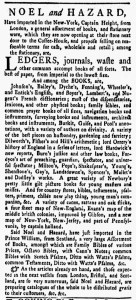
New-York Gazette and Weekly Mercury (May 13, 1771).

“Preparing catalogues … to be distributed gratis to their customers.”

In the spring of 1771, booksellers Noel and Hazard took to the pages of the New-York Gazette and Weekly Mercury to advertise the “general assortment of books, and stationary ware” available at their shop.  They sought customers of all sorts, offering their inventory both “wholesale and retail.”  The partners made recommendations for the proprietors of country stores, including “bibles, testaments, psalters, primers, childs new play thing, [and] young man’s companion.”  They also had on hand a “great variety of Newbury’s pretty little gilt picture books for young masters and misses,” encouraging adults to purchase books for children.  For prospective customers who pursued certain occupations, Noel and Hazard stocked “navigation books and instruments, surveying books and instruments, [and] architect books and instruments.”  For all sorts of other readers, they sold English and French dictionaries, a “variety of the best pieces on husbandry, gardening and farriery,” and works by Milton, Pope, Shakespeare, and a variety of other authors familiar to eighteenth-century readers.

Noel and Hazard imported their merchandise from London and Scotland.  They anticipated expanding their inventory upon the arrival of “the next vessels from London, Bristol, and Scotland.”  At that time, the items available at their shop would become “so very numerous” that a newspaper advertisement would not longer suffice.  As an alternative, Noel and Hazard were “preparing catalogues of the whole to be distributed gratis to their customers.”  Booksellers regularly produced and disseminated catalogs to supplement their newspaper advertisements.  Those catalogues took various forms, sometimes appearing as broadsides and other times as pamphlets.  Over time, they became more sophisticated in terms of organization.  Rather than listing available titles according to the size of the volumes, booksellers instead grouped them together according to genre.  Doing so assisted prospective customers in locating titles of interest and discovering items they were most likely to purchase but might not have otherwise considered.  Promising free catalogs also served as a ploy to get consumers into shops.  Noel and Hazard described an extensive inventory in their advertisement, but readers who visited their shop to acquire a complete catalog had an opportunity to browse and examine the merchandise for themselves.

Few eighteenth-century book catalogs survive relative to how often booksellers mentioned them in newspaper advertisements.  That has prompted some historians to suspect that many never actually made it into print.  After all, Noel and Hazard stated that they “are preparing catalogues,” not that the catalogs were ready for distribution.  The mere promise of a catalog may have also drawn prospective customers into shops.  Still, booksellers promoted catalogs so frequently that it seems likely that they did distribute many of them, at least in sufficient numbers for prospective customers to have reasonable expectations of acquiring catalogs described in newspaper advertisements.

Slavery Advertisements Published May 13, 1771

The Slavery Adverts 250 Project chronicles the role of newspaper advertising in perpetuating slavery in the era of the American Revolution. The project seeks to reveal the ubiquity of slavery in eighteenth-century life from New England to Georgia by republishing advertisements about enslaved people – for sale as individuals or in groups, wanted to purchase or for hire for short periods, runaways who liberated themselves, and those who were subsequently captured and confined in jails and workhouses – in daily digests on this site as well as in real time via the @SlaveAdverts250 Twitter feed, utilizing twenty-first-century media to stand in for the print media of the eighteenth century.

The project aims to provide modern audiences with a sense of just how often colonists encountered these advertisements in their daily lives. Enslaved men, women, and children appeared in print somewhere in the colonies almost every single day. Those advertisements served as a constant backdrop for social, cultural, economic, and political life in colonial and revolutionary America. Colonists who did not purport to own enslaved people were still confronted with slavery as well as invited to maintain the system by purchasing enslaved men, women, and children or assisting in the capture of so-called “runaways” who sought to free themselves from bondage. The frequency of these newspaper advertisements suggests just how embedded slavery was in colonial and revolutionary American culture in everyday interactions beyond the printed page.

These advertisements also testify to the experiences of enslaved men, women, and children, though readers must consider that those experiences have been remediated through descriptions offered by enslavers rather than enslaved people themselves. Often unnamed in the advertisements, enslaved men, women, and children were not invisible or unimportant in early America.

These advertisements appeared in colonial American newspapers 250 years ago today.

Massachusetts Gazette and Boston Post-Boy (May 13, 1771).

**********

New-York Gazette and Weekly Mercury (May 13, 1771).

**********

New-York Gazette and Weekly Mercury (May 13, 1771).

**********

Supplement to the New-York Gazette and Weekly Mercury (May 13, 1771).

**********

Supplement to the New-York Gazette and Weekly Mercury (May 13, 1771).

**********

South-Carolina and American General Gazette (May 13, 1771).

**********

South-Carolina and American General Gazette (May 13, 1771).

**********

South-Carolina and American General Gazette (May 13, 1771).

**********

South-Carolina and American General Gazette (May 13, 1771).

**********

South-Carolina and American General Gazette (May 13, 1771).

**********

South-Carolina and American General Gazette (May 13, 1771).

**********

South-Carolina and American General Gazette (May 13, 1771).

**********

South-Carolina and American General Gazette (May 13, 1771).

**********

South-Carolina and American General Gazette (May 13, 1771).

**********

South-Carolina and American General Gazette (May 13, 1771).

**********

South-Carolina and American General Gazette (May 13, 1771).

**********

South-Carolina and American General Gazette (May 13, 1771).

**********

South-Carolina and American General Gazette (May 13, 1771).

**********

South-Carolina and American General Gazette (May 13, 1771).