The Slavery Adverts 250 Project chronicles the role of newspaper advertising in perpetuating slavery in the era of the American Revolution. The project seeks to reveal the ubiquity of slavery in eighteenth-century life from New England to Georgia by republishing advertisements about enslaved people – for sale as individuals or in groups, wanted to purchase or for hire for short periods, runaways who liberated themselves, and those who were subsequently captured and confined in jails and workhouses – in daily digests on this site as well as in real time via the @SlaveAdverts250 Twitter feed, utilizing twenty-first-century media to stand in for the print media of the eighteenth century.
The project aims to provide modern audiences with a sense of just how often colonizers encountered these advertisements in their daily lives. Enslaved men, women, and children appeared in print somewhere in the colonies almost every single day. Those advertisements served as a constant backdrop for social, cultural, economic, and political life in colonial and revolutionary America. Colonizers who did not purport to own enslaved people were still confronted with slavery as well as invited to maintain the system by purchasing enslaved men, women, and children or assisting in the capture of so-called “runaways” who sought to free themselves from bondage. The frequency of these newspaper advertisements suggests just how embedded slavery was in colonial and revolutionary American culture in everyday interactions beyond the printed page.
These advertisements also testify to the experiences of enslaved men, women, and children, though readers must consider that those experiences have been remediated through descriptions offered by enslavers rather than enslaved people themselves. Often unnamed in the advertisements, enslaved men, women, and children were not invisible or unimportant in early America.
These advertisements appeared in colonial American newspapers 250 years ago today.
What was advertised in a colonial American newspaper 250 years ago today?
Massachusetts Spy (June 18, 1772).
“HATS manufactured and sold by the advertiser.”
Of the five newspapers published in Boston in the summer of 1772, the Massachusetts Spy had the most elaborate masthead, but it also had featured the fewest innovations in design for the rest of the contents, including advertisements. For instance, a decorative border enclosed Jolley Allen’s advertisement when it appeared in each of the other newspapers, but that distinctive format was not incorporated into Allen’s notice when he submitted identical copy to the Massachusetts Spy.
That did not prevent Martin Bicker from attempting to draw more attention to his advertisement with an image of his merchandise in the upper left corner. Bicker advertised that he “manufactured and sold” hats. A woodcut depicting a tricorne hat, a popular style at the time, alerted readers to the contents of the advertisement before they read it. Bicker did not provide many details about his hats, but he did declare that he “hopes he has given such satisfaction to his customers as will induce them to continue their favours.” In other words, he invited repeat business and recommendations via word of mouth.
New-York Journal (June 18, 1772).
The same day that Bicker’s advertisement ran in the Massachusetts Spy, Nesbitt Deane once again inserted his advertisement for hats in the New-York Journal. Both the appeals he made to customers and the image that accompanied the notice were more sophisticated. Deane trumpeted that he made hats “to exceed in Fineness, Cut, Colour and Cock.” In addition, he devised a means “to turn rain, and prevent the Sweat of the Head damaging the crown.” Prospective customers would not find that feature in other hats, Deane asserted, because he invented “a Method peculiar to himself. He also gave a discount to retailers who bought in volume, offering “Encouragement to those who buy to sell again.” Like Bicker, Deane acknowledged his existing customers and asked them to promote his hats. “Such Gentry and others, who have experienced his Ability, ’tis hoped will recommend.” The image at the top of Deane’s advertisement included both a tricorne hat and a banner with his name. Rococo flourishes further enhanced that image.
Bicker did not deploy as many appeals as Deane in his effort to entice consumers to purchase his hats, but including an image in his advertisement distinguished it from most others in the Massachusetts Spy. Relatively few advertisements published in the eighteenth-century newspapers featured images of any sort. Did including images give advertisers an advantage? Deane apparently thought so. By the time Bicker placed his notice, Deane had been running his advertisement for nearly a year. He likely would not have inserted it in the New-York Journal so many times if he did not believe he received a return on his investment.
The Slavery Adverts 250 Project chronicles the role of newspaper advertising in perpetuating slavery in the era of the American Revolution. The project seeks to reveal the ubiquity of slavery in eighteenth-century life from New England to Georgia by republishing advertisements about enslaved people – for sale as individuals or in groups, wanted to purchase or for hire for short periods, runaways who liberated themselves, and those who were subsequently captured and confined in jails and workhouses – in daily digests on this site as well as in real time via the @SlaveAdverts250 Twitter feed, utilizing twenty-first-century media to stand in for the print media of the eighteenth century.
The project aims to provide modern audiences with a sense of just how often colonizers encountered these advertisements in their daily lives. Enslaved men, women, and children appeared in print somewhere in the colonies almost every single day. Those advertisements served as a constant backdrop for social, cultural, economic, and political life in colonial and revolutionary America. Colonizers who did not purport to own enslaved people were still confronted with slavery as well as invited to maintain the system by purchasing enslaved men, women, and children or assisting in the capture of so-called “runaways” who sought to free themselves from bondage. The frequency of these newspaper advertisements suggests just how embedded slavery was in colonial and revolutionary American culture in everyday interactions beyond the printed page.
These advertisements also testify to the experiences of enslaved men, women, and children, though readers must consider that those experiences have been remediated through descriptions offered by enslavers rather than enslaved people themselves. Often unnamed in the advertisements, enslaved men, women, and children were not invisible or unimportant in early America.
These advertisements appeared in colonial American newspapers 250 years ago today.
What was advertised in a colonial American newspaper 250 years ago this week?
Supplement to the Pennsylvania Packet (June 15, 1772).
“Sweeping brushes as 19 s. per dozen, and lower by the half or whole gross.”
John Hannah described himself as a “WHOLESALE AND RETAIL BRUSHMAKER” in an advertisement that appeared in the supplement that accompanied the June 15, 1772, edition of the Pennsylvania Packet. Although he stocked “a good assortment of painting brushes” and “a general assortment of bone brushes” that he “imported in the last vessels from England and Holland,” he focused on the items that he produced in his own shop “AT THE HOG, … At the north-east corner of Second and Chestnut Streets” in Philadelphia. A woodcut depicting a boar, the bristles on the crest of its back evident, adorned his advertisement.
Hannah declared that he “made and manufactured” all kinds of brushes “in the best manner” at his shop, assisted by “the best hands in the city.” The quality of his brushes derived from both the materials, “a large and general assortment of Bristles” imported from Europe, and the skills of those who worked in his shop. In addition to quality, Hannah promoted low prices, especially for wholesale transactions. He proclaimed that he “can sell on as reasonable terms as any manufacturer in the province,” challenging prospective customers to compare his prices to those set by his competitors. To demonstrate that he did indeed offer good bargains, he listed some of his prices. Hannah sold a dozen sweeping brushes for nineteen shillings. He offered discounts to buyers who purchased in greater volume. Similarly, he charged four shilling for a dozen “weavers brushes” and “lower by the half or whole gross.” That he did not specify how deeply he discounted such purchases suggested that customers could negotiate the prices.
Hannah incorporated several appeals into his advertisement. He emphasized the quality of his finished product as well as the skills of the workers who labored in his shop. He promoted the range of choices available to customers. He also promised the lowest prices in the colony, listing his prices and offering discounts to retailers and others who purchased large quantities of brushes. To draw attention to his advertisement, he included a woodcut that resembled the sign that marked the location of his shop, a rudimentary form of branding his business.
What was advertised in a colonial American newspaper 250 years ago today?
Connecticut Courant (June 16, 1772).
“He Desires all Persons indebted to him, to make Immediate Payment.”
In a short advertisement in the June 16, 1772, edition of the Connecticut Courant, John Cable, a “BAKER from GERMANY,” informed the public “that he is (in a short Time) going to New York where he intends to Purchase a considerable Quantity of Flower for the Purpose of supplying his Customers as usual.” He did not merely intend to incite demand for the bread he would bake upon his return; instead, he also aimed to raise the funds necessary to acquire the supplies he needed to continue operating his business. Cable declared that since “his undertaking requires CASH, he Desires all Persons indebted to him, to make Immediate Payment.” Unlike many others who published similar messages, he did not threaten legal action against those who did not heed his request.
Graphic design likely played a significant role in drawing attention to Cable’s advertisement. A border comprised of decorative type, leafy flourishes, surrounded his notice. No other advertisement in that issue or any recent issue of the Connecticut Courant had a border. Only two images appeared in that edition, a crown and seal flanked by a lion and unicorn in the masthead and a much less elaborate woodcut depicting a horse in an advertisement about a strayed or stolen mare. Compared to newspapers published in larger cities, the Connecticut Courant generally featured fewer images and fewer experiments with graphic design, though Caleb Bull’s advertisement for “New, New, New GOODS!” that ran once again demonstrated an interest in innovative marketing strategies. Given Hartford’s proximity to Boston, Cable may have spotted Jolley Allen’s or Andrew Dexter’s advertisements with borders in one of the newspapers published there, prompting him to request similar treatment for his advertisement when he submitted the copy to the printing office. Alternately, he may have envisioned the format on his own, searching for a means of distinguishing his notice from others in hopes of increasing the chances that “Persons indebted to him” would see it and settle accounts before he ventured to New York.
The Slavery Adverts 250 Project chronicles the role of newspaper advertising in perpetuating slavery in the era of the American Revolution. The project seeks to reveal the ubiquity of slavery in eighteenth-century life from New England to Georgia by republishing advertisements about enslaved people – for sale as individuals or in groups, wanted to purchase or for hire for short periods, runaways who liberated themselves, and those who were subsequently captured and confined in jails and workhouses – in daily digests on this site as well as in real time via the @SlaveAdverts250 Twitter feed, utilizing twenty-first-century media to stand in for the print media of the eighteenth century.
The project aims to provide modern audiences with a sense of just how often colonizers encountered these advertisements in their daily lives. Enslaved men, women, and children appeared in print somewhere in the colonies almost every single day. Those advertisements served as a constant backdrop for social, cultural, economic, and political life in colonial and revolutionary America. Colonizers who did not purport to own enslaved people were still confronted with slavery as well as invited to maintain the system by purchasing enslaved men, women, and children or assisting in the capture of so-called “runaways” who sought to free themselves from bondage. The frequency of these newspaper advertisements suggests just how embedded slavery was in colonial and revolutionary American culture in everyday interactions beyond the printed page.
These advertisements also testify to the experiences of enslaved men, women, and children, though readers must consider that those experiences have been remediated through descriptions offered by enslavers rather than enslaved people themselves. Often unnamed in the advertisements, enslaved men, women, and children were not invisible or unimportant in early America.
These advertisements appeared in colonial American newspapers 250 years ago today.
Connecticut Courant (June 16, 1772).
**********
Connecticut Courant (June 16, 1772).
**********
Essex Gazette (June 16, 1772).
**********
South-Carolina Gazette and Country Journal (June 16, 1772).
**********
South-Carolina Gazette and Country Journal (June 16, 1772).
**********
South-Carolina Gazette and Country Journal (June 16, 1772).
**********
South-Carolina Gazette and Country Journal (June 16, 1772).
**********
South-Carolina Gazette and Country Journal (June 16, 1772).
**********
South-Carolina Gazette and Country Journal (June 16, 1772).
**********
South-Carolina Gazette and Country Journal (June 16, 1772).
**********
South-Carolina Gazette and Country Journal (June 16, 1772).
**********
South-Carolina Gazette and Country Journal (June 16, 1772).
**********
South-Carolina Gazette and Country Journal (June 16, 1772).
**********
South-Carolina Gazette and Country Journal (June 16, 1772).
**********
South-Carolina Gazette and Country Journal (June 16, 1772).
**********
South-Carolina Gazette and Country Journal (June 16, 1772).
**********
Supplement to the South-Carolina Gazette and Country Journal (June 16, 1772).
**********
Supplement to the South-Carolina Gazette and Country Journal (June 16, 1772).
**********
Supplement to the South-Carolina Gazette and Country Journal (June 16, 1772).
**********
Supplement to the South-Carolina Gazette and Country Journal (June 16, 1772).
**********
Supplement to the South-Carolina Gazette and Country Journal (June 16, 1772).
**********
Supplement to the South-Carolina Gazette and Country Journal (June 16, 1772).
**********
Supplement to the South-Carolina Gazette and Country Journal (June 16, 1772).
What was advertised in a colonial American newspaper 250 years ago today?
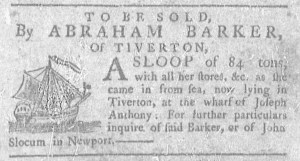
Newport Mercury (June 15, 1772).
“A SLOOP of 84 tons, with all her stores.”
I found Abraham Barker’s advertisement in the June 15, 1772, issue of the Newport Mercury very interesting. The shipbuilding industry was extremely important to the colonies and played a significant role in the economy of the New England—in this case, Rhode Island specifically. Ships were essential to the survival of the colonies in countless ways. The shipbuilding industry was a lucrative portion of the economy, while simultaneously supporting the lumber industry. Ships were used for transportation of people and goods, fishing, communication, and naval and coastal defense, as well as many other purposes. With a strong shipbuilding tradition, the colonies were able to encourage and achieve a strong mercantile tradition.
Barker’s advertisement told of the robust shipping industry of Newport, Rhode Island, as well as the surrounding towns, including Tiverton. The ports of Rhode Island were a valuable location for colonial commerce as well as arriving merchants from Britain, providing a hub of trade for the region. According to historians at the John Carter Brown Library, Rhode Island also played a major in the transatlantic slave trade, for a time accounting for the home ports of approximately 20% of all slave trading ships in continental North America. Rhode Island’s well-suited harbors and prime location between the ports of Boston and New York allowed the colony’s shipping and shipbuilding industries to flourish.
**********
ADDITIONAL COMMENTARY: Carl Robert Keyes
There are many pedagogical benefits to inviting students in my courses to serve as guest curators for the Adverts 250 Project and the Slavery Adverts 250 Project. They gain experience working with primary sources, pursuing independent research that incorporates both primary and secondary sources, identifying the significance of the advertisements they select, crafting an argument, writing, and revising. Throughout the entire process, they understand that they do not have an audience of one, the professor, as is the case with most assignments, but instead are making contributions to a digital humanities project consulted by fellow students, scholars, and the general public.
I ask students to select their advertisements but not to conduct too much research until I approve those advertisements for inclusion in the project. I wish to make sure that their advertisements fit within the general themes of the Adverts 250 Project. I also steer students away from any advertisements I suspect will be too difficult to research. In general, I recommend that these novice researchers choose advertisements that focus on a commodity or a service that helps to tell a story about commerce, politics, or everyday life in eighteenth-century America.
In previous semesters, students have often struggled when working with advertisements offering ships for sale, usually because they focused too much on the descriptions of particular ships. As a result, I initially told Joe that I was not certain that Abraham Barker’s advertisement about a sloop for sale was the best choice for this project, but I was open to learning more about why he selected it and what he hoped to accomplish before rejecting it and instructing him to find another advertisement. Joe then explained that he was not interested solely in this particular vessel but instead wanted to learn more about shipbuilding and shipping in New England, especially Rhode Island. Even before he commenced his research, he had ideas about the bigger picture, the larger significance of this advertisement, rather than getting bogged down in the details in the notice.
After that conversation with Joe, I enthusiastically approved the advertisement. I was even more pleased with the work Joe did for the Adverts 250 Project when he submitted a draft that incorporated Rhode Island’s prominence in the transatlantic slave trade, building on one of the central themes of a course that grappled with the tension between liberty and slavery during the era of the American Revolution. I doubt that I would have selected Barker’s advertisement to feature today, which makes me all the more pleased with the entry inspired by it that Joe has crafted. That underscored another aspect of students serving as guest curators that I especially enjoy. We work together as colleagues rather than only as teacher and student. Their ideas and contributions matter in our shared endeavor.
Joseph Vanacore is a sophomore in the Honors Program at Assumption University in Worcester, Massachusetts. He is double majoring in History and Political Science. He is also a member of the Daniel Patrick Moynihan Scholars Group as well as its accompanying Model Senate. Joseph plans to attend law school and hopes to one day have a political career. A self-described “history nerd,” Joseph has always had a passion for history of all periods, though Revolutionary America is one of his favorite eras. Growing up in North Attleborough, Massachusetts, Joseph always felt a local connection to important historical events like the American Revolution and King Philip’s War, and he values the importance of preserving, sharing, and understanding these historical narratives. Joseph made his contributions to the Adverts 250 Project and the Slavery Adverts 250 Project while enrolled in HIS 359 Revolutionary America, 1763-1815, in Fall 2021.
The Slavery Adverts 250 Project chronicles the role of newspaper advertising in perpetuating slavery in the era of the American Revolution. The project seeks to reveal the ubiquity of slavery in eighteenth-century life from New England to Georgia by republishing advertisements about enslaved people – for sale as individuals or in groups, wanted to purchase or for hire for short periods, runaways who liberated themselves, and those who were subsequently captured and confined in jails and workhouses – in daily digests on this site as well as in real time via the @SlaveAdverts250 Twitter feed, utilizing twenty-first-century media to stand in for the print media of the eighteenth century.
The project aims to provide modern audiences with a sense of just how often colonizers encountered these advertisements in their daily lives. Enslaved men, women, and children appeared in print somewhere in the colonies almost every single day. Those advertisements served as a constant backdrop for social, cultural, economic, and political life in colonial and revolutionary America. Colonizers who did not purport to own enslaved people were still confronted with slavery as well as invited to maintain the system by purchasing enslaved men, women, and children or assisting in the capture of so-called “runaways” who sought to free themselves from bondage. The frequency of these newspaper advertisements suggests just how embedded slavery was in colonial and revolutionary American culture in everyday interactions beyond the printed page.
These advertisements also testify to the experiences of enslaved men, women, and children, though readers must consider that those experiences have been remediated through descriptions offered by enslavers rather than enslaved people themselves. Often unnamed in the advertisements, enslaved men, women, and children were not invisible or unimportant in early America.
These advertisements appeared in colonial American newspapers 250 years ago today.
Boston-Gazette (June 15, 1772).
**********
Supplement to the Boston-Gazette (June 15, 1772).
**********
New-York Gazette and Weekly Mercury (June 15, 1772).
**********
New-York Gazette and Weekly Mercury (June 15, 1772).
**********
New-York Gazette and Weekly Mercury (June 15, 1772).
**********
New-York Gazette and Weekly Mercury (June 15, 1772).
**********
New-York Gazette and Weekly Mercury (June 15, 1772).
**********
Supplement to the New-York Gazette and Weekly Mercury (June 15, 1772).
**********
Pennsylvania Chronicle (June 15, 1772).
**********
Pennsylvania Packet (June 15, 1772).
**********
Supplement to the Pennsylvania Packet (June 15, 1772).
**********
Supplement to the Pennsylvania Packet (June 15, 1772).
“From and ADVERTISEMENT in Mess. Purdie & Dixon’s Paper of March 1772, he appears to be the same Negro advertised by Mr. Perkins.”
In the spring of 1772, James Eppes, the jailer in Charles City, placed an advertisement in Purdie and Dixon’s Virginia Gazette to inform Hardin Perkins that he imprisoned “a Negro FELLOW, who says his Name is Tom.” This notice demonstrates how closely some colonizers read and remembered the runaway advertisements that regularly appeared in early American newspapers. In addition to Tom stating that he “belongs to Mr. Hardin Perkins of Buckingham,” Eppes surmised “From and ADVERTISEMENT in Mess. Purdie & Dixon’s Paper of March 1772” that Tom “appears to be the same Negro advertised by Mr. Perkins, as he exactly answers the Description.” That earlier advertisement described Tom as “about forty Years old, of the middle Size, and has an impediment in his Speech.”
Tom managed to elude capture for about nine months. Perkins reported that Tom liberated himself in August 1771, not long after the enslaver purchased him. Perkins suspected that Tom was “lurking about Williamsburg” and offered forty shillings to anyone who “secures the said Negro, or gives me such information that I may get him again” or five pounds to anyone who delivered Tom to Perkins. According to Eppes, Tom was “COMMITTED to Charles City Jail” on May 10. Eppes did not mention where Tom spent his time during his nine months of freedom or the circumstances of his capture. Like other advertisements offering rewards for enslaved men and women who liberated themselves, this one told only part of the story.
That Eppes matched Tom to an advertisement that ran in Purdie and Dixon’s Virginia Gazette two months earlier suggests that the jailer carefully read the runaway advertisements and kept newspapers on hand for at least several months so he could review the notices and consult them for similarities when imprisoning Black men and women. Newspapers played an important role in the infrastructure of returning enslaved people who liberated themselves to those who purported to be their owners or masters. Printers disseminated the information, followed by jailers and others creating archives to aid in the capture and return of fugitives who sought freedom.