July 2

What was advertised in a colonial American newspaper 250 years ago today?

New-York Journal (July 2, 1772).

“Mr. SIMNET boasts with Gratitude the abundant Favours of the Gentry.”

The cantankerous John Simnet, “WATCH-FINISHER, and Manufacturer, of London,” inserted a colorful new advertisement in the July 2, 1772, edition of the New-York Journal.  He simultaneously promoted his own business, mending watches, while mocking James Yeoman, a competitor.  The two traded insults back and forth in a series of advertisements in the New-York Journal and the New-York Gazette and Weekly Mercury in 1772.  For many weeks, Yeoman advertised that he made and repaired “WATCHES, HORIZONTAL, REPEATING, or PLAIN; CLOCKS, ASTRONOMICAL, Musical or Plain,” prompting Simnet to replicate that headline in the headline of his own notice.  He then posed a question: “IS any ingenious Artificer (of Spirit) within 100 Miles, capable of making either, or a Thing in Imitation of either?”  The question alone carried the implication that Yeoman did not possess the skill or expertise to deliver on his promises.  Not satisfied to leave it at that, Simnet provided a snide answer to the question, suggesting that Yeoman might be able to make something that looked like and astronomical or musical clock, but of such poor quality that “‘tis not worth a Dollar.”  Even that would constitute “a wonderful Rarity.”

Simnet then shifted to discussing his own business, “boast[ing] with Gratitude the abundant Favours of the Gentry, &c. in Town and Country, which surpass Expectation.”  In other words, he claimed that discerning customers from near and far entrusted their watches to him for repairs.  He expressed just a little bit of surprise at how many hired him, while also explaining that serving so many customers “enable[d] him to continue to reduce the Price of mending Work.”  More customers meant that he could afford to lower his rates.  He made another dig at Yeoman and other competitors, describing prices as “very—very high.”  In contrast, he did repairs “at HALF Price.”  Simnet eventually made appeals related to his own business, but only after denigrating another watchmaker.  Most advertisers did not resort to such tactics.  Did Simnet have a difficult personality?  Or did he believe that he ultimately benefited from any sort of attention that he could draw to his business?

Slavery Advertisements Published July 2, 1772

The Slavery Adverts 250 Project chronicles the role of newspaper advertising in perpetuating slavery in the era of the American Revolution. The project seeks to reveal the ubiquity of slavery in eighteenth-century life from New England to Georgia by republishing advertisements about enslaved people – for sale as individuals or in groups, wanted to purchase or for hire for short periods, runaways who liberated themselves, and those who were subsequently captured and confined in jails and workhouses – in daily digests on this site as well as in real time via the @SlaveAdverts250 Twitter feed, utilizing twenty-first-century media to stand in for the print media of the eighteenth century.

The project aims to provide modern audiences with a sense of just how often colonizers encountered these advertisements in their daily lives. Enslaved men, women, and children appeared in print somewhere in the colonies almost every single day. Those advertisements served as a constant backdrop for social, cultural, economic, and political life in colonial and revolutionary America. Colonizers who did not purport to own enslaved people were still confronted with slavery as well as invited to maintain the system by purchasing enslaved men, women, and children or assisting in the capture of so-called “runaways” who sought to free themselves from bondage. The frequency of these newspaper advertisements suggests just how embedded slavery was in colonial and revolutionary American culture in everyday interactions beyond the printed page.

These advertisements also testify to the experiences of enslaved men, women, and children, though readers must consider that those experiences have been remediated through descriptions offered by enslavers rather than enslaved people themselves. Often unnamed in the advertisements, enslaved men, women, and children were not invisible or unimportant in early America.

These advertisements appeared in colonial American newspapers 250 years ago today.

Maryland Gazette (July 2, 1772).

**********

Maryland Gazette (July 2, 1772).

**********

Maryland Gazette (July 2, 1772).

**********

Maryland Gazette (July 2, 1772).

**********

Supplement to the Massachusetts Gazette and Boston Weekly News-Letter (July 2, 1772).

**********

New-York Journal (July 2, 1772).

**********

New-York Journal (July 2, 1772).

**********

Pennsylvania Gazette (July 2, 1772).

**********

Pennsylvania Gazette (July 2, 1772).

**********

Pennsylvania Gazette (July 2, 1772).

**********

Pennsylvania Packet (July 2, 1772).

**********

Pennsylvania Packet (July 2, 1772).

**********

Pennsylvania Packet (July 2, 1772).

**********

South-Carolina Gazette (July 2, 1772).

**********

South-Carolina Gazette (July 2, 1772).

**********

South-Carolina Gazette (July 2, 1772).

**********

South-Carolina Gazette (July 2, 1772).

**********

South-Carolina Gazette (July 2, 1772).

**********

South-Carolina Gazette (July 2, 1772).

**********

South-Carolina Gazette (July 2, 1772).

**********

South-Carolina Gazette (July 2, 1772).

**********

Supplement to the South-Carolina Gazette (July 2, 1772).

**********

Supplement to the South-Carolina Gazette (July 2, 1772).

**********

Supplement to the South-Carolina Gazette (July 2, 1772).

**********

Supplement to the South-Carolina Gazette (July 2, 1772).

**********

Supplement to the South-Carolina Gazette (July 2, 1772).

**********

Virginia Gazette [Purdie and Dixon] (July 2, 1772).

**********

Virginia Gazette [Purdie and Dixon] (July 2, 1772).

**********

Virginia Gazette [Purdie and Dixon] (July 2, 1772).

**********

Virginia Gazette [Purdie and Dixon] (July 2, 1772).

**********

Virginia Gazette [Purdie and Dixon] (July 2, 1772).

**********

Virginia Gazette [Purdie and Dixon] (July 2, 1772).

**********

Virginia Gazette [Purdie and Dixon] (July 2, 1772).

**********

Virginia Gazette [Purdie and Dixon] (July 2, 1772).

**********

Virginia Gazette [Purdie and Dixon] (July 2, 1772).

July 1

What was advertised in a colonial American newspaper 250 years ago this week?

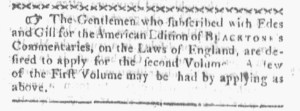
Boston-Gazette (June 29, 1772).

“The Gentlemen who subscribed … for the American Edition of BLACKSTONE’S Commentaries … are desired to apply for the second Volume.”

Benjamin Edes and John Gill, printers of the Boston-Gazette, inserted a brief notice at the bottom of the final column of the June 29, 1772, edition.  “The Gentlemen who subscribed with Edes and Gill for the American Edition of BLACKSTONE’S Commentaries on the Laws of England,” they announced, are desired to apply for the second Volume.”  In addition, “A few of the First Volume may be had by applying as above.”  Edes and Gill did not publish this “American Edition.”  Instead, they served as local agents for Robert Bell, a printer and bookseller based in Philadelphia.

Over the course of many months, Bell inserted subscription notices for an American edition of William Blackstone’s Commentaries on the Laws of England in newspapers from New England to South Carolina.  He also distributed handbills to promote the project.  Bell sought to cultivate an American literary market that supplied American readers with American editions instead of books imported from London.  In addition to Blackstone’s Commentaries, he advertised an American edition of David Hume’s History of England, from the Invasion of Julius Caesar to the Revolution in 1688.  Bell suggested that consumers had a civic obligation to purchase these volumes, addressing his subscription notices to “all those who are animated by the Wish of seeing Native Fabrications in AMERICA.”

Bell also stated that those who assisted him in this venture engaged in “peaceable, yet active Patriotism.”  In case that was not enough to recruit local agents like Edes and Gill in Boston, he also pledged that “All Persons who collect the Names and Residence, and deliver the Books to twelve Subscribers, have a Claim of Right, and are allowed fourteen to the Dozen for their Assiduity.”  In other words, local agents received two copies gratis for each dozen they sold to subscribers.  The copies of the first volume of Blackstone’s Commentaries that Edes and Gill offered for sale when they announced that subscribers could pick up the second volume may have been copies they received for gathering subscriptions in Boston.  Bell devised marketing strategies to entice both reader-consumers and local agents.