July 8

Who was the subject of an advertisement in a colonial American newspaper 250 years ago today?

Newport Mercury (July 8, 1772).

“STOP a MURDERER!”

Yesterday I examined instances of advertisements in the Connecticut Courant delivering news to readers.  Notices about burglaries and prisoners who escaped from jails kept communities informed about recent events in their area.  On occasion, advertisements that doubled as news items merited regional coverage through publication in newspapers in several cities and towns.  Such was the case with the “STOP a MURDERER!” advertisements that ran in several newspapers published in New England in June and July 1772.

Elijah Williams, sheriff of Berkshire County in Massachusetts, reported that James Hervey, “a transient person” was suspected of robbing and murdering James Farrel in Stockbridge.  Williams listed the items that Hervey stole and might wear or attempt to sell, including “one pair of large silver shoe-buckles, marked I.F.”  The sheriff also provided a description of Hervey, “about six feet high, about 24 years old, very meanly clothed, of a fair complexion, very light coloured hair, supposed to be an Englishman.”  Williams enlisted the aid of the public in apprehending Hervey, offering a reward to whoever captured him and delivered him to the jail in Berkshire County.

This notice appeared among the advertisements, rather than integrated with news items, in several newspapers, including the July 3 edition of the New-London Gazette, the July 4 edition of the Providence Gazette, and the July 6 edition of the Newport Mercury.  Only Thomas Green and Samuel Green, printers of the Connecticut Journal and New-Haven Post-Boy, gave the notice a privileged place that suggested they considered it news as well as an advertisement.  They inserted the notice as the first item in the first column on the first page.  In combination with the headline, that increased the likelihood that readers would take note.  European news that arrived via ships from London and Bristol appeared immediately below.  In contrast, advertisements of various sorts surrounded the “STOP a MURDERER!” advertisement in other publications.  Still, the headline likely drew attention, especially considering that colonizers were accustomed to active reading as they navigated the dense text that filled eighteenth-century newspapers.

July 7

What was advertised in a colonial American newspaper 250 years ago today?

Connecticut Courant (July 7, 1772).

“The County Goal in this Place was broke up.”

Ebenezer Watson, printer of the Connecticut Courant, typically placed news items on the first pages of his newspaper and advertisements on the final pages.  Not every colonial printer did so.  Some dispersed paid notices throughout their newspapers, even placing advertisements on the first page.  Watson sometimes included advertisements in the final column of the second page, as he did in the July 7, 1772, edition of the Connecticut Courant, before continuing with additional news items on the third page and devoting the final page to advertisements.  As a general rule, only news items ran on the first page and only paid notice and the “POETS CORNER” appeared on the last page.

That did not mean, however, that readers did not encounter news when they perused the last page.  Among the advertisements for consumer goods and services in the July 7 issue, for instance, one advertisement featured a prominent headline that advised the public to “Take Notice!”  It described three men who recently escaped from the county jail.  Ely Warner, the jailer, offered rewards for the capture and return of Elisha Wadsworth of Hartford, “confined for Debt,” Abraham Curtiss of Suffield, “committed for Debt,” and John Grant, “a transient Person, committed for Burglary.”  Another advertisement had a dramatic headline that alerted readers to a “BURGLARY!”  Benjamin Sedgwick of Canaan reported that his shop “was broke open” and several items stolen on June 26.  He offered a reward for apprehending the thief and the stolen merchandise.  In another advertisement, Lynde Lord alerted the public that “noted Burglarian John Brown, who was under Sentence of Death for House breaking,” escaped from the jail in Litchfield sometime during the night of June 14.  Readers could easily recognize him since previous punishments included cropping his ears and branding.

Several of the advertisements in the Connecticut Courant delivered news, much of it more immediately relevant to residents of central Connecticut than stories reprinted from London, Philadelphia, and Boston.  When they paid to insert notices, advertisers acquired limited responsibilities as editors and journalists who aided in keeping their communities informed about local events.

Slavery Advertisements Published July 7, 1772

The Slavery Adverts 250 Project chronicles the role of newspaper advertising in perpetuating slavery in the era of the American Revolution. The project seeks to reveal the ubiquity of slavery in eighteenth-century life from New England to Georgia by republishing advertisements about enslaved people – for sale as individuals or in groups, wanted to purchase or for hire for short periods, runaways who liberated themselves, and those who were subsequently captured and confined in jails and workhouses – in daily digests on this site as well as in real time via the @SlaveAdverts250 Twitter feed, utilizing twenty-first-century media to stand in for the print media of the eighteenth century.

The project aims to provide modern audiences with a sense of just how often colonizers encountered these advertisements in their daily lives. Enslaved men, women, and children appeared in print somewhere in the colonies almost every single day. Those advertisements served as a constant backdrop for social, cultural, economic, and political life in colonial and revolutionary America. Colonizers who did not purport to own enslaved people were still confronted with slavery as well as invited to maintain the system by purchasing enslaved men, women, and children or assisting in the capture of so-called “runaways” who sought to free themselves from bondage. The frequency of these newspaper advertisements suggests just how embedded slavery was in colonial and revolutionary American culture in everyday interactions beyond the printed page.

These advertisements also testify to the experiences of enslaved men, women, and children, though readers must consider that those experiences have been remediated through descriptions offered by enslavers rather than enslaved people themselves. Often unnamed in the advertisements, enslaved men, women, and children were not invisible or unimportant in early America.

These advertisements appeared in colonial American newspapers 250 years ago today.

Essex Gazette (July 7, 1772).

**********

Essex Gazette (July 7, 1772).

**********

South-Carolina Gazette and Country Journal (July 7, 1772).

**********

South-Carolina Gazette and Country Journal (July 7, 1772).

**********

South-Carolina Gazette and Country Journal (July 7, 1772).

**********

South-Carolina Gazette and Country Journal (July 7, 1772).

**********

South-Carolina Gazette and Country Journal (July 7, 1772).

**********

South-Carolina Gazette and Country Journal (July 7, 1772).

**********

South-Carolina Gazette and Country Journal (July 7, 1772).

**********

South-Carolina Gazette and Country Journal (July 7, 1772).

**********

South-Carolina Gazette and Country Journal (July 7, 1772).

**********

South-Carolina Gazette and Country Journal (July 7, 1772).

**********

South-Carolina Gazette and Country Journal (July 7, 1772).

**********

South-Carolina Gazette and Country Journal (July 7, 1772).

**********

Supplement to the South-Carolina Gazette and Country Journal (July 7, 1772).

**********

Supplement to the South-Carolina Gazette and Country Journal (July 7, 1772).

**********

Supplement to the South-Carolina Gazette and Country Journal (July 7, 1772).

**********

Supplement to the South-Carolina Gazette and Country Journal (July 7, 1772).

**********

Supplement to the South-Carolina Gazette and Country Journal (July 7, 1772).

**********

Supplement to the South-Carolina Gazette and Country Journal (July 7, 1772).

**********

Supplement to the South-Carolina Gazette and Country Journal (July 7, 1772).

**********

Supplement to the South-Carolina Gazette and Country Journal (July 7, 1772).

**********

Supplement to the South-Carolina Gazette and Country Journal (July 7, 1772).

**********

Supplement to the South-Carolina Gazette and Country Journal (July 7, 1772).

**********

Supplement to the South-Carolina Gazette and Country Journal (July 7, 1772).

**********

Supplement to the South-Carolina Gazette and Country Journal (July 7, 1772).

July 6

What was advertised in a colonial American newspaper 250 years ago today?

Boston Evening-Post (July 6, 1772).

“THE STAGE-COACH Between NEW-YORK and BOSTON.”

In the early 1770s, Jonathan Brown and Nicholas Brown placed advertisements seeking “encouragement” for stagecoach service they wished to establish between Boston and New York.  In addition to calling on the public to support them by traveling on their stagecoaches, the Browns sought investors “willing to become adventurers … in said undertaking.”  They outlined the various benefits of this service, including increasing commerce in the Connecticut as colonizers traveled through the province instead of bypassing it by sailing from New York to Providence and then continuing overland to Boston.

When summer arrived, the Browns launched the service on a trial basis.  They initially placed an advertisement in the June 25 edition of the New-York Journal to announce that the “STAGE COACH BETWEEN NEW-YORK AND BOSTON … for the first Time sets out this Day.”  In the following days, they placed additional advertisements in the Connecticut Courant, published in Hartford, and the Connecticut Journal, published in New Haven.  On July 6, their advertisement from the New-York Journal appeared in the Boston Evening-Post, alerting the public at that end of the line that the stagecoach paused in Hartford for a week and would arrive in Boston on July 11.  The Browns planned for the next trip to depart on July 11, so prospective passengers had nearly a week to make plans if they wished to travel at that time.  If demand warranted, the operators intended to “perform the Stage once a Week.”

The advertisement in the Boston Evening-Post included one element not included in the New-York Journal.  A woodcut depicting horses, a driver, and a stagecoach with a passenger visible inside appeared at the top of the advertisement.  That helped to draw attention to their notice by distinguishing it from others, especially since it was the only advertisement in that issue that incorporated an image (though Jolley Allen’s notice on the following page did feature his trademark border).

In hopes that their “Trial” would find sufficient “Encouragement” to establish a permanent route that ran once a week, the Browns placed advertisements in several newspapers along their route.  They did not, however, advertise as extensively as possible, perhaps due to budgetary constraints.  They could have flooded the market with advertising, placing notices in both newspapers printed in New York, all five in Boston, and even any in Philadelphia for prospective passengers who planned to travel north.  Perhaps they wished to assess the return on their investment for their initial round of advertising before expanding to additional publications.

Slavery Advertisements Published July 6, 1772

The Slavery Adverts 250 Project chronicles the role of newspaper advertising in perpetuating slavery in the era of the American Revolution. The project seeks to reveal the ubiquity of slavery in eighteenth-century life from New England to Georgia by republishing advertisements about enslaved people – for sale as individuals or in groups, wanted to purchase or for hire for short periods, runaways who liberated themselves, and those who were subsequently captured and confined in jails and workhouses – in daily digests on this site as well as in real time via the @SlaveAdverts250 Twitter feed, utilizing twenty-first-century media to stand in for the print media of the eighteenth century.

The project aims to provide modern audiences with a sense of just how often colonizers encountered these advertisements in their daily lives. Enslaved men, women, and children appeared in print somewhere in the colonies almost every single day. Those advertisements served as a constant backdrop for social, cultural, economic, and political life in colonial and revolutionary America. Colonizers who did not purport to own enslaved people were still confronted with slavery as well as invited to maintain the system by purchasing enslaved men, women, and children or assisting in the capture of so-called “runaways” who sought to free themselves from bondage. The frequency of these newspaper advertisements suggests just how embedded slavery was in colonial and revolutionary American culture in everyday interactions beyond the printed page.

These advertisements also testify to the experiences of enslaved men, women, and children, though readers must consider that those experiences have been remediated through descriptions offered by enslavers rather than enslaved people themselves. Often unnamed in the advertisements, enslaved men, women, and children were not invisible or unimportant in early America.

These advertisements appeared in colonial American newspapers 250 years ago today.

Boston Evening-Post (July 6, 1772).

**********

Boston-Gazette (July 6, 1772).

**********

New-York Gazette and Weekly Mercury (July 6, 1772).

**********

Supplement to the New-York Gazette and Weekly Mercury (July 6, 1772).

**********

Supplement to the New-York Gazette and Weekly Mercury (July 6, 1772).

**********

Pennsylvania Chronicle (July 6, 1772).

July 5

What was advertised in a colonial American newspaper 250 years ago this week?

Massachusetts Gazette and Boston Weekly News-Letter (July 2, 1772).

“M. ASBY, Millener from LONDON.”

In the summer of 1772, James Asby took to the pages of the Massachusetts Gazette and Boston Weekly News-Letter to inform the public that he imported a “compleat Assortment of Gold, Silver, Pinchbeck & Tortoishell WATCHES” and sold them at his shop “nearly opposite the British Coffee-House in King-street.”  He placed that notice in collaboration with M. Asby, a “Millener from LONDON” who advised “her Customers and other Ladies” that she “removed from the Corner of Cross-street to a Tenement in Capt. Joy’s Buildings in Quaker-Lane.”  James and M. did not disclose their relationship.  They might have been husband and wife operating businesses at different locations, but they might have been brother and sister, father and daughter, or mother and son.

Whatever their relationship, promoting the millinery shop accounted for two-thirds of the advertisement, an interesting contrast to most advertisements shared by male and female relations.  In most instances, women’s contributions to the family business or enterprises that they pursued on their own amounted to a brief sentence or two at the end of an advertisement, if they were mentioned at all.  In this case, however, M. described in some detail the “compleat Assortment of dress and undress Caps of the newest Fashions, Ribbons, Gauzes, silk Gloves and Mits, Ladies Patterns for Ruffels, and Handkerchiefs, and many other Articles in the Millenary Way” that she imported.  In addition, she declared that she made cloaks, hats, bonnets, and other garments “on the shortest Notice, and in the most fashionable Taste.”  By reiterating “newest Fashions” and “most Fashionable Taste,” she sought to reassure prospective customers that they could trust her to outfit them according to the latest styles.  Underscoring that she was an entrepreneur in her own right, M. concluded the advertisement with a note that “An Apprentice is wanted to the said Business.”

Even as James and M. invested in an advertisement together, she became the focal point of the notice.  Her name and occupation, “M. ASBY, Millener from LONDON,” appeared in larger font and centered, drawing attention.  In contrast, James’s name, though in all capitals, appeared in the same size font in the middle of a paragraph.  Only on closer examination would readers have discovered that the two placed the advertisement together.  At first glance, most readers likely assumed the advertisement concerned M. and her business alone.  Even though her name appeared second, she took the lead in the advertisement that James and M. shared.

July 4

Who was the subject of an advertisement in a colonial American newspaper 250 years ago today?

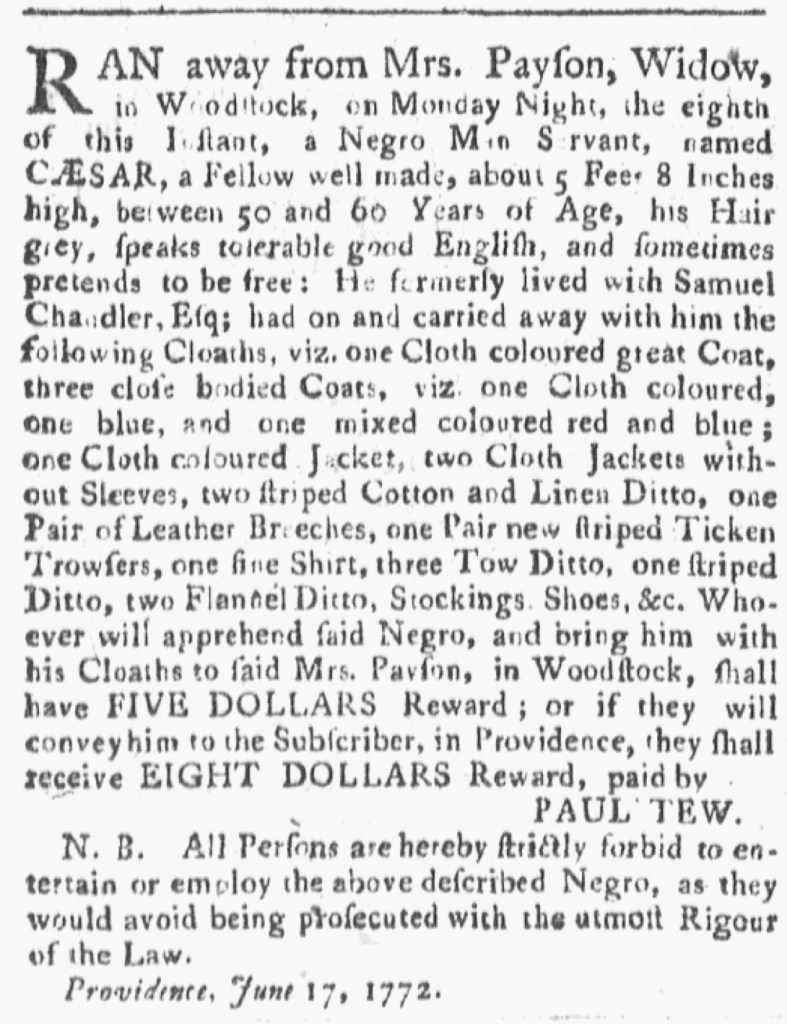
Providence Gazette (July 4, 1772).

“RAN away … a Negro Man Servant, named CAESAR … sometimes pretends to be free.”

On July 4, 1772, American colonizers did not know that on that day just four years later the Continental Congress would declare the independence of a new nation.  They did know that for the better part of a decade they experienced an increasingly turbulent relationship with Great Britain.  Following the empire’s victory in the Seven Years War and the expulsion of France from North America, the George III issued the Royal Proclamation of 1763.  In it, the king decreed colonizers were not to settle west of the Appalachians.  Instead, he reserved that territory for the crown’s new Indian subjects.  Colonizers felt betrayed.  They fought and died to gain access to that land, but the king chose favor the Indians who allied with the French.  After the war, Parliament sought to regulate trade more systematically, imposing first the Stamp Act in 1765 and the Townshend Acts a few years later.  Colonizers responded with protests of various sorts, including boycotts of imported goods.  In addition, Britain quartered troops in American cities.  On March 5, 1770, some of those troops fired into a crowd in Boston, killing several people.  Colonizers continued to protest, sometimes resorting to violence.  On June 9, colonizers in Rhode Island boarded and burned the Gaspee, a British customs schooner, when it ran aground in Narragansett Bay.

Throughout this period, colonizers discussed their rights and demanded their freedom.  They did so in the town square, in taverns, in coffeehouses, in newspapers, and in petitions.  Simultaneously, enslaved people liberated themselves throughout the era of the American Revolution.  Black men and women “RAN away” from their enslavers rather than endure bondage.  Caesar, “a Negro Man Servant” enslaved by “Mrs. Payson, Widow,” in Woodstock, Connecticut, liberated himself in June 1772.  He “RAN away” at the same time that word spread about colonizers striking a blow against Britain by burning the Gaspee.  The Providence Gazette carried Caesar’s story, at least a truncated version of it as written by enslavers and their accomplices, in an advertisement that ran for several weeks, including on July 4.  That notice described Caesar, “a Fellow well made, about 5 Feet 8 Inches high, between 50 and 60 Years of Age, his Hair grey, speaks tolerable good English,” and offered a reward for his capture and return.  In so doing, the advertisers encouraged colonizers to participate in the surveillance of Black men they encountered to determine if any of them matched the description in the newspaper.  They also threatened legal penalties for anyone who assisted Caesar, warning that “All Persons are hereby strictly forbid to entertain or employ the above described Negro, as they would avoid being prosecuted with the utmost Rigour of the Law.”

The advertisement also mentioned that Caesar “sometimes pretends to be free.”  As colonizers proclaimed that they deserved freedom from British oppression and participated in protests of various sorts, Caesar determined that he was done pretending.  He did not need a Declaration of Independence to assert his freedom.  Instead, he declared independence by refusing to remain enslaved in Woodstock.  He was one of countless enslaved men, women, and children who liberated themselves in the eighteenth century.

For other stories of enslaved people liberating themselves originally published on July 4 during the era of the American Revolution, see:

Slavery Advertisements Published July 4, 1772

The Slavery Adverts 250 Project chronicles the role of newspaper advertising in perpetuating slavery in the era of the American Revolution. The project seeks to reveal the ubiquity of slavery in eighteenth-century life from New England to Georgia by republishing advertisements about enslaved people – for sale as individuals or in groups, wanted to purchase or for hire for short periods, runaways who liberated themselves, and those who were subsequently captured and confined in jails and workhouses – in daily digests on this site as well as in real time via the @SlaveAdverts250 Twitter feed, utilizing twenty-first-century media to stand in for the print media of the eighteenth century.

The project aims to provide modern audiences with a sense of just how often colonizers encountered these advertisements in their daily lives. Enslaved men, women, and children appeared in print somewhere in the colonies almost every single day. Those advertisements served as a constant backdrop for social, cultural, economic, and political life in colonial and revolutionary America. Colonizers who did not purport to own enslaved people were still confronted with slavery as well as invited to maintain the system by purchasing enslaved men, women, and children or assisting in the capture of so-called “runaways” who sought to free themselves from bondage. The frequency of these newspaper advertisements suggests just how embedded slavery was in colonial and revolutionary American culture in everyday interactions beyond the printed page.

These advertisements also testify to the experiences of enslaved men, women, and children, though readers must consider that those experiences have been remediated through descriptions offered by enslavers rather than enslaved people themselves. Often unnamed in the advertisements, enslaved men, women, and children were not invisible or unimportant in early America.

These advertisements appeared in colonial American newspapers 250 years ago today.

Providence Gazette (July 4, 1772).

**********

Providence Gazette (July 4, 1772).

July 3

What was advertised in a colonial American newspaper 250 years ago today?

New-Hampshire Gazette (July 3, 1772).

The Printers will not Promise to exchange after the first of August next.”

Daniel Fowle and Robert Fowle, printers of the New-Hampshire Gazette, gave one of their advertisements a privileged place in the July 3, 1772, edition of their newspaper.  They positioned their notice about “Compleat Sets of the new and correct Law-Book, for the Province of New-Hampshire” at the top of the first full column of advertising, increasing the likelihood that readers would take note of it as they finished the news items even if they only quickly glanced at the advertisements.

To encourage sales of the new edition, the Fowles offered a deal to customers who owned copies of the previous edition.  They stated that they “will take the old ones of such Persons, as were subscribers for that Edition, and allow them one Dollar for the same.”  In other words, those customers received a discount when they traded in the outdated edition.  To convince customers that this was a good deal, the Fowles proclaimed that the previous edition was “not worth a Farthing” now that they published a “new and correct” edition, so customers might as well take advantage of their generosity in allowing “one Dollar” for it.

The Fowles also attempted to create a sense of urgency by making clear that this was a limited time offer.  They asserted that customers who wished to return the previous edition must “purchase a new Book now.”  They warned that “the Printers will not Promise to exchange after the first of August next.”  Customers had only four weeks to contemplate this offer before the Fowles potentially rescinded it.  In addition, the printers had “but few to dispose of in this Way,” or so they claimed.  That meant that interested readers needed to make the exchange while supplies lasted.

The Fowles deployed several savvy marketing strategies when they published a new and updated edition of the laws of the colony.  They offered discounts to former customers who traded in the old edition, simultaneously pressuring them to purchase the new volume soon by cautioning that they had limited supply and the offer expired soon.  Prospective customers needed to act quickly or risk missing out!

Slavery Advertisements Published July 3, 1772

The Slavery Adverts 250 Project chronicles the role of newspaper advertising in perpetuating slavery in the era of the American Revolution. The project seeks to reveal the ubiquity of slavery in eighteenth-century life from New England to Georgia by republishing advertisements about enslaved people – for sale as individuals or in groups, wanted to purchase or for hire for short periods, runaways who liberated themselves, and those who were subsequently captured and confined in jails and workhouses – in daily digests on this site as well as in real time via the @SlaveAdverts250 Twitter feed, utilizing twenty-first-century media to stand in for the print media of the eighteenth century.

The project aims to provide modern audiences with a sense of just how often colonizers encountered these advertisements in their daily lives. Enslaved men, women, and children appeared in print somewhere in the colonies almost every single day. Those advertisements served as a constant backdrop for social, cultural, economic, and political life in colonial and revolutionary America. Colonizers who did not purport to own enslaved people were still confronted with slavery as well as invited to maintain the system by purchasing enslaved men, women, and children or assisting in the capture of so-called “runaways” who sought to free themselves from bondage. The frequency of these newspaper advertisements suggests just how embedded slavery was in colonial and revolutionary American culture in everyday interactions beyond the printed page.

These advertisements also testify to the experiences of enslaved men, women, and children, though readers must consider that those experiences have been remediated through descriptions offered by enslavers rather than enslaved people themselves. Often unnamed in the advertisements, enslaved men, women, and children were not invisible or unimportant in early America.

These advertisements appeared in colonial American newspapers 250 years ago today.

New-Hampshire Gazette (July 3, 1772).

**********

New-Hampshire Gazette (July 3, 1772).

**********

New-London Gazette (July 3, 1772).