August 25

What was advertised in a colonial American newspaper 250 years ago today?

Connecticut Courant (August 25, 1772).

“WINES.”

William Ellery stocked a variety of wares, but emphasized “WINES” in his advertisement in the August 25, 1772, edition of the Connecticut Courant.  Many purveyors of goods and services used their names as the sole or primary headline in their newspaper advertisements, but Ellery opted to open his advertisement with a segment of his merchandise that he thought would attract attention.  The headline, “WINES,” appeared in a large font, followed by a list of “CHOICE Old Madeira, Claret, Teneriff and Mountain, Malaga WINES.”  Only after that preview did Ellery give his name and location as a secondary headline before providing a more extensive account of beer, spirits, and groceries.  In contrast, an advertisement in the next column featured a more familiar headline, “Imported from LONDON, and to be sold by Stephen Mears, Opposite the North Meeting House in Hartford,” with “Stephen Mears” centered and in a larger font.

Ellery used graphic design to his advantage elsewhere in his advertisement as well.  The “N.B.” that marked the nota bene that followed his list of merchandise appeared in an even larger font than “WINES,” as did the “M” in “MR. ELLERY.”  Even if readers skimmed over “Bristol Beer, and Dorchester Ale, by the Cask, or Dozen Bottles” and “Coffee by the Bag or single Pound,” the large letters guided them to a message from the merchant.  He expressed “his Thanks to those People who have heretofore favour’d him with their Custom” and invited them to continue to “favour him with their Custom.”  Ellery deployed two of the most popular marketing appeals of the period, choice and price, proclaiming that he “his Shop is fuller sorted than ever, as he has just received a large Supply of the above Articles, and flatters himself he cans sell so low as to give intire satisfaction” to his customers.  In contrast, other advertisers tended to position such notes below the headline and above the list of goods.  Once again, Ellery adopted a format that distinguished his advertisement from others.

Ellery’s notice consisted entirely of text, as did all of the advertisements in most issues of the Connecticut Courant.  That did not mean, however, that every advertisement looked the same.  Some advertisers did rely on standard formats, but others sought to engage readers by presenting familiar messages in less familiar formats.  The design of Ellery’s advertisement challenged prospective customers to look more closely at his merchandise and the assertions he made about low prices and extensive choices.

Slavery Advertisements Published August 25, 1772

The Slavery Adverts 250 Project chronicles the role of newspaper advertising in perpetuating slavery in the era of the American Revolution. The project seeks to reveal the ubiquity of slavery in eighteenth-century life from New England to Georgia by republishing advertisements about enslaved people – for sale as individuals or in groups, wanted to purchase or for hire for short periods, runaways who liberated themselves, and those who were subsequently captured and confined in jails and workhouses – in daily digests on this site as well as in real time via the @SlaveAdverts250 Twitter feed, utilizing twenty-first-century media to stand in for the print media of the eighteenth century.

The project aims to provide modern audiences with a sense of just how often colonizers encountered these advertisements in their daily lives. Enslaved men, women, and children appeared in print somewhere in the colonies almost every single day. Those advertisements served as a constant backdrop for social, cultural, economic, and political life in colonial and revolutionary America. Colonizers who did not purport to own enslaved people were still confronted with slavery as well as invited to maintain the system by purchasing enslaved men, women, and children or assisting in the capture of so-called “runaways” who sought to free themselves from bondage. The frequency of these newspaper advertisements suggests just how embedded slavery was in colonial and revolutionary American culture in everyday interactions beyond the printed page.

These advertisements also testify to the experiences of enslaved men, women, and children, though readers must consider that those experiences have been remediated through descriptions offered by enslavers rather than enslaved people themselves. Often unnamed in the advertisements, enslaved men, women, and children were not invisible or unimportant in early America.

These advertisements appeared in colonial American newspapers 250 years ago today.

Essex Gazette (August 25, 1772).

**********

South-Carolina Gazette and Country Journal (August 25, 1772).

**********

South-Carolina Gazette and Country Journal (August 25, 1772).

**********

South-Carolina Gazette and Country Journal (August 25, 1772).

**********

South-Carolina Gazette and Country Journal (August 25, 1772).

**********

South-Carolina Gazette and Country Journal (August 25, 1772).

**********

South-Carolina Gazette and Country Journal (August 25, 1772).

**********

South-Carolina Gazette and Country Journal (August 25, 1772).

**********

South-Carolina Gazette and Country Journal (August 25, 1772).

**********

South-Carolina Gazette and Country Journal (August 25, 1772).

**********

South-Carolina Gazette and Country Journal (August 25, 1772).

**********

South-Carolina Gazette and Country Journal (August 25, 1772).

**********

South-Carolina Gazette and Country Journal (August 25, 1772).

**********

South-Carolina Gazette and Country Journal (August 25, 1772).

**********

South-Carolina Gazette and Country Journal (August 25, 1772).

August 24

What was advertised in a colonial American newspaper 250 years ago today?

Boston Evening-Post (August 24, 1772).

“At the Sign of the STAGE COACH and FOUR on the one Side, and MAN and HORSE on the other.”

Shop signs identified a variety of businesses in colonial Boston.  Thomas Fleet and John Fleet, printers of the Boston Evening-Post, operated their printing office at the Sign of the Heart and Crown, a symbol so synonymous with their business that in an advertisement in the August 24, 1772, edition they advised readers of “Paper, To be Sold at the Heart& Crown” without giving any other details about the location.

In the same issue, Edward Wentworth, Jr., included two shop signs in his advertisement for a “Variety Shop” where he sold “All Sorts of West-India Goods, and many other Articles in the Grocery Way.”  He indicated that customers could find the shop “at the Sign of the STAGE COACH and FOUR on the one Side, and MAN and HORSE on the other,” perhaps appropriating signs that marked other businesses in directing customers to the “Variety Shop.”  The remainder of the advertisement suggests that Wentworth ran one or both of those other businesses as well.  He offered “Victualling, Lodging & Boarding for Gentlemen and good Keeping for Horses” as well as “Horses and Carriages to Let.”  The “Variety Shop” may have been a new venture, one that did not yet merit its own sign since others already marked its location.

Wentworth may have been quite content to stick with signs already familiar to residents of the South End, images they associated with his reputation, rather than hanging yet another sign, especially if he was uncertain how long he might run a “Variety Shop” in addition to a tavern.  After all, the devices on shop signs did not always directly correspond to the goods and services available in the shops they marked.  Residents of Boston knew that the Sign of the Heart and Crown adorned a printing office through experience, not because the image replicated the work undertaken there.  The Sign of the Stage Coach and Four and the Sign of the Man and Horse did correlate with “Victualling, Lodging & Boarding for Gentlemen and good Keeping for Horses,” but that did not preclude Wentworth from associating those images with other enterprises.   Rather than literal representations of the businesses they marked, shop signs often served as symbols meant to resonate with much more meaning.  They represented colonial entrepreneurs, their skills and reputations, not just the work they performed.

Slavery Advertisements Published August 24, 1772

The Slavery Adverts 250 Project chronicles the role of newspaper advertising in perpetuating slavery in the era of the American Revolution. The project seeks to reveal the ubiquity of slavery in eighteenth-century life from New England to Georgia by republishing advertisements about enslaved people – for sale as individuals or in groups, wanted to purchase or for hire for short periods, runaways who liberated themselves, and those who were subsequently captured and confined in jails and workhouses – in daily digests on this site as well as in real time via the @SlaveAdverts250 Twitter feed, utilizing twenty-first-century media to stand in for the print media of the eighteenth century.

The project aims to provide modern audiences with a sense of just how often colonizers encountered these advertisements in their daily lives. Enslaved men, women, and children appeared in print somewhere in the colonies almost every single day. Those advertisements served as a constant backdrop for social, cultural, economic, and political life in colonial and revolutionary America. Colonizers who did not purport to own enslaved people were still confronted with slavery as well as invited to maintain the system by purchasing enslaved men, women, and children or assisting in the capture of so-called “runaways” who sought to free themselves from bondage. The frequency of these newspaper advertisements suggests just how embedded slavery was in colonial and revolutionary American culture in everyday interactions beyond the printed page.

These advertisements also testify to the experiences of enslaved men, women, and children, though readers must consider that those experiences have been remediated through descriptions offered by enslavers rather than enslaved people themselves. Often unnamed in the advertisements, enslaved men, women, and children were not invisible or unimportant in early America.

These advertisements appeared in colonial American newspapers 250 years ago today.

Boston-Gazette (August 24, 1772).

**********

Newport Mercury (August 24, 1772).

**********

Newport Mercury (August 24, 1772).

**********

Newport Mercury (August 24, 1772).

**********

New-York Gazette and Weekly Mercury (August 24, 1772).

**********

Supplement to the New-York Gazette and Weekly Mercury (August 24, 1772).

**********

Supplement to the New-York Gazette and Weekly Mercury (August 24, 1772).

**********

Supplement to the New-York Gazette and Weekly Mercury (August 24, 1772).

**********

Supplement to the New-York Gazette and Weekly Mercury (August 24, 1772).

**********

Supplement to the New-York Gazette and Weekly Mercury (August 24, 1772).

**********

Supplement to the New-York Gazette and Weekly Mercury (August 24, 1772).

**********

Supplement to the New-York Gazette and Weekly Mercury (August 24, 1772).

**********

Supplement to the New-York Gazette and Weekly Mercury (August 24, 1772).

**********

Supplement to the Pennsylvania Packet (August 24, 1772).

August 23

What was advertised in a colonial American newspaper 250 years ago this week?

Maryland Gazette (August 20, 1772).

“Black Velvet Collars, which are now worn instead of Necklaces, with Danglers.”

In the summer of 1772, M. Evans ran advertisements in the Maryland Gazette to announce to “the Ladies in Annapolis, and the Publick in general” that she stocked a variety of millinery and other items at her shop in Baltimore.  Her merchandise “Lately arrived from London.”  That being the case, she made clear to prospective customers that she carried current styles from the cosmopolitan center of the empire.  Her inventory included “the fashionable Net and Gauze Bonnets” and “fashionable Stomachers and Sleeve-knots with Italian Flowers.”  In addition, Evans listed many other items, including “Hats and long Cloaks in the French gray Queen’s Silk,” “Bonnets and Tippets” for young ladies, and a variety of combs, pins, earrings, and “Danglers.”  She concluded with “&c. &c. &c.” to indicate that she stocked much more than would fit in a newspaper advertisement.

In marketing her wares, Evans presented herself as a guide for prospective customers, not merely a shopkeeper.  She was in a position to offer advice and suggestions as well as keep her clients apprised of the latest fashions.  For instance, she included “black Velvet Collars … with Danglers” among her catalog of merchandise, explaining that they “are now worn instead of Necklaces.”  Some of the “Ladies in Annapolis” may have already been aware of this trend, but Evans apparently believed that many were not yet familiar with it.  Acting as a guide helped incite demand, tantalizing prospective customers with news of the latest styles while simultaneously encouraging them to acquire those styles for themselves.  Shopkeepers, milliners, and others who sold clothing and accessories were in a position to exert considerable influence over the customers they served, provided that those customers considered them well-informed and trustworthy.  Evans aimed to cultivate such relationships, marketing her knowledge of current fashions in her efforts to sell goods imported from London.  Her familiarity with new styles and ability to provide guidance to her customers made her more than a mere purveyor of goods.

August 22

What was advertised in a colonial American newspaper 250 years ago today?

Pennsylvania Chronicle (August 22, 1772).

“The APPENDIX is not in the London Edition.”

Henry Miller, printer of the Wöchentliche Pennsylvanische Staatsbote, published and advertised an American edition of A Complete German Grammar by John James Bachmair in 1772.  German-speaking colonizers constituted a significant portion of Pennsylvania’s population, prompting Miller, himself born in the principality of Waldeck on the Upper Rhine, to believe a local market existed for this book.  He informed prospective customers that he charged nine shillings for his edition, compared to fourteen shillings for the London edition.

In addition to declaring that he published the third edition, “greatly altered and improved,” Miller also promoted an Appendix that included “An Index of German Words similar in Sound, but of different Orthography and Signification,” “Names of the most common Occupations and Trades, as also the Names of the Materials and Implements, &c. thereto belonging,” and an “Explication of a German Proverb.”  In a nota bene, Miller underscored that all of those items were bonus materials not included in the London edition.  In addition to the lower price, the useful and entertaining supplemental materials likely made Miller’s American edition seem like an even better choice for colonizers interested in learning German.

Miller also deployed a blurb from the first edition in his efforts to market the book.  He quoted from the preface to the first edition, highlighting Bachmair’s assertion that “those who have a Mind to learn fundamentally the German Language, will find such plain and easy Instructions, that, even without a Master, they may at least attain to read and understand it.”  The blurb simultaneously offered encouragement and set expectations.  With some diligence, those who studied from the book could learn to read and understand German, even if they did not become fluent enough to speak and write the language.  They could achieve that level of proficiency studying on their own rather than working with tutors or schoolmasters.

Miller incorporated a variety of marketing strategies into advertisements for his American edition of Bachmair’s German Grammar.  He hawked supplementary materials that did not appear in the more expensive London edition, while also including a blurb in which the author gave encouragement and promised “plain and easy Instructions.”  In describing the contents of the appendix and inserting the blurb, Miller sought to help prospective customers imagine themselves learning German with greater ease than they previously anticipated.

Slavery Advertisements Published August 22, 1772

The Slavery Adverts 250 Project chronicles the role of newspaper advertising in perpetuating slavery in the era of the American Revolution. The project seeks to reveal the ubiquity of slavery in eighteenth-century life from New England to Georgia by republishing advertisements about enslaved people – for sale as individuals or in groups, wanted to purchase or for hire for short periods, runaways who liberated themselves, and those who were subsequently captured and confined in jails and workhouses – in daily digests on this site as well as in real time via the @SlaveAdverts250 Twitter feed, utilizing twenty-first-century media to stand in for the print media of the eighteenth century.

The project aims to provide modern audiences with a sense of just how often colonizers encountered these advertisements in their daily lives. Enslaved men, women, and children appeared in print somewhere in the colonies almost every single day. Those advertisements served as a constant backdrop for social, cultural, economic, and political life in colonial and revolutionary America. Colonizers who did not purport to own enslaved people were still confronted with slavery as well as invited to maintain the system by purchasing enslaved men, women, and children or assisting in the capture of so-called “runaways” who sought to free themselves from bondage. The frequency of these newspaper advertisements suggests just how embedded slavery was in colonial and revolutionary American culture in everyday interactions beyond the printed page.

These advertisements also testify to the experiences of enslaved men, women, and children, though readers must consider that those experiences have been remediated through descriptions offered by enslavers rather than enslaved people themselves. Often unnamed in the advertisements, enslaved men, women, and children were not invisible or unimportant in early America.

These advertisements appeared in colonial American newspapers 250 years ago today.

Pennsylvania Chronicle (August 22, 1772).

August 21

What was advertised in a colonial American newspaper 250 years ago today?

New-Hampshire Gazette (August 21, 1772).

“PROPOSED to Print by SUBSCRIPTION.”

In the summer of 1772, Daniel Fowle and Robert Fowle, printers of the New-Hampshire Gazette, distributed a proposal for printing “A rational Interpretation of the prophetic Visions of St. John … By SAMUEL LANGDON, D.D. Pastor of the first Church in Portsmouth.”  Before taking the work to press, they first sought subscribers who pledged in advance that they would purchase it.  Printing by subscription was a common business model in eighteenth-century America. Subscription proposals allowed printers to encourage interest in their projects and assess demand before investing time, materials, and other resources in ventures unlikely to succeed.  The Fowles claimed that they considered publishing Langdon’s “Series of expository Discourses … at the earnest Request of many Gentlemen acquainted with it,” suggesting that some demand already existed.  Savvy consumers, however, may have suspected that claim was merely a ploy to get them to jump on the bandwagon.  Regardless of how many “Gentlemen” already subscribed, the Fowles declared that they would not move forward with the project unless “proper Encouragement is given by a full Subscription.”  Furthermore, “No more will be printed than what are engaged by Subscribers.”  The printers attempted to create a sense of urgency around subscribing to what they portrayed as a popular project as soon as possible or miss out on having their names printed among the list of subscribers.

Production of the book, on the other hand, would take quite a bit of time.  Rather than take the entire volume to press, the Fowles proposed a serial publication that would “come out in month Numbers, containing about 32 Octavo Pages, on good Paper and a new Type.”  Subscribers paid only when they received new installments of the series.  The Fowles estimated that it would take about two years to publish the entire work, “each Year making a Volume of about 380 Pages.”  They promised that the “Numbers will be duely sent, free of Charge, to all the principal Towns where Subscriptions are taken in.”  They listed nearly a dozen local agents in towns in New Hampshire, Massachusetts, Rhode Island, Connecticut, New York, and Philadelphia, stating that they sent subscription papers to them.  In addition, the Fowles explained that each number would be “advertised in the publick Prints as soon as publish’d.”  Those who resided “at too great a distance to receive the Numbers seasonably” could instead choose “to subscribe for the whole in Volumes, stitched or bound,” as long as they “specify their Desire, in the Subscription.”  The Fowles asserted that they would send each annual volume “as soon as published.”  They did not, however, indicate how often such subscribers were expected to submit payment.  Overall, they outlined a complicated system of distributing and collecting subscription proposals as well as distributing serialized “numbers” and collecting payments each month.  The logistics may have been too complicated.  It does not appear that they printed and distributed the first “number” in November 1772 as intended.  They did publish a pamphlet by Langdon, “A Rational Explication of St. John’s Vision of the Two Beasts,” thirty-two pages on octavo paper, in 1774.  They may have published other essays by Langdon separately as well, but not the entire project as originally envisioned and presented to prospective subscribers.  If few subscribers responded to their proposals, that likely played a significant role in their decision not to pursue the project.

August 20

What was advertised in a colonial American newspaper 250 years ago today?

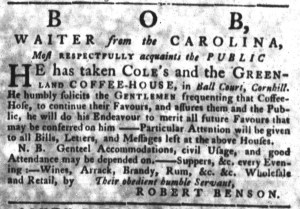
Supplement to the South-Carolina Gazette (August 20, 1772).

“He makes American Punch in Perfection.”

When Robert Benson became the new proprietor of “COLE’S and the GREENLAND COFFEE-HOUSE, in Ball Court, Cornhill,” in London, he placed advertisements in newspapers in South Carolina.  Having formerly worked as a waiter at the Carolina Coffee House, he likely hoped that some merchants who had conducted business there would remember him fondly enough to visit his new establishment when they next traveled to London as well as entrust him to receive “Bills, Letters, and Messages” directed to local associates.  He opened his first advertisement with a headline introducing himself as “BOB, WAITER from the CAROLINA,” but concluded it more formally as his prospective customers’ “obedient humble Servant, ROBERT BENSON.”  In a subsequent advertisement, he dispensed with giving his full name, opting instead to solely use the more familiar “BOB, WAITER from the CAROLINA and PENNSYLVANIA COFFEE-HOUSE, in Birchin Lane.”

South-Carolina Gazette and Country Journal (August 18, 1772).

Benson made other changes when he published a second advertisement in newspapers in Charleston.  In particular, he declared that “for the Accommodation of American Gentlemen, the South-Carolina, Georgia, and Pennsylvania News-Papers, will be regularly taken in.”  Those newspapers featured a significant amount of news from Europe, especially London, that would have been more quickly and more readily available to visitors to the city, but they also carried digests of news from throughout the colonies, varying amounts of local news, prices current for a variety of commodities in Charleston, Savannah, and Philadelphia, and shipping news from the customs houses in those busy ports.  In addition, readers could glean a fair amount of news (and gossip) from reading the advertisements, including legal notices and advertisements intended to promote commerce and consumption (and notices cutting off credit for disobedient wives who “ran away” from their husbands).  Benson considered supplying American newspapers one of the services for his customers that demonstrated he “will exert his utmost Endeavours to merit their Favours.”  He also declared that he “has fitted up” his establishment “very elegantly.”  In addition to the newspapers, American merchants and other travelers would feel at home at Cole’s and the Greenland Coffee House because Benson “makes American Punch in Perfection.”  Even as colonial merchants took part in London’s cosmopolitan culture, Benson suspected they would welcome a taste of home.  He listed the “American Punch” last in his advertisement, one of several amenities that he hoped would make his coffeehouse an attractive destination.  His competitors relied on reputation and word of mouth to attract customers from Charleston and other towns in the colonies.  Benson, the affable “BOB,” on the other hand, believed that directly marketing his new venture in the colonies would contribute to its success.  He attempted to leverage his reputation while also promoting the amenities that made his coffeehouse a rival to any others in London.

Slavery Advertisements Published August 20, 1772

The Slavery Adverts 250 Project chronicles the role of newspaper advertising in perpetuating slavery in the era of the American Revolution. The project seeks to reveal the ubiquity of slavery in eighteenth-century life from New England to Georgia by republishing advertisements about enslaved people – for sale as individuals or in groups, wanted to purchase or for hire for short periods, runaways who liberated themselves, and those who were subsequently captured and confined in jails and workhouses – in daily digests on this site as well as in real time via the @SlaveAdverts250 Twitter feed, utilizing twenty-first-century media to stand in for the print media of the eighteenth century.

The project aims to provide modern audiences with a sense of just how often colonizers encountered these advertisements in their daily lives. Enslaved men, women, and children appeared in print somewhere in the colonies almost every single day. Those advertisements served as a constant backdrop for social, cultural, economic, and political life in colonial and revolutionary America. Colonizers who did not purport to own enslaved people were still confronted with slavery as well as invited to maintain the system by purchasing enslaved men, women, and children or assisting in the capture of so-called “runaways” who sought to free themselves from bondage. The frequency of these newspaper advertisements suggests just how embedded slavery was in colonial and revolutionary American culture in everyday interactions beyond the printed page.

These advertisements also testify to the experiences of enslaved men, women, and children, though readers must consider that those experiences have been remediated through descriptions offered by enslavers rather than enslaved people themselves. Often unnamed in the advertisements, enslaved men, women, and children were not invisible or unimportant in early America.

These advertisements appeared in colonial American newspapers 250 years ago today.

Maryland Gazette (August 20, 1772).

**********

Maryland Gazette (August 20, 1772).

**********

Maryland Gazette (August 20, 1772).

**********

Maryland Gazette (August 20, 1772).

**********

Massachusetts Gazette and Boston Weekly News-Letter (August 20, 1772).

**********

Massachusetts Spy (August 20, 1772).

**********

New-York Journal (August 20, 1772).

**********

New-York Journal (August 20, 1772).

**********

South-Carolina Gazette (August 20, 1772).

**********

South-Carolina Gazette (August 20, 1772).

**********

South-Carolina Gazette (August 20, 1772).

**********

South-Carolina Gazette (August 20, 1772).

**********

Supplement to the South-Carolina Gazette (August 20, 1772).

**********

Supplement to the South-Carolina Gazette (August 20, 1772).

**********

Supplement to the South-Carolina Gazette (August 20, 1772).

**********

Supplement to the South-Carolina Gazette (August 20, 1772).

**********

Supplement to the South-Carolina Gazette (August 20, 1772).

**********

Supplement to the South-Carolina Gazette (August 20, 1772).

**********

Supplement to the South-Carolina Gazette (August 20, 1772).

**********

Supplement to the South-Carolina Gazette (August 20, 1772).

**********

Supplement to the South-Carolina Gazette (August 20, 1772).

**********

Supplement to the South-Carolina Gazette (August 20, 1772).

**********

Supplement to the South-Carolina Gazette (August 20, 1772).

**********

Supplement to the South-Carolina Gazette (August 20, 1772).

**********

Virginia Gazette [Purdie and Dixon] (August 20, 1772).

**********

Virginia Gazette [Purdie and Dixon] (August 20, 1772).

**********

Virginia Gazette [Purdie and Dixon] (August 20, 1772).

**********

Virginia Gazette [Purdie and Dixon] (August 20, 1772).

**********

Virginia Gazette [Purdie and Dixon] (August 20, 1772).

**********

Virginia Gazette [Purdie and Dixon] (August 20, 1772).

**********

Virginia Gazette [Purdie and Dixon] (August 20, 1772).

**********

Virginia Gazette [Purdie and Dixon] (August 20, 1772).

**********

Virginia Gazette [Purdie and Dixon] (August 20, 1772).

**********

Virginia Gazette [Purdie and Dixon] (August 20, 1772).