August 19

What was advertised in a colonial American newspaper 250 years ago today?

Pennsylvania Gazette (August 19, 1772).

“The FULLING BUSINESS, in all its branches.”

Joseph Blackwood operated a fulling mill “on the north branch of Raccoon creek, in the county of Gloucester,” New Jersey, in the early 1770s.  In an effort to cultivate customers for this enterprise, he ran an advertisement in the August 19, 1772, edition of the Pennsylvania Gazette.  Blackwood confidently informed readers that he pursued “the FULLING BUSINESS, in all its branches, in as extensive a manner and at as cheap rates, as at any Mill in New-Jersey or Pennsylvania.”

To convince prospective customers that was the case, the fuller declared that he possessed “all necessary tools and conveniences” for processing any cloth delivered to him.  In addition, he was able to operate the mill throughout the year because it had been “so commodiously constructed, with all the works inclosed in a large stone house, in order to avoid being retarded in the winter season.”  Blackwood believed that the equipment combined with his skill and experience would result in customers “having their cloth dressed in the neatest and best manner, and with the greatest expedition.”  He promised quality as well as a quick turnaround on his services.  Blackwood also made it convenient for prospective customers to hire him by establishing a network of local agents in several towns in New Jersey.  Those associates collected “CLOTH for the Mill” and instructions.  The fuller visited each local agent once a week to collect cloth for new orders and deliver processed cloth.

Blackwood made a variety of appeals, yet he did not rely on advertising copy alone.  A woodcut depicting equipment at the fulling mill occupied nearly half the space he purchased in the Pennsylvania Gazette, making his advertisement the only one adorned with an image not supplied by the printers.  Throughout the remainder of the issue, only two other images appeared, the ornate shield with three balls, the crest of the Penn family, in the masthead and a vessel at sea, a stock image, in an advertisement for a ship departing for South Carolina.  The image of the equipment at the fulling mill likely caught the attention of readers, further enhancing an advertisement that incorporated a variety of marketing strategies.  The woodcut encouraged readers to learn about Blackwood’s low prices, speedy service, notable equipment, and network of local associates.  The image likely prompted some readers to examine the dense text in the fuller’s advertisement more closely than they would have without an image to engage their curiosity.

Slavery Advertisements Published August 19, 1772

The Slavery Adverts 250 Project chronicles the role of newspaper advertising in perpetuating slavery in the era of the American Revolution. The project seeks to reveal the ubiquity of slavery in eighteenth-century life from New England to Georgia by republishing advertisements about enslaved people – for sale as individuals or in groups, wanted to purchase or for hire for short periods, runaways who liberated themselves, and those who were subsequently captured and confined in jails and workhouses – in daily digests on this site as well as in real time via the @SlaveAdverts250 Twitter feed, utilizing twenty-first-century media to stand in for the print media of the eighteenth century.

The project aims to provide modern audiences with a sense of just how often colonizers encountered these advertisements in their daily lives. Enslaved men, women, and children appeared in print somewhere in the colonies almost every single day. Those advertisements served as a constant backdrop for social, cultural, economic, and political life in colonial and revolutionary America. Colonizers who did not purport to own enslaved people were still confronted with slavery as well as invited to maintain the system by purchasing enslaved men, women, and children or assisting in the capture of so-called “runaways” who sought to free themselves from bondage. The frequency of these newspaper advertisements suggests just how embedded slavery was in colonial and revolutionary American culture in everyday interactions beyond the printed page.

These advertisements also testify to the experiences of enslaved men, women, and children, though readers must consider that those experiences have been remediated through descriptions offered by enslavers rather than enslaved people themselves. Often unnamed in the advertisements, enslaved men, women, and children were not invisible or unimportant in early America.

These advertisements appeared in colonial American newspapers 250 years ago today.

Pennsylvania Journal (August 19, 1772).

August 18

What was advertised in a colonial American newspaper 250 years ago today?

Essex Gazette (August 18, 1772).

“His utmost Abilities will be exerted to give Satisfaction to his Customers.”

In August 1772, George Deblois alerted readers of the Essex Gazette that he “has received, in the last Ships from LONDON, and has now for SALE … A Good and general Assortment of Hard-Ware and ENGLISH GOODS” at his shop in Salem.  The merchant boasted that he purchased this merchandise “in England on the best Terms.”  As a result, he “is enabled, and is determined to sell them, by Wholesale and Retail, at the very lowest Advance.”  Deblois hoped to hook “his Customers and others” with lots of choices and low prices.

He did not, however, catalog his inventory in an attempt to demonstrate the many choices he made available to consumers, a popular strategy among eighteenth-century advertisers.  Instead, he suggested that doing so “would be only tedious” because “his Assortment consists of a great Variety.”  Rather than publish a dense list of his wares, he encouraged prospective customers to visit his shop, browse his merchandise, and see for themselves that they would “find almost every Article usually enquired for, and on as low terms as can be purchased in the Province.”  He pledged that “those who please to call and look” at his imported goods would not be disappointed.  Deblois also emphasized customer service in his efforts to encourage colonizers into his shop, declaring that “His utmost Abilities will be exerted to give Satisfaction to his Customers, and to use them in such a Manner as to encourage them to call again, or to recommend any of their Friends.”  In addition, he added a nota bene to underscore that “Constant Attendance will be given, and the Favours of his Customers gratefully acknowledged.”

Many merchants and shopkeepers focused primarily on their merchandise when they advertised in colonial newspapers.  Deblois took a different approach, treating shopping as an experience to be enjoyed by consumers in Salem and nearby towns.  He invited colonizers to browse in his shop, encountering items they wanted or needed on their own instead of finding them in a list in the public prints.  That experience included customer service as well as the “Hard-Ware and ENGLISH GOODS” offered for sale.  Deblois seemed to understand that cultivating relationships with “his Customers and others” who had not yet visited his shop would likely yield subsequent sales over time.  Accordingly, he emphasized more than moving merchandise in his advertisement.

Slavery Advertisements Published August 18, 1772

The Slavery Adverts 250 Project chronicles the role of newspaper advertising in perpetuating slavery in the era of the American Revolution. The project seeks to reveal the ubiquity of slavery in eighteenth-century life from New England to Georgia by republishing advertisements about enslaved people – for sale as individuals or in groups, wanted to purchase or for hire for short periods, runaways who liberated themselves, and those who were subsequently captured and confined in jails and workhouses – in daily digests on this site as well as in real time via the @SlaveAdverts250 Twitter feed, utilizing twenty-first-century media to stand in for the print media of the eighteenth century.

The project aims to provide modern audiences with a sense of just how often colonizers encountered these advertisements in their daily lives. Enslaved men, women, and children appeared in print somewhere in the colonies almost every single day. Those advertisements served as a constant backdrop for social, cultural, economic, and political life in colonial and revolutionary America. Colonizers who did not purport to own enslaved people were still confronted with slavery as well as invited to maintain the system by purchasing enslaved men, women, and children or assisting in the capture of so-called “runaways” who sought to free themselves from bondage. The frequency of these newspaper advertisements suggests just how embedded slavery was in colonial and revolutionary American culture in everyday interactions beyond the printed page.

These advertisements also testify to the experiences of enslaved men, women, and children, though readers must consider that those experiences have been remediated through descriptions offered by enslavers rather than enslaved people themselves. Often unnamed in the advertisements, enslaved men, women, and children were not invisible or unimportant in early America.

These advertisements appeared in colonial American newspapers 250 years ago today.

Essex Gazette (August 18, 1772).

**********

South-Carolina Gazette and Country Journal (August 18, 1772).

**********

South-Carolina Gazette and Country Journal (August 18, 1772).

**********

South-Carolina Gazette and Country Journal (August 18, 1772).

**********

South-Carolina Gazette and Country Journal (August 18, 1772).

**********

South-Carolina Gazette and Country Journal (August 18, 1772).

**********

South-Carolina Gazette and Country Journal (August 18, 1772).

**********

Supplement to the South-Carolina Gazette and Country Journal (August 18, 1772).

**********

Supplement to the South-Carolina Gazette and Country Journal (August 18, 1772).

**********

Supplement to the South-Carolina Gazette and Country Journal (August 18, 1772).

**********

Supplement to the South-Carolina Gazette and Country Journal (August 18, 1772).

**********

Supplement to the South-Carolina Gazette and Country Journal (August 18, 1772).

**********

Supplement to the South-Carolina Gazette and Country Journal (August 18, 1772).

**********

Supplement to the South-Carolina Gazette and Country Journal (August 18, 1772).

**********

Supplement to the South-Carolina Gazette and Country Journal (August 18, 1772).

**********

Supplement to the South-Carolina Gazette and Country Journal (August 18, 1772).

**********

Supplement to the South-Carolina Gazette and Country Journal (August 18, 1772).

**********

Supplement to the South-Carolina Gazette and Country Journal (August 18, 1772).

**********

Supplement to the South-Carolina Gazette and Country Journal (August 18, 1772).

**********

Supplement to the South-Carolina Gazette and Country Journal (August 18, 1772).

**********

Supplement to the South-Carolina Gazette and Country Journal (August 18, 1772).

August 17

Who was the subject of an advertisement in a colonial American newspaper 250 years ago today?

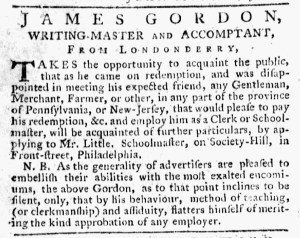
Pennsylvania Packet (August 17, 1772).

“He came on redemption, and was disappointed in meeting his expected friend.”

James Gordon found himself in an unanticipated situation when he migrated from Londonderry to Philadelphia in the summer of 1772.  The “WRITING-MASTER AND ACCOMPTANT” declared that he “came on redemption, and was disappointed in meeting his expected friend.”  In other words, he did not pay his passage in advance, nor did he sign an indenture and agree to work for a set number of years in exchange for transportation across the Atlantic.  Instead, Gordon became a redemptioner.  Compared to indentured servants who signed contracts that outlined their commitments in advance of departing European ports, redemptioners were “redeemed” by colonizers who paid their passage upon arrival.  Many redemptioners arranged in advance for family and friends to redeem them.  Others, however, sailed without knowing who might redeem them, sold into indentured servitude after crossing the Atlantic.  That system was especially popular with German-speaking migrants.  Newspapers published in Philadelphia ran the greatest numbers of advertisements offering redemptioners for sale.

Gordon apparently thought that a friend would redeem him when he arrived in Philadelphia, though the friend may not have been aware of that arrangement.  Whatever the circumstances, he placed an advertisement seeking a patron to redeem him by paying for his passage and hiring him “as a Clerk or Schoolmaster.”  Gordon expressed his willingness to work for “any Gentleman, Merchant, Farmer, or other, in any part of the province of Pennsylvania, or New-Jersey.”  If no one who wanted to hire him as a clerk or schoolmaster were to “pay his redemption,” he could be redeemed by someone who had him do other kinds of work that Gordon likely would have found much less agreeable.

To avoid that possibility, Gordon added a nota bene in which he attempted to promote the qualities that made him a good schoolmaster and clerk while simultaneously not scaring off prospective employers by overselling himself.  Perhaps most importantly, he wanted to impress them with his honesty.  “As the generality of advertisers are pleased to embellish their abilities with the most exalted encomiums,” he declared, “the above Gordon, as to that point inclines to be silent, only, that by his behaviour, method of teaching, (or clerkmanship) and assiduity, flatters himself of meriting the kind approbation of any employer.”  Gordon hoped that his advertisement would convince someone would hire him as a schoolmaster or clerk.  Otherwise, he faced the prospects of the owner or captain of the vessel that carried him across the ocean would allow others to “pay his redemption” and employ him as they saw fit.  Gordon may have thought that he had a deal in place when he left Londonderry, but redemption turned out to be a gamble for the writing master and clerk.

Slavery Advertisements Published August 17, 1772

The Slavery Adverts 250 Project chronicles the role of newspaper advertising in perpetuating slavery in the era of the American Revolution. The project seeks to reveal the ubiquity of slavery in eighteenth-century life from New England to Georgia by republishing advertisements about enslaved people – for sale as individuals or in groups, wanted to purchase or for hire for short periods, runaways who liberated themselves, and those who were subsequently captured and confined in jails and workhouses – in daily digests on this site as well as in real time via the @SlaveAdverts250 Twitter feed, utilizing twenty-first-century media to stand in for the print media of the eighteenth century.

The project aims to provide modern audiences with a sense of just how often colonizers encountered these advertisements in their daily lives. Enslaved men, women, and children appeared in print somewhere in the colonies almost every single day. Those advertisements served as a constant backdrop for social, cultural, economic, and political life in colonial and revolutionary America. Colonizers who did not purport to own enslaved people were still confronted with slavery as well as invited to maintain the system by purchasing enslaved men, women, and children or assisting in the capture of so-called “runaways” who sought to free themselves from bondage. The frequency of these newspaper advertisements suggests just how embedded slavery was in colonial and revolutionary American culture in everyday interactions beyond the printed page.

These advertisements also testify to the experiences of enslaved men, women, and children, though readers must consider that those experiences have been remediated through descriptions offered by enslavers rather than enslaved people themselves. Often unnamed in the advertisements, enslaved men, women, and children were not invisible or unimportant in early America.

These advertisements appeared in colonial American newspapers 250 years ago today.

Boston-Gazette (August 17, 1772).

**********

Boston-Gazette (August 17, 1772).

**********

Newport Mercury (August 17, 1772).

**********

Newport Mercury (August 17, 1772).

**********

New-York Gazette and Weekly Mercury (August 17, 1772).

**********

New-York Gazette and Weekly Mercury (August 17, 1772).

**********

New-York Gazette and Weekly Mercury (August 17, 1772).

**********

New-York Gazette and Weekly Mercury (August 17, 1772).

**********

New-York Gazette and Weekly Mercury (August 17, 1772).

**********

New-York Gazette and Weekly Mercury (August 17, 1772).

**********

Pennsylvania Packet (August 17, 1772).

August 16

What was advertised in a colonial American newspaper 250 years ago this week?

South-Carolina Gazette Extraordinary (August 10, 1772).

“The Public may be assured that THEIRS are the GENUINE.”

When Thomas Powell and Company published a midweek supplement, the South-Carolina Gazette Extraordinary on August 10, 1772, they proclaimed their intention to print both news and advertising as quickly as possible for the “ENTERTAINMENT” and “EMOLUMENT” of the public.  Headers identifying “New Advertisements” appeared on three of the four pages of the supplement.  Powell and Company placed one of their own advertisements immediately below one of those headers.

That advertisement continued a feud with Charles Crouch, printer of the South-Carolina Gazette and Country Journal, that the rivals pursued in advertisements in their newspapers throughout July.  Powell and Company temporarily ceased participating at the time that Edward Hughes, one of the partners, died on July 30, but launched a new volley a short time later.  Their desire to engage Crouch once again may have played a part in their decision to print a midweek supplement in early August.

The feud did not concern the printing trade or editorial policy.  Instead, Crouch and Powell and Company squabbled over how best to market a patent medicine for venereal disease and which of them carried an authentic remedy.  In a new advertisement in the midweek supplement, Powell and Company declared that they “lately received a Quantity of Dr. KEYSER’S GENUINE PILLS,” echoing the description most recently used by Crouch, “from Mr. James Rivington, Bookseller, in New-York, who is the ONLY Person that is appointed (by the Proprietor) for vending them in America.”  That being the case, Powell and Company implied that Crouch sold counterfeit pills.  “Therefore,” they proclaimed, “as the above T. POWELL, & Co. have always received the Pills sold by them from Mr. Rivington, the Public may be assured that THEIRS are the GENUINE.”

In a nota bene, Powell and Company referred readers to the third newspaper published in Charleston at the time, the South-Carolina and American General Gazette printed by Robert Wells.  “For a surprising Cure performed by the Pills sold by Mr. Rivington,” Powell and Company instructed, “see Mr. WELLS’s Gazette, of August 3, 1772.”  In what capacity did such an account appear in that newspaper?  Was it part of an advertisement?  If so, who placed it?  Was it a puff piece that masqueraded as a news item?  Did it direct readers to purchase the pills from a particular vender?  Did Wells also sell the pills while managing to avoid a confrontation with Powell and Company?  Or did Powell and Company intend for this advertisement to undermine both Crouch and Wells?  Unfortunately, only scattered issues of the South-Carolina and American General Gazette from 1772 survive.  Those issues have not been digitized for greater access.  The combination of those factors prevent exploring what role Wells and his newspaper played in this controversy over marketing and selling patent medicines in Charleston in the summer of 1772.

August 15

What was advertised in a colonial American newspaper 250 years ago today?

Providence Gazette (August 15, 1772).

“Such as are indebted to the Printer for advertising … are requested to discharge their Accounts.”

In the colophon that appeared at the bottom of the final page of each issue of the Providence Gazette, John Carter offered a variety of services, asserting that “all Manner of Printing-Work is performed with Care and Expedition” in his printing office and “Hand-Bills in particular done in a neat and correct Manner, at a very short Notice, and on reasonable Terms.”  Even as he attempted to generate new business, he inserted notices calling on customers to pay their bills.  Throughout the colonies, newspaper printers regularly placed such notices after extending credit to subscribers and other customers.  Some subscribers fell years behind on settling accounts, but they were not alone in failing to make payment to printers.

In a notice in the August 15, 1772, edition of the Providence Gazette, Carter declared that “THE Subscribers to this Gazette, who are one or more Years in Arrear, likewise such as are indebted to the Printer for advertising, or in any other Manner (particularly those who have been repeatedly called on) are requested to discharge their Accounts, that he may be enabled to pay his own Debts.”  This notice merits particular attention because Carter included advertising among the unpaid bills.  Similar notices usually addressed subscribers as well as customers who engaged other services, but they did not identify advertising as one of those services.  That suggests that printers did not allow credit for advertising, choosing instead to build their subscription lists via extensive credit while generating significant revenue from advertisers who paid in advance.  That was indeed the practice adopted by some colonial printers.  It was even Carter’s policy at one point.  In February 1771, the colophon for the Providence Gazette advised readers that “ADVERTISEMENTS of a moderate Length (accompanied with the Pay) are inserted in this Paper three Weeks for Four Shillings.”  That line subsequently disappeared from the colophon and Carter apparently accepted advertisements without “the Pay.”  Other printers experienced similar difficulties with overdue payments for advertising, including the printers of the Connecticut Courant, the Connecticut Journal, and the New-Hampshire Gazette.  Even if most printers did demand payment for advertisements before running them in their newspapers, that does not seem to have been a practice adopted universally in colonial America.

Slavery Advertisements Published August 15, 1772

The Slavery Adverts 250 Project chronicles the role of newspaper advertising in perpetuating slavery in the era of the American Revolution. The project seeks to reveal the ubiquity of slavery in eighteenth-century life from New England to Georgia by republishing advertisements about enslaved people – for sale as individuals or in groups, wanted to purchase or for hire for short periods, runaways who liberated themselves, and those who were subsequently captured and confined in jails and workhouses – in daily digests on this site as well as in real time via the @SlaveAdverts250 Twitter feed, utilizing twenty-first-century media to stand in for the print media of the eighteenth century.

The project aims to provide modern audiences with a sense of just how often colonizers encountered these advertisements in their daily lives. Enslaved men, women, and children appeared in print somewhere in the colonies almost every single day. Those advertisements served as a constant backdrop for social, cultural, economic, and political life in colonial and revolutionary America. Colonizers who did not purport to own enslaved people were still confronted with slavery as well as invited to maintain the system by purchasing enslaved men, women, and children or assisting in the capture of so-called “runaways” who sought to free themselves from bondage. The frequency of these newspaper advertisements suggests just how embedded slavery was in colonial and revolutionary American culture in everyday interactions beyond the printed page.

These advertisements also testify to the experiences of enslaved men, women, and children, though readers must consider that those experiences have been remediated through descriptions offered by enslavers rather than enslaved people themselves. Often unnamed in the advertisements, enslaved men, women, and children were not invisible or unimportant in early America.

These advertisements appeared in colonial American newspapers 250 years ago today.

Pennsylvania Chronicle (August 15, 1772).

**********

Pennsylvania Chronicle (August 15, 1772).

**********

Pennsylvania Chronicle (August 15, 1772).

August 14

What was advertised in a colonial American newspaper 250 years ago today?

New-Hampshire Gazette (August 14, 1772).

My purpose to Ride weekly, and carry the News Papers from Portsmouth … to Canterbury.”

Published in Portsmouth, the New-Hampshire Gazette served the entire colony as well as portions of Massachusetts (including the region that became Maine in 1820).  Daniel Fowle established the newspaper in October 1756.  In September 1764, he began a partnership with his nephew, Robert Fowle.  They faced little competition from other printers in the colony.  Thomas Furber and Ezekiel Russell briefly published the Portsmouth Mercury between 1765 and 1767 (with the last known issue dated September 29, 1766).  No other newspaper appeared in New Hampshire until after the American Revolution.  The short-lived Exeter Chronicle lasted about six months in 1784.  At about the same time it folded, Robert Gerrish commenced publishing the New-Hampshire Mercury in Portsmouth.  Other newspapers appeared in Exeter, Keene, and Portsmouth by the end of the decade.

Prior to the American Revolution, colonizers in New-Hampshire depended on the New-Hampshire Gazette for news and advertising.  Although the Fowles printed the newspaper, others assumed some of the responsibility for disseminating it to subscribers and other readers throughout the colony.  John Erving, for instance, rode a route that served ten towns between Portsmouth and Canterbury.  In the summer of 1772, he ran an advertisement to announce his plan “to Ride weekly, and carry the News Papers from Portsmouth through Greenland, Newmarket, Epping, Nottingham, Deerfield, Alenstown, Pembrook, Concord, Boscawen, and thence to Canterbury.”  He also offered to deliver the New-Hampshire Gazette to other towns along that route.

Riders like Erving helped make publishing the newspaper a viable venture for the Fowles.  Delivery services expanded the geographic reach of the newspaper as well as the number of prospective subscribers and advertisers.  That being the case, did the Fowles offer Erving any sort of discount on his advertisement or publish it free of charge?  They did not give it a privileged place in their newspaper.  In the August 14, 1772, edition, it appeared near the bottom of the last column on the third page.  In the same issue, the Fowles placed their own notice calling on “ALL Persons Indebted to the Printers of this Paper … to settle the same immediately” or face legal action at the top of the first column on the front page, making it the first item readers encountered under the masthead.  They could have chosen to place Erving’s advertisement immediately below their own notice on the front page or placed it at the beginning of the advertisements or at the top of a column on another page.  They could have incorporated larger font, as they did in advertisements that had “George Deblois,” “Forge Masters,” and “Mr. MORGAN” in significantly larger letters.  The placement and the format of Erving’s advertisement did little to distinguish it from other content in the New-Hampshire Gazette.  Even if the Fowles did extend some sort of discount to Erving, they did not otherwise aid him in marketing the delivery of the newspaper they published.

**********

The publication history of New Hampshire’s eighteenth-century newspapers comes from entries in Clarence S. Brigham’s History and Bibliography of American Newspapers, 1690-1820 and Edward Connery Lathem’s Chronological Tables of American Newspapers, 1690-1820.