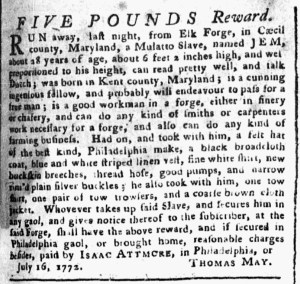
Slavery Advertisements Published August 3, 1772

The Slavery Adverts 250 Project chronicles the role of newspaper advertising in perpetuating slavery in the era of the American Revolution. The project seeks to reveal the ubiquity of slavery in eighteenth-century life from New England to Georgia by republishing advertisements about enslaved people – for sale as individuals or in groups, wanted to purchase or for hire for short periods, runaways who liberated themselves, and those who were subsequently captured and confined in jails and workhouses – in daily digests on this site as well as in real time via the @SlaveAdverts250 Twitter feed, utilizing twenty-first-century media to stand in for the print media of the eighteenth century.

The project aims to provide modern audiences with a sense of just how often colonizers encountered these advertisements in their daily lives. Enslaved men, women, and children appeared in print somewhere in the colonies almost every single day. Those advertisements served as a constant backdrop for social, cultural, economic, and political life in colonial and revolutionary America. Colonizers who did not purport to own enslaved people were still confronted with slavery as well as invited to maintain the system by purchasing enslaved men, women, and children or assisting in the capture of so-called “runaways” who sought to free themselves from bondage. The frequency of these newspaper advertisements suggests just how embedded slavery was in colonial and revolutionary American culture in everyday interactions beyond the printed page.

These advertisements also testify to the experiences of enslaved men, women, and children, though readers must consider that those experiences have been remediated through descriptions offered by enslavers rather than enslaved people themselves. Often unnamed in the advertisements, enslaved men, women, and children were not invisible or unimportant in early America.

These advertisements appeared in colonial American newspapers 250 years ago today.

Boston Evening-Post (August 3, 1772).

**********

Boston-Gazette (August 3, 1772).

**********

Newport Mercury (August 3, 1772).

**********

New-York Gazette and Weekly Mercury (August 3, 1772).

**********

New-York Gazette and Weekly Mercury (August 3, 1772).

**********

New-York Gazette and Weekly Mercury (August 3, 1772).

**********

New-York Gazette and Weekly Mercury (August 3, 1772).

**********

New-York Gazette and Weekly Mercury (August 3, 1772).

**********

New-York Gazette and Weekly Mercury (August 3, 1772).

**********

New-York Gazette and Weekly Mercury (August 3, 1772).

**********

New-York Gazette and Weekly Mercury (August 3, 1772).

**********

New-York Gazette and Weekly Mercury (August 3, 1772).

**********

New-York Gazette and Weekly Mercury (August 3, 1772).

**********

Pennsylvania Packet (August 3, 1772).

August 2

What was advertised in a colonial American newspaper 250 years ago this week?

New-York Journal (July 30, 1772).

“If any person will take the trouble to call upon me … I shall fully satisfy him of what I have here asserted.”

Among the many advertisements in the July 30, 1772, edition of the New-York Journal, one consisted entirely of a testimonial submitted to the printing office by Bartly Clarke.  He lauded a cure for “that terrible distemper the cancer” he experienced under the care of “that famous doctor Kemmena, now living in Maiden-Lane, in the city of New-York.”  Clarke explained that he had suffered with cancer “in my lip” for fifteen years.  He spent “a large sum of money” in seeking treatment from “several eminent physicians,” but none restored him to health.  Clarke sought out Kemmena upon the recommendation of “Capt. Charles Chadwick, of New-London, who was cured of the like distemper by him, almost three years ago.”

According to Clarke, Kemmena “effectually cured” him “in the space of four weeks, by the application of his famous plaster.”  During that time, Clare observed “three different persons cured of the cancer” by Kemmena.  He provided their names, enlisted them in bolstering his testimonial.  Daniel Davis, for instance, “had his whole under lip taken away, and in the space of a fortnight closed it up with sound flesh, so that it scarcely left a scar.”  Davis resided on Long Island, as did Nancy Curshow.  The third patient, Captain Rite, hailed from Bermuda, making it difficult for readers to consult any of the “three different persons” that Clarke claimed Kemmena also cured.

They could, however, speak to Clarke to learn more and assess his trustworthiness in person … but only for a limited time.  He offered that “if any person will take the trouble to call upon me at the house of doctor Kemmena, (during my stay, which will be until Sunday the second day of August) I shall fully satisfy him of what I have here asserted.”  Clarke intended to depart for his plantation in South Carolina just days after inserting the testimonial, dated July 30, in the newspaper.  That did not give other colonizers much time to consult him.  The notations at the end, however, alerted the compositor that the advertisement should run for four weeks from issue 1543 to issue 1546, circulating for some time after Clarke left the city.

Whether or not Clarke worked with Kemmena in composing and publishing this testimonial, he likely believed that its appearance independent of additional advertising by the doctor would enhance its veracity.  On occasion, other doctors ran advertisements that incorporated testimonials after they described their services, so a testimonial appearing alone amounted to a novel approach.  Clarke framed his missive as so important that he needed to share his good fortune before leaving town.  Savvy readers, on the other hand, would have questioned the timing as well as the other claims, especially since Clarke indicated that “some malicious person” spread false rumors that the doctor’s cures were not effective.  For some, none of the particulars in the testimonial may have mattered.  This advertisement, like so many others for medicines and medical treatment, leveraged hope as its primary marketing strategy.

August 1

What was advertised in a colonial American newspaper 250 years ago today?

Providence Gazette (August 1, 1772).

“At the very lowest Rates that any Merchants sell for in America.”

John Brown, a prominent merchant who made a portion of his fortune through participation in the transatlantic slave trade, wanted it both ways in an advertisement for “English and India GOODS” he placed in the August 1, 1772, edition of the Providence Gazette.  He declared that it “would be needless to particularize every Article in a News-Paper,” but them provided an extensive list of items that customers would find “among the great Variety” of items he imported from London.  Extending two-thirds of a column, the catalog of goods included “a neat assortment of looking glasses,” “a compleat assortment of hard ware, consisting of almost every article ever imported,” “beads and necklaces,” “boys furred caps,” and “ivory and horn combs.”  Like many other merchants and shopkeepers, Brown listed dozens of textiles. Despite considering it “needless to particularize every Article,” Brown published the longest advertisement, by far, in that issue of the Providence Gazette.

In addition to demonstrating the range of choices available at his store, Brown sought to distinguish his advertisement by promising low prices to merchants and shopkeepers who made wholesale purchases.  He promised the “very lowest Rates that any Merchants sell for in America,” making a bold claim that extended far beyond his competitors in Providence.  Brown claimed that his prices matched or beat those set by merchants in Newport, the other major port in the colony, as well as merchants in Boston, New York, Philadelphia, and Charleston.  Retailers in Providence and other towns in Rhode Island, Connecticut, and Massachusetts did not need to acquire their merchandise from merchants in Boston or New York in hopes of getting the best deals.  Instead, they could streamline the supply chain by working directly with Brown.  Merchants and shopkeepers sometimes claimed they offered the lowest prices in town or in the colony or region.  Just as he “went big” with his list of imported goods, Brown attempted to awe and entice prospective customers with hyperbolic declarations about offering the best prices anywhere in the colonies.

Slavery Advertisements Published August 1, 1772

The Slavery Adverts 250 Project chronicles the role of newspaper advertising in perpetuating slavery in the era of the American Revolution. The project seeks to reveal the ubiquity of slavery in eighteenth-century life from New England to Georgia by republishing advertisements about enslaved people – for sale as individuals or in groups, wanted to purchase or for hire for short periods, runaways who liberated themselves, and those who were subsequently captured and confined in jails and workhouses – in daily digests on this site as well as in real time via the @SlaveAdverts250 Twitter feed, utilizing twenty-first-century media to stand in for the print media of the eighteenth century.

The project aims to provide modern audiences with a sense of just how often colonizers encountered these advertisements in their daily lives. Enslaved men, women, and children appeared in print somewhere in the colonies almost every single day. Those advertisements served as a constant backdrop for social, cultural, economic, and political life in colonial and revolutionary America. Colonizers who did not purport to own enslaved people were still confronted with slavery as well as invited to maintain the system by purchasing enslaved men, women, and children or assisting in the capture of so-called “runaways” who sought to free themselves from bondage. The frequency of these newspaper advertisements suggests just how embedded slavery was in colonial and revolutionary American culture in everyday interactions beyond the printed page.

These advertisements also testify to the experiences of enslaved men, women, and children, though readers must consider that those experiences have been remediated through descriptions offered by enslavers rather than enslaved people themselves. Often unnamed in the advertisements, enslaved men, women, and children were not invisible or unimportant in early America.

These advertisements appeared in colonial American newspapers 250 years ago today.

Pennsylvania Chronicle (August 1, 1772).

**********

Pennsylvania Chronicle (August 1, 1772).

**********

Pennsylvania Chronicle (August 1, 1772).