
What was advertised in a revolutionary American newspaper 250 years ago today?
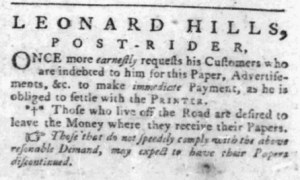
“Those who live off the Road are desired to leave the Money where they receive their Papers.”
During the era of the American Revolution, newspapers often featured advertisements from the post riders who delivered them to readers beyond the cities and towns where they were printed. Sometimes the post riders promoted their services, seeking new customers, but other times they called on current customers to pay for their services. Like newspaper printers, post riders extended credit to their patrons and, in turn, experienced similar difficulties in collecting from them.
Such was the case for Leonard Hills, a post rider who carried the Norwich Packet; and the Connecticut, Massachusetts, New-Hampshire & Rhode-Island Weekly Advertiser to subscribers in New England. With a hint of exasperation, he declared that he “ONCE more earnestly requests his Customers who are indebted to him … to make immediate payment” in an advertisement in the August 26, 1776, edition. Hills warned of the consequences, drawing attention with both a manicule and italics: “Those that do not speedily comply with the above reasonable Demand, may expect to have their Papers discontinued.”
Who would make that decision? The advertisement suggested that Hills made it rather than the printer, John Trumbull. The advertisement also revealed other aspects of how the service worked. “Those who live off the Road,” Hills instructed, “are desired to leave the Money where they receive their Papers.” The post rider did not deliver the Norwich Packet to every subscriber along his route. Instead, he left the right number of copies at a central location, such as a tavern, for subscribers to retrieve when they had a chance. Local agents thus assisted in distributing the newspapers once Hills dropped them off. Hills also stated that he was “obliged to settle with the PRINTER,” indicating that Trumbull did not directly handle subscriptions along Hills’s route. Instead, the post rider sold and managed those subscriptions. He also called on his customers to pay for “this Paper, Advertisements, &c.” That suggested that Hills served as an intermediary who handled advertisements that his customers placed in the Norwich Packet (and did so on credit rather than being required to pay for advertisements in advance) and that the post rider sold other items, perhaps almanacs or books. Hills’s notice revealed all sort of details about the services he provided. As a post rider, he assumed many responsibilities beyond merely deliver newspapers.
[…] During the era of the American Revolution, newspapers often featured advertisements from the post riders who delivered them to readers beyond the cities and towns where they were printed. Sometimes the post riders promoted their services, seeking new customers, but other times they called on current customers to pay for their services. Like newspaper printers, post riders extended credit to their patrons and, in turn, experienced similar difficulties in collecting from them. Read more… […]