January 25

What was advertised in a colonial American newspaper 250 years ago today?

Supplement to the Pennsylvania Packet (January 25, 1773).

“A LAWYER … lent the fourth volume of BLACKSTONE’s COMMENTARIES … to some gentleman whose name he hath forgot.”

A curious story appeared among the advertisements in the supplement that accompanied the January 25, 1773, edition of the Pennsylvania Packet, a story that may have been a complete fiction designed to incite interest in the forthcoming publication of “the FOURTH VOLUME of the AMERICAN EDITION of BLACKSTONE’s COMMENTARIES ON THE LAWS OF ENGLAND.”  The story concerned an unnamed lawyer seeking the return of a London edition that he lent “to some gentleman whose name he hath forgot,” but that lawyer and the missing book may very well have been creations of Robert Bell, a bookseller and publisher known for his innovative marketing strategies and flamboyant personality.  During the final third of the eighteenth century, Bell became one of the most vocal proponents of creating an American literary market, launching inventive advertising campaigns.

This particular advertisement described a lawyer who loaned the book and asked that the borrower “return it as soon as possible to ROBERT BELL, Bookseller, at the late Union Library in Third-street.”  The narrator of the advertisement, which may have been either Bell or the lawyer, stated that there was “reason to surmise the said fourth volume hath been lent to several persons since it left the proprietor’s library.”  Focus then shifted to anyone who had consulted the loaned-but-not-returned copy of the book.  “All the world assert it is a pity,” the narrator lamented, “that generosity should suffer; therefore it is hoped, even the second, third or fourth borrower possesseth integrity enough” to alert Bell about the whereabouts of the missing book.  Contending that so many readers consulted that copy of the book suggested both its utility and popularity.

That set the stage for the nota bene that appeared at the end of the advertisement.  The narrator announced that “Sometime in February” the fourth volume of the American edition of Blackstone’s Commentaries “will be ready for the subscribers.”  Bell just happened to be the publisher of that project, having advertised and distributed the first three volumes in 1771 and 1772.  (The title page for the fourth volume says 1772, but this advertisement suggests that may have been an error and that Bell actually released the fourth volume in early 1773.)  Although an extensive list of subscribers appeared before the title page of the fourth volume, Bell may have anticipated printing surplus copies to sell to customers who had not subscribed in advance.  Whether or not there was any truth to the story of the lawyer who loaned out a London edition of the book, Bell seems to have tried to generate even more interest in the forthcoming publication of his American edition.

Slavery Advertisements Published January 25, 1773

The Slavery Adverts 250 Project chronicles the role of newspaper advertising in perpetuating slavery in the era of the American Revolution. The project seeks to reveal the ubiquity of slavery in eighteenth-century life from New England to Georgia by republishing advertisements about enslaved people – for sale as individuals or in groups, wanted to purchase or for hire for short periods, runaways who liberated themselves, and those who were subsequently captured and confined in jails and workhouses – in daily digests on this site as well as in real time via the @SlaveAdverts250 Twitter feed, utilizing twenty-first-century media to stand in for the print media of the eighteenth century.

The project aims to provide modern audiences with a sense of just how often colonizers encountered these advertisements in their daily lives. Enslaved men, women, and children appeared in print somewhere in the colonies almost every single day. Those advertisements served as a constant backdrop for social, cultural, economic, and political life in colonial and revolutionary America. Colonizers who did not purport to own enslaved people were still confronted with slavery as well as invited to maintain the system by purchasing enslaved men, women, and children or assisting in the capture of so-called “runaways” who sought to free themselves from bondage. The frequency of these newspaper advertisements suggests just how embedded slavery was in colonial and revolutionary American culture in everyday interactions beyond the printed page.

These advertisements also testify to the experiences of enslaved men, women, and children, though readers must consider that those experiences have been remediated through descriptions offered by enslavers rather than enslaved people themselves. Often unnamed in the advertisements, enslaved men, women, and children were not invisible or unimportant in early America.

These advertisements appeared in colonial American newspapers 250 years ago today.

Boston Evening-Post (January 25, 1773).

**********

Boston Evening-Post (January 25, 1773).

**********

Boston Evening-Post (January 25, 1773).

**********

Boston Evening-Post (January 25, 1773).

**********

Boston-Gazette (January 25, 1773).

**********

Boston-Gazette (January 25, 1773).

**********

Boston-Gazette (January 25, 1773).

**********

Massachusetts Gazette and Boston Post-Boy (January 25, 1773).

**********

Newport Mercury (January 25, 1773).

**********

New-York Gazette and Weekly Mercury (January 25, 1773).

**********

New-York Gazette and Weekly Mercury (January 25, 1773).

**********

New-York Gazette and Weekly Mercury (January 25, 1773).

**********

New-York Gazette and Weekly Mercury (January 25, 1773).

**********

New-York Gazette and Weekly Mercury (January 25, 1773).

**********

New-York Gazette and Weekly Mercury (January 25, 1773).

**********

New-York Gazette and Weekly Mercury (January 25, 1773).

**********

Pennsylvania Packet (January 25, 1773).

**********

Pennsylvania Packet (January 25, 1773).

**********

Pennsylvania Packet (January 25, 1773).

January 24

What was advertised in a colonial American newspaper 250 years ago this week?

Virginia Gazette [Purdie and Dixon] (January 21, 1773).
“He likewise makes Head Dresses for Ladies, so natural as not to be distinguished by the most curious Eye.”

George Lafong described himself as a “Hair Cutter and Dresser” in an advertisement he placed in the January 21, 1773, edition of the Virginia Gazette.  He aimed to generate business by suggesting that he already served a satisfied clientele, extending his “humble Thanks to such Ladies and Gentlemen as have been pleased to honour him with their Commands.”  In addition, he invited new clients to engage his services.

Lafong deployed several appeals in his efforts to convince residents of Williamsburg and nearby towns to hire him.  For instance, he did not require that clients visit his shop.  Instead, they could schedule appointments in advance “by giving timely Notice” and the hairdresser traveled to their homes and “waited upon [them] at any Distance from Town.”  He did not charge exorbitant prices, but instead set “very reasonable Terms” for such excursions.

In addition, Lafong promoted an associate that he recently hired, reporting that he “has engaged a Man from London who dresses in the newest and most elegant Taste.”  That gave Lafong an advantage over other hairdressers who relied on correspondence to learn about the latest trends in the cosmopolitan center of the empire.  His associate had firsthand knowledge and experience with the latest styles in London.  That advantage transferred to clients; not only did their appearance testify to making good choices in selecting a hairdresser but they could also boast about that hairdresser to friends and acquaintances.

In case that was not enough to convince prospective clients, Lafong also indicated that someone in his shop, either his new associate or Lafong himself, “makes Head Dresses for Ladies, so natural as not to be distinguished by the most curious eye.”  In other words, he created wigs and extensions, such as the popular high roll, that withstood close scrutiny.  Observers would not be able to tell which portions, if any, of his client’s hairstyle was not her actual hair.  Such authenticity helped in projecting grace, elegance, and other genteel attributes.

Fashion found its way to places far removed from London as colonizers participated in a transatlantic consumer revolution in the eighteenth century.  Hairdressers offered their services in major urban ports, like Charleston, New York, and Philadelphia, while also seeking to generate demand among prospective clients in the countryside “any Distance from Town.”  Fashion, both as a practice and as a motivation, was not confined to early American cities.

January 23

What was advertised in a colonial American newspaper 250 years ago today?

Providence Gazette (January 23, 1773).

“Opposite the East End of the Great Bridge.”

American cities and towns did not have standardized street numbers before the American Revolution.  Some of the largest cities began assigning street numbers in the late 1780s and 1790s, but prior to that residents and visitors relied on combinations of shop signs, landmarks, and directions of varying lengths to specify the locations of homes and businesses.

Consider how some advertisers directed prospective customers to their shops in advertisements that ran in the January 23, 1773, edition of the Providence Gazette.  Joseph fuller made and sold tools “At his Shop in Broad-street, on the West Side of the Great Bridge, next Door to Samuel Nightingale, Esq.”  Thomas Stoddard and Benjamin Clap established a smithy “on the East Side of the Great Bridge, opposite Dr, Sterling’s.”  Daniel Spencer, a cabinet- and chairmaker, had a workshop “Opposite the East End of the Great Bridge, in Providence.”  Not all advertisers listed their locations in relation to the Great Bridge, but enough did so to demonstrate that it was a major landmark in the city.

The Great Bridge connected the portions of Providence located on opposite sides of the basin created by the confluence of the Woonasquatucket and Moshassuck Rivers.  A map of the “BAY of NARRAGANSET in the Province of NEW-ENGLAND,” published in London in 1777, shows the larger part of the city on the eastern side of the basin, the smaller part on the western side, and a bridge connecting the two.  According to an account of the Providence Great-Bridge Lottery of 1790, the bridge measured twelve feet wide when constructed in 1711 and eighteen feet wide following alterations in 1744.  Following the lottery, the bridge was widened to fifty-six feet in the early 1790s.  Although it was not as “great” in terms of width in 1773 as it would become by the end of the century, the Great Bridge served as an important landmark that artisans and other entrepreneurs noted when directing prospective customers to their businesses.

January 22

What was advertised in a colonial American newspaper 250 years ago today?

Connecticut Journal (January 22, 1773).

“By Reason of an ill State of Health, and other Misfortunes, he has been for some Time unable to attend his Business.”

Joseph Hopkins, a goldsmith and jeweler in Waterbury, took to the pages of the Connecticut Journal and New-Haven Post-Boy to raise interest in his business in January 1773. He pledged that he “will supply those who may want any Articles in either the Goldsmith or Jewelry Way, on the most reasonable Terms.”  Such appeals, however, were not the primary focus of his advertisement.

Instead, Hopkins sought to generate sympathy among prospective customers.  He reported that he reopened his shop after having been closed, stating that “by Reason of an ill State of Health, and other Misfortunes, he has been for some Time unable to attend his Business.”  The goldsmith did not go into detail about any of those “Misfortunes,” though some readers may have already been familiar with his situation.  He did declare that he “has of late, in some good Measure recovered his Health” and was ready to serve clients once again.

Hopkins offered other news to entice readers into his shop.  He announced that he “engaged an approved Workman,” presumably someone with training and experience as either a goldsmith or jeweler, to provide assistance.  He likely hoped that employing an associate would help alleviate any concerns about what kinds of service customers would experience now that his shop opened again.  Yet Hopkins did not want the public to have the mistaken impression that he merely entrusted orders to his new assistance.  He asserted that he gave “constant Attendance himself.”

In his efforts to attract customers to his shop, Hopkins balanced pleas for sympathy with assurances of competence.  He hoped that recovering from poor health and other unspecified “Misfortunes” would prompt prospective customers to give him their business, but he also realized that sympathy alone might not win them over.  Accordingly, he maintained that both he and his new assistant were qualified to produce “any Articles in either the Goldsmith or Jewelry Way” for customers who gave his shop a chance.

Slavery Advertisements Published January 22, 1773

The Slavery Adverts 250 Project chronicles the role of newspaper advertising in perpetuating slavery in the era of the American Revolution. The project seeks to reveal the ubiquity of slavery in eighteenth-century life from New England to Georgia by republishing advertisements about enslaved people – for sale as individuals or in groups, wanted to purchase or for hire for short periods, runaways who liberated themselves, and those who were subsequently captured and confined in jails and workhouses – in daily digests on this site as well as in real time via the @SlaveAdverts250 Twitter feed, utilizing twenty-first-century media to stand in for the print media of the eighteenth century.

The project aims to provide modern audiences with a sense of just how often colonizers encountered these advertisements in their daily lives. Enslaved men, women, and children appeared in print somewhere in the colonies almost every single day. Those advertisements served as a constant backdrop for social, cultural, economic, and political life in colonial and revolutionary America. Colonizers who did not purport to own enslaved people were still confronted with slavery as well as invited to maintain the system by purchasing enslaved men, women, and children or assisting in the capture of so-called “runaways” who sought to free themselves from bondage. The frequency of these newspaper advertisements suggests just how embedded slavery was in colonial and revolutionary American culture in everyday interactions beyond the printed page.

These advertisements also testify to the experiences of enslaved men, women, and children, though readers must consider that those experiences have been remediated through descriptions offered by enslavers rather than enslaved people themselves. Often unnamed in the advertisements, enslaved men, women, and children were not invisible or unimportant in early America.

These advertisements appeared in colonial American newspapers 250 years ago today.

New-London Gazette (January 22, 1773).

**********

New-London Gazette (January 22, 1773).

January 21

What was advertised in a colonial American newspaper 250 years ago today?

Massachusetts Spy (January 21, 1773).

“The SECOND EDITION.”

Just a week after the Massachusetts Gazette and Boston Weekly News-Letter and the Massachusetts Spy carried advertisements announcing that An Oration on the Beauties of Liberty or the Essential Rights of the Americans was “Now in the press, and will be published in a few days” on January 14, 1773, both newspapers carried notices about the publication of a second edition.  John M. Bumsted and Charles E. Clark identify the author, “A British Bostonian,” as John Allen, a Baptist minister who migrated to New England in the early 1770s.  They consider the Oration “one of the best-selling pamphlets of the pre-Revolutionary crisis, passing through seven editions in four cities between 1773 and 1775.”[1]

The Oration very quickly went to a second edition.  Was that because the first edition sold out so quickly?  Or did other factors play a role.  The advertisement in the January 21 edition of the Massachusetts Spy implied that it was the former, that the popularity of the pamphlet prompted the printers, David Kneeland and Nathaniel Davis, to publish “The SECOND EDITION.”  In addition to the advertisements that ran on January 14, another advertisement appeared in the Boston-Gazette on January 18, helping to incite interest and demand in a pamphlet drawn from an address that many Bostonians heard several weeks earlier.  Word-of-mouth chatter about the Oration likely supplemented newspaper advertisements in promoting the pamphlet.

The advertisement in the January 21 edition of the Massachusetts Gazette and Boston Weekly News-Letter provided additional details. It featured two revisions to the original notice.  The headline now read “This Day Published” instead of “To-Morrow will be Published.”  In addition, a new line at the end of the notice advised prospective customers that they could purchase “The SECOND EDITION corrected.”  Did Kneeland and Davis sell out of the first edition?  Or did they take advantage of producing a second edition that corrected errors to suggest that such the first edition met with such success that it made the immediate publication of a second edition necessary?  Either way, the reception of the first two editions apparently convinced other printers in Boston, Hartford and New London in Connecticut, and Wilmington in Delaware, that they could generate revenues by publishing their own editions.  In so doing, they assisted in disseminating arguments that encouraged colonizers to move from resistance to revolution during the era of the imperial crisis that culminated in thirteen colonies declaring independence from Great Britain.

**********

[1] John M. Bumsted and Charles E. Clark, “New England’s Tom Paine: John Allen and the Spirit of Liberty,” William and Mary Quarterly, 3rd ser., 21, no. 4 (October 1964): 561.

Slavery Advertisements Published January 21, 1773

The Slavery Adverts 250 Project chronicles the role of newspaper advertising in perpetuating slavery in the era of the American Revolution. The project seeks to reveal the ubiquity of slavery in eighteenth-century life from New England to Georgia by republishing advertisements about enslaved people – for sale as individuals or in groups, wanted to purchase or for hire for short periods, runaways who liberated themselves, and those who were subsequently captured and confined in jails and workhouses – in daily digests on this site as well as in real time via the @SlaveAdverts250 Twitter feed, utilizing twenty-first-century media to stand in for the print media of the eighteenth century.

The project aims to provide modern audiences with a sense of just how often colonizers encountered these advertisements in their daily lives. Enslaved men, women, and children appeared in print somewhere in the colonies almost every single day. Those advertisements served as a constant backdrop for social, cultural, economic, and political life in colonial and revolutionary America. Colonizers who did not purport to own enslaved people were still confronted with slavery as well as invited to maintain the system by purchasing enslaved men, women, and children or assisting in the capture of so-called “runaways” who sought to free themselves from bondage. The frequency of these newspaper advertisements suggests just how embedded slavery was in colonial and revolutionary American culture in everyday interactions beyond the printed page.

These advertisements also testify to the experiences of enslaved men, women, and children, though readers must consider that those experiences have been remediated through descriptions offered by enslavers rather than enslaved people themselves. Often unnamed in the advertisements, enslaved men, women, and children were not invisible or unimportant in early America.

These advertisements appeared in colonial American newspapers 250 years ago today.

Maryland Gazette (January 21, 1773).

**********

Maryland Gazette (January 21, 1773).

**********

Maryland Gazette (January 21, 1773).

**********

Maryland Gazette (January 21, 1773).

**********

Maryland Gazette (January 21, 1773).

**********

Massachusetts Gazette and Boston Weekly News-Letter (January 21, 1773).

**********

Massachusetts Gazette and Boston Weekly News-Letter (January 21, 1773).

**********

Massachusetts Gazette and Boston Weekly News-Letter (January 21, 1773).

**********

Massachusetts Gazette and Boston Weekly News-Letter (January 21, 1773).

**********

Massachusetts Gazette and Boston Weekly News-Letter (January 21, 1773).

**********

New-York Journal (January 21, 1773).

**********

South-Carolina Gazette (January 21, 1773).

**********

South-Carolina Gazette (January 21, 1773).

**********

South-Carolina Gazette (January 21, 1773).

**********

South-Carolina Gazette (January 21, 1773).

**********

South-Carolina Gazette (January 21, 1773).

**********

South-Carolina Gazette (January 21, 1773).

**********

South-Carolina Gazette (January 21, 1773).

**********

South-Carolina Gazette (January 21, 1773).

**********

South-Carolina Gazette (January 21, 1773).

**********

South-Carolina Gazette (January 21, 1773).

**********

Supplement to the South-Carolina Gazette (January 21, 1773).

**********

Supplement to the South-Carolina Gazette (January 21, 1773).

**********

Supplement to the South-Carolina Gazette (January 21, 1773).

**********

Supplement to the South-Carolina Gazette (January 21, 1773).

**********

Supplement to the South-Carolina Gazette (January 21, 1773).

**********

Virginia Gazette [Purdie and Dixon] (January 21, 1773).

**********

Virginia Gazette [Purdie and Dixon] (January 21, 1773).

**********

Virginia Gazette [Purdie and Dixon] (January 21, 1773).

**********

Virginia Gazette [Purdie and Dixon] (January 21, 1773).

**********

Virginia Gazette [Purdie and Dixon] (January 21, 1773).

**********

Virginia Gazette [Purdie and Dixon] (January 21, 1773).

**********

Virginia Gazette [Purdie and Dixon] (January 21, 1773).

**********

Virginia Gazette [Purdie and Dixon] (January 21, 1773).

**********

Virginia Gazette [Purdie and Dixon] (January 21, 1773).

**********

Virginia Gazette [Purdie and Dixon] (January 21, 1773).

**********

Virginia Gazette [Purdie and Dixon] (January 21, 1773).

**********

Virginia Gazette [Purdie and Dixon] (January 21, 1773).

**********

Virginia Gazette [Purdie and Dixon] (January 21, 1773).

**********

Virginia Gazette [Rind] (January 21, 1773).

**********

Virginia Gazette [Rind] (January 21, 1773).

**********

Virginia Gazette [Rind] (January 21, 1773).

**********

Virginia Gazette [Rind] (January 21, 1773).

**********

Virginia Gazette [Rind] (January 21, 1773).

**********

Virginia Gazette [Rind] (January 21, 1773).

January 20

What was advertised in a colonial American newspaper 250 years ago today?

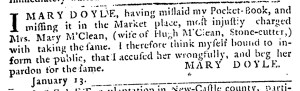
Pennsylvania Journal (January 20, 1773).

“I accused her wrongfully, and beg her pardon for the same.”

Newspaper advertisements delivered many kinds of information in eighteenth-century America.  Some described consumer goods and services offered by merchants, shopkeepers, and artisans.  Legal notices and estate notices supplemented news articles about local events.  Advertisements about enslaved people who liberated themselves by running away from their enslavers and indentured servants who ran away before their contracts ended provided descriptions and promised rewards for their capture and return.  Notices about wives who “eloped” from their husbands and, as a result, no longer had access to credit kept readers informed about some of the gossip in their community.

Other advertisements carried other kinds of gossip.  In the January 20, 1773, edition of the Pennsylvania Journal, for instance, Mary Doyle inserted a notice in which she confessed that she mistakenly accused an acquaintance of stealing her pocketbook, realized her error, and asked for forgiveness.  “I MARY DOYLE,” she stated, “having mislaid my Pocket-Book, and missing it in the Market place, most injustly charged Mrs. Mary M’Clean, (wife of Hugh M’Clean, Stone-cutter,) with taking the same.”  Doyle apparently found her missing pocketbook and realized her error, prompting her to published the advertisement.  “I therefore think myself bound to inform the public,” she continued, “that I accused her wrongfully, and beg ger pardon for the same.”

Like most advertisements about recalcitrant wives who vexed their husbands, this advertisement did not include all the juicy details about what happened at the market.  Readers could imagine the scene that unfolded.  Some may have already been aware of what transpired, having witnessed it themselves.  Others may have already heard gossip about an altercation between the two women.  Those learning about the confrontation for the first time may have wanted to learn more and decided to ask their friends and acquaintances about what occurred.  Rather than quiet the gossip about Doyle’s missing pocketbook and the accusations she made against McClean, the advertisement may have helped in inciting more gossip.  New chatter, however, had a conclusion in which Doyle set the record straight by restoring McClean’s reputation.  She shifted the story away from a possible theft to her own mistake in making an erroneous accusation.  Doyle sought to repair her relationship with McClean, though publishing a newspaper advertisement also facilitated gossip about a recent argument in the market.

Slavery Advertisements Published January 20, 1773

The Slavery Adverts 250 Project chronicles the role of newspaper advertising in perpetuating slavery in the era of the American Revolution. The project seeks to reveal the ubiquity of slavery in eighteenth-century life from New England to Georgia by republishing advertisements about enslaved people – for sale as individuals or in groups, wanted to purchase or for hire for short periods, runaways who liberated themselves, and those who were subsequently captured and confined in jails and workhouses – in daily digests on this site as well as in real time via the @SlaveAdverts250 Twitter feed, utilizing twenty-first-century media to stand in for the print media of the eighteenth century.

The project aims to provide modern audiences with a sense of just how often colonizers encountered these advertisements in their daily lives. Enslaved men, women, and children appeared in print somewhere in the colonies almost every single day. Those advertisements served as a constant backdrop for social, cultural, economic, and political life in colonial and revolutionary America. Colonizers who did not purport to own enslaved people were still confronted with slavery as well as invited to maintain the system by purchasing enslaved men, women, and children or assisting in the capture of so-called “runaways” who sought to free themselves from bondage. The frequency of these newspaper advertisements suggests just how embedded slavery was in colonial and revolutionary American culture in everyday interactions beyond the printed page.

These advertisements also testify to the experiences of enslaved men, women, and children, though readers must consider that those experiences have been remediated through descriptions offered by enslavers rather than enslaved people themselves. Often unnamed in the advertisements, enslaved men, women, and children were not invisible or unimportant in early America.

These advertisements appeared in colonial American newspapers 250 years ago today.

Pennsylvania Gazette (January 20, 1773).