Slavery Advertisements Published February 3, 1773

The Slavery Adverts 250 Project chronicles the role of newspaper advertising in perpetuating slavery in the era of the American Revolution. The project seeks to reveal the ubiquity of slavery in eighteenth-century life from New England to Georgia by republishing advertisements about enslaved people – for sale as individuals or in groups, wanted to purchase or for hire for short periods, runaways who liberated themselves, and those who were subsequently captured and confined in jails and workhouses – in daily digests on this site as well as in real time via the @SlaveAdverts250 Twitter feed, utilizing twenty-first-century media to stand in for the print media of the eighteenth century.

The project aims to provide modern audiences with a sense of just how often colonizers encountered these advertisements in their daily lives. Enslaved men, women, and children appeared in print somewhere in the colonies almost every single day. Those advertisements served as a constant backdrop for social, cultural, economic, and political life in colonial and revolutionary America. Colonizers who did not purport to own enslaved people were still confronted with slavery as well as invited to maintain the system by purchasing enslaved men, women, and children or assisting in the capture of so-called “runaways” who sought to free themselves from bondage. The frequency of these newspaper advertisements suggests just how embedded slavery was in colonial and revolutionary American culture in everyday interactions beyond the printed page.

These advertisements also testify to the experiences of enslaved men, women, and children, though readers must consider that those experiences have been remediated through descriptions offered by enslavers rather than enslaved people themselves. Often unnamed in the advertisements, enslaved men, women, and children were not invisible or unimportant in early America.

These advertisements appeared in colonial American newspapers 250 years ago today.

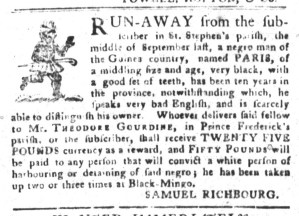
Pennsylvania Gazette (February 3, 1773).

**********

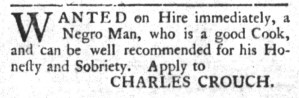
Pennsylvania Gazette (February 3, 1773).

**********

Pennsylvania Journal (February 3, 1773).

**********

Pennsylvania Journal (February 3, 1773).

February 2

What was advertised in a colonial American newspaper 250 years ago today?

Essex Gazette (February 2, 1773).

“An ORATION on the Beauties of LIBERTY.”

For the third consecutive week, an advertisement for “An ORATION on the Beauties of LIBERTY, from Mic. vii. 3. Delivered at the Second Baptist Church in Boston, on the last Thanksgiving Day” ran in the February 2, 1773, edition of the Essex Gazette.  That notice also informed readers that the printers of the newspaper, Samuel Hall and Ebenezer Hall, also sold “Fleeming’s REGISTER for New-England and Nova-Scotia, with an Almanack for 1773.”  Some of the contents of the almanac became obsolete with each passing day, but the principles expressed in the Oration endured long after John Allen, known as a “British Bostonian,” gave the address in December 1772.

John M. Bumsted and Charles E. Clark described the Oration as “one of the best-selling pamphlets of the pre-Revolutionary crisis, passing through seven editions in four cities between 1773 and 1775.”[1]  In addition to printers producing the pamphlet in Boston, Hartford and New London in Connecticut, and Wilmington in Delaware, printers and booksellers advertised the Oration in other cities and towns.  The Halls encouraged the popularity and dissemination of the pamphlet by advertising it in Salem as soon David Kneeland and Nathaniel Davis, the printers, took it to press and made it available for purchase.  On January 14, Kneeland and Davis placed notices in the Massachusetts Gazette and Boston Weekly News-Letter and the Massachusetts Spy to announce that the pamphlet was “Now in the press, and will be published in a few days.”  Just five days later, the Halls advertised that they sold the pamphlet.

The Halls almost certainly stocked and sold other books that they did not advertise in their newspaper.  They chose to devote space to promoting two items they considered timely, an almanac for 1773 and a pamphlet that critiqued the appointment of Commissioners of Inquiry concerning the Gaspee incident.  Advertisements in multiple newspapers published in multiple cities and distributed to even more cities and towns likely helped Allen’s Oration become such a popular pamphlet during the era of the American Revolution.

**********

[1] John M. Bumsted and Charles E. Clark, “New England’s Tom Paine: John Allen and the Spirit of Liberty,” William and Mary Quarterly, 3rd ser., 21, no. 4 (October 1964): 561.

Slavery Advertisements Published February 2, 1773

The Slavery Adverts 250 Project chronicles the role of newspaper advertising in perpetuating slavery in the era of the American Revolution. The project seeks to reveal the ubiquity of slavery in eighteenth-century life from New England to Georgia by republishing advertisements about enslaved people – for sale as individuals or in groups, wanted to purchase or for hire for short periods, runaways who liberated themselves, and those who were subsequently captured and confined in jails and workhouses – in daily digests on this site as well as in real time via the @SlaveAdverts250 Twitter feed, utilizing twenty-first-century media to stand in for the print media of the eighteenth century.

The project aims to provide modern audiences with a sense of just how often colonizers encountered these advertisements in their daily lives. Enslaved men, women, and children appeared in print somewhere in the colonies almost every single day. Those advertisements served as a constant backdrop for social, cultural, economic, and political life in colonial and revolutionary America. Colonizers who did not purport to own enslaved people were still confronted with slavery as well as invited to maintain the system by purchasing enslaved men, women, and children or assisting in the capture of so-called “runaways” who sought to free themselves from bondage. The frequency of these newspaper advertisements suggests just how embedded slavery was in colonial and revolutionary American culture in everyday interactions beyond the printed page.

These advertisements also testify to the experiences of enslaved men, women, and children, though readers must consider that those experiences have been remediated through descriptions offered by enslavers rather than enslaved people themselves. Often unnamed in the advertisements, enslaved men, women, and children were not invisible or unimportant in early America.

These advertisements appeared in colonial American newspapers 250 years ago today.

Essex Gazette (February 2, 1773).

**********

South-Carolina Gazette and Country Journal (February 2, 1773).

**********

South-Carolina Gazette and Country Journal (February 2, 1773).

**********

South-Carolina Gazette and Country Journal (February 2, 1773).

February 1

What was advertised in a colonial American newspaper 250 years ago today?

New-York Gazette and Weekly Mercury (February 1, 1773).

He most humbly addresses the Fair Sex, requesting their aid.”

John Keating regularly offered “READY MONEY … for CLEAN LINEN RAGS” in the New-York Gazette and Weekly Mercury in the late 1760s and early 1770s.  The papermaker needed as many rags as he could gather to supply his mill with raw materials.  To convince readers to make an effort to collect and submit rags, he developed appeals that emphasized both commerce and devotion to the best interests of the colonies.

In an advertisement that ran on February 1, 1773, for instance, Keating stated that the “advantages that must result to this colony from the establishment of manufactories in it, are so obvious that the subject needs no elucidation.”  Then he elucidated.  “Since paper manufactories were established in Pennsylvania, the money saved and brought into that province, the money saved and brought into the province” amounted to “the many thousand pounds of which is annually drained of[f] by purchasing paper in England.”  Supporting domestic manufactures, goods produced in the colonies, helped to address the trade imbalance with Great Britain.  Keating challenged readers to think about what more they accomplish by working together.  “Might not every shilling of this money be saved?  Have we not materials amongst ourselves?  Is our patriotism all pretence …?

New Yorkers did indeed already have the materials necessary for making paper, clean linen rags.  Keating suggested that women played a vital role in sustaining the patriotic project that he pursued, declaring that he “most humbly addressed the Fair Sex, requesting their aid, without which it will be impossible for him to establish this manufactory upon a respectable or prudent footing.”  He requested that every “frugal matron … hang up a bag … and take care to put every piece of linen that is unfit for any other use, in it.”  When the bag was full, the frugal matron would sell the contents to Keating in an eighteenth-century version of recycling to support a good cause.  The papermaker indicated that in return for the clean linen rags the frugal matron would receive enough money to “supply herself and family with the very essential article of pins.”  Just as significantly, “she will have the satisfaction of being conscious of contributing her part to the advancement of her country.”  Women’s industry served a dual purpose when it manifested patriotism.

The project did not depend solely on those frugal matrons.  Keating also asked “young ladies to co-operate … in saving rags,” though he presented a more romantic rationale to them.  The papermaker asked young women to “observe a very curious remark made by the celebrated Mr. Addison in the Spectator, ‘That a young lady who sends her shift to the paper mill, may very possibly in less than six months, have it returned made into a piece of fair paper, upon which her lover has written a billet doux.’”  Although Keating (and Addision) asked young women to imagine love letters, their shifts and other linen garments may just as likely been transformed into newspapers that kept their households informed about the imperial crisis that faced New York and other colonies.

Women, both “frugal matrons” and “young ladies,” participated in politics and expressed their patriotism when they heeded the call of papermakers who encouraged them to collect clean linen rags.  Similarly, their actions and decisions made an impact when they produced homespun textiles and garments and participated in nonconsumption agreements.  During the era of the American Revolution, both men and women understood that the personal was political.  That included gathering clean linen rags in “a bag in some convenient part of the house.”

Slavery Advertisements Published February 1, 1773

The Slavery Adverts 250 Project chronicles the role of newspaper advertising in perpetuating slavery in the era of the American Revolution. The project seeks to reveal the ubiquity of slavery in eighteenth-century life from New England to Georgia by republishing advertisements about enslaved people – for sale as individuals or in groups, wanted to purchase or for hire for short periods, runaways who liberated themselves, and those who were subsequently captured and confined in jails and workhouses – in daily digests on this site as well as in real time via the @SlaveAdverts250 Twitter feed, utilizing twenty-first-century media to stand in for the print media of the eighteenth century.

The project aims to provide modern audiences with a sense of just how often colonizers encountered these advertisements in their daily lives. Enslaved men, women, and children appeared in print somewhere in the colonies almost every single day. Those advertisements served as a constant backdrop for social, cultural, economic, and political life in colonial and revolutionary America. Colonizers who did not purport to own enslaved people were still confronted with slavery as well as invited to maintain the system by purchasing enslaved men, women, and children or assisting in the capture of so-called “runaways” who sought to free themselves from bondage. The frequency of these newspaper advertisements suggests just how embedded slavery was in colonial and revolutionary American culture in everyday interactions beyond the printed page.

These advertisements also testify to the experiences of enslaved men, women, and children, though readers must consider that those experiences have been remediated through descriptions offered by enslavers rather than enslaved people themselves. Often unnamed in the advertisements, enslaved men, women, and children were not invisible or unimportant in early America.

These advertisements appeared in colonial American newspapers 250 years ago today.

Boston Evening-Post (February 1, 1773).

**********

Boston Evening-Post (February 1, 1773).

**********

Boston Evening-Post (February 1, 1773).

**********

Boston Evening-Post (February 1, 1773).

**********

Boston-Gazette (February 1, 1773).

**********

Massachusetts Gazette and Boston Post-Boy (February 1, 1773).

**********

Massachusetts Gazette and Boston Post-Boy (February 1, 1773).

**********

New-York Gazette and Weekly Mercury (February 1, 1773).

**********

New-York Gazette and Weekly Mercury (February 1, 1773).

**********

Supplement to the New-York Gazette and Weekly Mercury (February 1, 1773).

**********

Supplement to the New-York Gazette and Weekly Mercury (February 1, 1773).

**********

Supplement to the New-York Gazette and Weekly Mercury (February 1, 1773).

**********

Pennsylvania Packet (February 1, 1773).

**********

Supplement to the Pennsylvania Packet (February 1, 1773).

**********

Supplement to the Pennsylvania Packet (February 1, 1773).

**********

Supplement to the Pennsylvania Packet (February 1, 1773).